Creator Lookalike Prompt - Your Best Creator Already Told You Who to Book Next
Lookalike search used as a diagnosis rather than an expansion, plus the move that uses your competitor's research for free.
The best input for your next creator search is not a niche. It is the creator who already worked.
One partnership that outperformed contains more information than any brief you could write: the right audience, the right format, the right register, the right price band. Lookalike search is how you get more of it. Most teams use it for the obvious thing and miss the two uses that matter more.
What a lookalike actually matches on
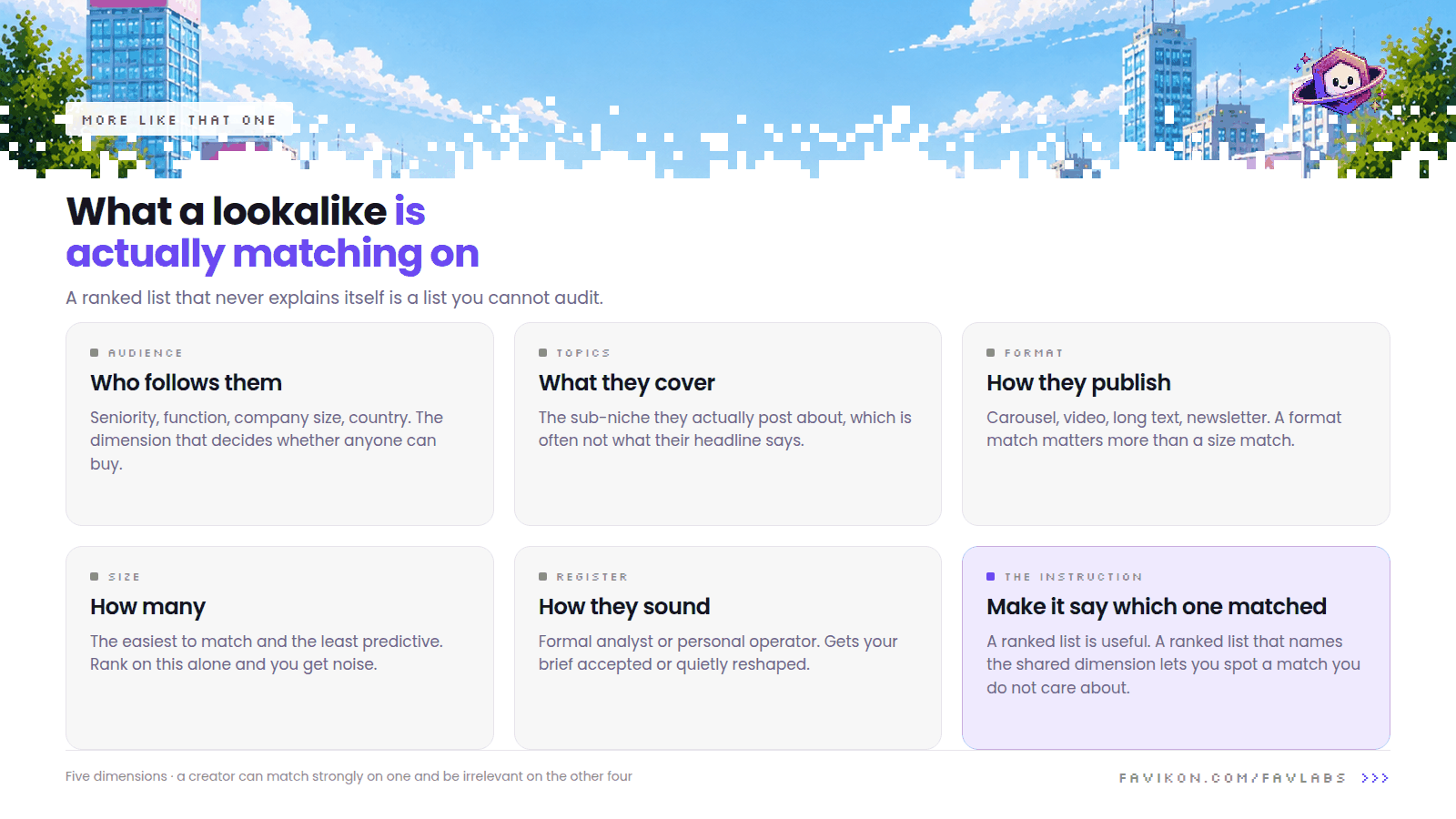
Before running anything, know what "similar" means here, because a ranked list that never explains itself is a list you cannot audit.
Five dimensions do the work: audience composition, topics covered, content format mix, account size, and register, meaning how formal or personal the creator sounds. A match can be strong on any one of them and irrelevant on the rest.
That is why the second sentence in the prompt below matters as much as the first. A ranked list is useful. A ranked list that names the shared attribute lets you spot when the algorithm matched on something you do not care about, which happens constantly and silently.
Use it backwards, which is where the value is
Lookalikes are usually framed as expansion. The more interesting use is diagnosis, and almost nobody runs it.
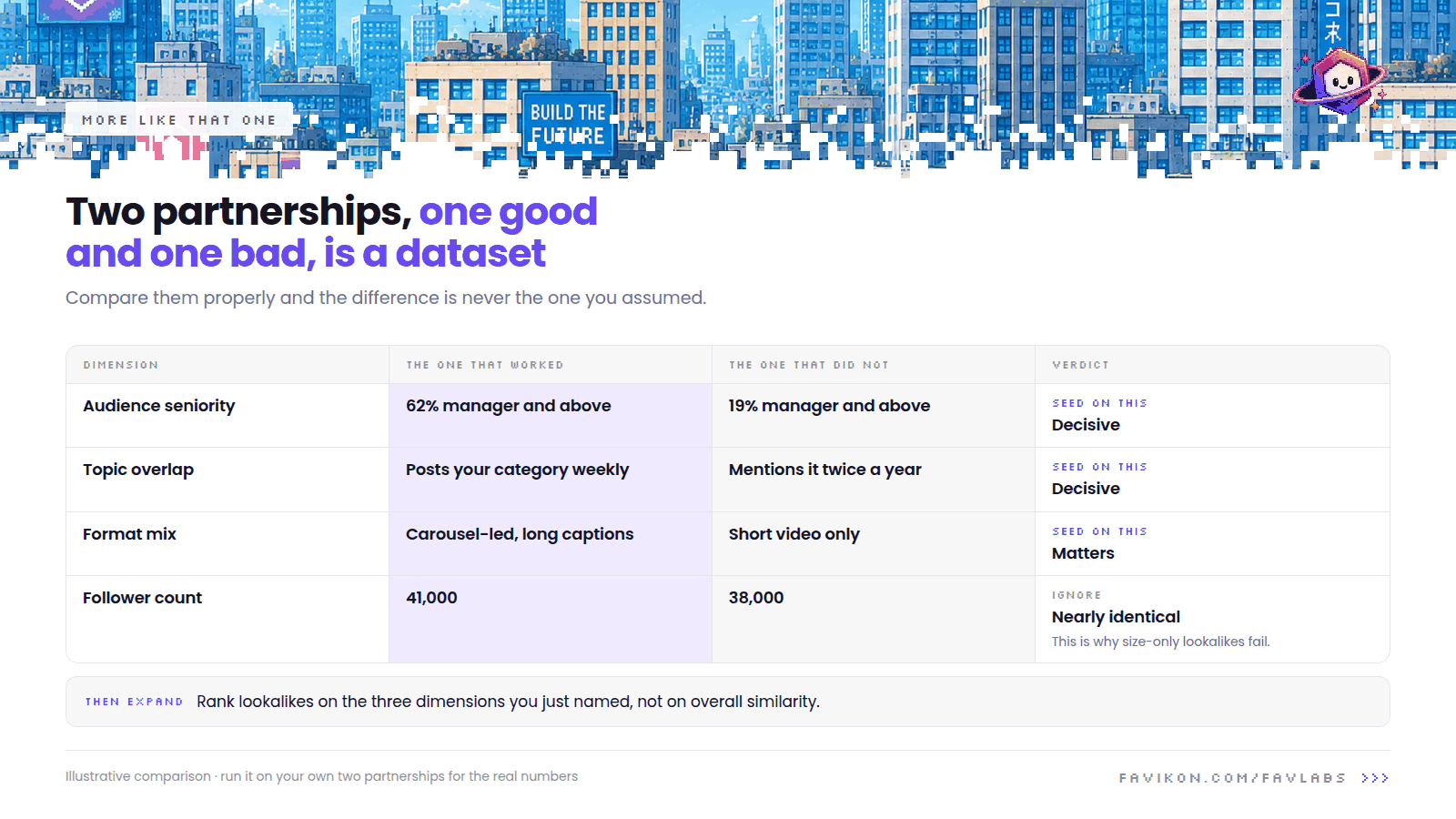
Two partnerships, one good and one bad, is a dataset. Most teams never mine it and just call the second one bad luck. This prompt mines it, then expands from what it learns.
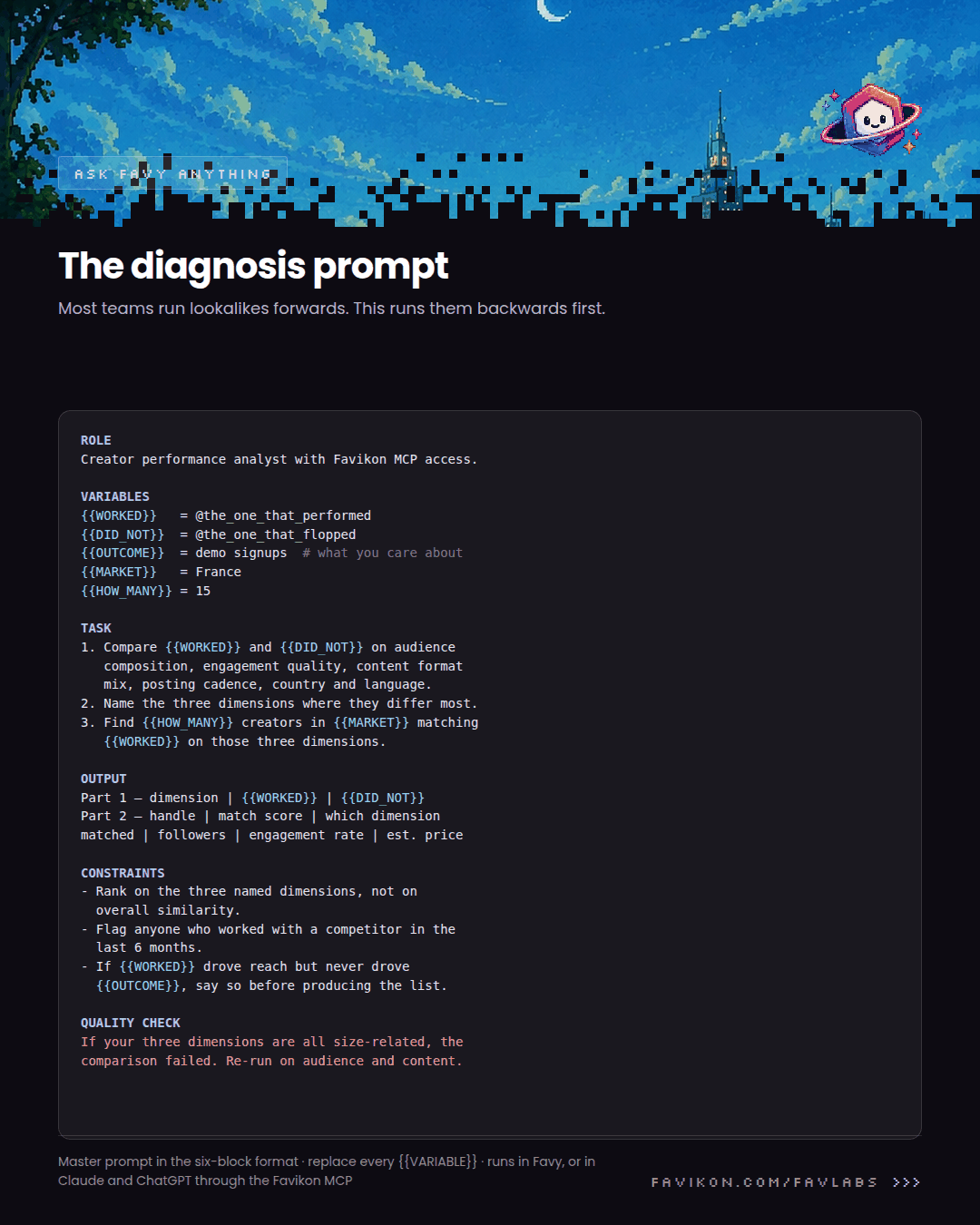
ROLE
Creator performance analyst with Favikon MCP access.

VARIABLES
{{WORKED}}   = @the_one_that_performed
{{DID_NOT}}  = @the_one_that_flopped
{{OUTCOME}}  = demo signups   # the metric you actually care about
{{MARKET}}   = France
{{HOW_MANY}} = 15

TASK
1. Compare {{WORKED}} and {{DID_NOT}} on audience composition,
   engagement quality, content format mix, posting cadence,
   audience country and language.
2. Name the three dimensions where they differ most.
3. Find {{HOW_MANY}} creators in {{MARKET}} matching {{WORKED}}
   on those three dimensions specifically.

OUTPUT
Part 1 — one row per dimension: dimension | {{WORKED}} | {{DID_NOT}}
Part 2 — ranked: handle | match score | which dimension
matched | followers | engagement rate | estimated price

CONSTRAINTS
- Rank on the three named dimensions, not on overall similarity.
- Flag anyone who worked with a competitor in the last 6 months.
- If {{WORKED}} drove reach but never drove {{OUTCOME}}, say so
  before producing the list. Cloning it clones the problem.

QUALITY CHECK
If your three dimensions are all size-related, the comparison
failed. Re-run on audience and content, not follower count.
The move that beats everything else here
Combine lookalikes with a competitor roster and you get the highest-leverage search available to a small budget.
Take the creators who worked for [competitor brand]. Find lookalikes for the top 3 who have NOT worked with anyone in this category yet. Rank by fit and show me estimated prices.
Your competitor spent money and months discovering which creator profile converts in your category. Lookalikes let you use that result without paying for the discovery. Better still, the creators it surfaces are uncontested, and uncontested creators are cheaper than the ones your competitor has already made expensive by bidding for them.
Two limits worth knowing
- Similar does not mean available. Check exclusivity windows and recent category partnerships before you get attached to a name. A perfect match under contract elsewhere is a wasted week.
- A lookalike of a bad match is a bad match. If the seed creator performed on reach but never drove anything you care about, cloning them clones the problem at scale. Pick the seed on the outcome you actually want, not the loudest number on the report.
That second one is worth sitting with. The temptation is always to seed from the partnership that felt biggest. Seed from the one that moved the metric in your board deck instead, even if it was quiet.
Where to run it
Lookalike search runs in Favy on every Favikon plan, and inside Claude or ChatGPT through the Favikon MCP on the Free Trial, Pro and Enterprise plans.
Others Tools