Find Influencer Prompt - How to Find the EXACT Creators You Need
The prompt that interrogates your brief before it searches, and the four filter mistakes that quietly empty a creator search.
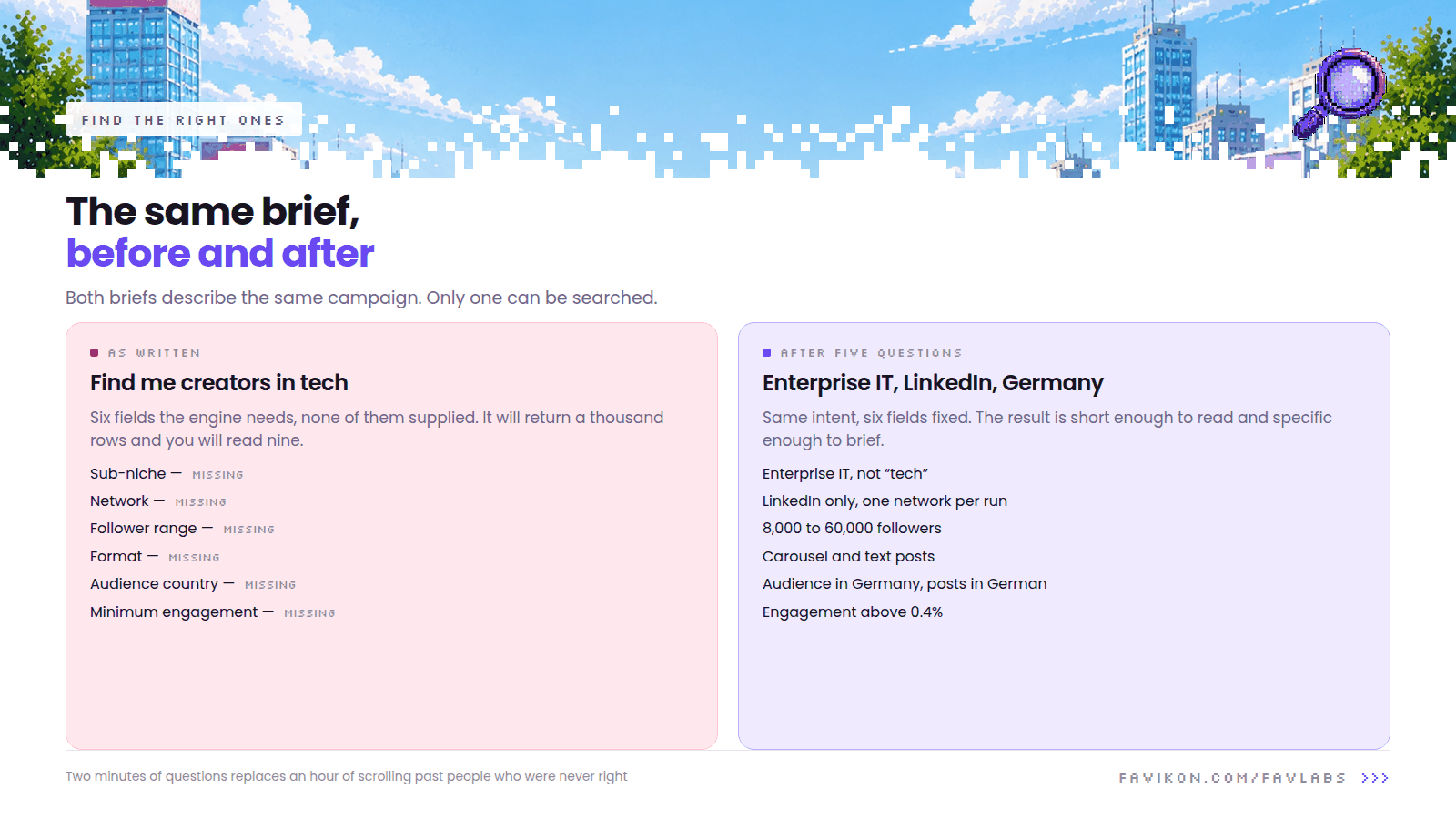
"Find me creators in tech" is not a brief. It is a mood.
It is also why so many creator searches return a thousand results nobody reads. The search engine did its job. The brief never gave it anything to work with.
Make the AI interrogate you first
Do not start by searching. Start by making the brief specific enough to search on. This prompt does exactly that, and it deliberately refuses to give you names yet.
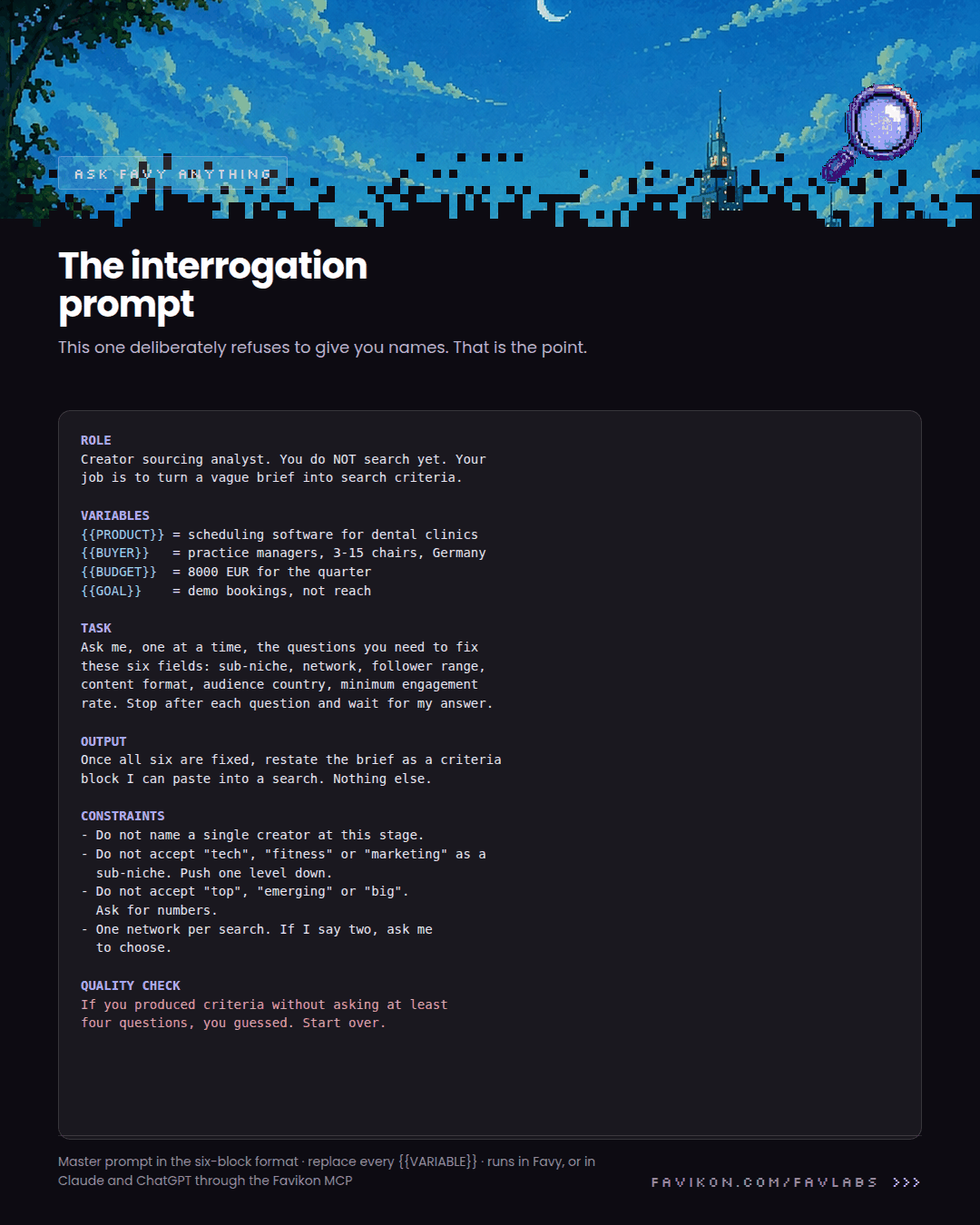
ROLE
Creator sourcing analyst. You do NOT search yet. Your job is
to turn a vague brief into search criteria.

VARIABLES
{{PRODUCT}} = scheduling software for dental clinics
{{BUYER}}   = practice managers, 3-15 chair clinics, Germany
{{BUDGET}}  = 8000 EUR for the quarter
{{GOAL}}    = demo bookings, not reach

TASK
Ask me, one at a time, the questions you need to fix these six
fields: sub-niche, network, follower range, content format,
audience country, minimum engagement rate.
Stop after each question and wait for my answer.

OUTPUT
Once all six are fixed, restate the brief as a criteria block
I can paste into a search. Nothing else.

CONSTRAINTS
- Do not name a single creator at this stage.
- Do not accept "tech", "fitness" or "marketing" as a
  sub-niche. Push one level down.
- Do not accept "top", "emerging" or "big". Ask for numbers.
- One network per search. If I say two, ask me to choose.

QUALITY CHECK
If you produced criteria without asking at least four
questions, you guessed. Start over.
Answering five questions takes two minutes and saves the hour you would otherwise spend scrolling past people who were never right.
Then run the precise version
Now run that search. Return each creator with follower count, engagement rate, average views per post, growth, country and niche, and one line on why they matched my criteria.
Four filter mistakes that quietly empty a search
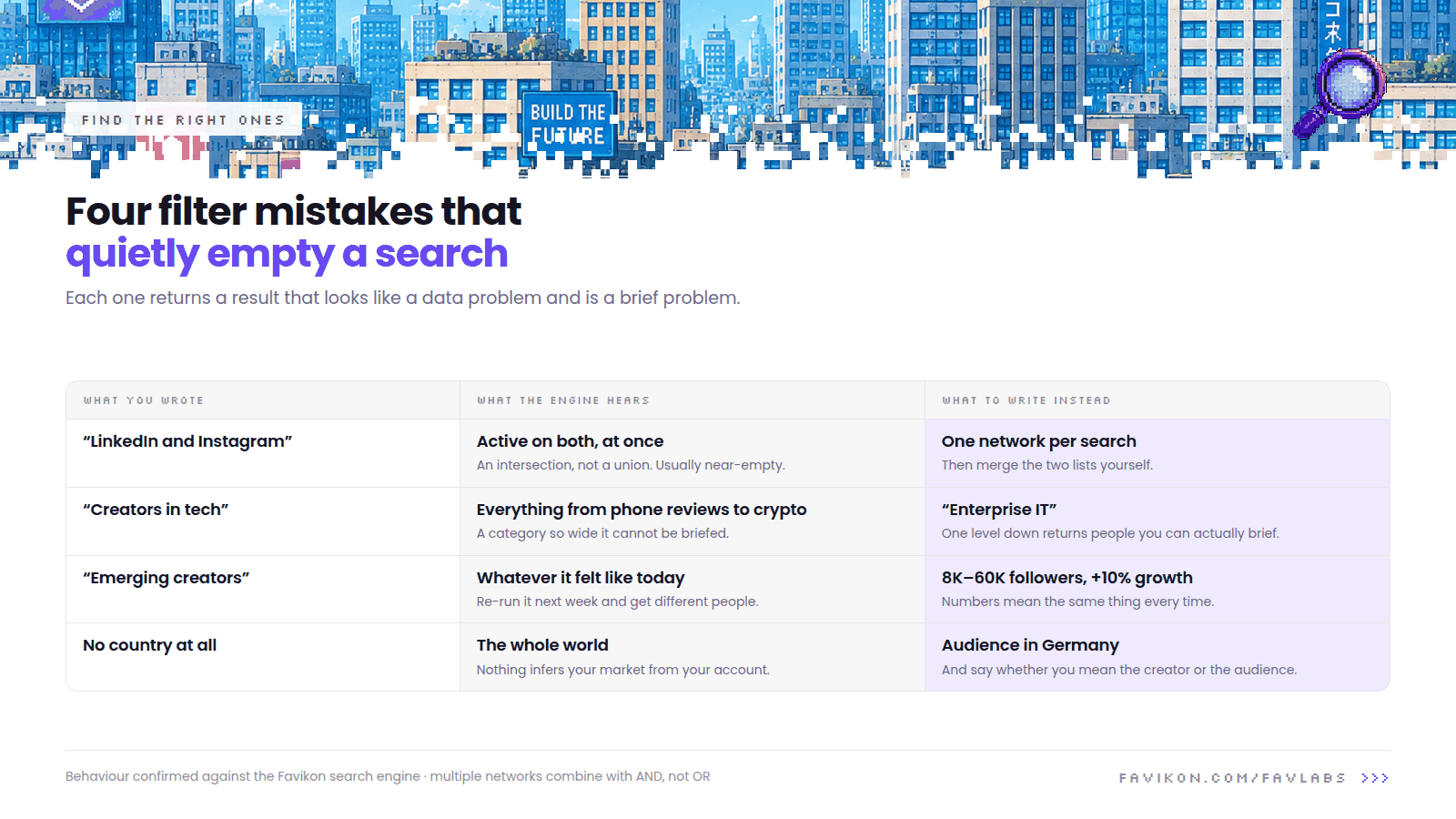
Each of these produces a result that looks like a data problem and is actually a brief problem.
- Asking for two networks at once. This is the big one, and it catches almost everybody. "LinkedIn and Instagram" is read as an intersection, not a union: creators who are active on both. That is a much smaller and much stranger group than you meant. Run one network per search and merge the lists afterwards.
- Using "tech" or "fitness" as the niche. Go one level down. "Enterprise IT" and "postpartum fitness" return people you can actually brief. "Tech" returns a phone reviewer, a CTO and a crypto trader in the same list.
- Saying "emerging" or "top" and hoping it lands. Say the numbers. A follower range and a minimum growth rate mean something. Adjectives do not, and worse, they get interpreted differently on every re-run, so you cannot compare two searches.
- Leaving the country out. Nothing infers it from your account. If you sell in Germany, say Germany, and say whether you mean where the creator lives or where their audience is. Those are different filters and they return different people.
When the precise search returns too few people
The instinct is to loosen the criteria. Do this instead, because it widens the pool without lowering the bar.
That list is too short. Rather than relaxing my criteria, search by what creators actually post about instead of what their profile says. Find people covering [topic] who did not appear in the first search, and merge the results.
Profile search and content search catch different people. One reads bios and headlines, the other reads what someone has actually published. A consultant whose LinkedIn headline says "Partner at Ellis & Co" but who posts constantly about dental practice management will never appear in the first search and is exactly who you wanted.
Running both is usually the difference between eight candidates and twenty.
The habit that makes this stick
Keep the criteria block. Not the results, the criteria. Six months later, when someone asks why a campaign targeted the people it targeted, the criteria block answers in ten seconds and the result list answers in forty minutes.
It is also the thing you edit when a campaign underperforms. A shortlist is an outcome. The criteria are the decision, and decisions are what you want to be able to revise.
Where to run it
Favy reads the same index the app search uses: 10M+ creator profiles across 9 networks, refreshed every 24 hours. It is on every Favikon plan. To run the same searches inside Claude or ChatGPT, connect the Favikon MCP.
Others Tools