CPM Calculator: Check a Creator's Price Against Your Paid Social
The calculation run end to end on a real quote, why followers are not impressions, and the three cases where a good CPM lies.
Creator quotes arrive as flat fees. Your ad platforms report in CPM. Until you convert one into the other, you are comparing a price to a rate and guessing which is better.
CPM is the bridge. It is the only number that lets you say "this creator costs less per thousand people reached than our paid social does right now" and be believed by whoever controls the budget.
The calculation, run end to end
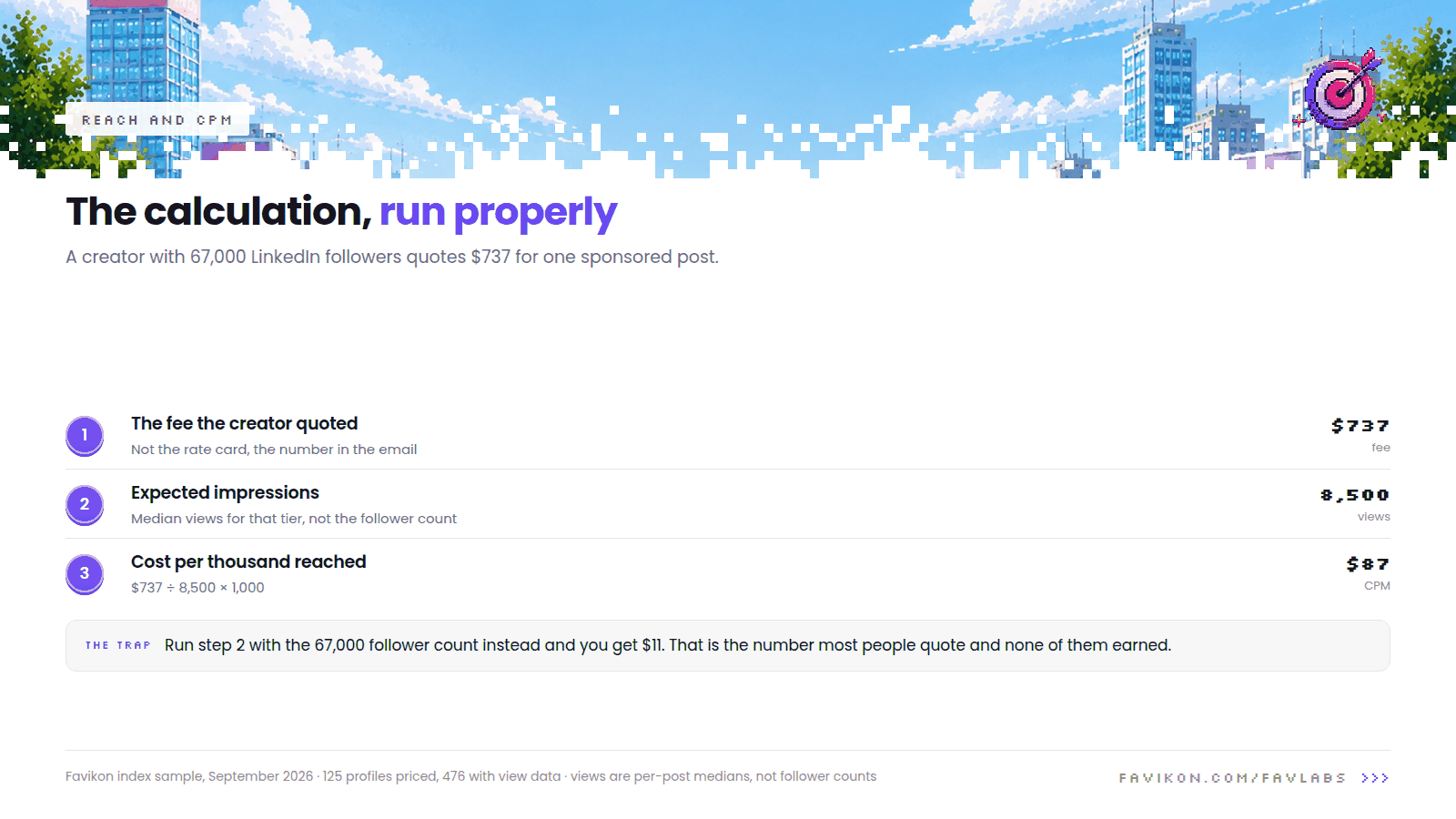
Take a real case. A LinkedIn creator with 67,000 followers quotes $737 for a single sponsored post. Their recent posts average 3,100 views.
- Fee - $737
- Expected impressions - 3,100, taken from their recent median, not their follower count
- CPM - $737 ÷ 3,100 × 1,000 = $237
That number looks alarming next to a paid social CPM, and it should. It is also the honest one. The trap is that most people run this calculation with the follower count in the denominator, which would give $11 and a completely fictional sense of a bargain.
Followers are not impressions, and the gap is enormous
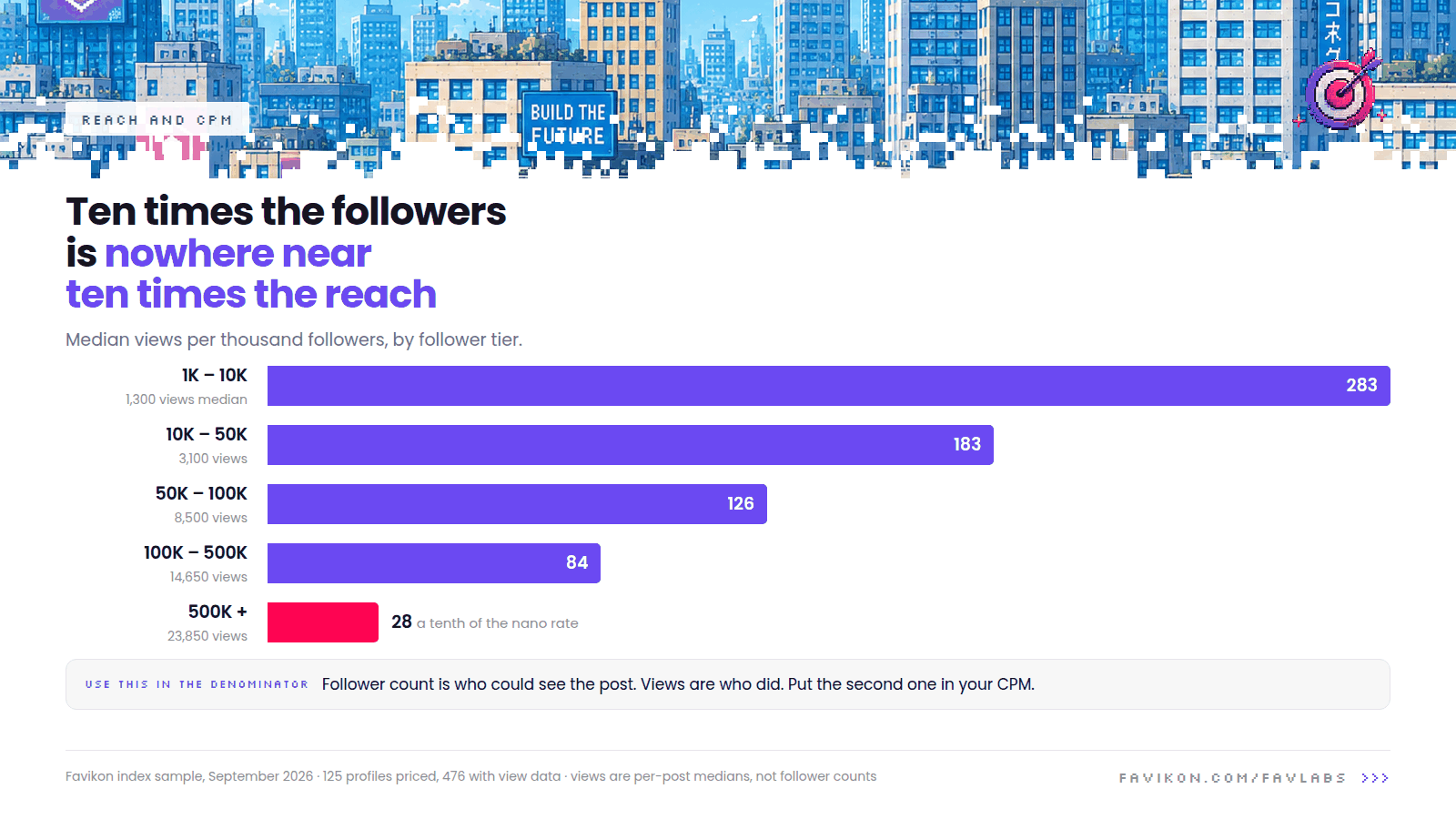
Follower count is who could see the post. Impressions are who did. On LinkedIn the gap is brutal and it widens as accounts grow.
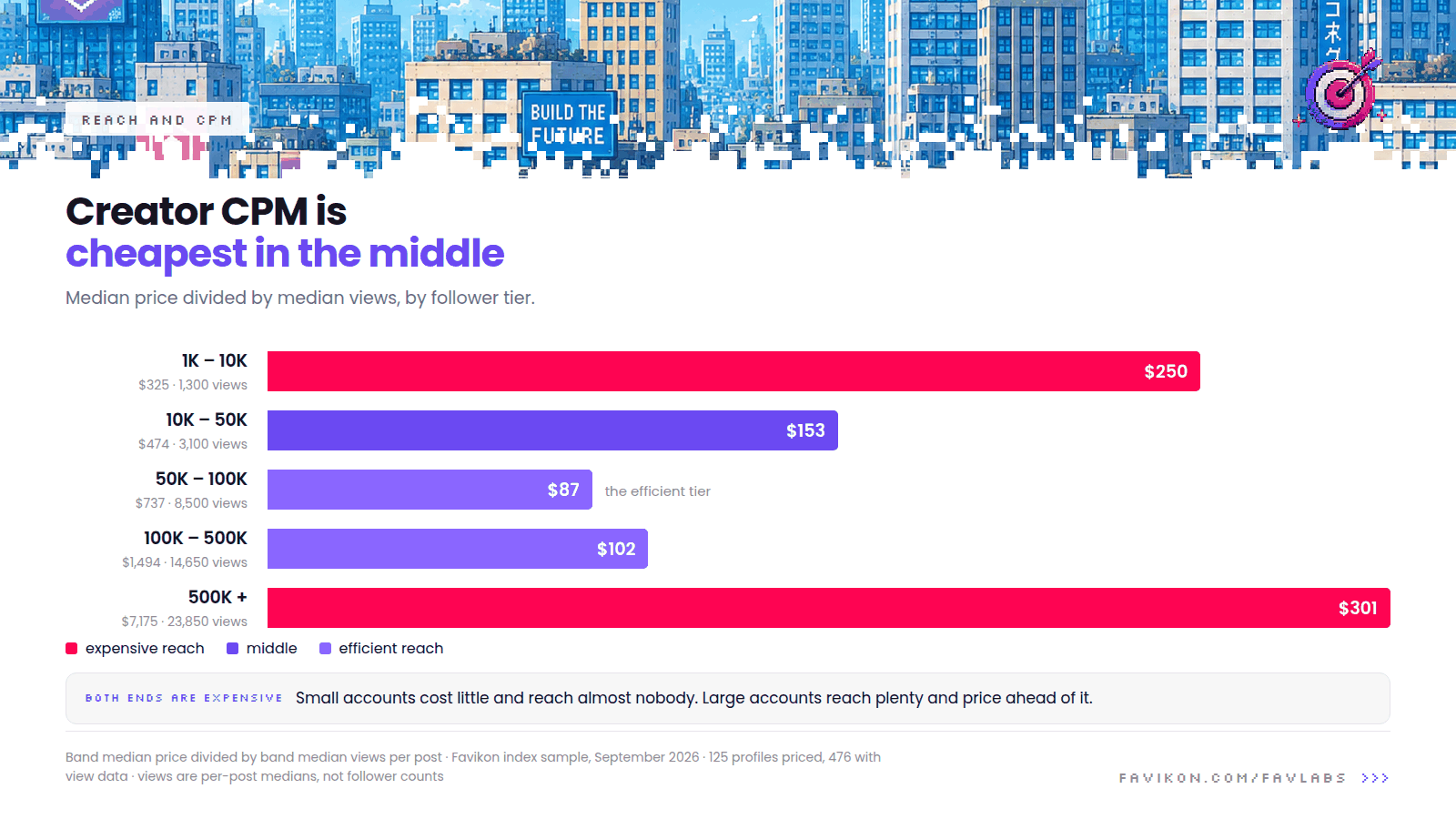
In a September 2026 sample of the Favikon index, median views per post ran around 531 for creators with 1K to 10K followers and around 315 for creators with 10K to 50K. Read that again: the larger band produced fewer median views per post. Audience size and distribution stopped moving together a long time ago.
Two safer inputs when you build the denominator:
- Use the creator's recent average views for the same format you are buying. A carousel and a text post do not perform alike, so average the right thing.
- Take the median, not the best post. Creators quote their best-performing content because that is a reasonable thing to be proud of. Their median is what you are actually buying.
The comparison that settles a budget argument
Run CPM on the creator deal, then run it on the same spend in paid social on the same platform, over the same period. Your own account is the benchmark. An industry average is not, because it is not the number your finance team will check you against.
If the creator wins, you have your case and it is a short one. If paid wins on CPM but the creator wins on relevance, say so explicitly and put a number on the relevance, even a rough one. A stated assumption beats an unstated instinct in any budget meeting, and it survives the follow-up question.
Three cases where a good CPM is a bad signal
CPM measures cost per eyeball. It says nothing about whose eyeballs, and in B2B that is usually the whole question.
- Audience mismatch. Cheap reach outside your market is not reach. A $4 CPM against a general audience can be worse value than a $200 CPM against exactly your buyer, and on LinkedIn it routinely is.
- Inflated impressions. If views look implausible next to likes and comments, the denominator is doing the work. Check the ratio before you trust the CPM.
- Content with a long tail. A YouTube video keeps earning impressions for a year. Judging it on week-one CPM undervalues it badly, and judging a LinkedIn post on a 12-month window overvalues it just as badly.
Putting a number on relevance
The honest version of the relevance argument is arithmetic, not rhetoric. If your paid social reaches a general professional audience and you estimate 8% of it matches your buyer, while the creator's audience matches at 60%, then your effective CPM on paid is not $30, it is $375. Now the two numbers are comparable.
You will be guessing at those percentages, and that is fine. Write the guess down, put it in the deck, and let someone challenge it. That is a better conversation than the one where two people trade intuitions about whether creators are worth it.
When you outgrow a calculator
CPM only works if the impressions input is honest, and self-reported creator numbers are the weakest data in the whole calculation. Favikon measures actual per-post performance across 9 networks and refreshes it every 24 hours, so the denominator in your CPM comes from observed data rather than a media kit screenshot.
Figures above come from a September 2026 sample of the Favikon index. Estimated prices are directional. Paid social CPMs should be taken from your own account over the same period, not from an industry average.
Others Tools