Linkedin creator price calculator Guide - What Should You Pay a LinkedIn Creator?
Real median prices by follower tier, what moves them, and the cost-per-engagement number that should decide your shortlist.
Three creators quote you for the same LinkedIn post. One says $300. One says $1,400. One says $7,000. Nothing in any of those emails tells you which is fair.
That is the whole problem with creator pricing. There is no rate card, so the first number usually gets accepted or refused on instinct. This page gives you the anchor instead, using what LinkedIn creators actually price at right now.
What a LinkedIn post actually costs
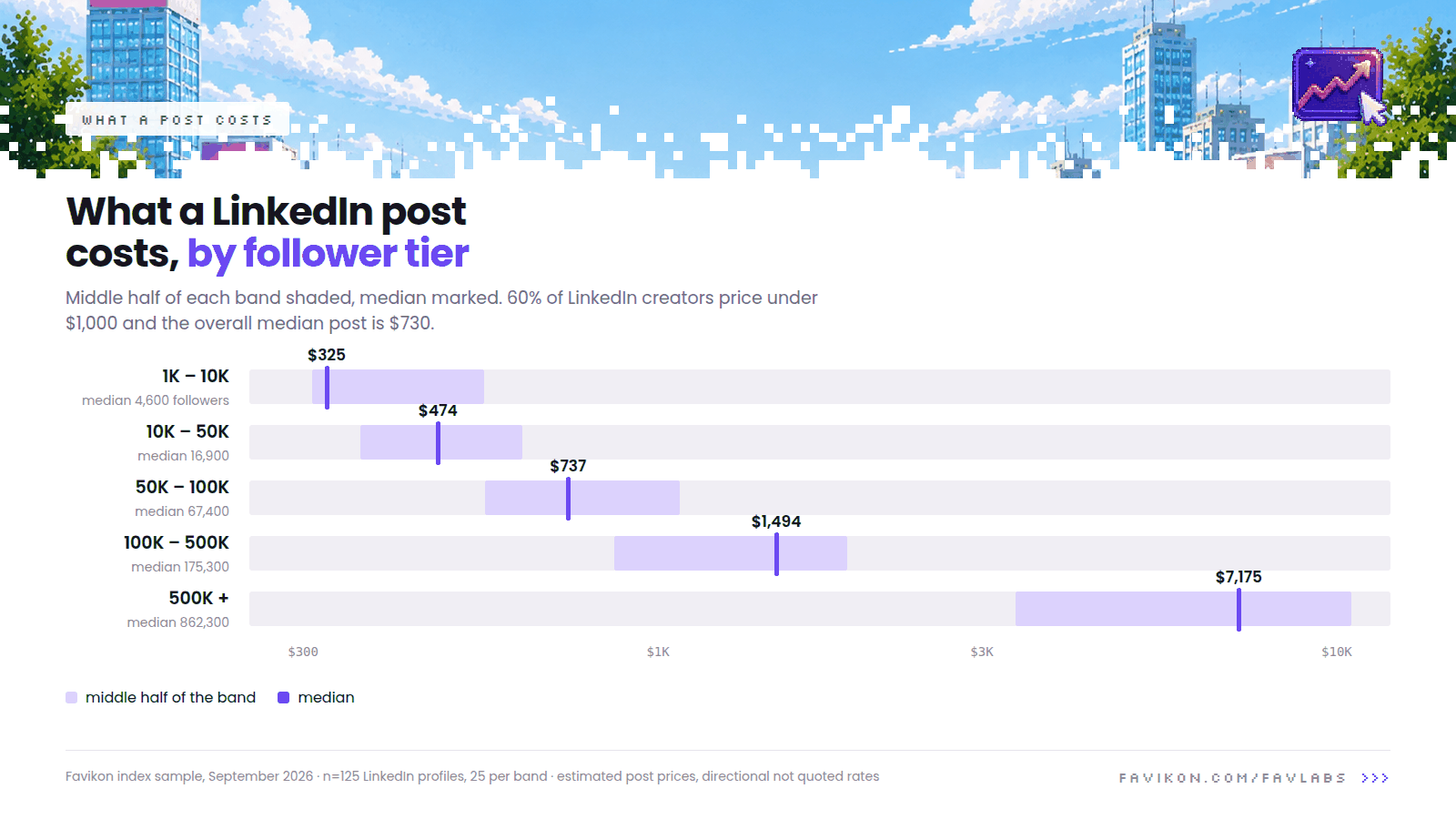
We pulled a sample of 125 LinkedIn creator profiles from the Favikon index in September 2026, spread evenly across five follower bands, and read the estimated post price for each one. Here is the shape of it.
- 1K to 10K followers -) median $325, with most quotes between $309 and $555.
- 10K to 50K - median $474.
- 50K to 100K - median $737.
- 100K to 500K - median $1,494.
- 500K and above - median $7,175, and the spread gets wild: $2,573 at the bottom, $21,000 at the top.
Two things fall out of that immediately. The median LinkedIn post across the whole sample is $730, and 60% of creators price under $1,000. If you have been told that LinkedIn creator partnerships are a five-figure game, that is true for roughly one creator in ten.
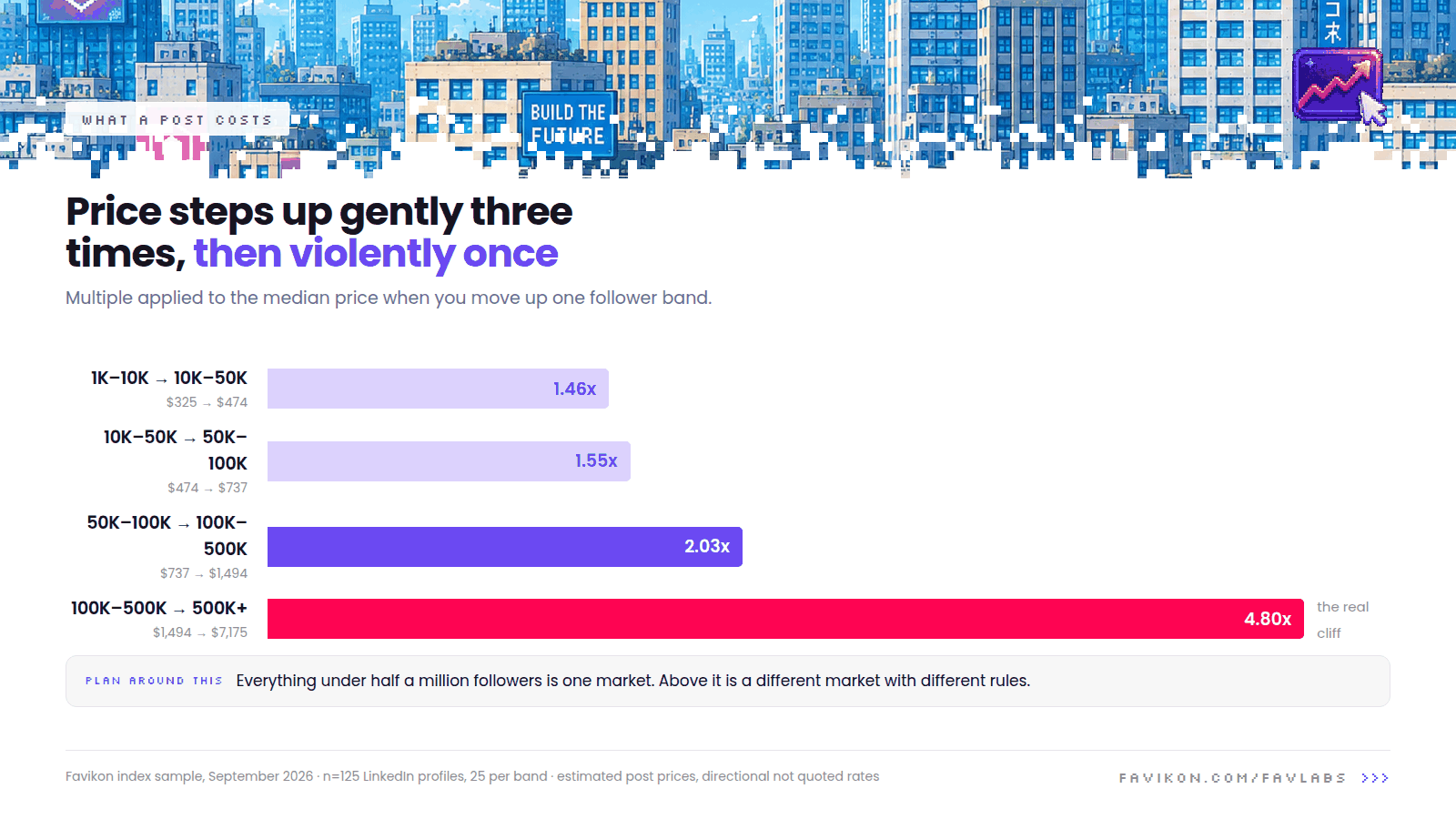
The second is where the price actually breaks. Between 50K and 500K followers, the median doubles. Between 500K and above, it nearly quintuples. Scale does not get expensive gradually. It gets expensive all at once, and it does it above half a million followers.
The number that should decide your shortlist
A price on its own is meaningless. What matters is what the price buys, and on LinkedIn that gets counterintuitive fast, because engagement collapses as audiences grow.
In a sample of 499 LinkedIn profiles across the same bands, the median engagement rate ran like this: 0.93% at 1K to 10K followers, 0.29% at 10K to 50K, 0.13% at 50K to 100K, 0.05% at 100K to 500K, and 0.02% above 500K. A big LinkedIn account is not a small account scaled up. It is a different object.
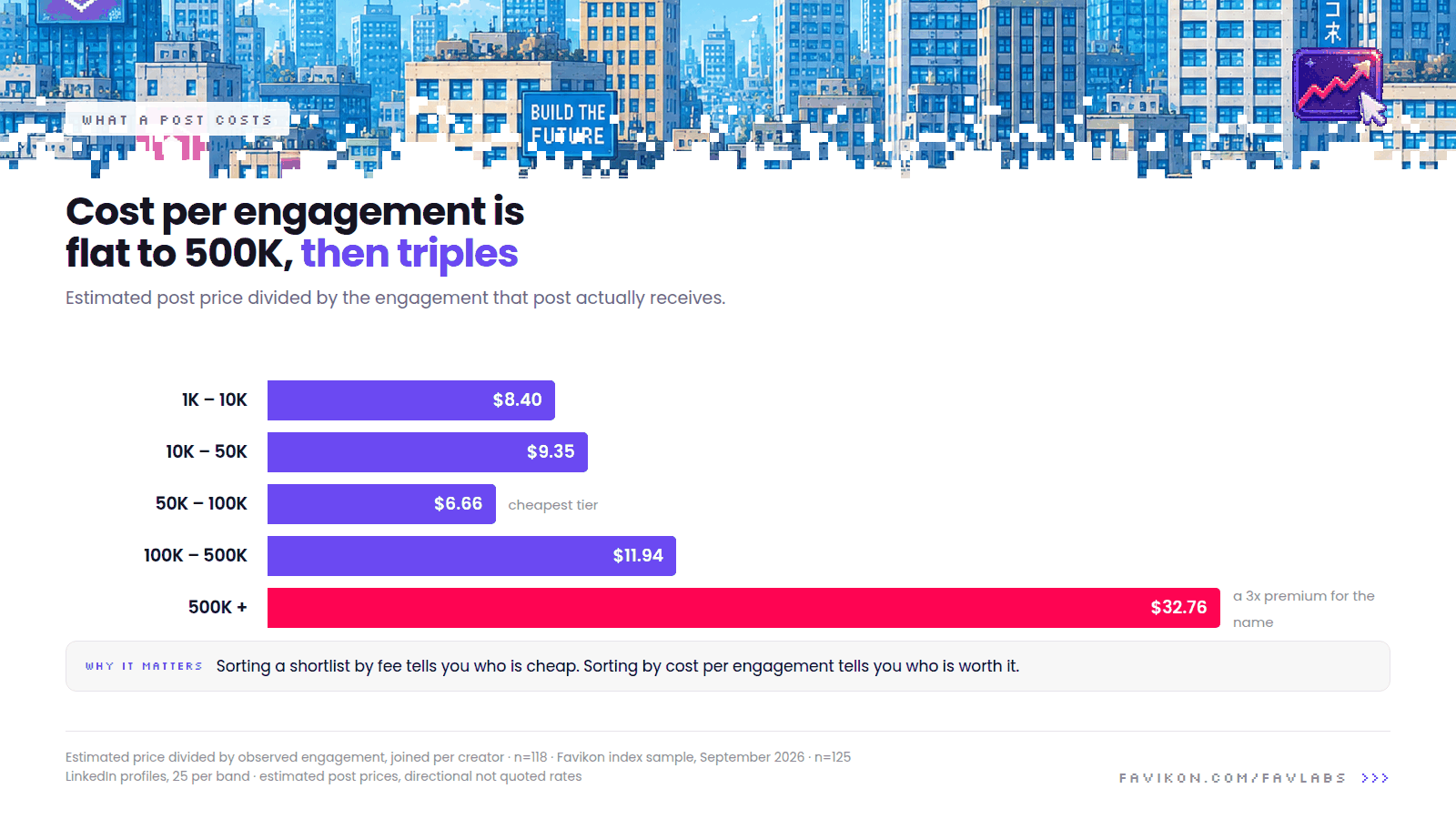
Divide price by actual engagement and the picture reorders itself:
- 1K to 10K - about $8.40 per engagement
- 10K to 50K - about $9.35
- 50K to 100K - about $6.66
- 100K to 500K - about $11.94
- 500K and above - about $32.76
Read that carefully, because it is not the story people expect. Cost per engagement is roughly flat from 1K all the way to 500K followers. The efficiency argument for micro creators is real but modest. What is not modest is the cliff above 500K: you pay around a 3x premium per engagement for the privilege of a big name.
Sometimes that premium is worth it. A launch that needs a recognisable face is buying credibility, not engagement, and credibility has never been cheap. Just know that you are buying it, and say so out loud in the budget meeting.
The four things that move a price more than audience size
Follower count is where the conversation starts, not where it lands. On real transacted deals, four other variables move the number harder.
- Format. A carousel typically adds 20 to 35% over a plain text post. Video adds 40 to 80%. A newsletter placement runs 1.5 to 3x a feed post, and event speaking commands roughly 4x. A post is inventory. A keynote is scarcity.
- Niche. FinTech, cybersecurity and enterprise IT audiences command two to five times the marketing-niche rate. The audience is not bigger, it is scarcer and worth more per head.
- Geography, and not in the direction you expect. The US, UK and Canada cluster around a $500 to $550 median. France sits near $300, India near $155. But thin-supply markets like Austria out-price both the UK and the US. A smaller market is not automatically a cheaper one.
- Usage rights. If you plan to run the content as a paid ad, that is a separate line item, not a courtesy. It is the single most commonly forgotten cost in a creator deal, and the one that turns a $2,000 post into a $20,000 argument six months later.
Why nano creators out-price micro creators
You will see it in our numbers too: the gap between the 1K to 10K band and the 10K to 50K band is much smaller than the follower gap suggests, and individual nano creators regularly quote above micro creators.
That looks broken until you see who those nano accounts are. Founders. CEOs. Heads of engineering at companies your buyer already respects. The audience is small, specific, and holds budget. You are not paying for reach. You are paying for a room.
How to use a quote you have just received
Put the quote next to the band median above and one of three things is true.
- Inside the band. Stop negotiating on price. Negotiate on scope: add a second post, add a story, extend the usage window. You will get more value per dollar than you would by shaving 10% off the fee, and you will not sour the relationship in the first email.
- Well above the band. Ask what the premium is for. There is often a real answer: a scarce niche, paid usage rights already included, an exclusivity window. If there is no answer, you now know.
- Well below the band. This is the one people celebrate and should not. A cheap post to an audience that does not exist is not a bargain, it is a smaller waste.
When price is not your problem yet
If the engagement looks inflated, stop. Check whether the audience is real before you argue about the fee. Our engagement rate benchmark takes about a minute and answers that question first.
And if the brand fit is wrong, that is a scope problem, not a price problem. No discount fixes the wrong audience.
When you outgrow a calculator
A calculator prices one creator at a time from public inputs. Once you are comparing twenty candidates, or once the creator's own media kit is the only source for their numbers, you need measured data rather than self-reported data. Favikon creator profiles replace the media kit with independently measured engagement, audience quality and authenticity scores, so the price you negotiate is anchored on numbers nobody had an incentive to round up.
Figures above come from a September 2026 sample of the Favikon index: 125 LinkedIn profiles for pricing, 499 for engagement, 25 per follower band. Estimated prices are directional, not quoted rates.
Others Tools