How to Measure Influencer Marketing Attribution: The Complete Guide
Measuring the true impact of influencer marketing has long been a challenge for many brands. This guide explains practical attribution methods that help connect creator campaigns to business results with greater accuracy.

Influencer Marketing Attribution: Finally Solved
Attribution is the reason influencer budgets get cut, defended, or doubled. It's also the part of the job almost nobody has fully figured out.
Search "influencer marketing attribution" on Reddit, LinkedIn, or any marketing forum and you'll find the same conversation on repeat: a brand runs creator campaigns for months, sales clearly go up, and then someone asks "but how much of that was the influencer?" and the room goes quiet. This guide breaks down why that question is so hard to answer, walks through every measurement method and model teams actually use in 2026, and gives you a framework for picking the right one for your industry, budget, and platform mix — plus the specific tools that help at each stage.
Why influencer attribution is still this hard
The core problem isn't that marketers are bad at tracking. It's that influencer-driven purchases rarely happen in one step.
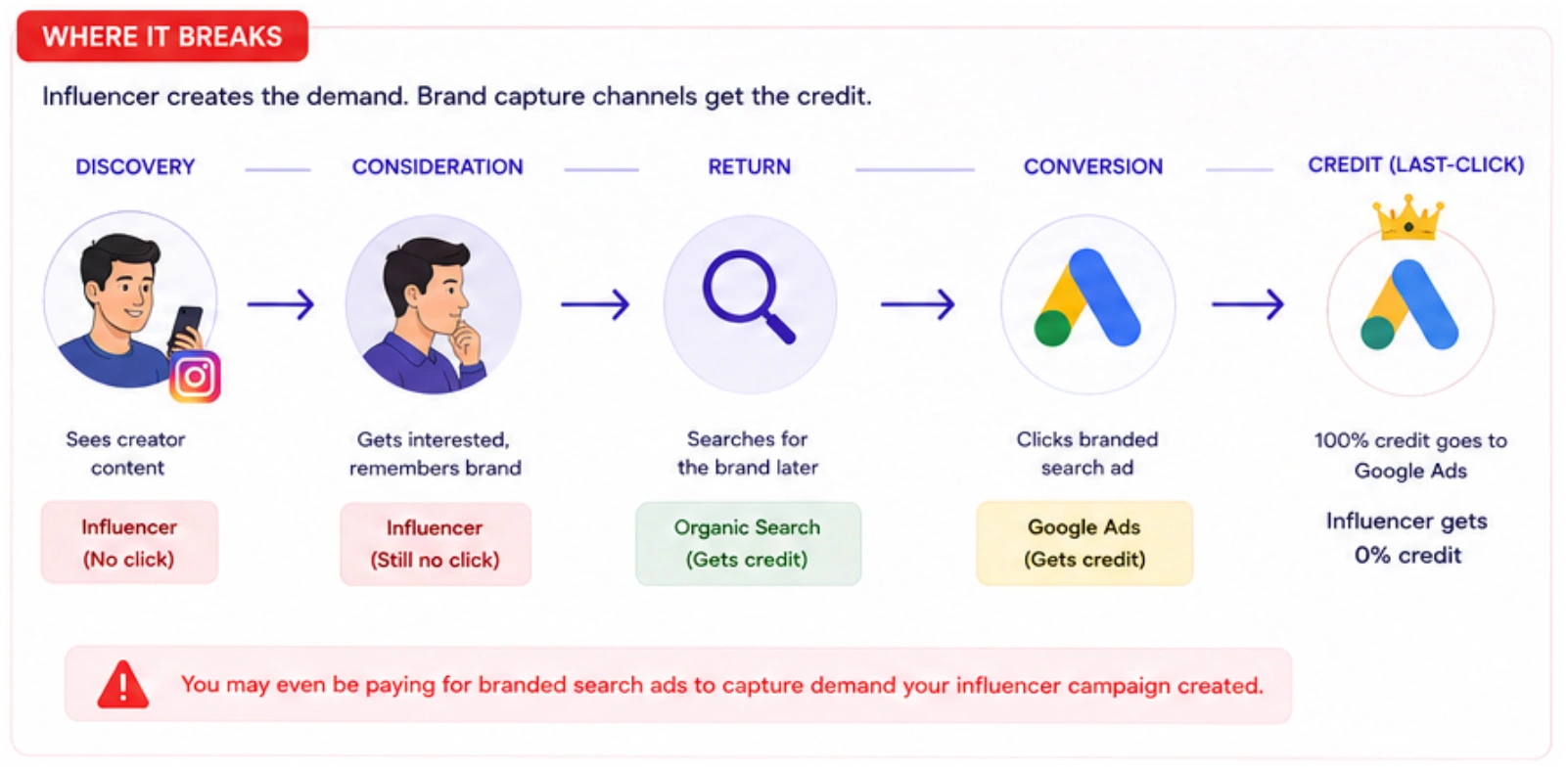
A Reddit thread from a brand that had been running creator campaigns for eight months laid out the exact failure mode: a creator posts about the product, a customer sees it, doesn't buy right away, and two weeks later Googles the brand name and purchases. Google Analytics logs that as organic search. Search Console shows a traffic spike right after the post went live. But the platform report says the creator drove nothing, because nobody clicked a link or used a code.
That's not a tracking bug. It's what Chris Hanson at Meltwater describes as the fundamental gap between engagement metrics and business outcomes — a shopper can discover a brand through a Reel, come back through organic search, click a retargeting ad, and buy after an email, and crediting only the last click ignores the interaction that started the whole relationship. Multiple people on that same Reddit thread described the same workaround: extend the attribution window, switch to first-touch instead of last-click, and accept that some real revenue will never show up cleanly attributed to anyone.
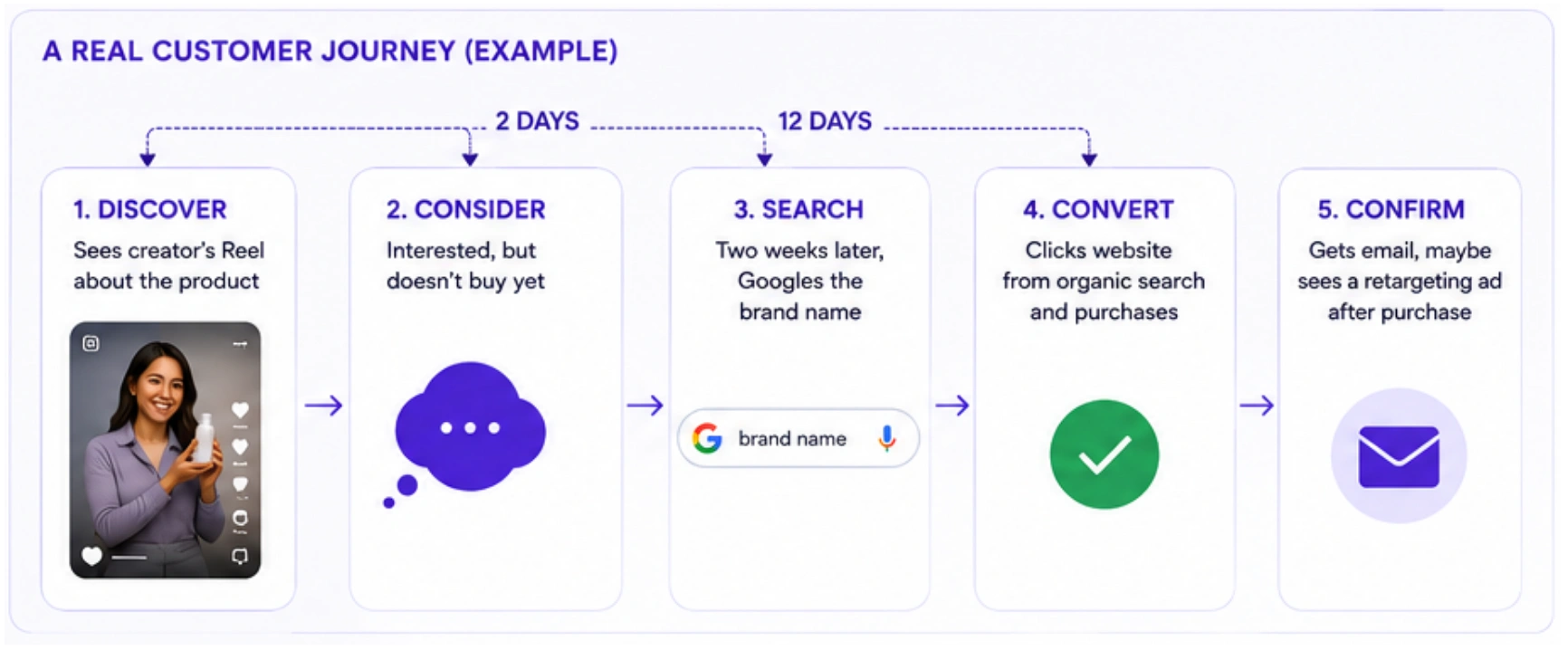
Ryan Prior, Head of Marketing at Modash, made a related point in a LinkedIn post: attribution models systematically over-credit the touchpoint closest to purchase and under-credit the ones early in the journey, and influencer content is disproportionately an early touchpoint — especially for anything that isn't an impulse buy. The less frequently something gets purchased, the longer the consideration window, and the more touchpoints sit between "saw the content" and "bought the thing." Influencers usually aren't touchpoint one or touchpoint last. They're somewhere in the messy middle, which is exactly where most attribution systems are weakest.
None of this means attribution is impossible. It means no single tracking method captures the whole picture, and treating one method as ground truth — whether that's a discount code redemption count or a UTM click report — will systematically undercount what influencer marketing actually does. The rest of this guide works through where each method breaks, what models exist to compensate, and how to combine them without turning measurement into its own full-time job.
Where each tracking method actually breaks
Before picking a model, it helps to know exactly what each underlying tracking method can and can't see. Every one of these has a specific, predictable blind spot.
UTM links and unique tracking URLs
How it works: Every creator gets a unique URL with UTM parameters (source, medium, campaign, content). Analytics tools attribute the resulting session, and often the eventual conversion, back to that link.
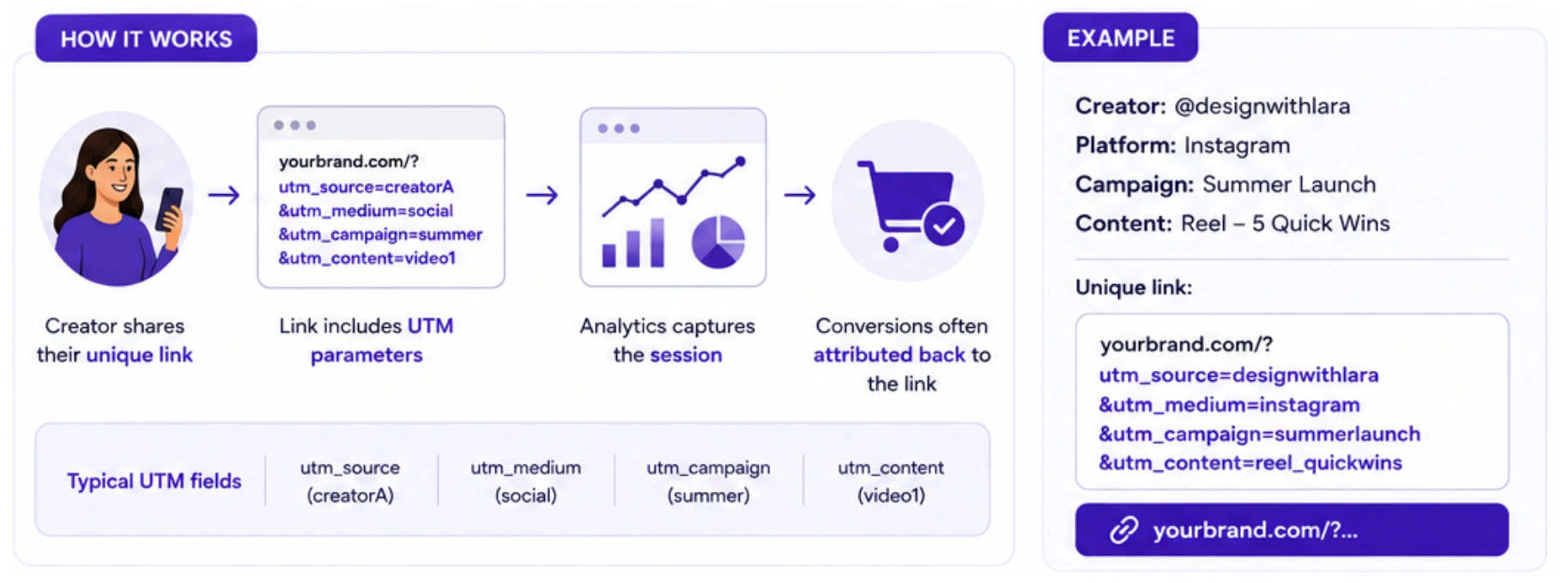
Where it breaks: UTMs only fire if someone clicks. A viewer who watches a TikTok or Instagram Reel, remembers the brand, and searches for it later on a different device leaves zero UTM trail. This is a bigger problem than it sounds — a growing share of YouTube is watched on connected TVs, where there's often no clickable link at all, only a spoken mention or a QR code that most people on a sofa won't scan. Kevin Brown, founder of Affiliate Window (now Awin) and current CEO of FanCircles, has written that roughly half of YouTube viewing now happens on TV screens for some creators' audiences, which means any report built purely on link clicks is structurally blind to that half. Treat that specific figure as his own estimate rather than an independently verified industry number, but the underlying mechanic — no click possible, no UTM data — is not in dispute.
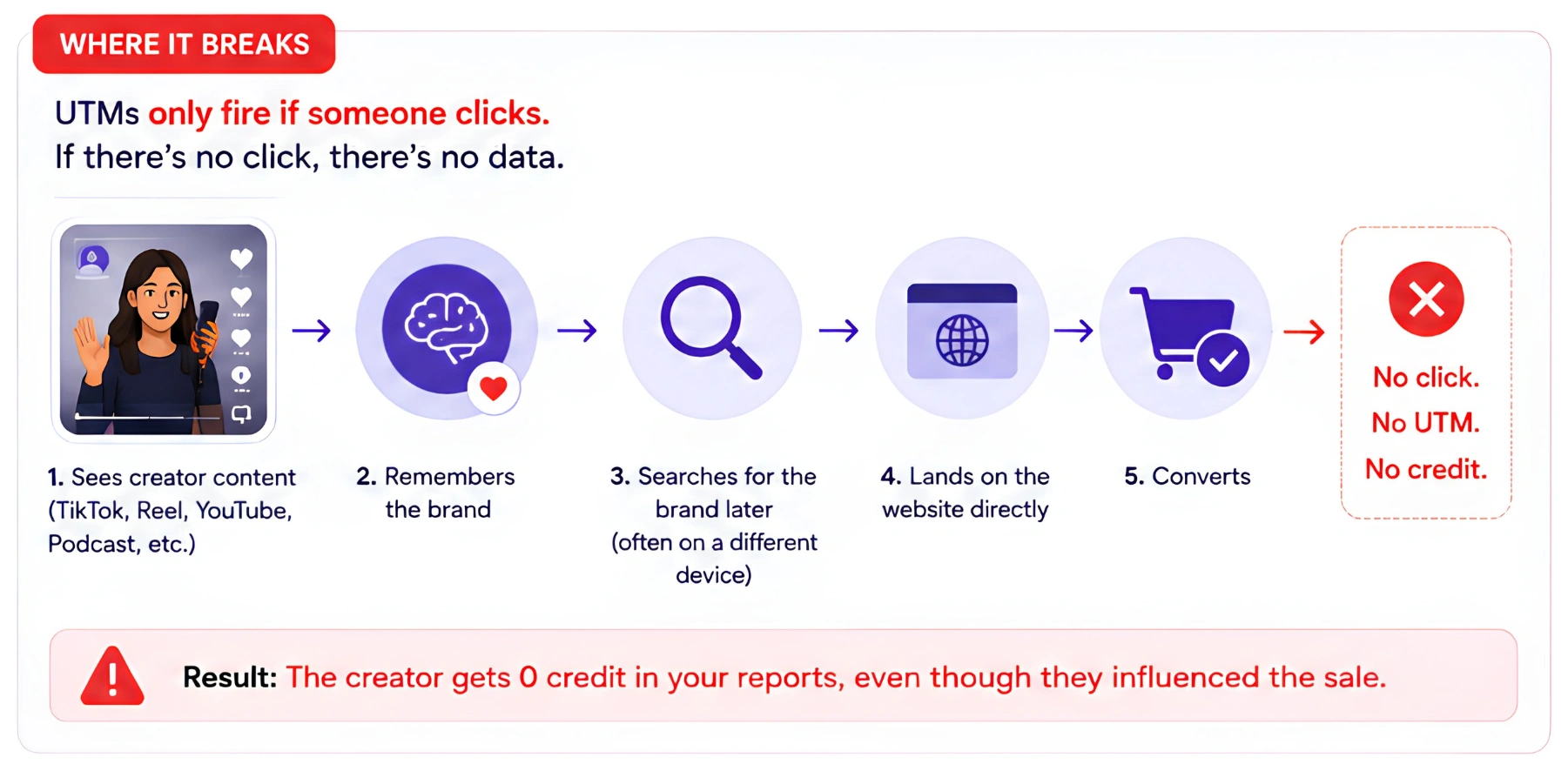
UTMs also break across devices: someone clicks on their phone, buys on a laptop three days later, and most analytics setups see two unconnected sessions instead of one customer journey.
Internally, this is exactly the gap covered in how to track ROI of influencer campaigns on Instagram — link-based tracking works until the platform itself doesn't support clickable links in the format the creator is using.
Discount and promo codes
How it works: Each creator gets a unique code. Redemptions at checkout are counted as their attributed conversions.
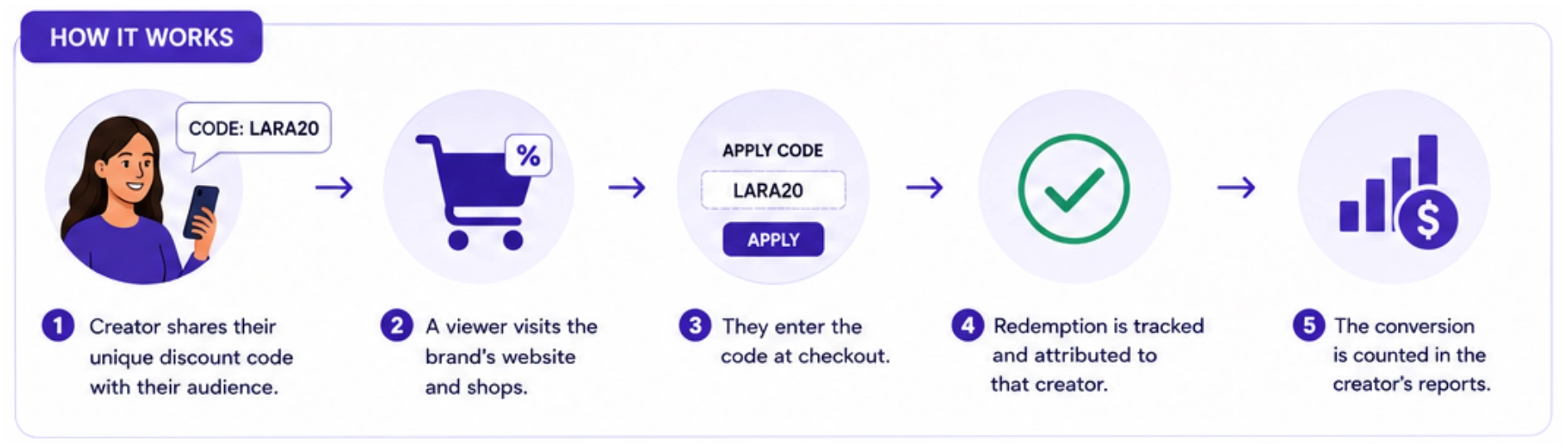
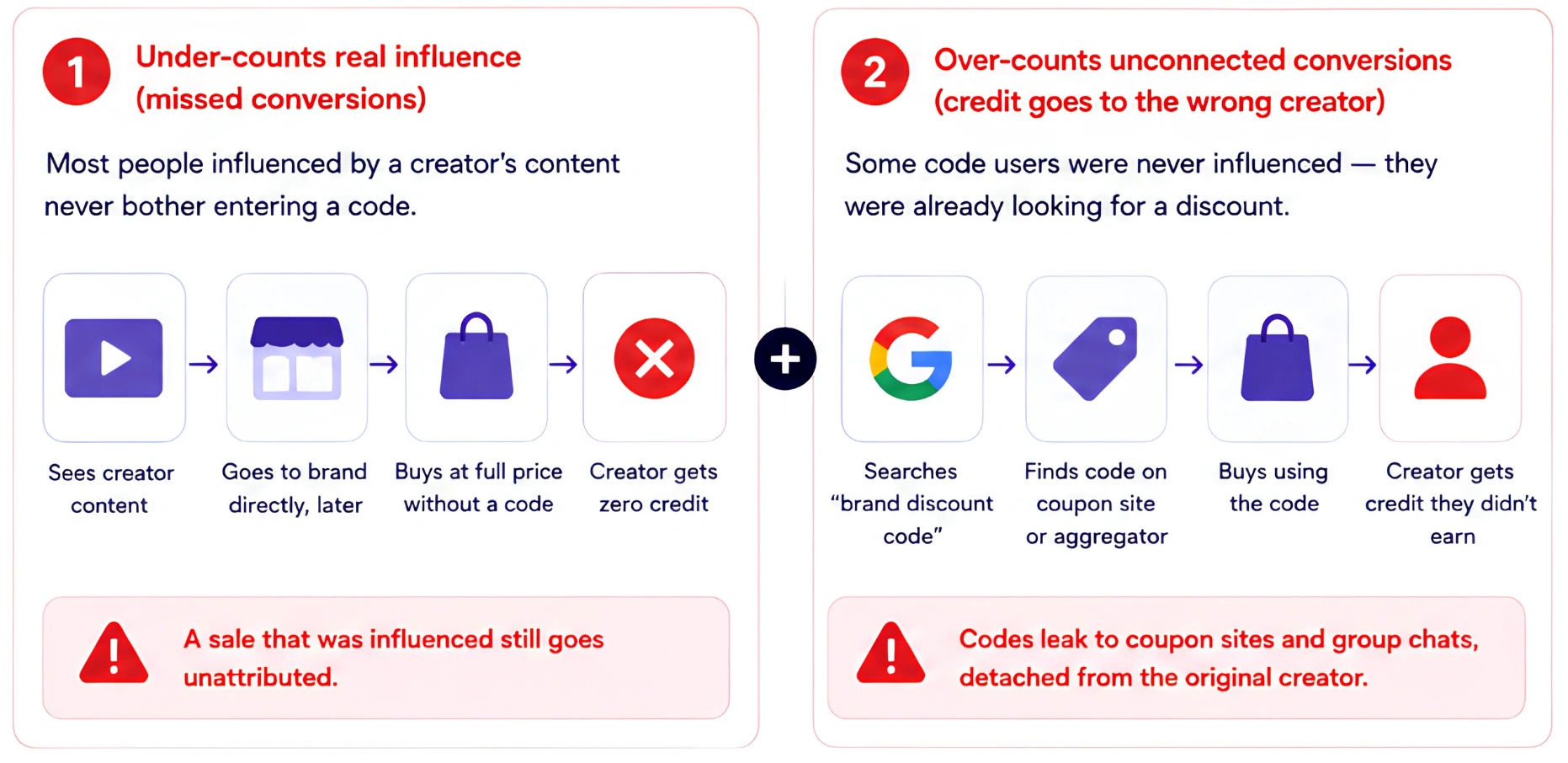
Where it breaks: Codes catch two very different populations badly. First, most people influenced by a creator's content never bother entering a code — they buy at full price through a completely different path, and the creator gets zero credit for a sale they caused. Second, some code users were never influenced at all; they searched "[brand] discount code" because they'd already decided to buy, and a search engine handed them a code that happens to be tied to a specific creator. Codes also leak: they get posted to coupon aggregator sites and shared in group chats, disconnected entirely from the creator who originally had them.
One Reddit commenter working through this exact problem recommended pairing custom codes with a longer cookie window (14–30 days) on the underlying tracking link, so a click that doesn't convert immediately still gets credited if the customer returns later — codes and click tracking compensating for each other's gaps rather than either one working alone.
Native click-tracking inside influencer platforms
How it works: Platforms like Favikon, Modash, GRIN, CreatorIQ, and Upfluence let you set up hashtag, mention, or keyword tracking across a campaign's creators, and some connect to GA4 or a pixel to show clicks and on-site behavior per creator.
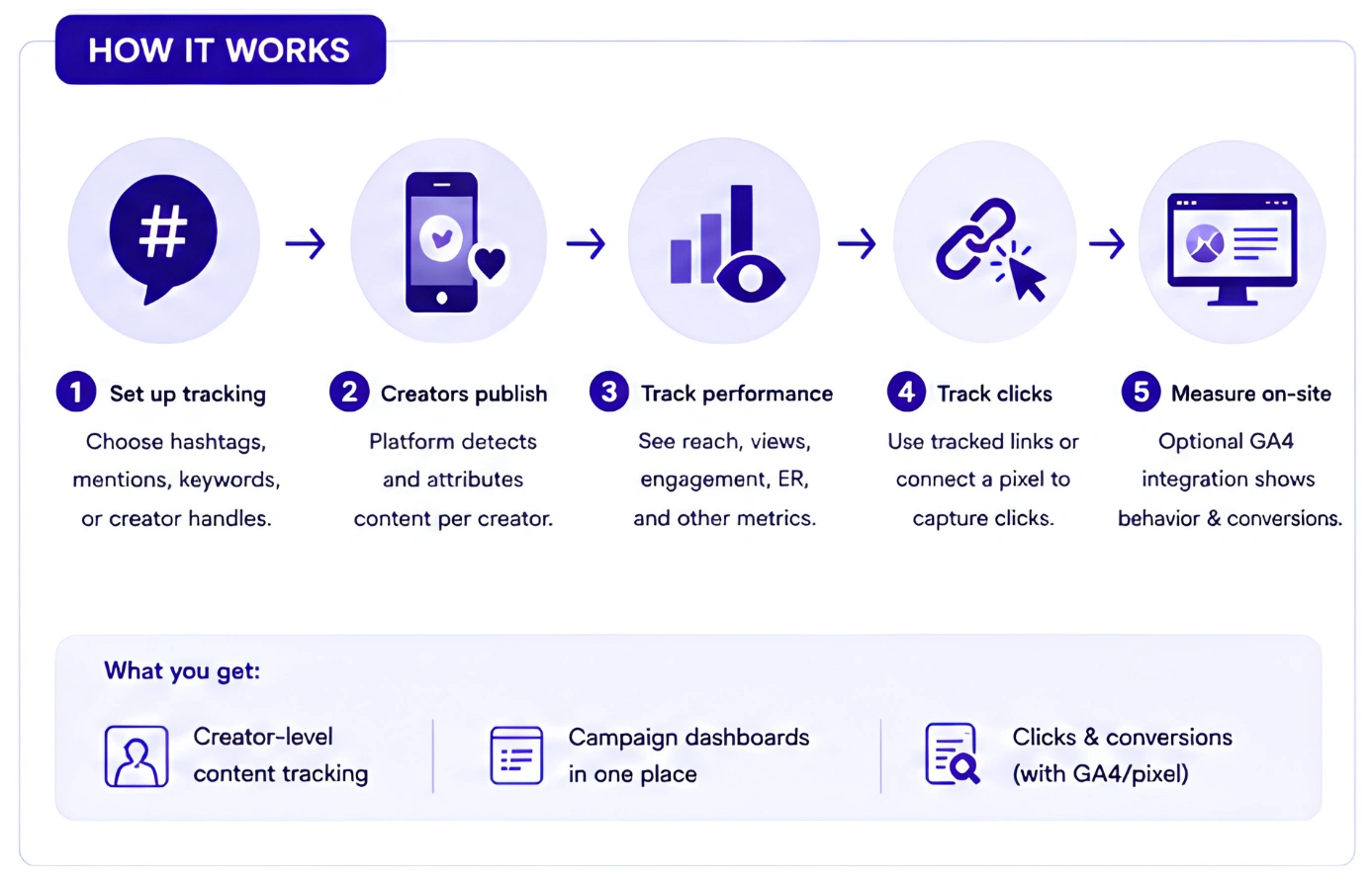
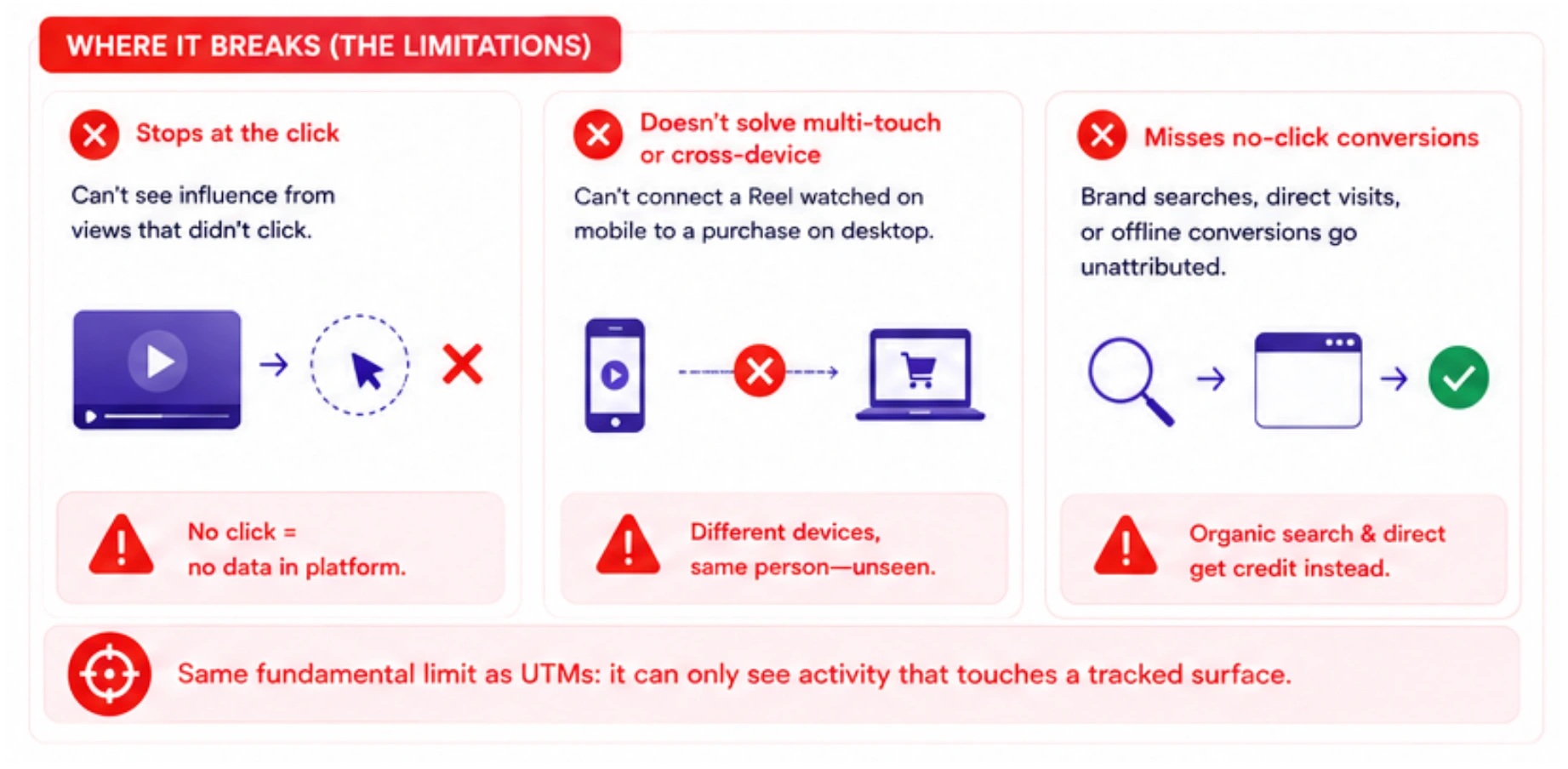
Where it breaks: This layer is genuinely good at telling you which creator produced which post and how that post performed on-platform — reach, engagement rate, view count, and (where connected) click-through to your site. It's the natural system of record for the campaign side of the equation. But on its own, it stops at the click or the on-platform action. It doesn't natively solve multi-touch, cross-device, or no-click attribution any better than a raw UTM link does, because the underlying limitation is the same: it can only see activity that touches a tracked surface. This is where Favikon's own campaign tracking sits — hashtag, mention, and keyword monitoring per creator, plus an optional GA4 connection to layer on click and conversion data. That combination covers content performance and on-site behavior well; it's not a substitute for the multi-touch or incrementality layers described later in this guide.
Last-click web analytics (GA4 and similar)
How it works: Whichever channel gets the final click before conversion gets the credit by default.
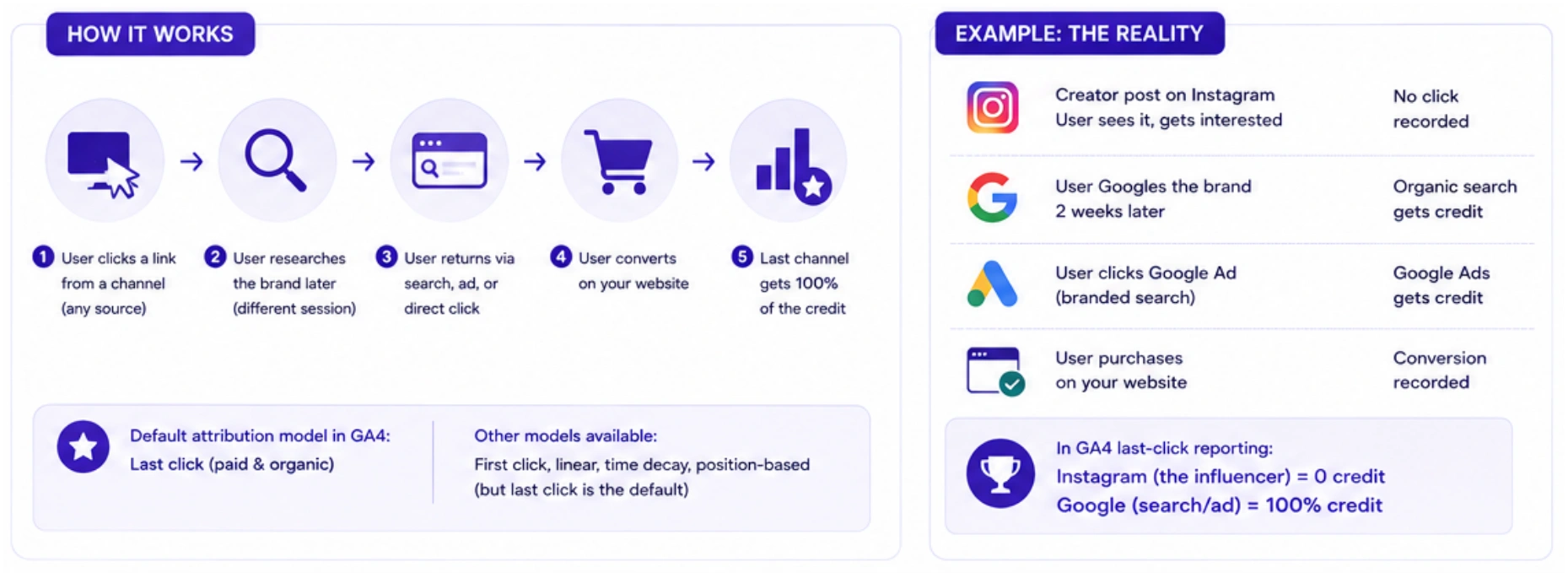
Where it breaks: This is the mechanism behind the exact scenario that opened this guide. A creator drives someone to Google the brand name; Google Ads or organic search gets the credit for a sale the creator actually caused, sometimes while the brand is simultaneously paying for a branded search ad to capture demand its own influencer campaign generated. The complete guide to calculating influencer marketing ROI covers this specific trap in more depth — last-click isn't wrong, it's just answering a narrower question ("what closed the sale") than the one most marketers are actually asking ("what caused the sale").
Post-purchase surveys and self-reported attribution
How it works: At checkout or right after purchase, ask "how did you hear about us?" with specific creator or campaign names as options.
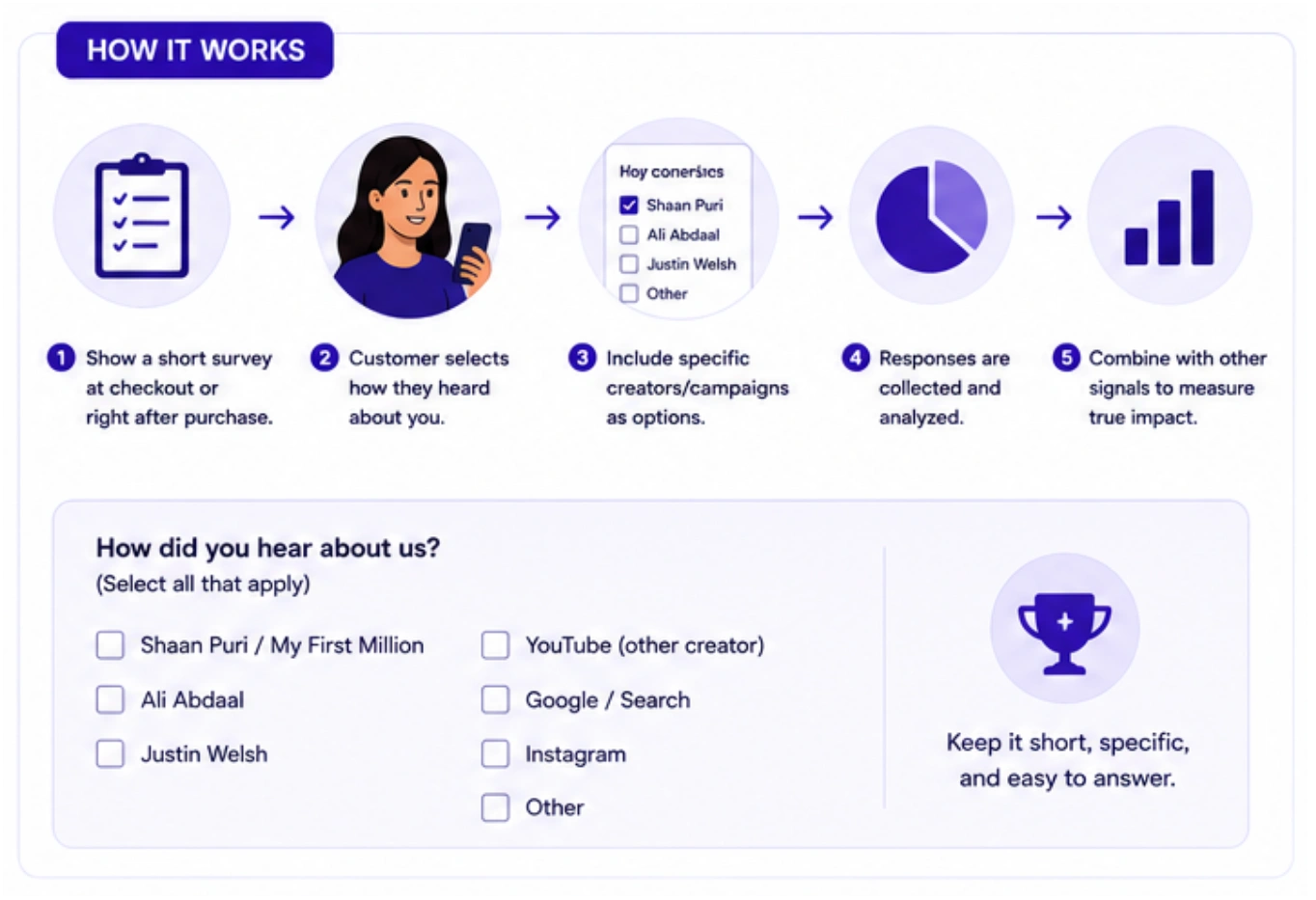
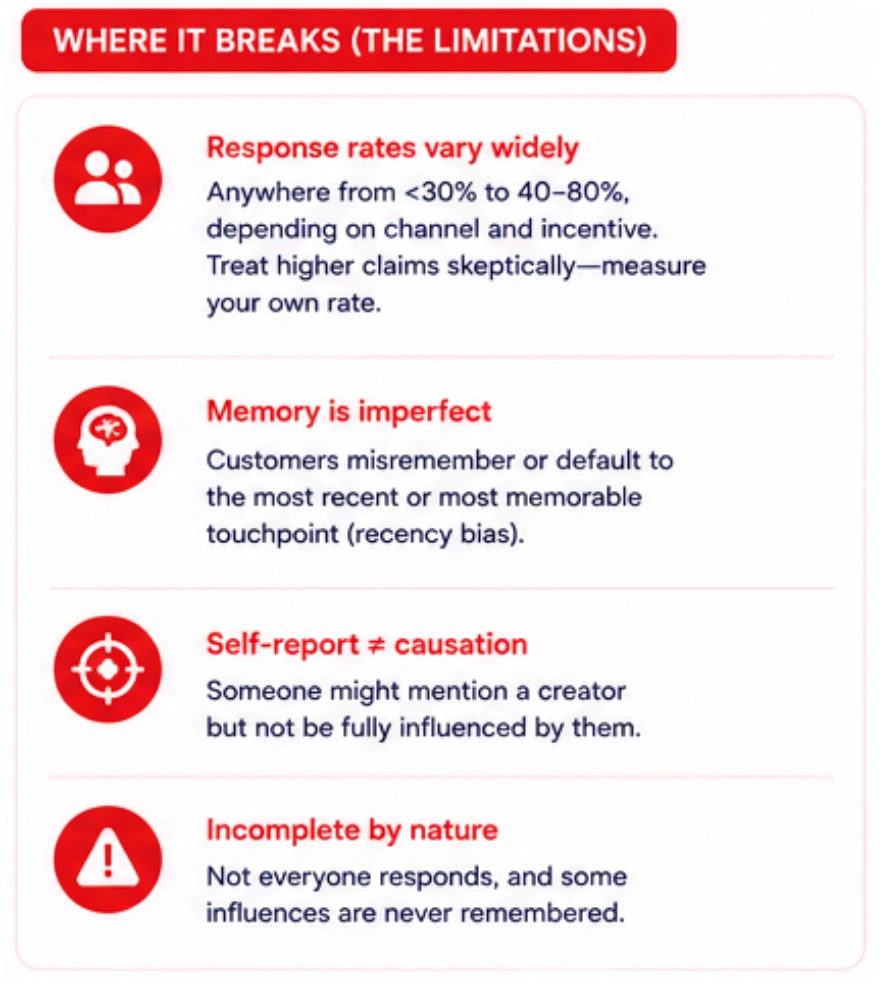
Where it breaks: Response rates vary hugely by channel and incentive — anywhere from under 30% to, per some vendor claims, 40–80% depending on how the survey is positioned and whether there's an incentive attached. Treat the higher end of that range skeptically until you've measured your own response rate. Customers also misremember or default to the most recent or most memorable touchpoint rather than the one that actually mattered, so self-reported data has its own recency bias baked in. Still, James King, a digital strategist who has led digital at Benefit Cosmetics AU, built a practical cheat sheet around exactly this: add influencer name as a follow-up question in a post-purchase survey, cross-check it against branded search lift in Search Console during the campaign window, and layer in coupon tracking as a third signal. No single layer is trusted alone — the survey exists to catch what UTMs and codes structurally can't see.
Brand search lift
How it works: Watch branded query volume in Search Console or a rank tracker before, during, and after a campaign. A spike that lines up with a post going live gets attributed, at least directionally, to that campaign.
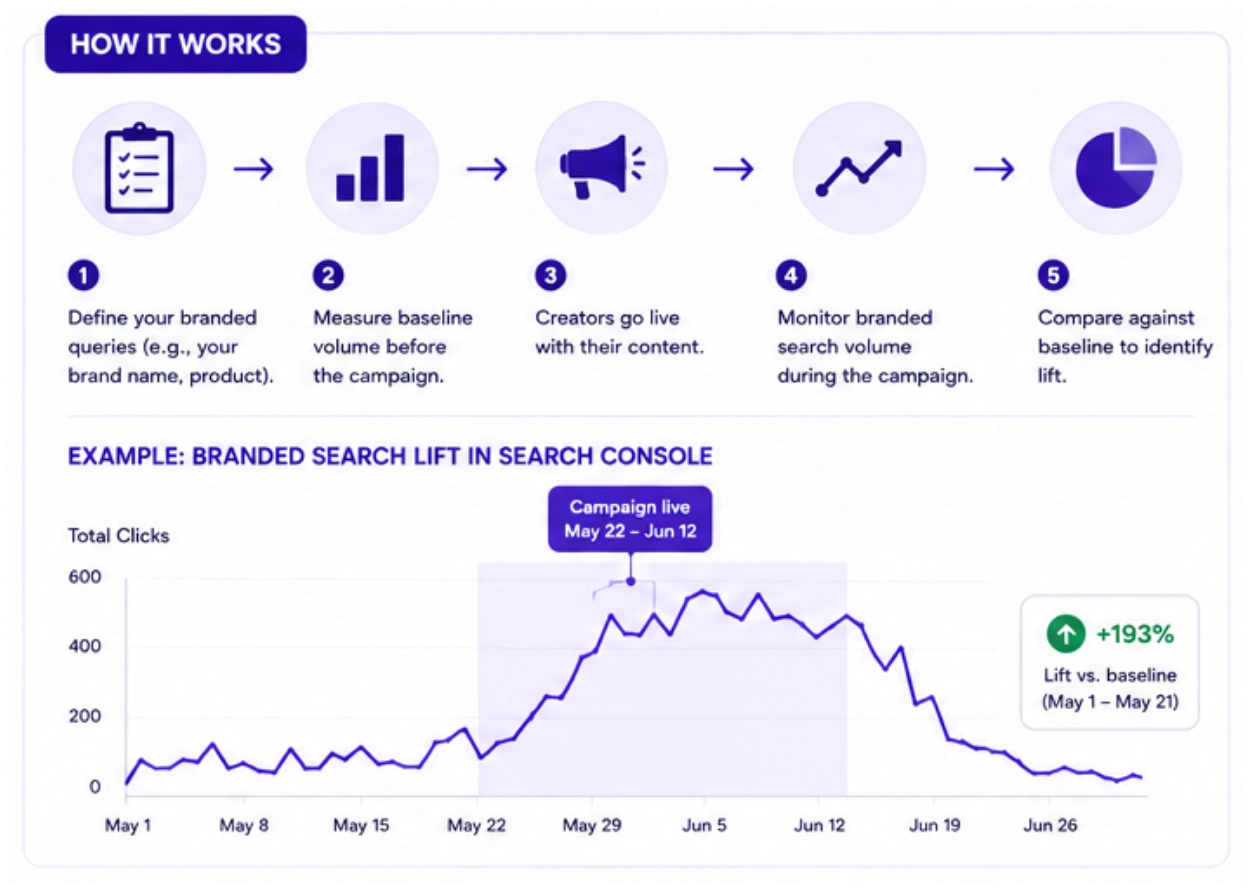
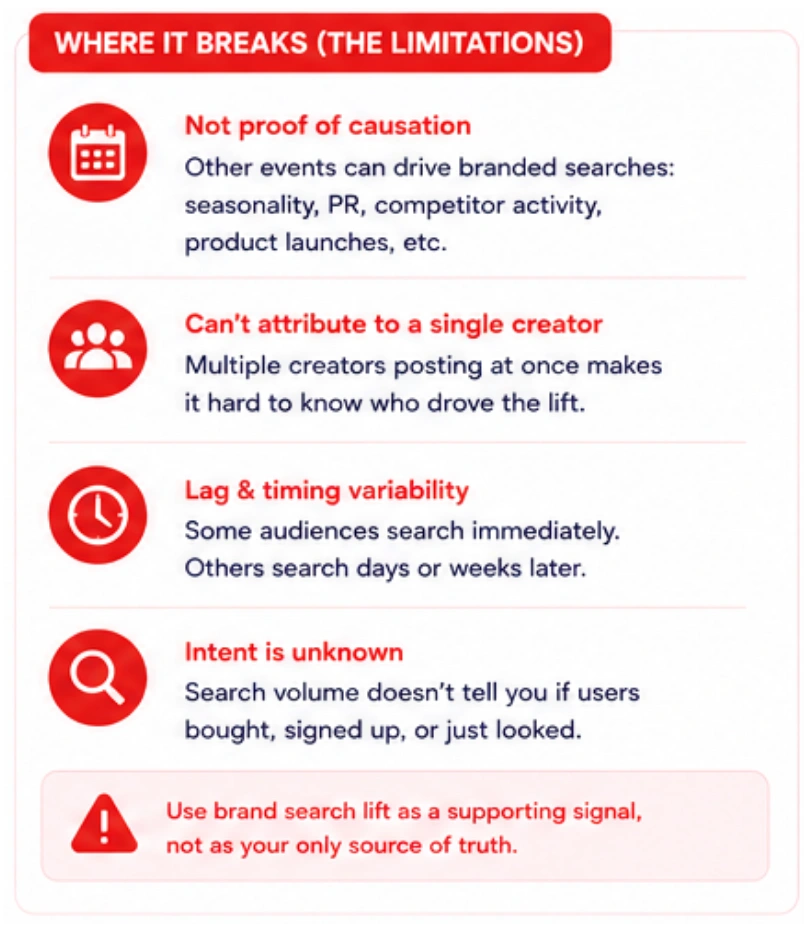
Where it breaks: It's a strong signal for awareness-driving content but a weak one on its own for proving causation — other things move branded search too (seasonality, a separate PR mention, a competitor's campaign pushing people to compare). It also can't tell you which specific creator, among several posting the same week, drove the spike, unless you stagger posting deliberately. Used alongside the other methods here, though, it's one of the only ways to catch the no-click, no-code, "saw it and remembered it later" customer that every other method misses by design.
The attribution models: how credit actually gets split
Once you've decided what to track, you still have to decide how to split credit across touchpoints. These are the standard models teams reach for, roughly in order of complexity.
Single-touch models
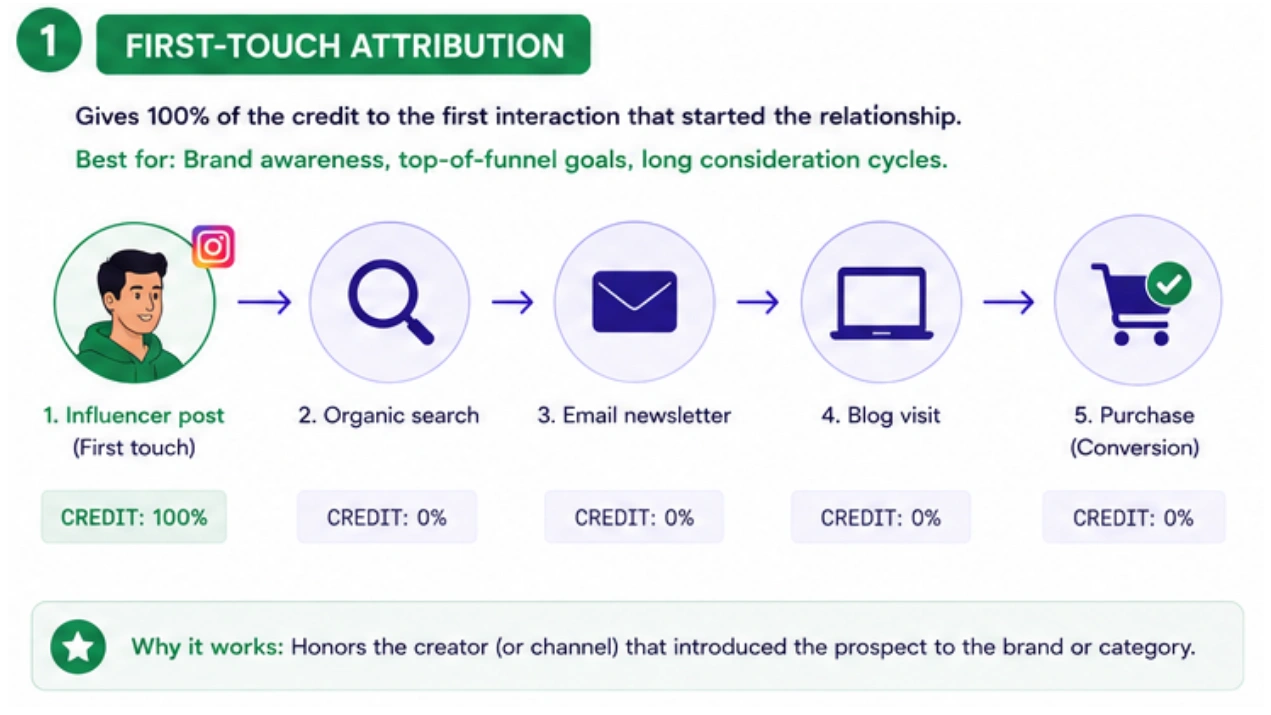
First-touch gives 100% of the credit to whichever interaction started the relationship. It's the natural choice for brand-awareness and top-of-funnel goals, and it's the model Meltwater recommends defaulting to for B2B, since a creator that introduces a prospect to a category often deserves more credit than the demo request three months later. Its weakness is obvious: it ignores everything that happened after the first touch, so you can't see what actually nurtured the customer toward buying.
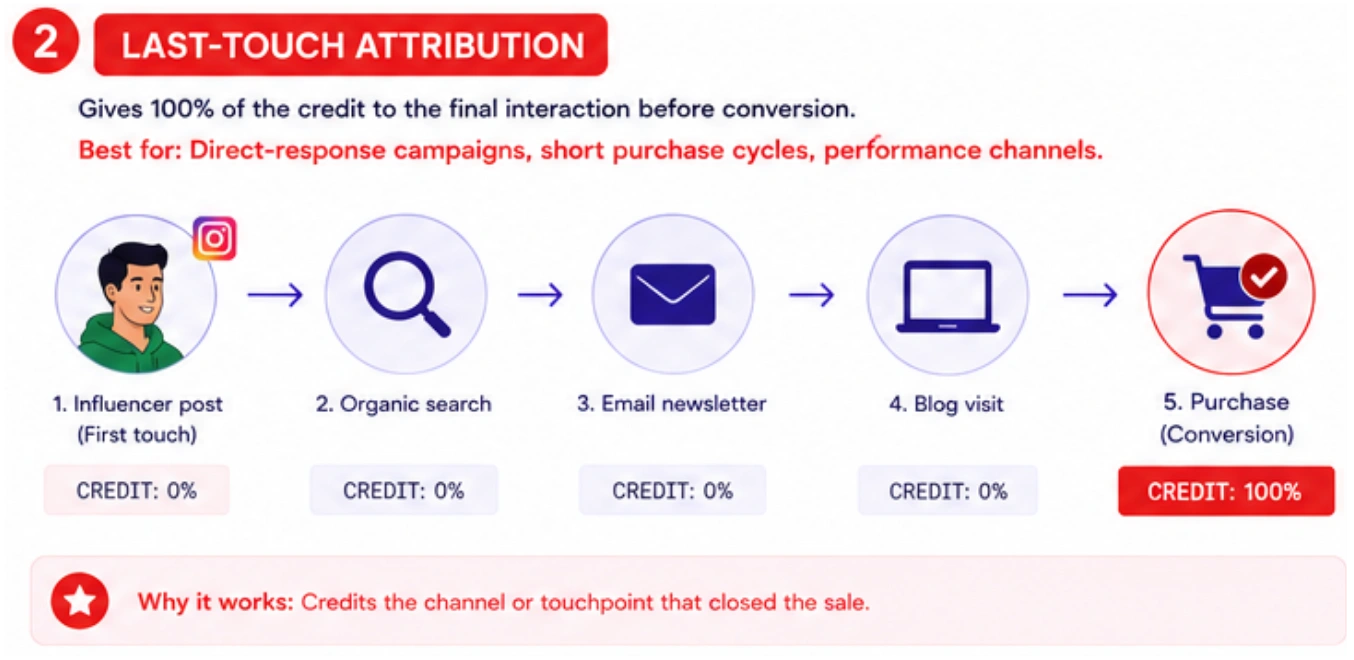
Last-touch gives 100% of the credit to the final interaction before conversion. It's simple, it's what most e-commerce platforms report by default, and it's the model most likely to make influencer marketing look like it isn't working — because creators are so often mid-funnel or top-of-funnel, not the final click.
Multi-touch attribution (MTA)
Multi-touch spreads credit across the whole journey instead of picking a winner:
- Linear splits credit evenly across every touchpoint. It's an easy first step past single-touch, but it treats a five-second impression the same as a fifteen-minute product review, which usually isn't true.
- Time-decay gives more weight to touchpoints closer to conversion while still crediting earlier ones. It fits longer sales cycles reasonably well, since it doesn't zero out the creator who started things three weeks ago, but it does discount them relative to whatever happened right before purchase.
- U-shaped (position-based) gives most of the credit to the first and last touchpoints, with the remainder split across the middle. It's intuitive because it explicitly values both "introduced the customer" and "closed the sale," which are genuinely the two moments most businesses care about most.
- Algorithmic / data-driven attribution uses a statistical model — typically a Markov chain or gradient-boosted model — trained on your own conversion paths to assign credit based on which touchpoints actually correlate with conversion, rather than a fixed rule. This is what most modern paid attribution platforms (covered in the tools section below) run under the hood. It requires meaningfully more path-level data to train on than the rule-based models above, and it's only as good as the tracking feeding it — garbage UTMs in, garbage attribution out.
The general framing across every credible source here — Meltwater, the InfluenceFlow guide on attribution best practices, and multiple practitioners on LinkedIn — agrees multi-touch is more accurate than single-touch for influencer specifically, because creators rarely sit at the very start or very end of a purchase journey. Worth flagging: InfluenceFlow's guide cites several precise-sounding statistics (78% of brands tracking ROI via attribution systems, a 23% accuracy gain from algorithmic over rule-based models, a 34% improvement from first-party data) without linking to the underlying studies. Those numbers read as directional claims from a vendor content site rather than verified research, so use the taxonomy from that piece, not the percentages.
Self-reported attribution as its own model
Some teams don't try to reconstruct the digital journey at all and instead ask the customer directly, treating the survey response as the attribution model rather than a supplementary signal. This is most common in B2B, where 6sense's research (cited via a B2B attribution software roundup) found buyers often don't contact a vendor until roughly two-thirds of the way through their own research process — meaning most of the influence already happened in a "dark funnel" no pixel will ever see. Will Taylor, a B2B GTM operator, described building this into sales process itself: coaching reps to ask "who sent you our way?" on calls, using an open-text field instead of a channel dropdown on intake forms, then tagging the resulting contacts in the CRM with a campaign code. It's less precise than a click log, but for a channel where most influence is invisible to tracking anyway, an honest self-report often beats a confident-looking but wrong pixel-based number.
Brand lift studies
Distinct from brand search lift, a brand lift study surveys exposed versus unexposed audiences directly — "before and after seeing this, how likely are you to buy this brand?" — to isolate a shift in awareness, consideration, or purchase intent that doesn't necessarily show up in a sales report at all. Platform-native versions (Meta Brand Lift, TikTok's equivalent) are the cheapest way to run one if you're amplifying creator content with paid spend behind it. This measures a real and different thing than sales attribution: a creator can drive strong brand lift and weak immediate sales, or the reverse, and conflating the two — as the Meltwater and InfluenceFlow guides both note — leads to under- or over-valuing a partnership based on the wrong metric.
Incrementality testing (holdout tests)
Incrementality asks a sharper question than any attribution model can: how many of these conversions would have happened anyway, without the campaign? The standard method is a holdout test — hold out a randomly selected geography, audience segment, or time window from exposure, and compare its conversion rate against the exposed group. A geographic holdout is the version most teams can run without specialized software: pick two sets of markets with comparable pre-campaign branded search or sales volume, run the campaign in one set, hold the other back, and the delta (adjusted for seasonality) is your incremental lift. One practitioner writeup on this method flagged three specific failure modes worth taking seriously: contaminating the control group by simultaneously running paid social with the same creator's content, ignoring spillover when a creator's organic reach crosses your supposed geographic boundary, and conflating a brand-lift result with a sales-lift result when they're genuinely different experiments measuring different things.
Marketing Mix Modeling (MMM)
MMM works completely differently from every method above: instead of tracking individual users or clicks, it uses aggregate, historical spend and revenue data (typically weekly, by channel) to statistically estimate each channel's contribution to outcomes. Because it needs no cookies, device IDs, or click-level data, it's become the answer of choice as privacy restrictions have eroded click-based tracking — Safari's Intelligent Tracking Prevention and iOS App Tracking Transparency alone are estimated to have cut multi-touch attribution's identity coverage from over 90% down to somewhere between 30–60%, depending on the source. What changed in 2026 specifically isn't the underlying statistics, which date back to the 1960s — it's access. Google open-sourced its Meridian framework, Meta maintains Robyn, and PyMC Labs ships PyMC-Marketing, and together these three free libraries have removed the six-figure consulting price tag that used to gate MMM to enterprise budgets. Any team with roughly two years of weekly spend and revenue data can now build a model in-house, though "can" and "should without a data science resource" are different questions — Meridian and PyMC-Marketing in particular still require real statistical expertise to build and maintain correctly.
For a channel as specific as influencer, MMM is best used to answer a portfolio-level question ("how much of our growth this quarter came from creator spend as a category, relative to paid and organic") rather than a creator-level one ("did this specific $3,000 LinkedIn post work") — it's the wrong tool for that granularity and the right one for the budget conversation with finance.
Cohort and LTV-based attribution
For subscription and recurring-revenue businesses, crediting a creator for one purchase understates their real value if that customer stays subscribed for a year. LTV-based attribution connects the initial acquisition to every subsequent renewal, upsell, or repeat purchase, and evaluates creator performance against lifetime value rather than first-order revenue. This matters more than it might seem: a creator who brings in fewer, higher-retention customers can easily outperform one who brings in more one-time buyers, and a first-purchase-only view would rank them backwards.
Emerging and vendor-specific approaches (read with caution)
A few genuinely interesting approaches surfaced in the research for this guide that are worth knowing about, with the caveat that each comes from the vendor or practitioner who built it, not from independent verification:
- A Reddit commenter who described their background as a statistics PhD proposed a causal, MMM-adjacent model using only aggregated exposure data (impressions or spend) to estimate the direct and indirect effect of each channel, positioning it as a middle ground between full MMM and per-click attribution. It's a real methodological approach (causal inference on aggregated data is standard in econometrics), but the specific open-source tool they were describing is theirs, so treat performance claims about it as unverified.
- Kevin Brown's FanCircles pitches a closed-loop alternative built on Apple/Google Wallet passes: a QR code or link adds a branded pass to the viewer's phone wallet instead of asking for a click-to-buy, and the brand can then push notifications to everyone who joined, which he argues solves the TV-viewing blind spot since the same low-friction call to action works whether someone's watching on a phone or a television. This is a single vendor's account of their own product's results, not an independently benchmarked comparison — worth knowing the mechanism exists, but not a substitute for evaluating it yourself.
- A separate Reddit thread from the founder of a company called CreatorScore described a six-layer stack (tracking links, server-side site tracking, post-purchase surveys, brand search lift, cross-device matching, and multi-touch credit-splitting) as their product's approach. It's a reasonable checklist of the methods covered individually above, but it's also a founder describing their own product on a forum, and one commenter — who said they'd led product at a 500-million-user consumer platform — pushed back point by point, noting that click-based tracking only ever captures a fraction of true influence, survey response rates are partial data at best, and isolating creator spend from ads, search, and marketplace data in isolation "only tries to justify creator spend" rather than showing the whole picture. That pushback is worth taking as seriously as the pitch.
Comparing the methods and models
A decision framework: which approach fits your situation
There's no universal "right" model. The right starting point depends on three things: your industry's purchase pattern, your campaign's scale, and which platforms your creators actually post on.
By industry
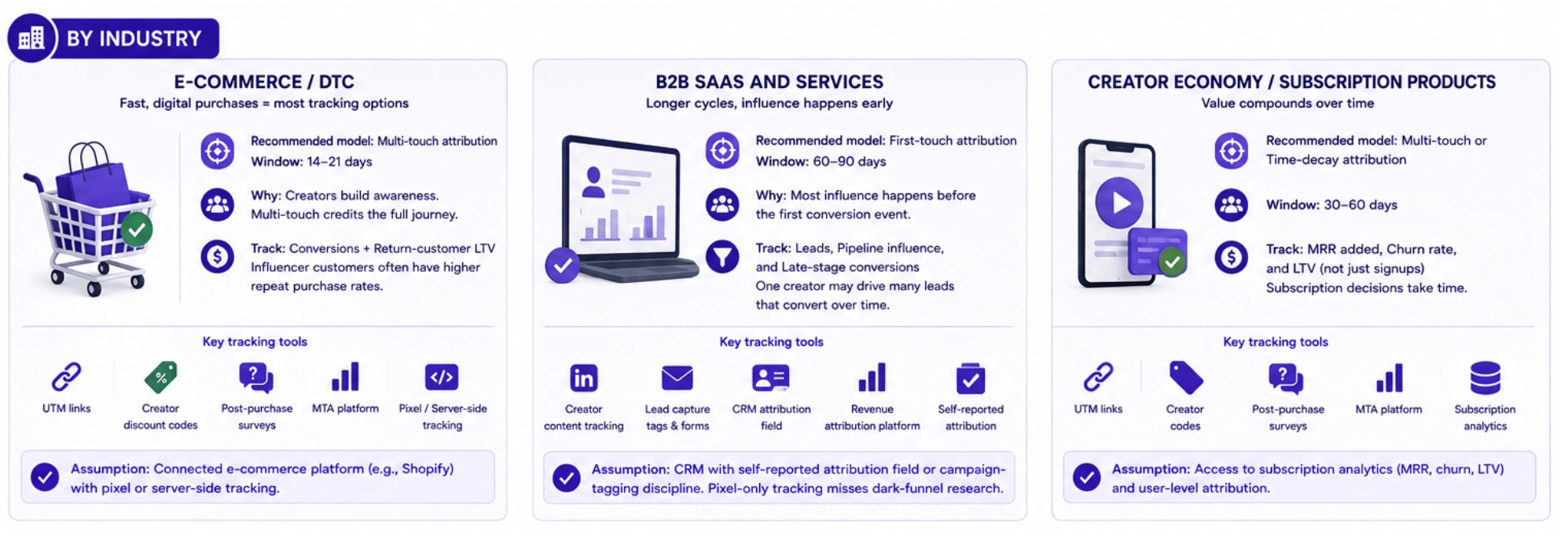
E-commerce / DTC. Purchases are fast and digital, so you have the most tracking options available. Multi-touch attribution with a 14–21 day window is the standard recommendation across every source reviewed for this guide, because creators here usually build awareness rather than close the sale directly. Layer in return-customer LTV tracking, since influencer-acquired customers in this category frequently have above-average repeat purchase rates. Assumption: you need a connected e-commerce platform (Shopify or similar) with pixel or server-side tracking as a baseline before any paid attribution tool adds value.
B2B SaaS and services. Sales cycles run weeks to months, and most of the influence happens before a prospect ever fills out a form — which is why first-touch attribution and long windows (60–90 days) tend to work better here than last-touch. Track leads and pipeline influence, not just closed deals, since a single creator might drive twenty leads that convert to five customers over a full quarter. The Favikon guide to B2B key performance indicators and how to set clear goals and KPIs for influencer campaigns both go deeper on choosing lead-stage metrics over vanity ones. Assumption: you need a CRM with a self-reported attribution field or campaign-tagging discipline, because pixel-based tracking alone will systematically miss the dark-funnel research phase that dominates B2B buying. The ultimate guide to B2B influencer marketing and best channels for B2B influencer marketing are useful starting points if you're still building out the program this attribution stack needs to measure.
Creator economy / subscription products. Value compounds over time, so a first-purchase or first-signup view understates real impact. Track MRR added, not one-time conversions, and use longer attribution windows (30–60 days) since subscription decisions take longer than impulse purchases.
By campaign size
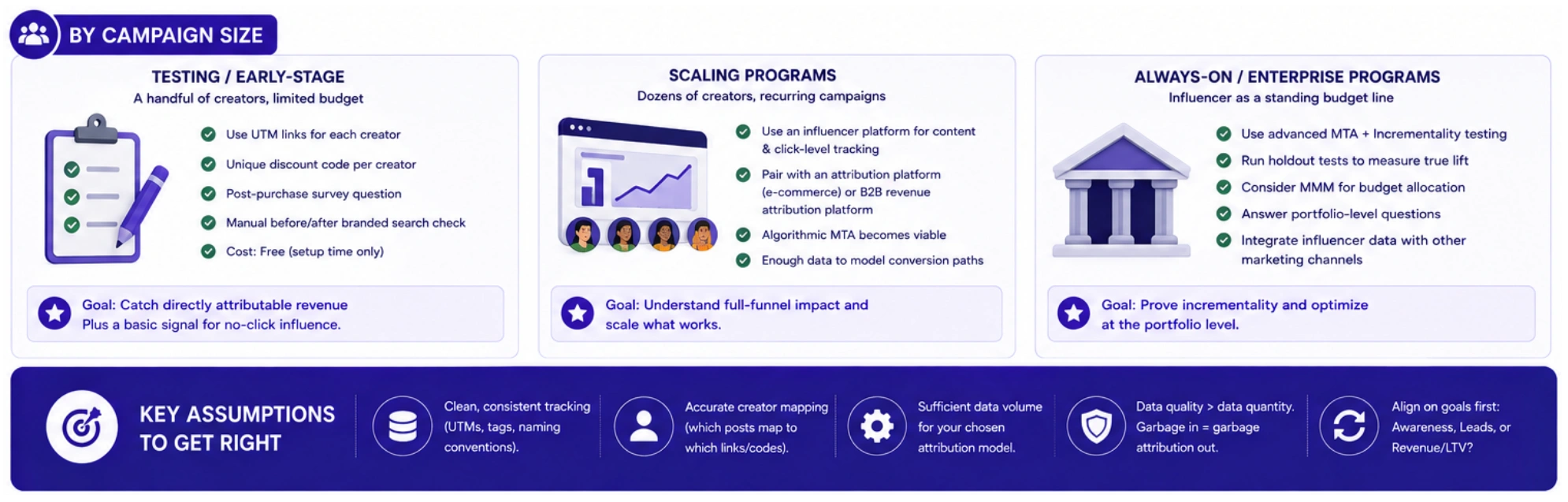
Testing / early-stage (a handful of creators, limited budget). Don't buy a platform. Use UTM links, a shared discount code per creator, and a simple post-purchase survey question. This costs nothing beyond setup time and catches the majority of directly attributable revenue. Add a manual before/after check on branded search volume — covered in detail in the next section — as your only concession to catching what links and codes miss.
Scaling programs (dozens of creators, recurring campaigns). This is where a dedicated influencer platform earns its keep for content and click-level tracking, paired with either a mid-market attribution tool (for e-commerce) or a B2B revenue attribution platform (for longer sales cycles). Algorithmic MTA becomes viable here because you finally have enough conversion paths to train a model on.
Always-on / enterprise programs (influencer as a standing budget line, not a campaign). This is the point where incrementality testing and MMM start paying for themselves — you have the volume to run a statistically valid holdout, and finance is asking portfolio-level budget-allocation questions that click-level attribution structurally can't answer.
By platform
Platforms with strong native link support (YouTube description links, Instagram Stories/bio links, blog and newsletter placements) are the easiest to track with UTMs and should default to that. Platforms with weak or no link support in the format being used — TikTok and YouTube Shorts without a shoppable integration, anything watched on a connected TV, most LinkedIn organic posts — need to lean harder on promo codes, brand search lift, and self-reported attribution, because the click simply isn't available as a data point no matter how good your tooling is.
How smaller companies measure lift without a full attribution stack
Not every team running influencer campaigns has the volume, budget, or data science support that incrementality testing or MMM require. The good news: you can still get a directionally reliable read on lift with tools you probably already have.
The simplest version, pulled together from the practitioner sources above, looks like this each month you run a campaign:
- Track branded search volume in Search Console (or Semrush/Ahrefs) for the campaign window and the four weeks before it. A visible spike right after content goes live, that doesn't correspond to any other marketing push, is your best free signal for the no-click conversions everything else misses.
- Compare revenue or signups for the campaign period against a recent comparable period without influencer activity — a rough version of "campaign flighting," where you deliberately run creator spend some weeks and pause it others, specifically so you have a clean before/after to compare. This isn't a statistically rigorous holdout test, but it's far more informative than a single point-in-time number.
- Add one question to your post-purchase flow or a follow-up email — "how did you hear about us," with specific creator or campaign names as options — and treat the response rate honestly rather than assuming it's comprehensive.
- Layer in whatever code or link data you do have, understanding it's a floor on attributable revenue, not a ceiling.
None of these four steps requires a paid attribution platform. Run them together every month you're active, and you'll catch most of what a small program needs: whether the campaign is working at all, and roughly how much of the lift is directly traceable versus likely-but-unproven. Favikon's guide to measuring influencer marketing and the benchmark report on 2025 engagement data are useful references for knowing what "normal" looks like before you try to isolate lift on top of it.
Tools that actually help prove influencer ROI
Tools split cleanly by what job they're doing. Here's where each category earns its keep, and where it doesn't.
Free and DIY stack
GA4, a UTM builder (or a free tool like Bitly for link shortening), and a spreadsheet cover the baseline for any program, regardless of size. GA4's built-in attribution is limited and last-click by default, but it's free, and for a small program it's often sufficient combined with the manual lift-checking steps above. Post-purchase survey tools like Fairing or a simple Typeform embed handle the self-reported layer without needing a dedicated attribution platform.
Influencer platform native tracking
Favikon, Modash, GRIN, CreatorIQ, Upfluence, and Traackr are built primarily for finding, vetting, and managing creator relationships, and secondarily for tracking content performance. Use these for what they're strongest at: campaign-level hashtag/mention/keyword tracking, engagement benchmarking, and (where connected) a GA4-fed view of clicks and on-site behavior per creator. Favikon's performance tracking and influencer tracking features, plus Reports and Campaigns for building the analysis out, sit in this category. Don't expect these platforms to solve multi-touch or incrementality on their own — that's not the layer they operate at, and any platform claiming otherwise is overstating what click-level tracking can do.
Affiliate and promo-code infrastructure
GoAffPro, Impact.com, PartnerStack, and Refersion handle unique codes and affiliate links at scale, typically with configurable cookie windows (14, 21, or 30 days is standard) so a click that doesn't convert immediately still gets credited on a return visit. This is the right layer if commission-based or hybrid compensation (a structure several practitioners described combining a base rate with ongoing commission and sometimes a content-licensing fee for reuse as ads) is part of how you pay creators, since the payment and the attribution data live in the same system.
E-commerce / DTC attribution and MTA platforms
This category exploded after iOS 14.5's App Tracking Transparency rollout broke pixel-based tracking for most DTC brands. Triple Whale (roughly free–$500+/month depending on tier) leans on pixel-based multi-touch attribution and is the easiest to set up for a Shopify-first team, though its attribution is MTA, not incrementality — it shows which channels touched the path, not which ones caused the conversion. Northbeam (from roughly $1,000/month) runs a hybrid of MTA and media mix modeling with more cross-channel path detail, at the cost of a heavier implementation. Rockerbox (enterprise pricing, often $2,000+/month) is built for brands with offline channels alongside digital, and adds managed incrementality testing. Wicked Reports (around $499/month) is worth a specific look if your influencer-acquired customers have meaningfully different repeat-purchase behavior, since it's built around LTV and cohort analysis rather than first-purchase attribution. Cometly (roughly $199–500/month) and Hyros are mid-range options that specifically emphasize server-side tracking resilient to ad blockers — a Reddit commenter mentioned using Cometly specifically to connect first-touch influencer exposure through to actual revenue, which lines up with how the tool positions itself independently. Treat all of these price points as directional; enterprise tiers in particular are typically quote-based and vary with ad spend volume.
B2B revenue attribution
Dreamdata (free tier available, paid plans from roughly $750/month) is purpose-built for account-level B2B attribution, mapping the full journey from anonymous first visit through closed-won deal, and is the strongest standalone option if revenue attribution is the core problem you're solving. HockeyStack (quote-based, no free tier, roughly $1,000+/month) positions attribution as one layer of a broader GTM intelligence platform and is a stronger fit if you're also trying to unify product usage data (useful for product-led-growth motions) alongside marketing touches. Windsor.ai (around $249/month) is a budget-friendly way to centralize data across sources and apply algorithmic (Markov chain) modeling yourself. Ruler Analytics is worth a specific mention if a meaningful share of your B2B conversions happen over the phone or through a form rather than online checkout, since it's built around connecting those offline conversion types back to marketing source. Whichever platform you pick, pair it with the self-reported CRM field described earlier — every source covering B2B attribution in 2026 agrees that software alone can't see the dark-funnel research phase that dominates B2B buying.
Marketing mix modeling and incrementality
Google's Meridian and Meta's Robyn are both free, open-source, and production-grade, which has genuinely changed who can access MMM — what used to be a six-figure consulting engagement is now something a team with two years of clean spend and revenue data can run in-house, provided someone on the team has the statistical background to build and validate the model correctly. PyMC-Marketing is the Python-native option for teams wanting more custom control over the Bayesian model underneath. If you'd rather not build and maintain this yourselves, Measured and Recast package MMM plus managed incrementality testing as a service, aimed at brands with enough spend across enough channels to justify it. None of these tools are the right starting point for a program running fewer than a handful of creators — they're built to answer channel-portfolio questions, not single-campaign ones.
Vendor-specific and emerging approaches
Tools like FanCircles' PushPass (wallet-pass-based tracking) and CreatorScore (a layered tracking-plus-survey stack aimed specifically at creator marketing) represent newer attempts to solve the no-click and dark-funnel problems directly, rather than working around them with better modeling. Both are worth knowing about, and both are best evaluated with your own pilot data rather than taken at the vendor's word — which, as covered above, is exactly the pushback one experienced product leader gave in response to a similar pitch on Reddit.
The takeaway
No single tracking method or attribution model gives you the full picture, and anyone telling you they've "finally solved" attribution with one tool is oversimplifying a genuinely hard measurement problem. What's changed in 2026 isn't that any one method got dramatically better — it's that the full toolkit (UTMs, codes, surveys, brand search lift, MTA, incrementality, and now genuinely accessible MMM) is cheap and available enough that most teams can layer several of them together instead of betting everything on one number.
Start with what your industry and platform mix actually require: multi-touch and LTV tracking for e-commerce, first-touch and self-reported attribution for B2B, cohort tracking for subscription products. Add incrementality testing and MMM once you have the volume to make them worthwhile, and until then, run the four-step lift check every month you're active. That combination won't give you a single perfect number, but it will consistently tell you the truth this whole conversation started with: whether the creator actually drove that sale, or whether Google just got there first.
If you're still building out the program this measurement stack needs to track, the ultimate guide to B2B influencer marketing and Favikon's platform are good next stops — including free calculators for EMV, CPM, and influencer pricing that pair well with whichever attribution approach you land on.
Others articles