The Best Creator Discovery Platforms in 2026
Looking for the best creator discovery platforms in 2026? This guide compares eight tools for finding influencers, checking audience data, and choosing the right creators for your campaigns.

You've spent two hours searching hashtags, opened seventeen tabs, and ended up with a shortlist full of creators your competitors are probably already working with. That's not a discovery problem, but a tooling problem.
The best creator discovery platforms fix that by putting tens of millions of indexed profiles behind a search bar, with filters for audience demographics, engagement quality, and authenticity scoring already built in. They find and vet creators.
What they don't automatically do is run your campaigns, draft your contracts, or pay your partners. Some blur that line by adding full campaign management on top of discovery, and that's worth knowing before you start comparing pricing.
This guide covers eight platforms in detail: who each one is built for, what they actually charge, and where each one falls short.
TL;DR: Best Creator Discovery Platforms
What Is a Creator Discovery Platform?
A creator discovery platform is a search engine for creators. You describe what you need, for example, a niche, a location, an audience demographic, or a content style. The platform surfaces matching profiles from a database of millions of indexed social accounts. Audience data, engagement metrics, and authenticity scores come with every result, so you can vet before you reach out.
The database is the core of it. Most platforms index public social profiles automatically without requiring creators to sign up, so you can find and vet anyone without waiting for them to register. Marketplace-based tools work differently, because they only surface creators who opted in and applied to campaigns, which caps the pool.
Creator discovery platforms differ from full influencer marketing platforms in scope. A discovery platform finds and vets creators. A full platform adds outreach, campaign management, content approval, and payments on top. Favikon covers both discovery and campaign tracking, which is why the category label matters less than knowing which parts of the workflow are included in the plan you're buying.
What Changed in Creator Discovery for 2026
Database sizes grew in 2026, but that's not the real story. The bigger shift is that three things buyers used to pay extra for are now expected on every platform: AI natural-language search, fraud detection on every profile, and e-commerce attribution that ties a creator's post to an actual sale.
One gap still hasn't closed. Most tools have limited coverage of LinkedIn and professional networks, and that's a hard ceiling for teams whose buyers live on those platforms instead of Instagram
Here's how each of those shifts plays out when you're evaluating a platform:
- AI natural-language and visual search: Typing a simple prompt like "female fitness creators on TikTok with an engaged 25-to-35 audience in the US" now returns usable results on most major platforms, without filter stacking. Some tools (Favikon, Modash, Upfluence) have extended this to image-based search, where you upload a reference creator and the platform finds similar profiles by aesthetic and content style.
- Fraud detection as a baseline expectation: Audience Quality Scores and fake follower detection, once HypeAuditor's defining edge, now appear across nearly every platform in this list. The differentiation has shifted to depth: surface-level flagging of suspicious follower counts versus deep analysis of comment authenticity, engagement patterns, and audience credibility signals at the profile level.
- First-party e-commerce attribution: The platforms winning DTC and Shopify customers are the ones that close the loop between a creator's post and an actual order, not just a click. Tools like Modash, GRIN, and Upfluence now pull Shopify data directly, tying discount codes and affiliate links back to individual creators and campaigns in one place.
- The LinkedIn and professional network gap: Most creator discovery tools were built for consumer brands first and have never properly indexed LinkedIn or professional networks. For teams whose buyers live on those platforms, that's a real limitation. Favikon is the only platform in this category with meaningful LinkedIn and Substack coverage alongside the standard consumer social stack.
How We Chose These Creator Discovery Platforms
We looked at more than a dozen platforms and narrowed the list to eight based on four criteria applied consistently across every tool.
- Database size and channel coverage: How many profiles are indexed, which social channels are included, and whether LinkedIn and B2B channels are genuinely covered or just listed.
- Search method: Whether the platform relies on keyword filters, AI natural-language search, content-based search, or some combination of the three, and how accurate the results actually are.
- Fraud and authenticity detection: Whether audience quality scoring is built into every profile or locked behind a higher tier, and how deep the analysis goes beyond follower count.
- Pricing transparency: Whether pricing is published, demo-gated, or custom-quoted, and what the base plan actually includes before you hit an upsell.
The eight tools that made the list each solve a distinct problem well enough to recommend to a specific kind of team.
1. Favikon
What is it? Favikon indexes 10M+ creator profiles across 9 channels, including LinkedIn and Substack, with an Authority Score and Authenticity Score on every single profile. It's the right fit for teams who can't afford blind spots in their creator shortlists and want discovery, outreach, and campaign tracking without switching tools.
Best for: Marketing teams and agencies that need creator coverage across multiple channels from one platform, not just Instagram and TikTok.
Why I Picked It: Favikon is built around multi-platform discovery from the start, not as an afterthought. While most tools excel on Instagram and TikTok, Favikon covers nine channels including LinkedIn and Substack, which matters if your creators or buyers live beyond the big three social platforms. The AI search works equally across all channels, not just consumer platforms.

Features
- AI creator and content search across 9 channels, so you're not running a separate search process for LinkedIn creators and another for Instagram.
- Authority Score and Authenticity Score on every profile, which means vetting happens the moment you find someone, not after you've already reached out.
- Campaign management with Kanban and calendar views, so shortlisting, outreach, and campaign status live in one workflow instead of three separate tools.
- Conversion tracking and creator rankings across 600+ niche categories, giving you a starting shortlist before you've run a single search of your own.
- Competitor Radar to see which creators rival brands are already working with so you're not guessing who's already proven in your category.
Limitations
- Aggregated, not opt-in, so contact details can go stale between searches. Refresh a creator's info before a large outreach push rather than assuming it's current.
- No in-platform creator payments yet, which means payouts still route through a separate tool or process.
- Shallower Shopify integration than GRIN or Modash, so high-volume DTC product seeding is a weaker fit here than on those platforms.
Pricing
Core starts at $199/month, or $159/month billed annually. Pro is $299/month, or $239/month billed annually. Enterprise is custom, with usage-based credits instead of per-seat pricing.
Start a free 7-day trial on Favikon →
2. GRIN
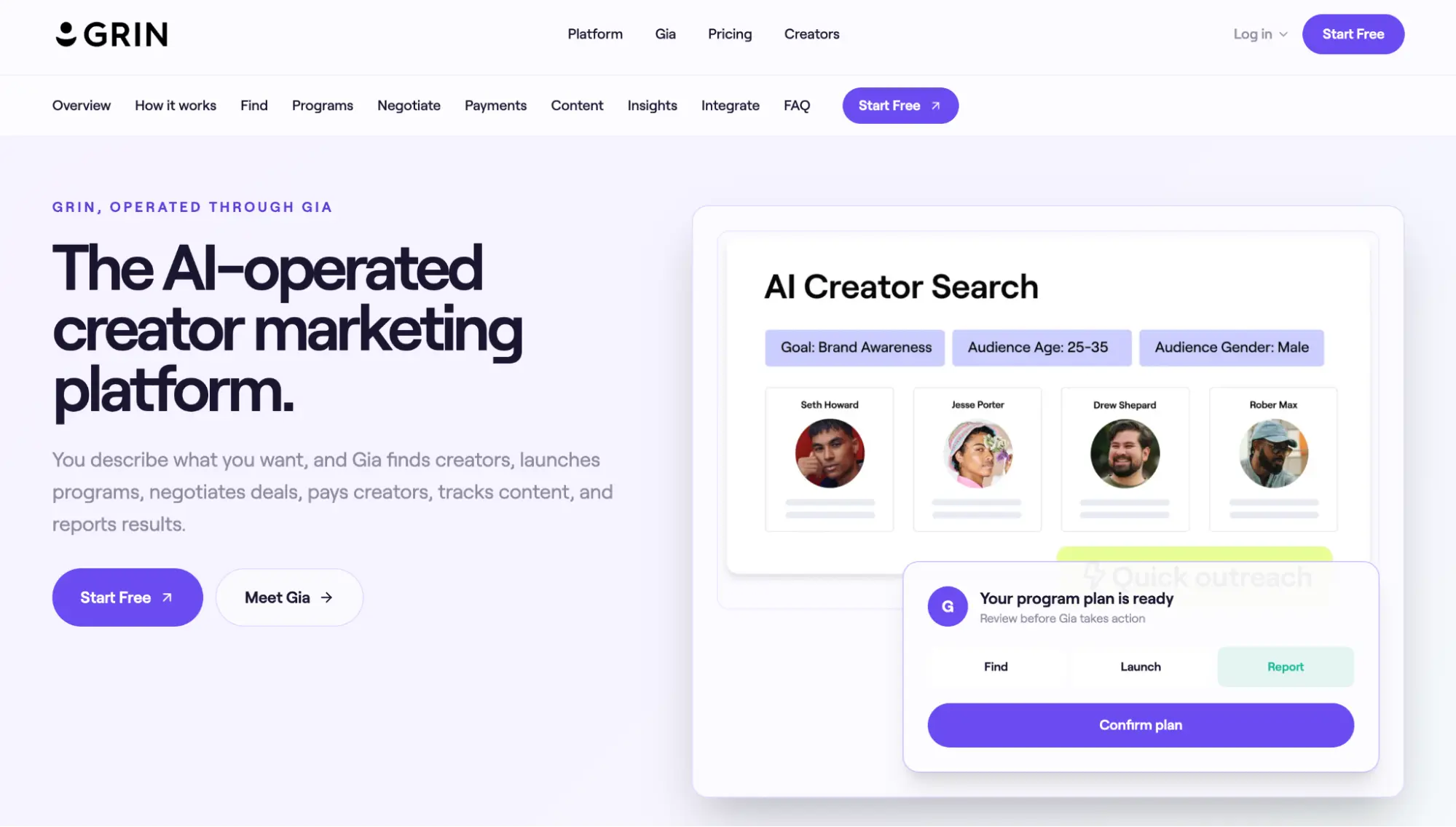
What is it? GRIN connects your Shopify store directly to your creator program, automating gifting, shipping, affiliate links, and creator payments inside one platform. Gia, GRIN's AI assistant, handles creator matching and outreach on a usage-based credit system. If your main goal is tracking which creator actually drove which sale down to the SKU level, that's where it earns its price tag.
Best for: DTC and e-commerce brands running product seeding and affiliate programs at scale, particularly on Shopify.
Why I Picked It: The usage-based credit model is what sold me. Every other DTC tool charges by active creators, which punishes you for scaling. GRIN charges for what you actually use. For brands running hundreds of gifting relationships at once, that pricing structure alone changes the math on whether the platform makes sense.
Features
- Automated creator payments and 1099 processing, so payouts and tax paperwork don't become a separate admin project every quarter.
- Affiliate link and discount code generation tied to individual creators, making it possible to trace a specific sale back to the creator who drove it.
- Content management and rights management built into the campaign workflow, so approved content is cleared to reuse without a separate legal check.
- Gia AI for creator matching, scored across 180 attributes using real brand-creator transaction data, which means matches are based on what's actually converted before, not just follower stats.
- Native Shopify, WooCommerce, and Magento integration for automated product seeding and sales attribution, so gifting and revenue tracking run through the same system.
Limitations
- No LinkedIn coverage, and discovery is limited to Instagram, TikTok, and YouTube, so B2B or professional-audience programs need a second tool alongside GRIN.
- Full creator management (GRIN Classic) only unlocks at Growth and above, so a smaller program can end up paying $500/month before it's proven the channel works.
Pricing
Free plan available at $0/month with 200 monthly Gia credits. Paid plans start at Starter at $200/month, Growth at $500/month, Scale at $1,000/month, and Complete at $1,500/month. Growth and above include GRIN Classic with active creator limits scaling from 100 to 500.
3. Modash
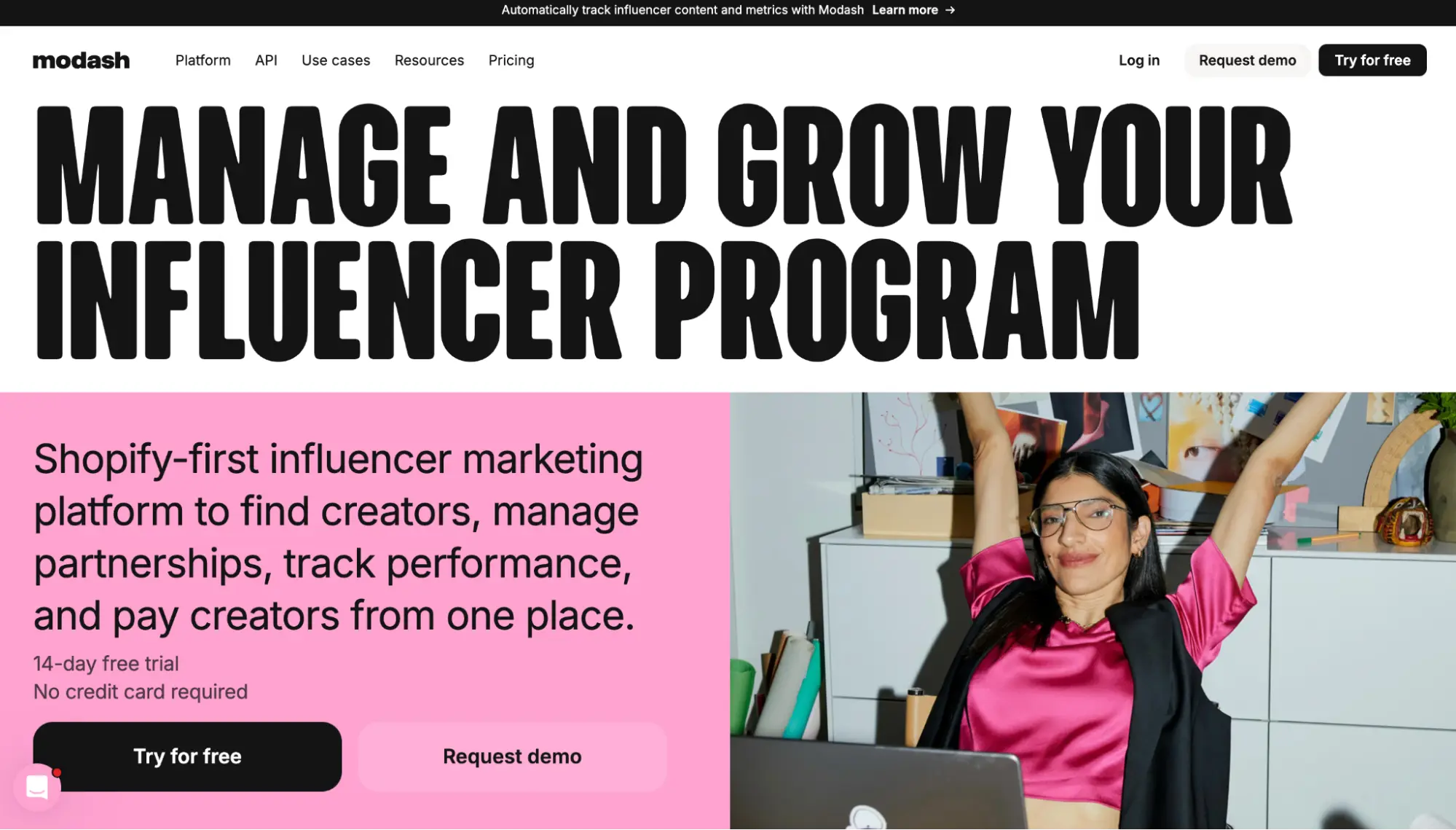
What is it? Modash covers 250M+ public profiles across Instagram, TikTok, and YouTube, with no creator opt-in required, meaning you can find and vet anyone before you reach out. The Shopify integration is one of the tighter ones in this category, handling discount codes, product gifting, affiliate attribution, and creator payments in a single connected workflow.
Best for: In-house teams at consumer brands on Shopify who want to run gifting, affiliates, and paid partnerships without stitching multiple tools together.
Why I Picked It: Every team I've seen struggle with an overcomplicated platform eventually asks the same question: can I just search for a creator and see their numbers? Modash answers that faster than anything else here. You don’t need to hop on any onboarding calls or configure an AI agent. You're in the data in under ten minutes.
Features
- AI search and 37 advanced filters for discovery and audience vetting, so narrowing 250M+ profiles down to a working shortlist doesn't take all afternoon.
- Shopify integration for product gifting, discount codes, and sales attribution, tying every gifted product back to whether it actually generated a sale.
- Automatic content and performance tracking without requiring creator sign-up, so you're not waiting on a creator to log in before you see how a post performed.
- Automated affiliate management with commission tracking and creator payouts, keeping the financial side of the program out of a separate spreadsheet.
- 250M+ public creator profiles across Instagram, TikTok, and YouTube, giving niche searches a real pool to draw from instead of the same handful of names.
Limitations
- Coverage limited to Instagram, TikTok, and YouTube, so teams whose buyers are on LinkedIn or other channels will hit a wall here.
- Searches by platform account rather than a unified creator profile, so a creator active on two platforms shows up as two separate records that need manual deduplication.
Pricing
Essentials is $199/month billed annually ($299/month on monthly billing). Performance is $499/month billed annually ($599/month on monthly billing). Enterprise starts at $14,700/year, with usage-based credits available. 14-day free trial, no credit card required.
4. HypeAuditor
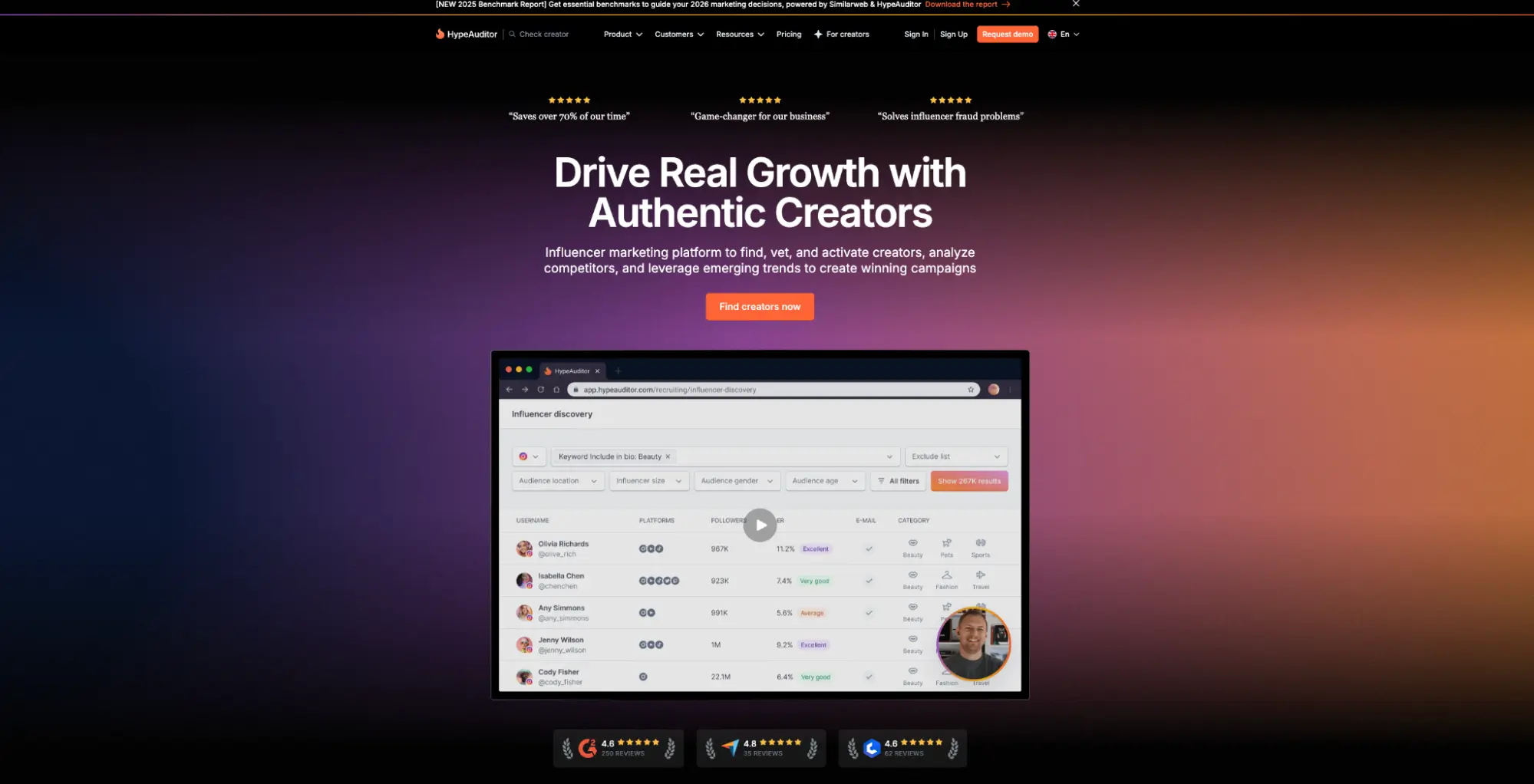
What is it? HypeAuditor built its reputation on the Audience Quality Score, a fraud detection metric that goes deeper than follower count by analyzing audience authenticity, engagement patterns, and comment quality across 35+ metrics. It covers 5 platforms (Instagram, TikTok, YouTube, X, and Twitch) across a database of 227.3M+ profiles.
Best for: Brands and agencies where audience quality and fraud detection are the primary vetting criteria, particularly on Instagram and TikTok.
Why I Picked It: I included it because the free entry point is genuinely useful before you spend a dollar. Run a few profile reports, see how their AQS holds up against creators you already know. Most platforms make you commit before you can verify anything. HypeAuditor lets you test the core before you talk to sales.
Features
- 227.3M+ creator profiles across Instagram, TikTok, YouTube, X, and Twitch, giving you a large enough pool to vet against even for niche categories.
- Audience Quality Score and 35+ per-profile metrics for fraud detection, catching bought followers and engagement pods that a simple follower count would miss entirely.
- Market analysis and competitor benchmarking tools built into the platform, so you can see how a creator's audience compares to category peers before committing budget.
- Campaign management with outreach, tracking, and PayPal-based creator payments, covering the basics of running a campaign without leaving the platform.
- Free plan to get started, with demo versions of core features available, so you can test the fraud detection on real profiles before paying anything.
Limitations
- Only 5 platforms covered, with no LinkedIn or other professional-network channels, so this isn't the right fit if your buyer isn't a consumer.
- Creator payments run through PayPal only, adding conversion fees on every payout to an international creator.
- Paid pricing is fully demo-gated, so you can't compare real costs against other tools without booking a sales call first.
Pricing
Free tier available with basic reports. Paid plans are demo-gated with no public pricing listed. Contact HypeAuditor directly to get a quote.
5. CreatorIQ
What is it? CreatorIQ connects directly to social platform APIs rather than scraping public data, which means the audience demographics, fraud signals, and performance metrics it surfaces are more accurate and more current than most tools in this category.
Best for: Fortune 500 brands and global agencies running creator programs across multiple markets, teams, and social platforms simultaneously.
Why I Picked It: I included it knowing most readers won't buy it. But if you're running creator programs across multiple markets with a large team, the API-first data model matters in ways you'll feel every week. Scraped data breaks. First-party data doesn't. At enterprise scale, that reliability gap is worth the price difference.

Features
- Direct social platform API integrations for first-party creator and content data, so the numbers you're reporting up the chain are harder to dispute than scraped alternatives.
- Creator Graph AI, trained on 10+ years of creator, content, and performance data, giving discovery results a depth of historical context most competitors can't match.
- AI-powered creator discovery with brand safety monitoring on every profile and post, catching risk before it becomes a campaign problem rather than after.
- Deep CRM with full partnership history, communications, and performance data in one place, so institutional knowledge about a creator relationship doesn't live in one person's inbox.
- End-to-end campaign management with creator onboarding, content approval, and automated tracking, built for programs running many campaigns in parallel.
Limitations
- Pricing is not published and every deal is demo-gated, so there's no way to gauge cost before entering a sales process.
- Built for teams of 50+ running creator marketing as a business function, so lean teams end up paying for infrastructure and implementation weight they won't fully use.
Pricing
Not published. Demo-gated, annual and often multi-year contracts.
6. Aspire
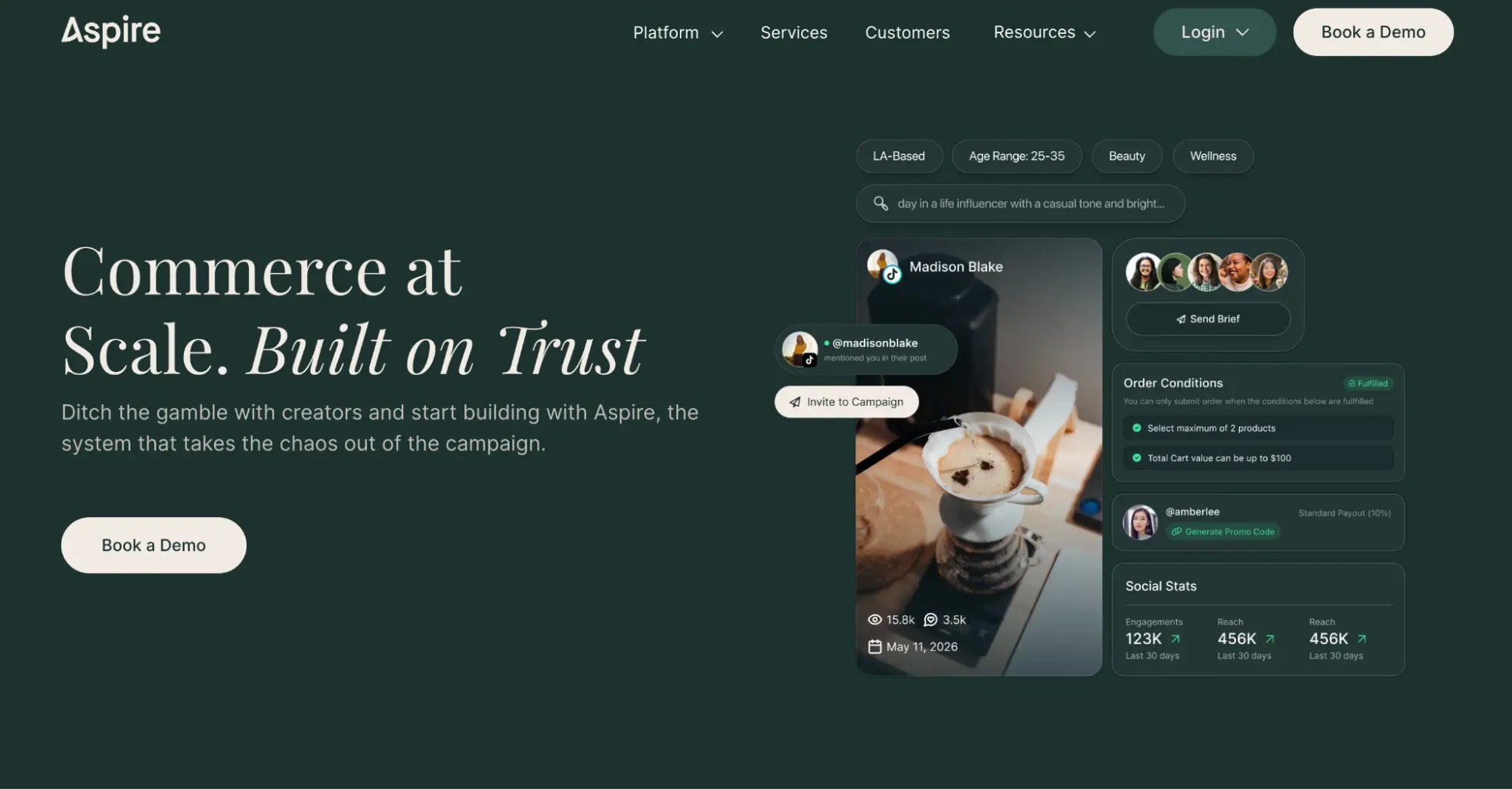
What is it? Aspire runs a two-sided model: you can post campaigns to their Creator Marketplace and have creators apply to you, or go outbound with AI natural language search across Instagram, TikTok, YouTube, Pinterest, and Facebook. The Shopify integration handles product fulfillment, creator storefronts, and click-to-checkout attribution in one connected workflow.
Best for: E-commerce brands that want inbound creator applications from a marketplace alongside outbound search, particularly those running product seeding, ambassador programs, and UGC for paid ads.
Why I Picked It: Aspire became one of my picks because inbound creator applications change the dynamic of the whole program. When a creator applies to your campaign, the brief conversation is different. The content brief lands differently. In my experience, inbound partnerships convert to long-term ambassadors at a higher rate than cold outreach ever does.
Features
- Creator Marketplace with inbound creator applications plus AI outbound search across 5 channels, so you're not choosing between cold outreach and waiting for applicants.
- CreatorAds Suite to boost top-performing creator content directly to Meta paid ads, turning organic wins into paid reach without a separate ad-creative process.
- Shopify integration for product seeding, creator storefronts, and revenue attribution per creator, tying every gifted product to whether it actually drove a sale.
- Affiliate links, promo codes, and commission structures with PayPal creator payments, keeping the financial side of the partnership inside the same platform.
- Workflow automation for briefs, approvals, reminders, and content management, cutting down the manual chasing that eats into a creator manager's week.
Limitations
- Pricing is not published and every plan requires a demo, so you can't compare costs against other tools before entering a sales conversation.
- The inbound marketplace depends on creators who've opted in, so the applicant pool is capped to whoever has registered rather than the full universe of potential fits.
Pricing
Not published. Contact Aspire directly for a quote.
7. Upfluence
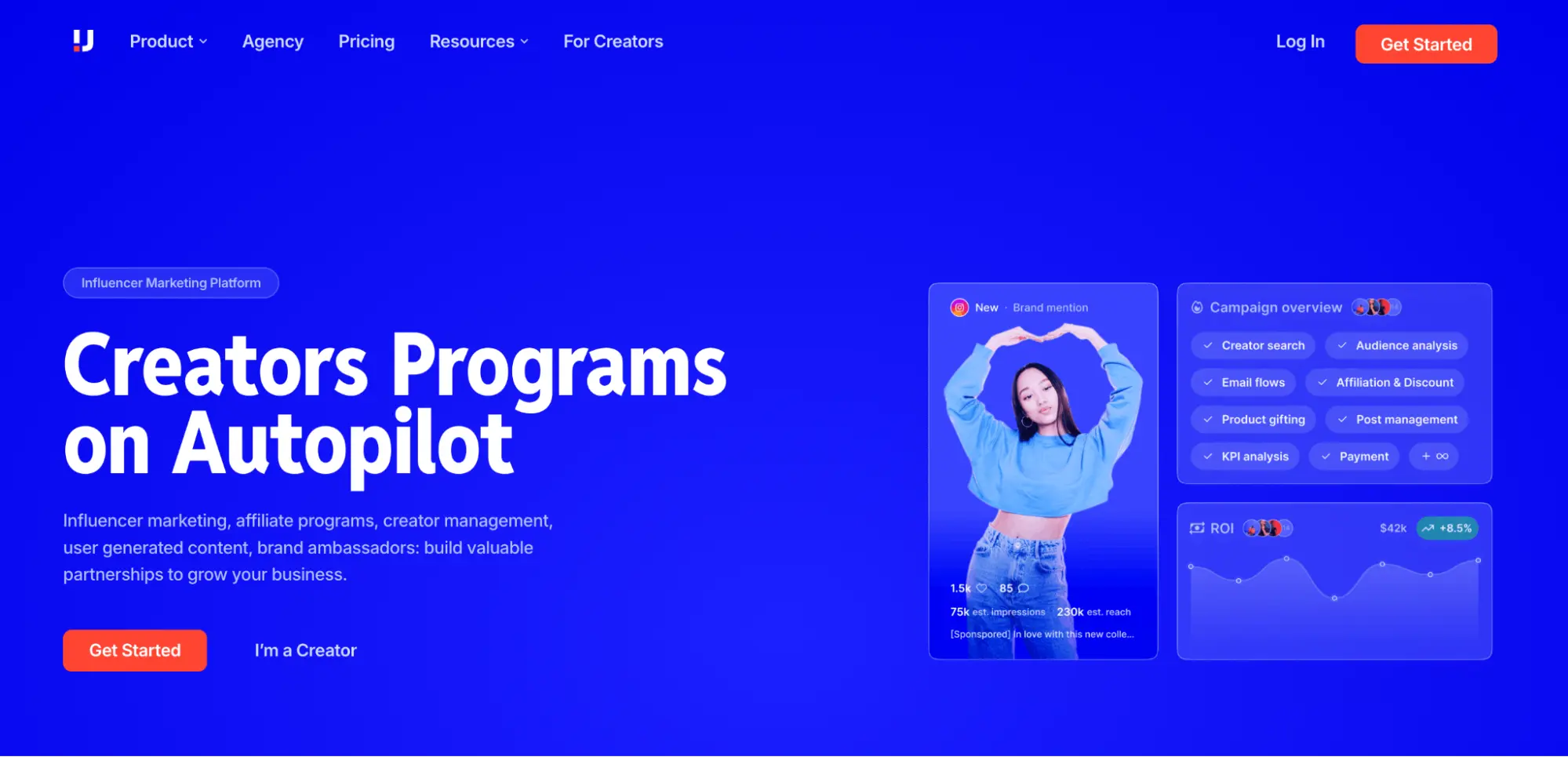
What is it? Upfluence's standout feature is its ability to surface creators already inside your customer base by matching your CRM or e-commerce data against their 14M+ creator database. The platform is priced in three modular tiers covering discovery, campaign management, and payments separately, so you only pay for what your program actually needs.
Best for: E-commerce brands and agencies running ongoing creator programs on Shopify, WooCommerce, Magento, BigCommerce, or Amazon who want sales attribution built into the workflow.
Why I Picked It: The customer-matching feature is something I hadn't seen done this cleanly elsewhere. Your best creators are probably already buying from you. Upfluence is the only tool here that starts from that assumption and builds the workflow around it, rather than treating your customer base and your creator program as two separate things.
Features
- CMS and ecommerce database matching to find creators already in your customer base, turning people who already love the product into your next wave of partnerships.
- 14M+ creator database across Instagram, TikTok, YouTube, Twitch, and Pinterest, covering standard cold discovery alongside the customer-matching feature.
- Jaice AI co-pilot for campaign creation, creator matching, and personalized outreach at scale, cutting down the manual work of drafting individual outreach messages.
- Native integrations with Shopify, WooCommerce, Magento, BigCommerce, and Amazon for sales tracking, so attribution works no matter which storefront you run.
- Global creator payments with multi-currency support, tax form generation, and compliance handling on the Autopilot plan, removing a real administrative burden for international programs.
Limitations
- No self-serve trial; a demo call comes first, so you're committing time to a sales process before you've seen the product firsthand.
- Minimum 12-month contract, which is a longer commitment than most tools on this list require before you know if the platform fits your workflow.
Pricing
Custom-quoted. Three modular plans: Find Creators, Scale Programs, and Autopilot. Fixed platform fee with no percentage taken from creator-driven sales. Minimum 12-month contract. Free trial available after an initial call.
8. Traackr
What is it? Traackr has been in this space since 2008, and it shows in the depth of their analytics infrastructure. The Brand Vitality Score (VIT) is their standout feature: a proprietary metric that measures visibility, impact, and trust of creator content mentioning your brand, normalized across platforms, and benchmarked against 1,000+ competitors. LinkedIn is not a primary focus here.
Best for: Mid-market and enterprise consumer brands in beauty, fashion, and CPG that need competitive benchmarking and share-of-voice measurement alongside standard influencer discovery and campaign management.
Why I Picked It: Traackr made it to my list for one reason: competitive benchmarking. Every other tool tells you how your creators are performing. Traackr tells you whether your competitors' creators are outperforming yours. For beauty and fashion brands where creator share of voice drives purchase decisions, that's the metric that actually moves budget conversations internally.

Features
- Brand Vitality Score (VIT) for cross-platform performance measurement, benchmarked against 1,000+ competitors, so you know where you stand in the category, not just how your own program trended.
- Creator lifecycle analytics tracking acquisition, retention, and churn versus competitors, showing whether you're actually winning creators away from rivals or just cycling through the same pool.
- Competitor analysis showing which creators are working with rival brands and how they perform, giving you a target list instead of a cold search.
- Influencer discovery across a database of 11M+ creators in 43 countries and 19 languages, built for programs that need to run consistently across multiple markets.
- Campaign management with product seeding, content review, payments, and compliance, keeping global program logistics inside one system.
Limitations
- LinkedIn is not a primary focus, so B2B-adjacent programs will find weaker coverage here than on a platform built around professional networks.
- Pricing is not published and every plan requires a demo, so budgeting for this tool means a sales conversation before you see a number.
Pricing
Not published. Contact Traackr directly for a quote.
Which Best Creator Discovery Tool You Should Choose?
The right creator discovery tool has less to do with database size and more to do with where your buyers spend time, what your e-commerce stack looks like, and how much of the campaign workflow you need the platform to cover. A team marketing to professional audiences on LinkedIn needs a completely different tool than a DTC brand running product seeding on Shopify.
Here's how to match the platform to your situation:
- Your buyers are on LinkedIn or Substack: Favikon is the only platform in this list with meaningful coverage of LinkedIn and Substack alongside the standard consumer channels. If your audience lives on professional networks rather than Instagram and TikTok, most other tools will leave you with a blind spot.
- You're running a Shopify-first DTC program: Modash, GRIN, Upfluence, and Aspire all connect directly to Shopify for product gifting, discount codes, and sales attribution. The difference is in depth: GRIN goes deepest on DTC lifecycle management, and Modash is the cleanest for discovery-first teams that want Shopify layered in.
- Fraud detection is your first filter: HypeAuditor and Favikon both run authenticity scoring on every profile in their databases. If you've been burned by fake engagement before and vetting is the primary job, start with one of these two.
- You need self-serve pricing without a sales call: Favikon, Modash, and GRIN all publish pricing and offer trials you can start today. If your budget doesn't support a demo-gated annual contract, CreatorIQ, Traackr, Aspire, and HypeAuditor will all require a sales conversation before you see a number.
- You're running programs across dozens of markets: CreatorIQ and Traackr are built for that scale. CreatorIQ connects directly to social platform APIs for first-party data accuracy. Traackr gives you competitive benchmarking across 43 countries. Both come with annual contracts and implementation timelines to match.
The right tool is the one that covers your channels, fits your workflow, and doesn't require a six-month onboarding to get your first shortlist. For most teams, that's a shorter list than the one you started with.
Start a free 7-day trial on Favikon →
Frequently Asked Questions
What is the difference between a creator discovery platform and an influencer marketing platform?
A creator discovery platform focuses on finding and vetting creators, with search, audience data, and authenticity scoring as the core features. An influencer marketing platform covers the full workflow: discovery, outreach, campaign management, and performance tracking in one place. Most tools that started as discovery-only have since expanded, so the line between the two has largely disappeared.
What is the best creator discovery platform for LinkedIn or B2B?
Favikon is the strongest option for LinkedIn and professional creator discovery. It's the only platform in this category that indexes LinkedIn and Substack creators alongside Instagram, TikTok, and YouTube, with an Authority Score and Authenticity Score on every profile. Most other tools were built for consumer brands first and added professional channels as an afterthought, if at all.
Do creator discovery platforms check for fake followers?
Yes, most creator discovery platforms include some form of fake follower detection, but the depth varies. HypeAuditor and Favikon both run authenticity scoring on every profile in their databases. Others flag suspicious follower patterns at the surface level but don't go as deep on comment quality, audience credibility, and engagement authenticity signals.
Is AI search better than keyword filters for finding creators?
Yes, AI search is generally faster and more accurate for creator discovery than keyword filters alone. Keyword filters require you to know exactly what to search for before you start. AI search lets you describe the creator you want in plain language, and the platform surfaces matches based on content, tone, and audience fit rather than rigid category labels.
Can I use one platform for both discovery and campaign management?
Yes, most modern creator discovery platforms cover both. Tools like Favikon, Modash, GRIN, and Aspire handle discovery, outreach, campaign tracking, and reporting in one workflow. The main trade-off is depth: a platform built primarily for discovery may have lighter campaign management than a dedicated campaign tool, and vice versa.
Others articles