How to Pay Influencers: The 6 Things That Break After You Agree the Price
Agreeing on an influencer's rate is just the first step, but payment issues can quickly slow down a campaign. Learn how to fix invoice errors, handle VAT questions, manage creator account setup, and avoid common payment delays.

I spent most of this year building the system that pays creators inside Favikon. Before that I assumed paying a creator was the simple part. You agree a number, you send the money, done.
It is not the simple part. Agreeing the number is the simple part.
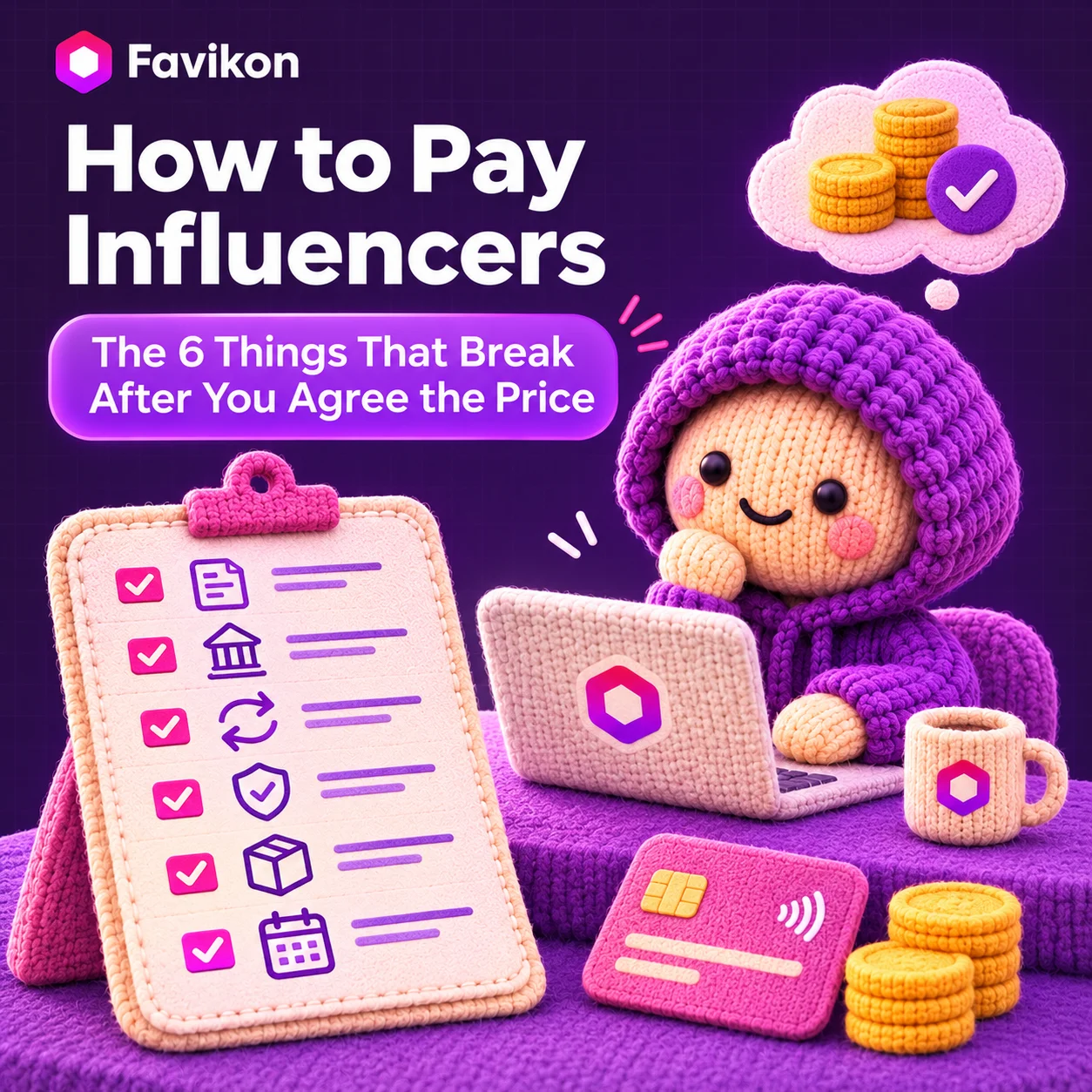
Almost every guide about paying influencers is about compensation models. Flat fee, commission, pay-per-post, gifting, retainer. Those are worth understanding and we have written about them elsewhere. But every one of those models runs into the same six operational problems the moment real money has to move, and nobody writes about those, because you only find them when you build the thing.
Here they are, in the order they usually bite.
1. The invoice nobody sends
The default workflow across the industry is that the creator sends you an invoice and you pay it. That assumption breaks constantly, because a large share of creators are individuals who have never issued a compliant invoice and do not particularly want to learn.
You can see the assumption baked into the tools. Upfluence will not process a payment until the creator has submitted their invoice and tax forms and claimed the payment with the right method selected. Modash asks creators to upload an invoice or use its generator, and its help centre carries an article answering what happens when the creator does not. That article exists because it happens often enough to need one.
The fix is called self-billing, and it inverts the flow. Instead of the creator writing the invoice, the paying party writes it on their behalf from details collected once at setup. It is legal in both the EU and the US as long as the creator agreed in advance. Gigapay has run this model for years, and it is the approach we took when we built FaviPay. Favikon generates each creator's invoice. There is nothing to chase, because nothing is being waited on.
If you are evaluating tools, this is the first question worth asking: does the creator write the invoice, or does the platform?
2. The VAT you get wrong
This one is almost entirely a European problem, which is why the US-built platforms barely mention it.
Inside the EU, a cross-border B2B creator payment normally falls under the reverse charge mechanism. Under Article 196 of the EU VAT Directive the place of supply is the brand's country, so the creator invoices with no VAT and a reverse-charge note, and the brand accounts for the VAT itself. Get the classification wrong, or let an invalid VAT number through, and reverse charge does not apply. Domestic VAT should have been charged, and the brand cannot reclaim what it never paid correctly.
There are really only four cases, and only one of them has VAT on it:
We built this as a decision the system makes, not a decision the marketer makes, because a marketer should not have to know Article 196 exists. The creator answers one question at setup, VAT registered or not, and the invoice comes out correct.
One detail trips people up. When VAT does apply, it comes out of the amount you entered rather than being added on top. Type one thousand euros and the invoice reads 833.33 plus 166.67 of VAT. The number you type is the number you pay.
3. The currency that eats the fee
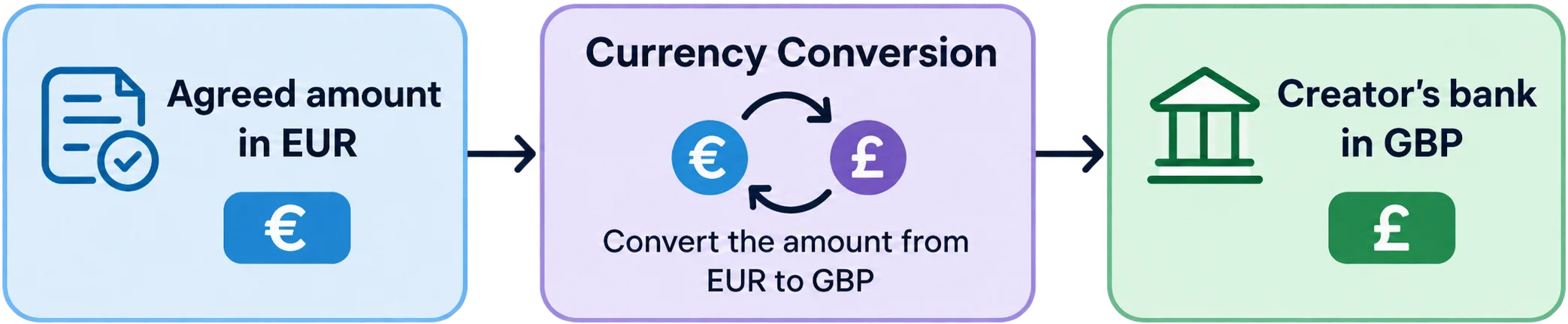
If your wallet is in euros and your creator banks in pounds, something has to convert, and conversion is never free. Industry FX margins on creator payouts generally land in the 1 to 3 percent range depending on the route. The question that actually matters is who absorbs it.
The market is split. Most platforms advertise that creators keep 100 percent and the brand carries the cost. Upfluence takes a different approach and lets the brand decide at payment time who absorbs the conversion fee. That is the honest design, because it makes the trade-off visible instead of burying it in one side's number.
Whatever tool you use, insist that both parties see the converted figure before the payment goes out. A creator who agreed to one thousand euros and received an unexplained amount in their own currency will ask you about it, and you will not have a good answer ready.
4. The creator who never finishes setup
This is the one that surprised me most, and it is the reason we designed FaviPay the way we did.
In nearly every tool I looked at while building, the payment is blocked until the creator completes something. Upfluence requires the creator to claim the payment with the right method selected. Aspire routes through PayPal, so no PayPal account means no payment. Modash needs the invoice uploaded first. Each of these makes the brand's payment contingent on an action by someone who does not work for them and may be on holiday.
The downstream effect is the thing everyone in this industry complains about. One review of Aspire's terms notes creators can wait 30 to 90 days or more after delivering content. Some of that is payment terms. A meaningful chunk of it is just this: the paperwork was not done, so the money never started moving.
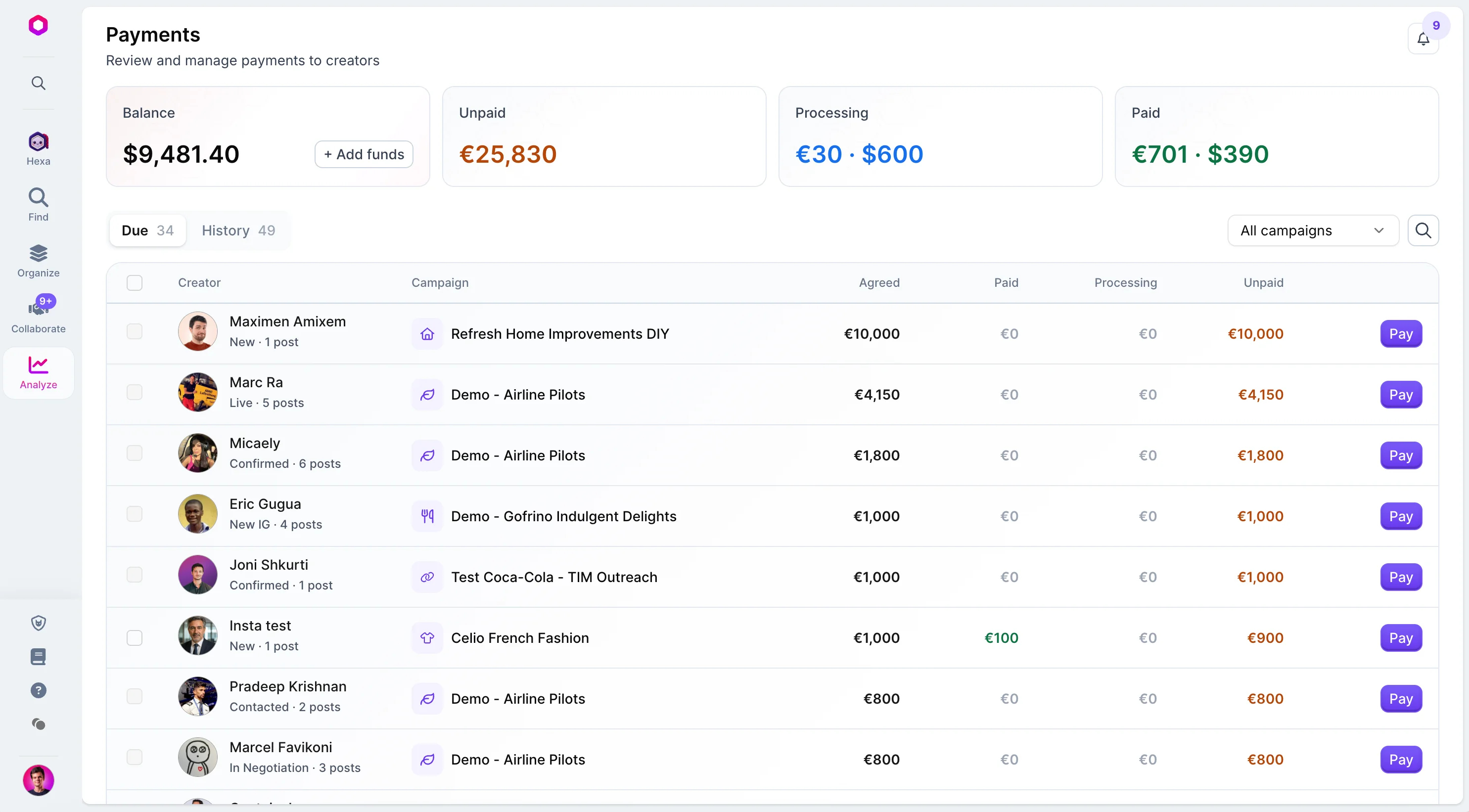
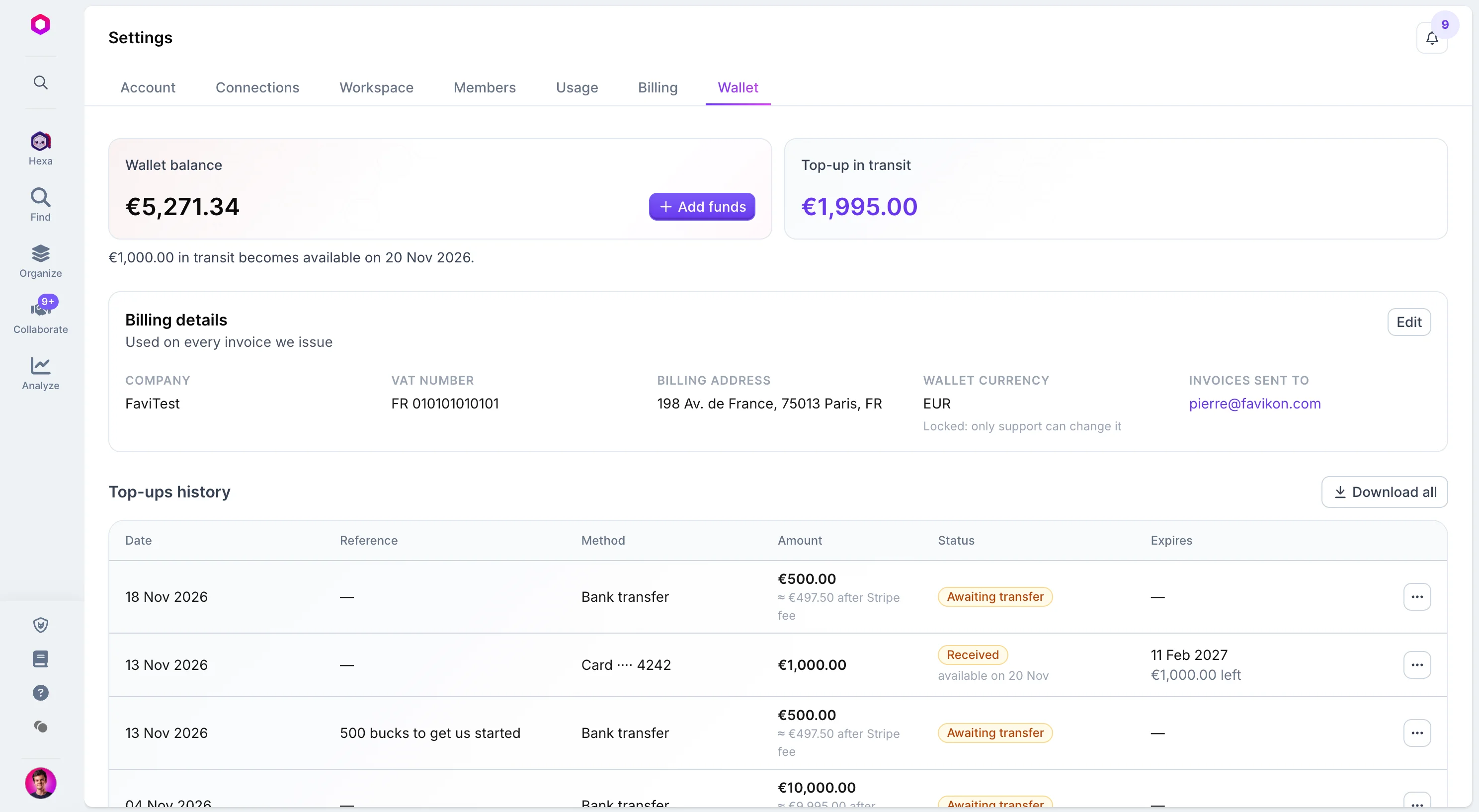
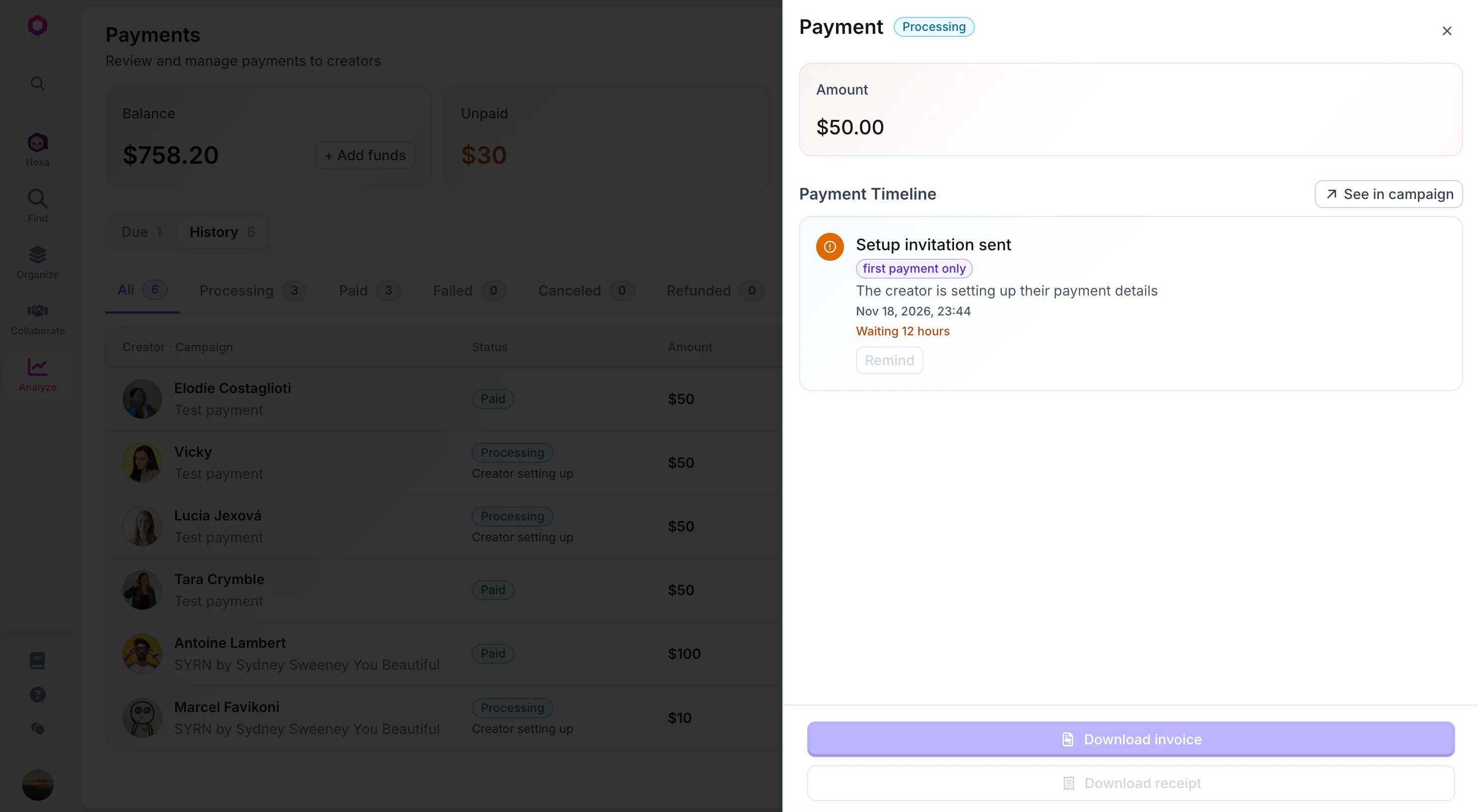
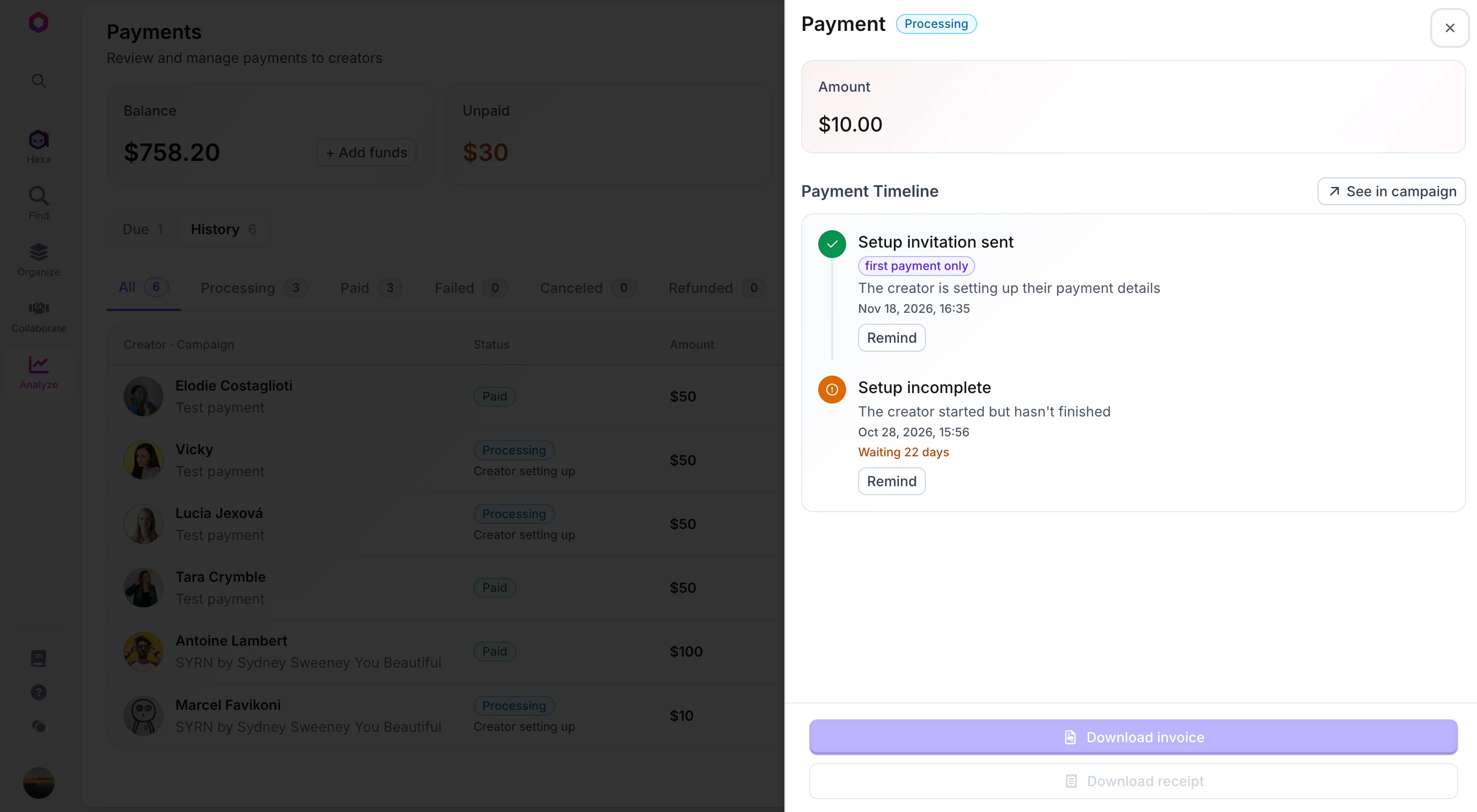
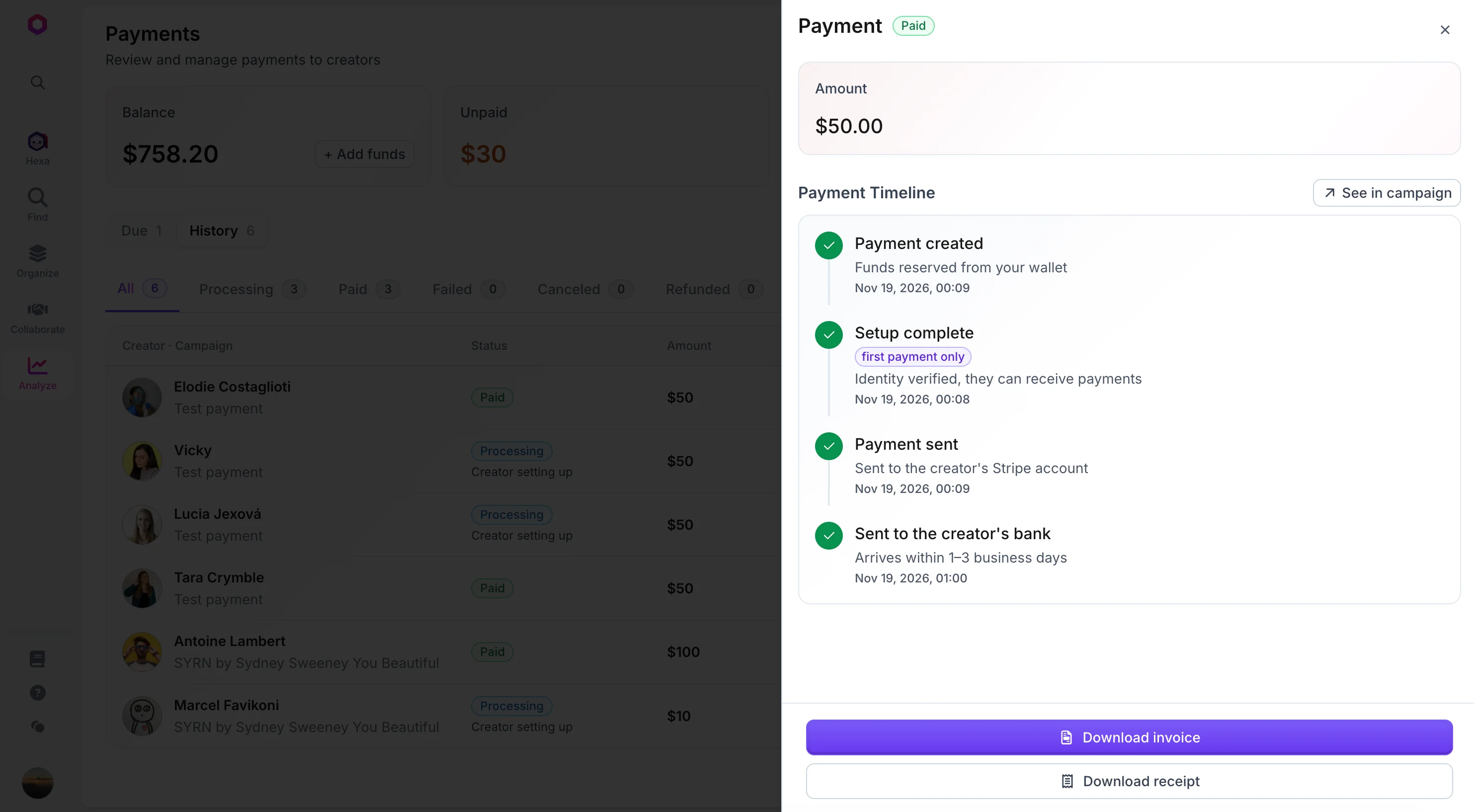
So we built it the other way around. In FaviPay the brand pays whenever they want. If the creator has not finished their setup, the payment still goes through from the brand's side, the money is reserved, and the payment shows as "Awaiting creator". The moment that creator completes their account, it releases automatically. The brand never does anything twice, and a missing tax detail never stops a payment from being initiated.
It is a small-sounding design decision that removes an entire category of chasing.
5. The payout that fails
Verification is not optional. Payment providers run identity and bank checks on every recipient before the first payout, because know-your-customer rules require it. That means the first payout to any creator takes longer than every subsequent one, often substantially.
Plan for this rather than promising around it. The pattern across providers is the same: the first payout waits on verification, later ones are routine. If you tell a creator a number on their first payment, you will probably be wrong.
The related failure is bank detail errors, which are common and mostly invisible until the transfer bounces. What you want from a tool is that it tells you the payment failed and retries once the creator fixes it, rather than silently marking it sent.
6. The country you cannot pay
Nobody likes this section, including me.
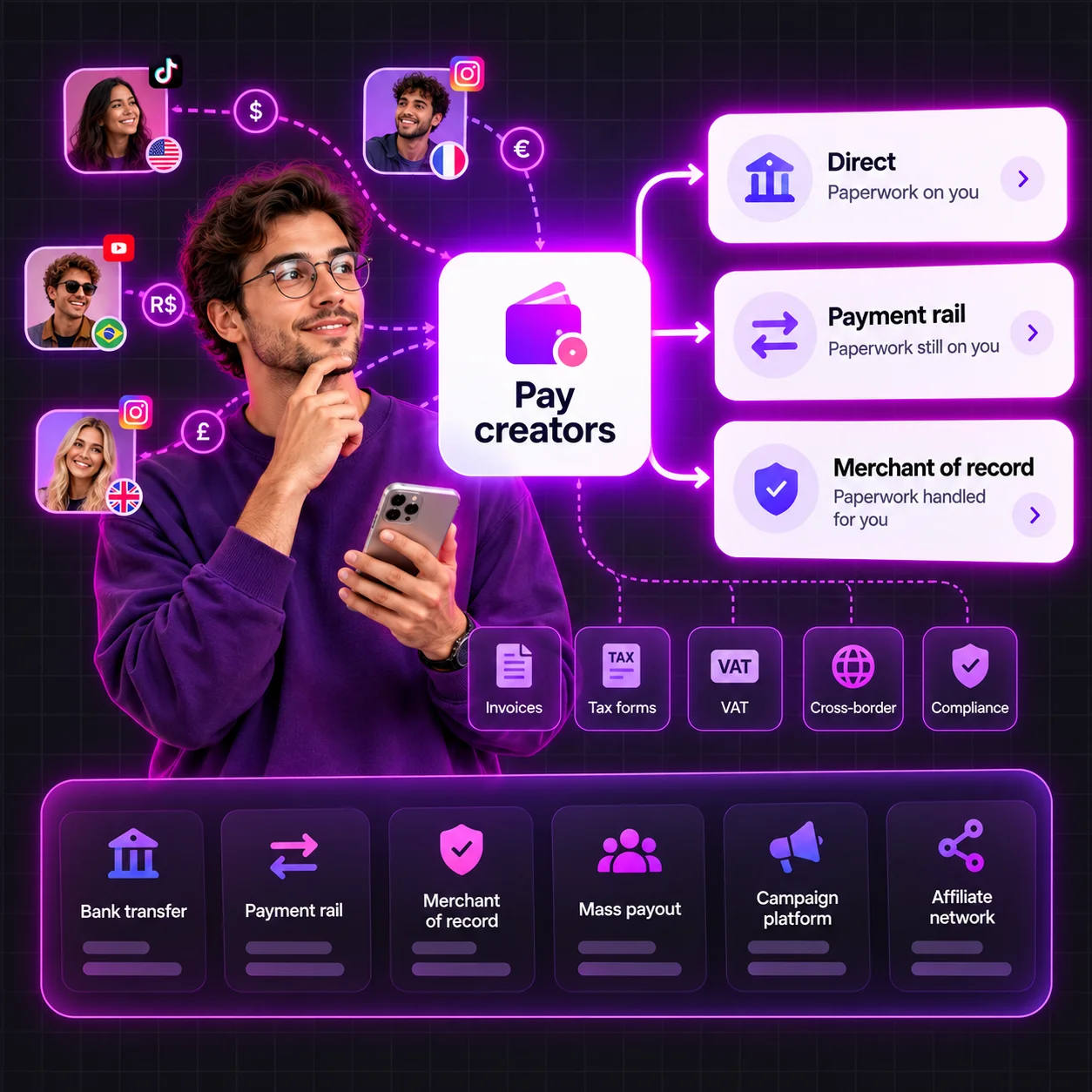
Creator payouts are not globally uniform. Coverage depends entirely on the rails underneath, and those rails differ. Platforms that act as merchant of record or master vendor, such as Lumanu and Modash, route across several providers and advertise coverage around 180 countries. Platforms built directly on Stripe Connect, which includes us, inherit Stripe's map instead. Stripe runs two separate products here: Connect cross-border payouts, open to platforms in the US, UK, EEA, Canada and Switzerland, and Global Payouts, which has far wider recipient coverage but only accepts senders in the US and UK. We are a French company, so we are on the first one.
That puts us at up to 47 countries today, with the bulk of them in Europe, and Stripe can still decline a market. It has already declined India for us.
I would rather say that plainly than let someone find out at payment time. In FaviPay, if a creator is in a country we cannot pay, the payment is cancelled, the money returns to the brand's balance, and that creator cannot be paid through Favikon. There is no partial state and no manual workaround in this version.
The practical advice: before you contract a creator in an unusual market, check that your payment tool reaches them. It is a five-minute check that prevents a genuinely awkward conversation.
What this actually means when you are choosing a tool
Six questions, in rough order of how much pain they save:
1. Who writes the creator's invoice, them or the platform?
2. Does the platform decide the VAT treatment, or do I?
3. Who absorbs currency conversion, and is it shown before payment?
4. Can I pay a creator who has not finished their setup?
5. What happens when a payout fails?
6. Which countries can I actually reach?
Most comparison pages answer the sixth and skip the first five. The first five are where the time goes.
See how FaviPay handles all six
FAQ
What options exist for managing influencer payments and contracts?
Broadly three. Do it manually with bank transfers and a spreadsheet, which works until roughly ten creators. Use a dedicated payout provider such as Lumanu, Gigapay or Tipalti, which handles money well but sits apart from where you found and briefed the creator. Or use an influencer platform with payments built in, which keeps everything in one workflow at the cost of narrower country coverage. We compared these in more detail in our guide to influencer payment solutions.
What is the best payment platform for a marketing agency paying influencers?
It depends on where your creators are. Agencies paying across many countries including emerging markets should look at a merchant-of-record provider. Agencies working mostly in Europe and North America get more value from payments built into the platform they already run campaigns in, because the handoff between campaign and finance is where agency time disappears.
What are the common influencer payment methods?
Bank transfer, PayPal and platform-managed payouts are the three that matter. PayPal is the most widely available and the most expensive at scale. Bank transfer in local currency is what most creators prefer. Platform payouts sit on top of one of those two and add the invoicing and compliance layer.
How do I streamline influencer payments for multiple campaigns running at the same time?
Fund once rather than per campaign, and pay from a single balance. The administrative cost in multi-campaign programs comes from repeating the funding and approval step, not from the payments themselves. Look for a tool that lets you top up once and pay many creators from that balance.
Do I need to collect tax forms from creators?
If you are paying US creators, yes. A Form W-9 before payment is standard practice. In the EU the equivalent question is VAT registration status, which determines the invoice treatment. Either way, collect it at onboarding rather than at payment time, which is the single change that removes the most delay from a payment run.
Other articles