Influencer Payment Solution: Which One Do You Really Need?
Paying influencers involves more than sending money, especially when invoices, taxes, and international payments come into play. Compare different influencer payment solutions, their costs, and who handles the paperwork to find the right option for your campaigns.

You are probably here after reading ten other guides. Let me save you the eleventh.
Most articles on creator payments are lists of platforms. Ten tools, a feature table, a conclusion that says "it depends on your needs". That does not help, because you already know it depends on your needs. What you do not know is which bucket you are in.
So this guide does it the other way round. I describe the situations, you find yours, and the solution falls out of it.
I am Sarthak and I run the influencer program at Favikon. I had exactly this problem. In B2B almost every creator you work with is independent, which means no talent agency absorbing the paperwork, which means it lands on you. We have paid creators through bank transfer, through PayPal and through Gigapay, and I have opinions about all three.
Nothing here is sponsored. Where I name a platform it is because it is the one most people end up looking at, or the one I have actually used.
Two things before the categories. First, five things you need to know before you pay anybody. Get these wrong and the tool choice does not matter. Second, a note on agencies, because if you work with big creators this whole question changes shape.
This covers the US and the EU. Those rules are different enough from each other to matter and I have kept them separate where they diverge.

Why this is worth more than an afternoon
Payments look like a finance chore. They are actually a retention problem.
The clearest number I have found comes from Lumanu, a creator payments company that surveyed over 500 influencers. 48% had been paid late in a single year. Of those, 38.5% waited more than a month past the due date.
Tipalti's own survey, reported by Digiday, found 56% of creators had faced late payments. The same Digiday piece has creators describing a delayed mortgage payment after three brands missed agreed terms, and one creator adding a 10% late fee to her invoices specifically to make brands pay attention.
Trolley surveyed 450 independent earners and found payment delays were the single highest-ranked reason people would stop working with a platform, ahead of rate.
A caveat I want to put up front, because it matters: almost every statistic in this space is published by a company selling payment software. That includes all three above. The direction is consistent enough across independent surveys that I believe it. The precision I do not.
The mechanism behind late payment is also boring rather than villainous. Creator invoices go into the same accounts payable queue as every other vendor, and a creator invoicing for €500 has none of the leverage of a supplier invoicing for €50,000. They get deprioritised by default, not by decision.
If you are running creator partnerships you want to repeat, and almost everyone is, this is the quiet thing that decides whether the second campaign happens.
Five things to know before you pay a single creator
These are the ones I see teams get wrong. None of them are hard. All of them are annoying to fix after the fact.
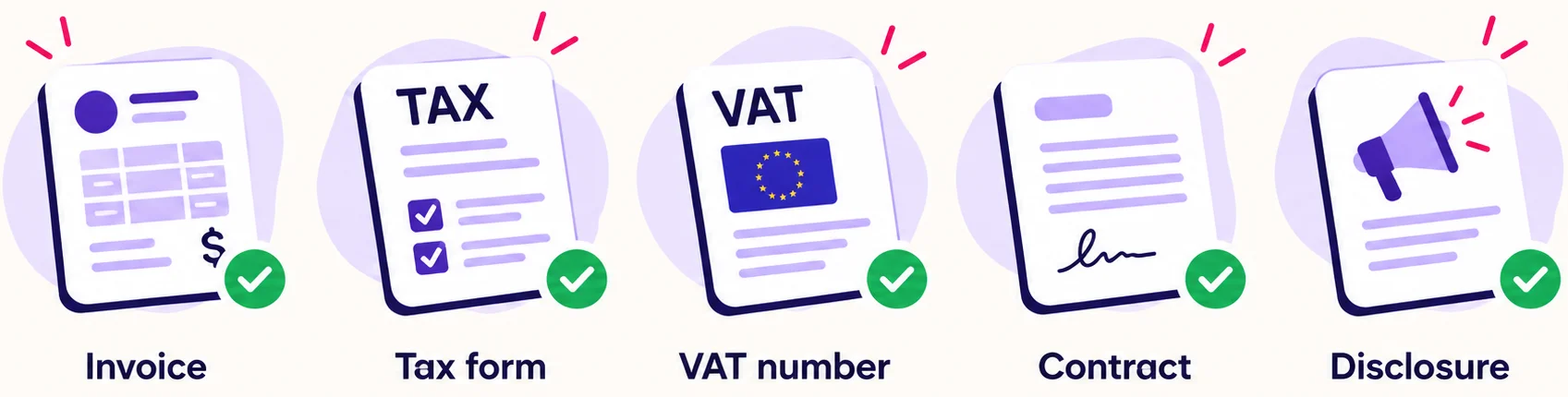
1. You need a piece of paper for every payment
You cannot just send money. You need an invoice from the creator. If they are too small to have a registered business and cannot invoice you, you write the invoice for them and they sign a form agreeing to it.
That is called self-billing, and it is legal in both the US and the EU as long as the creator has agreed in advance.
No paper, no deduction. Your finance team will find this out in March and they will not be pleased. This is the single most common failure point with nano and micro creators, and it is the reason entire companies exist in this space.
2. Get the tax form before you pay, not after
This is the one that costs real money.
If you are a US company: you need a W-9 from US creators and a W-8BEN (or W-8BEN-E) from foreign ones, collected before the payment goes out. If a creator earns more than the reporting threshold in a year and you did not collect their form, you are the one holding the problem at tax time. Without a valid W-8, payments to foreign payees can be subject to backup withholding, and you cannot claw that back from the creator afterwards.
If you are an EU company: several member states apply a withholding tax on payments to foreign suppliers for services used domestically. Tax treaties usually reduce it to zero, but the relief is not automatic.
You need a certificate of tax residence from the creator to prove it. France is a clear example, where the default rate without treaty relief is 25%. The pattern is the same on both sides of the Atlantic. One email before the first payment, or a reassessment on gross amounts later. Ask for it at the same time you ask for their bank details. It takes the creator five minutes.
3. VAT costs you nothing, but you still have to declare it
This one is EU-specific. When you buy a service from a supplier in another country, the reverse charge applies. You declare the VAT and deduct it in the same move. Net zero cash impact. What you do need is their VAT number, checked on the EU's VIES database, with the proof saved and dated.
The cost is zero. The paperwork is not optional. US companies reading this: there is no federal equivalent. Services from a creator are not a sales tax event for you.
4. Do not let a creator slowly turn into an employee
Same person, every month. You set the brief. You set the schedule. You are most of their income. That is how a contractor gets reclassified as staff, and it is expensive in both jurisdictions.
In the US it is an IRS and Department of Labor worker classification problem with back taxes attached. In the EU it is requalification, which in some countries carries criminal exposure, not just financial.
One-off sponsored posts are not a risk. A long-running ambassador on a monthly retainer is. Keep each collaboration a separate project with its own contract and its own deliverables. If you are building a long-term creator relationship on purpose, read how to build long-term relationships with content creators and structure it deliberately rather than by accident.
5. Disclosure is your liability too, not just theirs
Marketers forget that the brand is on the hook alongside the creator.
In the US, the FTC Endorsement Guides require clear and conspicuous disclosure of a material connection. The 2023 revision was explicit that advertisers, endorsers and intermediaries all face potential liability, and that an advertiser's exposure is not limited to whether the endorser's statement was true. The FTC has since sent warning letters putting recipients on notice of civil penalties of up to $50,120 per violation.
Two details people miss. A contract clause saying the creator will disclose does not transfer the liability. And a platform's built-in disclosure tool may not be sufficient on its own, because the test is whether the actual audience can easily notice and understand it.
In the EU, the Unfair Commercial Practices Directive covers hidden advertising, several member states have passed influencer-specific laws on top of it, and the Digital Services Act adds platform-level disclosure obligations. France's 2023 influencer law, for one, makes advertiser and influencer jointly liable. Put the disclosure requirement in the contract in writing. Do not leave it to the creator to remember.
First, check whether this is even your problem
If you are working with a large creator, they are very likely represented by a talent agency or a management company. In that case the payment question is mostly answered for you. You get an invoice from the agency, you pay the agency, the agency pays the creator, and the compliance burden sits with them. That is the easiest version of this and it is worth knowing you are in it.
But two things have changed. Brands are increasingly working with mid-tier and micro creators rather than the top of the market, because the economics are better. And a growing number of creators have left agencies or never joined one, especially in B2B where the creator is usually a practitioner with a day job rather than a full-time content professional.
So the self-managed creator is now the default case, not the exception. Everything below assumes you are paying creators directly. If you are still working out what to pay them in the first place, that is a different question and we covered it in the complete B2B influencer pricing guide. The B2B influencer price calculator will tell you whether a quote you have been given is sane, and how to negotiate with influencers as a brand covers getting from quote to agreed number.
The six categories
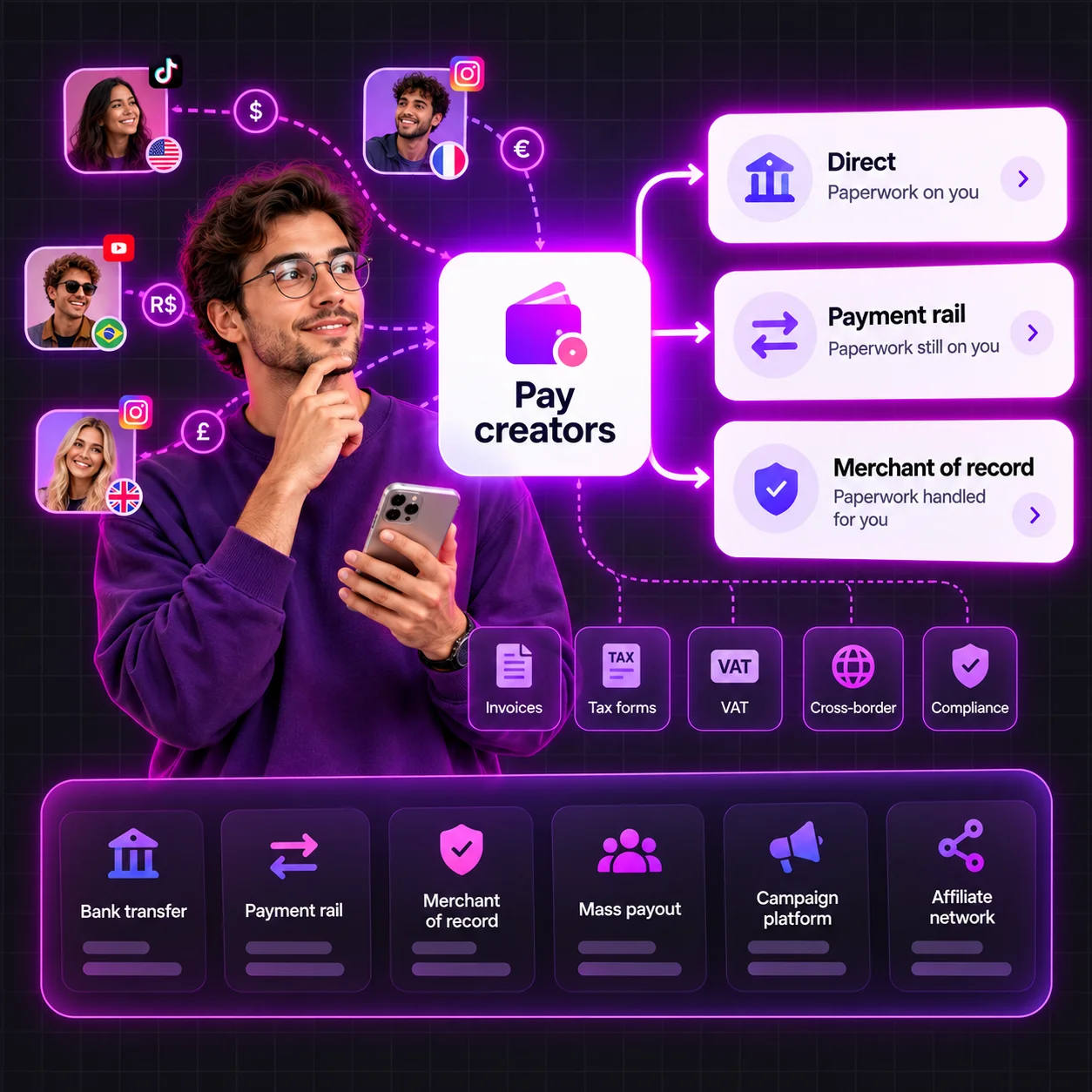
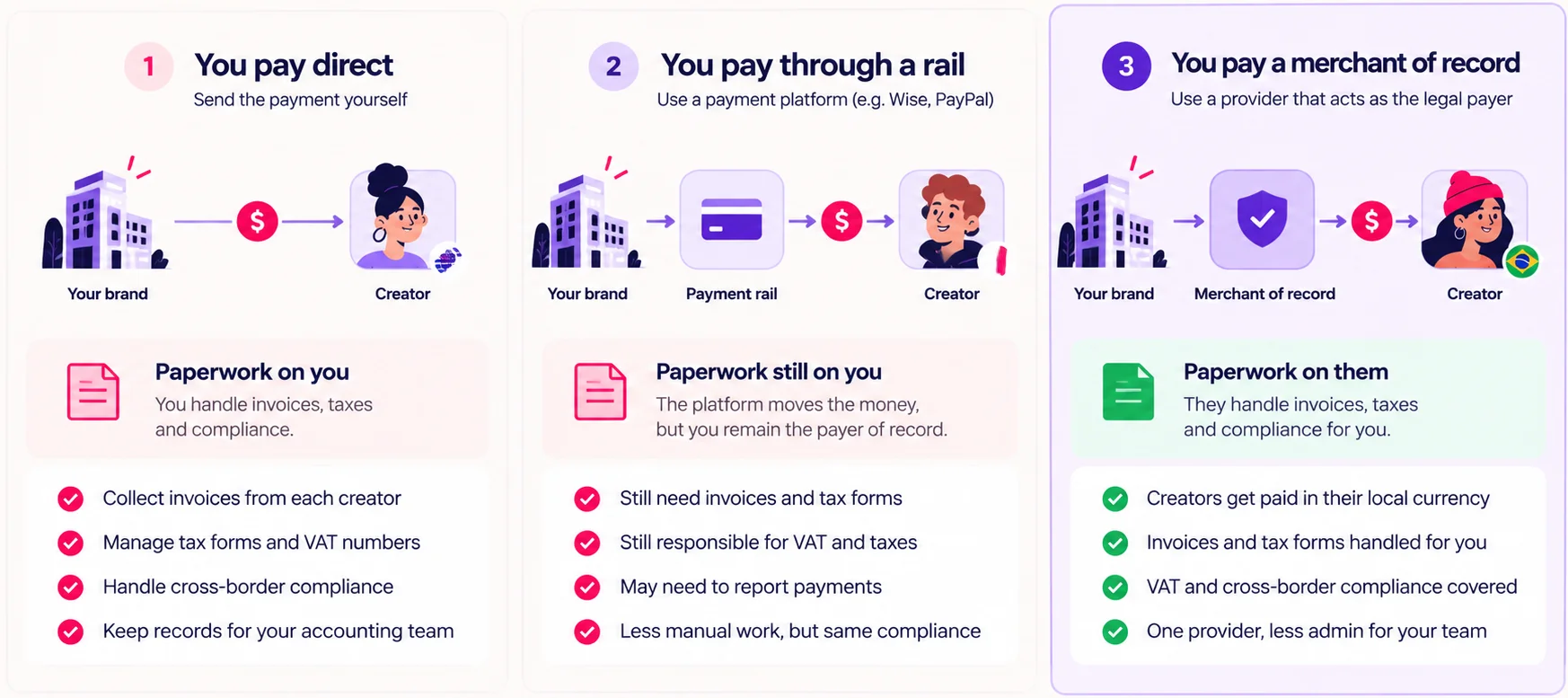
Everything on the market falls into one of six buckets. The difference between them is not features. It is who absorbs the paperwork: you, nobody, or a company you pay to take it. That is the axis. Hold it in your head and the rest is easy.
1. Bank transfer against an invoice
What it is: no tool. The creator invoices you, you pay it, your accountant files it. SEPA in the EU, ACH or wire in the US.
What it costs: effectively nothing domestically. Cross-border wires run a flat fee plus whatever your bank takes on FX.
Who it fits: fewer than roughly ten payments a month, with creators who are all registered businesses or freelancers capable of issuing a real invoice.
This is the clean case and it is underrated. Every tool below exists to solve a problem you may not have. If your creators invoice you properly, you already have the best setup available, and it is free.
Where it breaks: the moment you are chasing invoices from people who have never written one. Or the moment your finance team opens a spreadsheet with forty supplier records on it.
2. Payment rails
What it is: PayPal, Wise, Payoneer, Revolut Business. They move money. That is the entire job.
What it costs: cross-border fees plus an FX spread, typically a few percent all-in. PayPal's receiving fee is paid by the creator, which they will notice and sometimes resent.
Who it fits: small volume, creators scattered across countries, bank transfers painful enough that you want a shortcut.
PayPal is the default and I understand why. Everybody has an account, it takes thirty seconds, and the money arrives. In the US it is particularly entrenched.
But I want to be blunt about what it does not do. PayPal does not give you an invoice. It does not collect a W-9 or a W-8BEN. It does not check a VAT number. It does not verify that the person receiving the money is who they say they are. You are still the merchant of record and every one of the five things above is still your job.
The caveat people forget: the creator needs an account, and in some markets they will not have one.
Where it breaks: when you realise you have sent money with no paper behind it. The rail does not care. Your auditor does.
3. Merchant of record
What it is: Gigapay, Lumanu. These sit between you and the creator and become the legal counterparty. They onboard the creator, verify them, handle the tax documentation, and bill you as a single vendor.
Your finance team sees one supplier instead of forty. That is the whole product.
What it costs: a subscription plus a percentage. Gigapay publishes €279 a month plus 4.9% per payout on its Pro plan. Lumanu is US-focused and prices by arrangement.
Who it fits: teams paying a lot of creators, especially individuals without business status, especially without a finance headcount to absorb the admin.
We used Gigapay at Favikon and I will give you the honest version.
What I like: they remove the admin overload entirely. If you are a small team with no accounts department, or you simply do not want to drop two hundred invoices on your finance colleague, this is a genuinely friendly solution. They also do KYC and creator verification, which almost no marketing team is equipped to do itself. And they handle the compliance layer, including DAC7 reporting in the EU.
What I would flag: around 5% is fine when you are buying back a lot of hours, but at scale it eats into your return in a way that shows up in your influencer marketing ROI numbers. The process can also move slowly. And despite being a platform it operates somewhat like a service, including calls with their team to get set up. If your pattern is fast and irregular, a payment today and two more tomorrow, that friction is real.
Where it breaks: low volume. The subscription is the entire story below a certain number of payments, and the percentage is noise.
4. Mass payout and AP automation
What it is: Tipalti, Trolley, Routable, Stripe Connect, Dots. Built to send hundreds or thousands of payments and collect tax forms automatically at onboarding.
What it costs: varies widely, generally a platform fee plus per-payment pricing. Enterprise-shaped.
Who it fits: high volume, an existing finance function, and ideally an engineer, because several of these are API-first.
The important distinction from category three: these automate the sending and the document collection, but you remain the legal payer. The compliance liability does not move. That is a feature if you want control and a bug if you wanted it gone.
Tipalti in particular was built for B2B vendor payments rather than creators, which shows up in creator-facing onboarding drop-off.
Where it breaks: when your payees are individuals rather than registered suppliers. These systems assume a vendor on the other end.
5. Campaign platform with payments built in
What it is: payment as one tab inside the tool you already use to find creators, brief them and track results.
What it costs: usually bundled into the platform subscription.
Who it fits: teams already running campaigns in a single system who want fewer tools, not more.
The argument for this category is workflow, not price. The creator you discovered, briefed and tracked is the same record you now pay, so nothing is retyped and nothing falls between two systems. If you are already managing campaigns in one place, splitting payments into a separate tool creates reconciliation work that did not need to exist.
Where it breaks: when the payment side is a thin feature bolted onto a discovery product. Ask specifically whether they are merchant of record or just moving money, because the two answers are very far apart.
6. Affiliate and performance networks
What it is: Impact, PartnerStack, Awin, FirstPromoter. Payouts tied to tracked conversions rather than a flat fee.
What it costs: typically a platform fee plus a cut of tracked revenue.
Who it fits: performance-based creator programs where the amount varies with results.
This is a different shape of problem. You are not paying for a post, you are paying for an outcome, and the payout logic is downstream of your tracking. If your attribution is weak, this category amplifies the weakness rather than fixing it. Worth reading influencer marketing attribution before you commit to it.
Where it breaks: flat-fee sponsored content. Wrong tool entirely.
The edge case: the long-term ambassador
None of the six fully solves one creator paid monthly for a year.
That is not a payments problem, it is the classification problem from point four. Contractor platforms like Deel and Remote exist for exactly this. Different category, different reason, and worth knowing about before your best creator relationship becomes an employment question.
The comparison table
One column is worth staring at. Who holds the paperwork is the only thing that genuinely separates these categories, and it is the column most comparison articles leave out.
If your problem is less "how do I send the money" and less "who do I even pay", that is the part Favikon handles today. Book a demo and we will walk through finding and vetting creators, then show you where payments fit once they ship.
So which one do you actually need
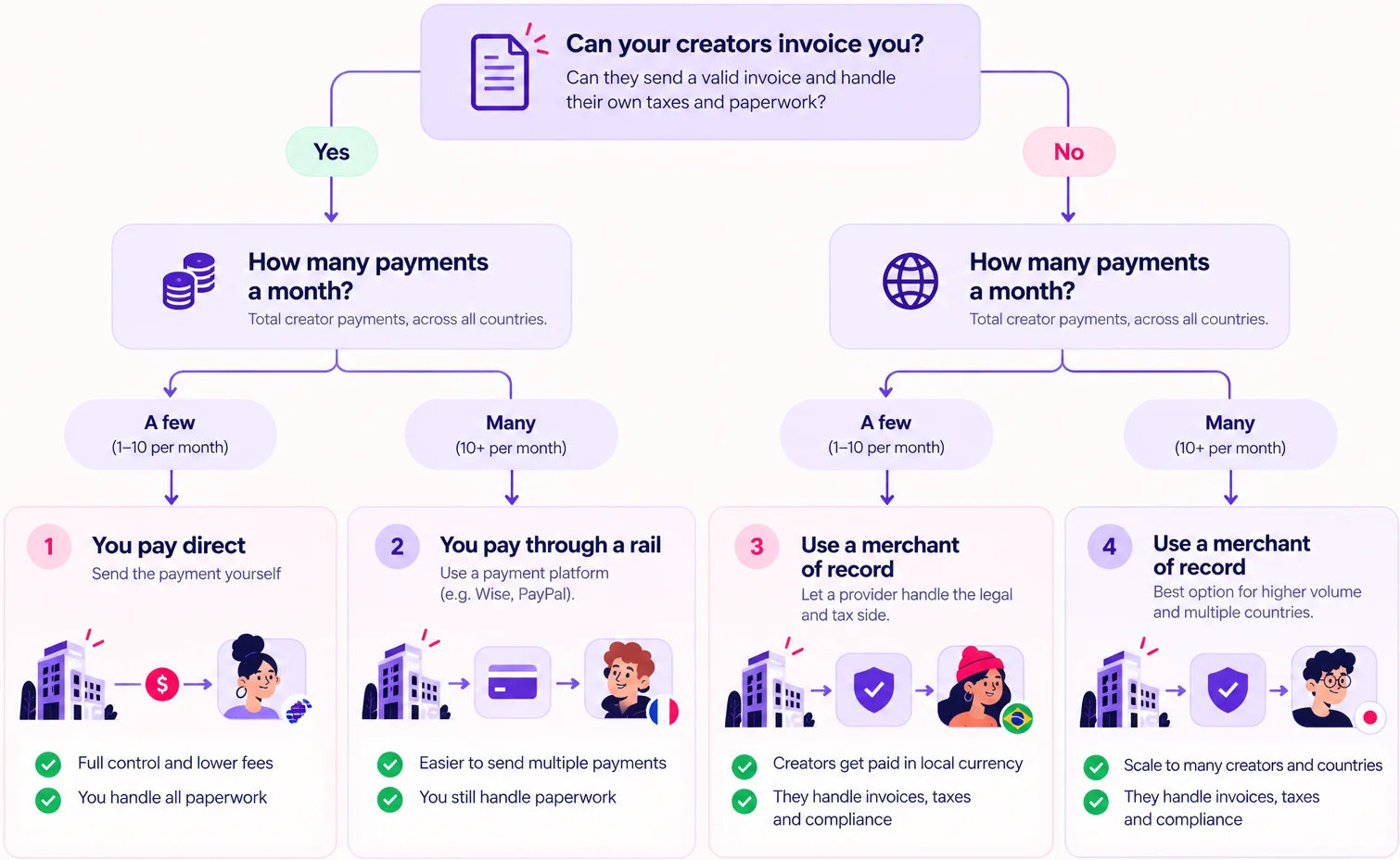
Find yourself below. These are the situations, not the products.
You pay fewer than ten creators a month and they all invoice you properly. Bank transfer. Do not buy anything. Collect the tax form, keep the invoice, move on. You already have the best setup and it costs you nothing.
You pay a handful of creators but half of them have no registered business. Still bank transfer, but set up self-billing properly. Build one template invoice and one signed self-billing mandate, and reuse them. This is an afternoon of work that saves you a tool subscription for a year.
You pay 30 to 50 creators a month and your finance team has started complaining. This is the real decision point. Count the hours your team spends on invoice chasing and onboarding, multiply by a loaded hourly rate, and compare it to a subscription plus 5%. Most teams cross over somewhere in this band. Below it the math does not work, above it the math is obvious.
You pay a lot of creators, many are individuals, and you have no accounts person. Merchant of record. This is exactly what the category is for. You are buying back hours and removing a liability, and both are worth paying for.
You pay hundreds of creators and you have a real finance function. Mass payout platform. You want control and automation rather than outsourcing, and you have the people to hold it.
You already run everything in one campaign tool. Use its payment layer if it exists, but ask whether they are merchant of record or just a rail. Do not assume.
You pay on performance, not per post. Affiliate network. Fix your attribution first.
You have one creator on a monthly retainer. Stop and look at the classification question before you look at tools.
You are in the US paying mostly US creators. Your constraint is W-9 and 1099 handling rather than VAT. Prioritise a solution that collects forms at onboarding, which rules out the plain rails.
You are in the EU paying across borders. Your constraint is VAT numbers, tax residence certificates and DAC7. A merchant of record earns its fee faster here than in the US, because there is simply more paperwork per payment.
The mistake I see most often is buying a platform to solve a problem of ten payments a month. The second most common is still being on PayPal and a spreadsheet at two hundred.
FAQ
The questions I get asked most, and the ones I had myself.
1. What payment terms are normal for influencer marketing?
Net 30 from invoice receipt is the stated standard. A 50/50 split, half at signing and half at publication, is increasingly the working default for ongoing programs.
What is actually happening is different. Digiday reports terms ranging from 30 to 90 days with frequent overruns on top. If you want to be the brand creators come back to, pay on net 15 or on publication. It costs you nothing and it is noticed.
2. Can I just pay a creator through PayPal?
Yes, and plenty of teams do. But understand what you are and are not getting.
PayPal moves money. It does not produce an invoice, collect a W-9 or W-8BEN, check a VAT number, or verify identity. You remain the merchant of record and the compliance work is still yours.
It also has a creator-side cost. The receiving fee comes out of their payment, which some creators will raise with you.
Fine for a handful of payments with the paperwork handled separately. Not a system.
3. Do I need a contract for every influencer payment?
Yes, and most teams do not have one. Influencer Marketing Hub has put the share of creators working with a formal written contract at around a third, against a large majority reporting payment delays or disputes. Those two numbers are related.
The contract is also where your disclosure requirement lives, which matters because under the FTC Endorsement Guides the liability for a missing disclosure sits with you as well as the creator.
4. What tax forms do I need from a creator?
US company: W-9 from US creators, W-8BEN or W-8BEN-E from foreign ones, collected before payment. You file 1099-NEC for US contractors above the reporting threshold.
EU company: VAT number checked on VIES where the creator is VAT-registered, and a certificate of tax residence from foreign creators so you can apply treaty relief on withholding.
In both cases, before the first payment. Collecting afterwards is possible and unpleasant.
5. Is Gigapay worth it?
Depends entirely on your volume and on whether your creators can invoice you.
It earns its fee if you are paying a lot of creators who are individuals without business status and you have no finance headcount to absorb the admin. It does not if you are paying eight registered freelancers a month, where the subscription alone outweighs any time saved.
We used it. The admin relief is real and so is the KYC. The friction is that setup involves calls with their team, and the process is not built for fast irregular payments.
6. What is a merchant of record and why does it matter?
It means the payment company becomes the legal counterparty to the creator rather than you. They contract with the creator, they verify them, they handle the tax documentation, and they invoice you as one vendor.
The practical effect is that your finance system sees one supplier instead of a hundred. That is the entire value proposition, and it is the only thing that genuinely separates this category from the payment rails.
7. Do I need to worry about DAC7?
Probably not, if you are a brand paying creators directly. DAC7 puts the reporting obligation on platform operators that facilitate activity between sellers and users.
You care about it for two reasons: your payout provider's DAC7 reporting affects your creators, and if you run a marketplace yourself the obligation becomes yours. Expect it to be sold to you as a problem you have. Check first.
8. How many creators before I need a payment platform?
My rough answer is 30 to 50 payments a month, but the honest answer is that it depends on your creator mix rather than the count.
Do the arithmetic instead of guessing. Hours your team spends on invoice chasing, onboarding and tax forms, multiplied by a loaded hourly rate, against a subscription plus a percentage of spend. Most teams find the crossover is later than the vendors suggest and earlier than they themselves assumed.
9. Can I pay a creator without an invoice?
Not if you want the expense deducted.
If the creator cannot issue one, set up self-billing. You produce the invoice, they sign a mandate agreeing to the arrangement in advance, and it is valid in both the US and the EU. Build the template once.
10. What is the cheapest way to pay international creators?
A bank transfer against a proper invoice, almost always. SEPA inside the eurozone is close to free. The rails charge a few percent plus an FX spread, and the platforms charge a subscription plus a percentage on top.
Cheapest and best are not the same question here. Cheapest is bank transfer. Best is whichever one your team will actually keep up with for a year.
Where I could be wrong, and what we are building
I would rather flag the weak points in this than pretend the categories are objective.
The crossover point is a guess, not a measurement. I have put the bank-transfer-to-platform switch somewhere around 30 to 50 payments a month. That is based on our own experience and conversations with other teams, not a study. Your number depends entirely on what your finance team's time is worth and how messy your creator mix is.
Most comparison content in this space is written by the vendors. Including, you will notice, some of what I read while writing this. Lumanu writes about Tipalti, Tipalti writes about everyone, and the rankings move accordingly. Treat any list you find with that in mind, this one included.
Published pricing goes stale fast. The Gigapay figures above are from their public pricing page at the time of writing. Check before you budget.
DAC7 is more nuanced than most articles suggest. Council Directive (EU) 2021/514 puts the obligation on platform operators that facilitate a relevant activity between sellers and users, not on brands paying creators directly. Personal services are a reportable activity, which is why payment platforms are in scope and you probably are not.
It still matters to you for two reasons. It determines whether your payout partner is reporting your creators' earnings to tax authorities, which your creators will want to know. And if you operate a marketplace yourself, it becomes your obligation rather than theirs. Vendors in this category will sell DAC7 to you hard. Check whether it is actually your problem before you buy it as one.
I have not personally used every category here. We have run bank transfer, PayPal and Gigapay. The mass payout and affiliate categories I know from research and from other teams, not from operating them.
What we are building
I will be upfront about the conflict of interest. Favikon is building payments and contracts into the platform, with automated DAC7 handling. The logic is the one in category five: if you already found, briefed and tracked a creator in one system, paying them should not require a second one.
It is not live yet. I will write about it properly when it is, including what it does not do.
In the meantime, if you want the rest of the workflow in one place, campaign management and the influencer CRM are where most of this already lives.
Before you go
If you are earlier than the payment question, which most teams are, the harder problem is finding creators worth paying in the first place. That is what we built. Book a demo and we will go through your category, show you who is actually moving in it, and be honest about whether you need us yet.
Others articles