What Is CPM in Influencer Marketing? (How to Read It)
CPM is a common metric for measuring the cost of reaching an audience through influencer campaigns. This guide explains how CPM works, how to calculate it, and when to use it alongside other marketing metrics.
.png)
.webp)
What Is CPM in Influencer Marketing? (How to Read It)
CPM, or cost per mille, is what you pay for every 1,000 impressions a sponsored post delivers, calculated as (total cost ÷ impressions) × 1,000. If you're the one who has to defend that number to a CMO instead of just running the campaign, this guide gives you the exact formula, real benchmark ranges by platform and creator tier, and a way to frame CPM in a stakeholder report so it holds up in a budget review, not just a wrap-up deck.
What Does CPM Mean in Influencer Marketing?
CPM stands for “cost per mille,” mille being Latin for thousand. In influencer marketing, it measures the cost of every 1,000 impressions a piece of sponsored content generates, whether that's a feed post, a Reel, a Story, or a long-form video.
Here's the distinction most competitor breakdowns skip: in traditional media buying, CPM is a guarantee. A publisher sells you a fixed block of ad impressions, and you know what you're buying before you spend a dollar. In influencer marketing, CPM is a derived number, calculated after the fact from the fee you paid and the impressions the post actually delivered. The creator doesn't sell you impressions directly (unless you've negotiated a CPM-based rate); the platform's algorithm decides how far the post travels, which is why the same creator can produce a $10 CPM one month and a $30 CPM the next with a similar brief.
That's also why CPM in influencer marketing bundles more than reach. It carries the value of a creator's endorsement and the algorithmic boost that comes from posting on a trusted, established account, things a programmatic display buy can't replicate at any price.
The CPM Formula (With a Worked Example)
CPM = (Total Cost ÷ Total Impressions) × 1,000
Say you pay a creator $3,000 for a sponsored Reel, and it delivers 150,000 impressions over the campaign window.
1. Cost ÷ Impressions: $3,000 ÷ 150,000 = 0.02
2. Multiply by 1,000: 0.02 × 1,000 = $20 CPM
Read it as: for every 1,000 people who saw the post, you paid $20. The same formula runs in reverse when you're planning a budget rather than reporting on one: target budget = (target impressions ÷ 1,000) × target CPM. If your team is running this math across more than a handful of creators a month, that's the point where a spreadsheet starts producing errors that a calculator won't.
What's a Good CPM? Real Benchmarks by Platform
There's no single “good” CPM. It depends on the platform, the creator's audience tier, and how narrow or high-intent that audience is. A $20 CPM is expensive for a broad-reach TikTok awareness push and cheap for a LinkedIn campaign targeting decision-makers. The ranges below blend Favikon campaign data with current cross-platform industry benchmarks.
LinkedIn CPMs run two to four times higher than the consumer platforms above, and that's not a red flag. The audience is narrower and higher-intent: a $50 CPM reaching partnerships managers and CMOs isn't the same buy as a $10 CPM reaching a general consumer feed. That comparison, reach quality over raw reach volume, is the line to lead with when a CMO asks why a LinkedIn campaign costs more per impression than last quarter's Instagram push.
See where your own campaigns land.
Run your numbers through the CPM calculator to check whether you're paying platform-standard rates for the tier and platform you're using, or overpaying without realizing it.
CPM vs. CPE vs. CPC — Why CPM Alone Isn't Enough
CPM tells you what you paid for reach. It doesn't tell you whether anyone stopped scrolling, and it says nothing about clicks or conversions. Two other metrics fill in the rest of the picture:
A campaign with a strong CPM and a weak CPE is usually a sign the impressions were bought at scale, but nobody stopped to engage. For the full breakdown of which metric to report against which campaign objective, see our guide to influencer marketing KPIs, which covers CPE, CPC, and the rest of the reporting stack CPM belongs to.
How to Report CPM to Stakeholders
A CPM number on its own reads as a verdict to a CMO, not context. Three adjustments make it defensible in a budget review:
1. Report it against a benchmark, not a feeling. Show the platform and tier range (like the table above) next to your actual CPM, so “$22” becomes “$22, in line with mid-tier Instagram creators” instead of a number that looks arbitrary.
2. Pair it with a second metric. CPM alone measures reach; showing CPM next to CPE or CPC in the same table makes clear which part of the funnel the campaign was built to win, and prevents a reach number from being judged on conversion terms.
3. Show the trend, not the point. A single CPM invites a yes/no judgment. Three or four campaigns side by side show whether cost efficiency is improving, holding steady, or drifting, which is the version of this data a CMO actually needs to make a call.
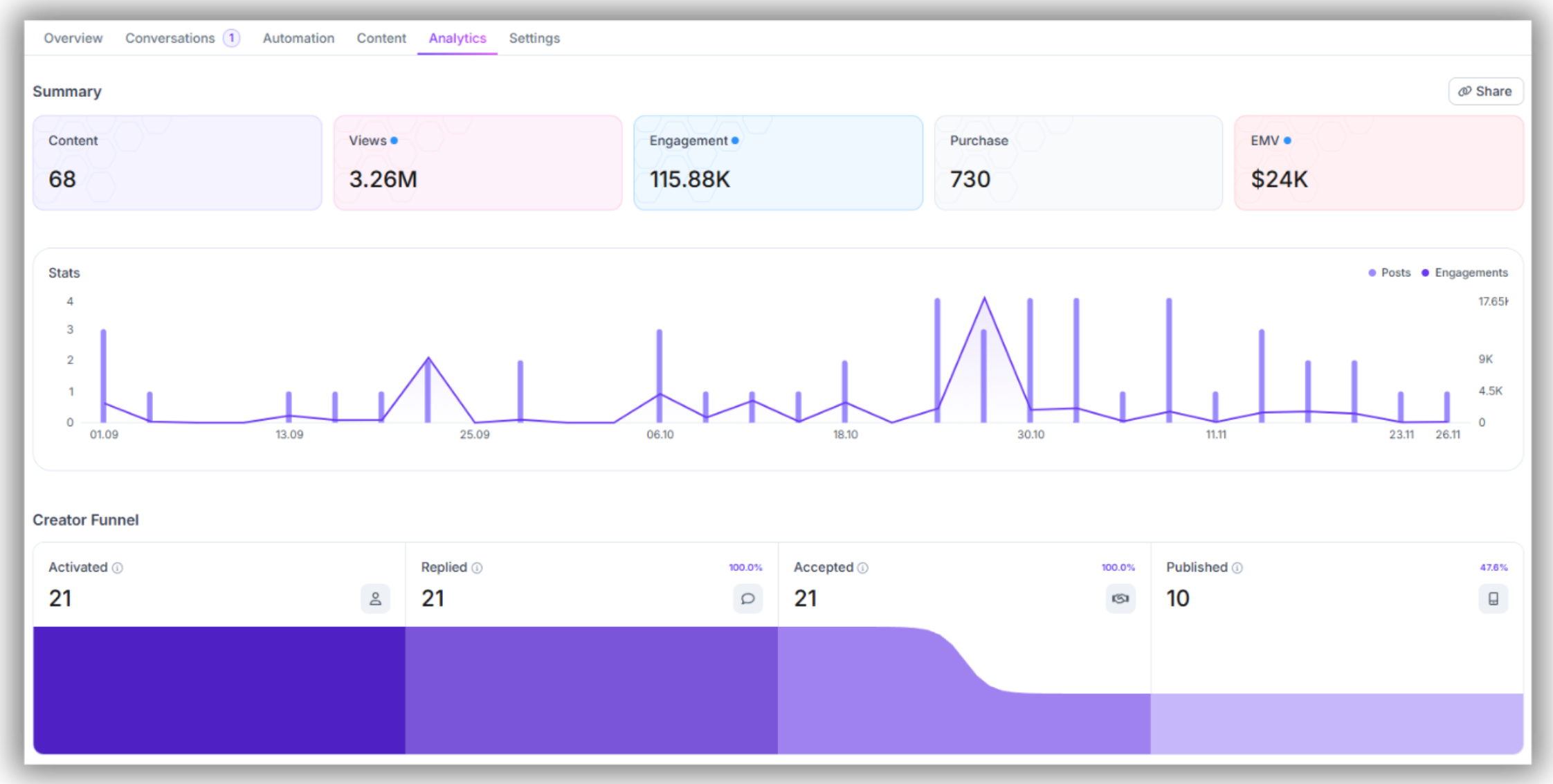
If you're doing this manually across a dozen creators and three platforms every month, that's the exact repetitive pull that an influencer campaign management platform is built to remove, by pulling cost, impressions, and calculated CPM into one view instead of a rebuilt spreadsheet each reporting cycle.
.webp)
Stop rebuilding this calculation every reporting cycle.
See how Favikon's reporting tools track CPM, CPE, and CPC automatically across every campaign and creator.
FAQ
1. What does CPM stand for?
CPM stands for “cost per mille,” with mille being Latin for thousand. In marketing, it means the cost of delivering 1,000 impressions.
2. What is a CPM in influencer marketing?
It's the price paid for every 1,000 impressions a sponsored influencer post generates, calculated as (cost ÷ impressions) × 1,000. Unlike programmatic display, those impressions aren't guaranteed in advance; they're counted after the post runs.
3. What is the CPM formula?
CPM = (Total Cost ÷ Total Impressions) × 1,000. To estimate budget instead, reverse it: (target impressions ÷ 1,000) × target CPM.
4. What's a good CPM for influencer marketing?
It depends on platform and creator tier. Broad ranges run from roughly $4 on TikTok nano accounts up to $90 for LinkedIn macro creators reaching a B2B audience; see the benchmark table above for the full breakdown by platform and tier.
Others articles

.png)