How ChatGPT Works With TikTok and Instagram Creators: An Influencer Marketing Case Study
Discover how ChatGPT uses TikTok and Instagram creators to promote its AI tools through influencer marketing. This case study explores creator partnerships, content strategies, and the role of social media in reaching new audiences.

How ChatGPT Works With TikTok and Instagram Creators: An Influencer Marketing Case Study
Behind the meteoric rise of ChatGPT is a very human marketing team. OpenAI, the AI giant, turned to real creators on TikTok and Instagram to help spread the word about its powerful tools.
Key Takeaways: 5 Lessons From ChatGPT's Creator Program
- Spread across niches. Lifestyle creators hit 1.03x and creative creators 0.88x, while developers and AI news channels, over half the posts, hit just 0.08x and 0.13x.
- Hook with a pain point, not news. Contrarian hooks hit 0.90x lift; news hooks, 30% of all posts, hit 0.08x.
- Let the story breathe before the plug. Posts that brought the product in at 25 to 50% of the video held 0.70x, vs 0.09x when it appeared in the first 10%.
- Show, don't talk. Screen recordings and shown artifacts earn 14 to 18x the saves and shares per view of talking heads (5.2 to 6.8 vs 0.37 per 1,000).
- Be funny, casual and specific. Humorous posts 0.94x, casual 0.56x, hype 0.09x, yet hype is the most common tone (42 of 107).
Interested in running your own analysis?
Download the full dataset here → CHATGPTPartner Creative Dataset (IG + TikTok)
Industries across the board are opting to use influencers in their marketing strategy. Hiring spokespeople who don't directly represent the brand has proven incredibly powerful in creating messaging that consumers actually believe and trust. When I heard that AI's biggest player, OpenAI, was scaling their influencer investment to spread the word about ChatGPT, I knew these posts would be worth taking a look at. I was curious to see how such an AI-forward company uses human voices to take its marketing to the next level.
ChatGPT hardly needs any introduction. If you don't use it, someone you know is certainly hooked on the platform's seemingly endless well of knowledge the software seems to provide. To take a deeper look at their influencer strategy, I took a look at 107 vertical video posts from 78 creator accounts on TikTok and Instagram.
Overall, the posts earned a median of 0.41x their creators' regular engagement. That is slightly below typical for a campaign like this (HubSpot's LinkedIn program earned 0.53x), and this modest average engagement lift is what lets me pinpoint exactly what worked and what didn't. With that baseline in place, let's get into the insights.
1. Hire Creators in Unexpected Niches
For this campaign, ChatGPT did not stick to influencers in the tech and AI niche. Instead, they invested across a wide array of niches, from DIY creators, students and lifestyle to, maybe most shocking of all, creative and design. You would think that stepping into these spaces would hurt performance, but most of these out-of-the-box categories outperformed the tech niches, and together they produced 13 of the 19 posts that beat their creator's usual engagement.
Traditional partners like developers and AI news channels made up 30% and 23% of the posts in this campaign (32 and 25 of 107), but saw just 0.08x and 0.13x their usual engagement, respectively. Alternatively, when the product was positioned differently, it lifted well. The creative and design niche saw 0.88x, and lifestyle and wellness creators won out and was the only niche to perform above creator average at 1.03x.
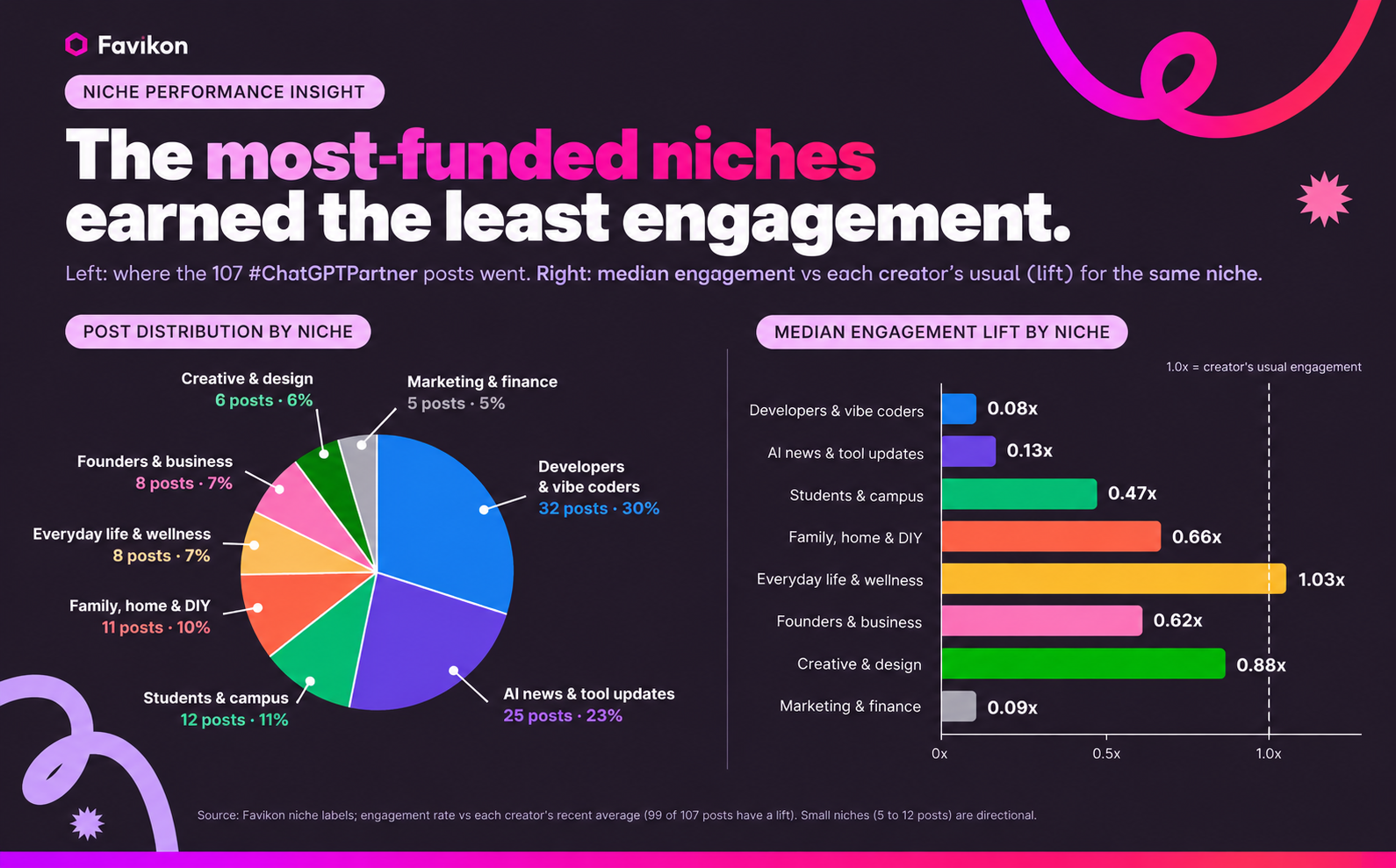
I think the unexpected niches were a smart strategy because these creators escaped the echo chamber of the tech and AI bubble. Instead of announcing a feature, they started from something people already cared about, like a new puppy or a DIY project, and then showed how ChatGPT helped them manage that. Comparing the two platforms that you can find the posts on, most of that diversity actually came from TikTok, where DIY, family, lifestyle and creative creators filled out the majority (57%) of the TikTok posts. Instagram content in the campaign stayed in AI-native niches with developers and AI news creators making up 49 of its 70 posts.
A great example within the data set is American, DIY creator Matt Turner (@rugturner), who built an optical illusion plant stand in under an hour. His video follows a clean problem-solution structure. He builds until he hits a wall, the suspension that holds the whole table up, and admits "I don't have an architecture degree, so I don't know how this works." Then he snaps a photo, asks ChatGPT what to do next, and it walks him through the hooks and chain order that finish the build. By expanding into untraditional niches in this campaign, ChatGPT was able to capture the attention of audiences that tech and AI creators would never reach.
Watch Matt's plant stand video
2. Hook With a Pain Point, Not News
Every good influencer brief should include guidance on the hook. Those first couple of seconds make or break the performance of a post. In our data, we broke down which type of hook generated the most lift in engagement, and contrarian hooks came out on top at 0.90x a creator's usual engagement.
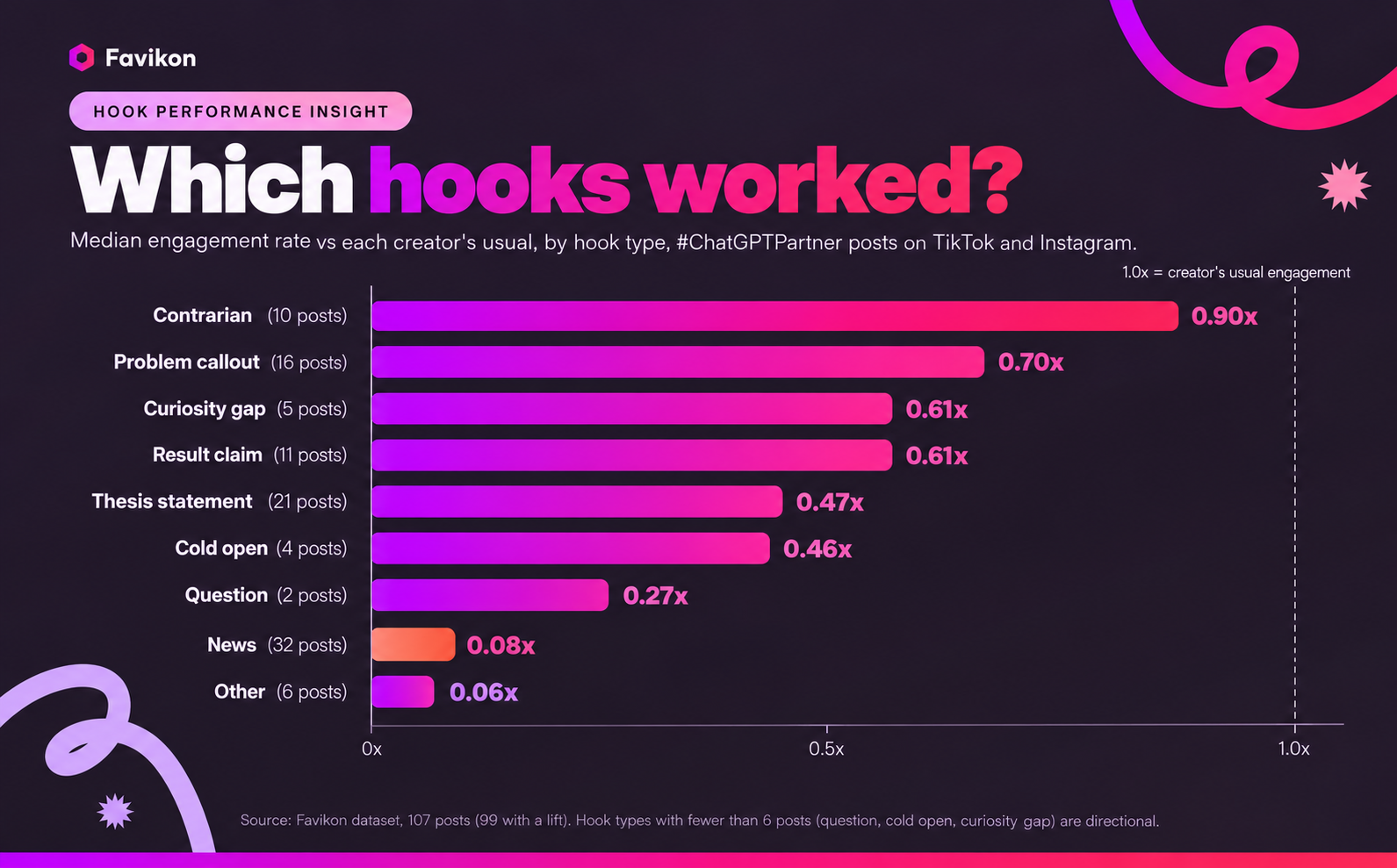
Contrarian hooks work because they challenge commonly held beliefs and create a space for discussion that naturally generates engagement. Contrarian posts drew the highest comment rate, at 1.48 comments per 1,000 views. A solid example of this hook format paying off was when Daniel Scalco (@itsbetterwithai) opened a video with "Most people don't know this, but Codex can actually take out your trash." That video landed at an impressive 1.24x.
Another hook format that did well was problem callouts performing a 0.70x average lift. Cam (@ayeeeitscamila), an influencer who falls in the student niche, led with "Aerospace job interviews are so hard." This is a pain point her student audience felt right away, and that resonance earned 1.41x her usual engagement.
Even though news-related hooks made up the largest share of posts (30%), they performed the poorest at just 0.08x. Leading with explicit announcements of product drops instantly turn people away from the content. The strength of using influencers as a mouthpiece for your brand is the automatic authenticity and consumer trust you obtain through this partnership. Jumping into content with the product immediately can break this cosmic partnership. Influencers that fell into this trap led with hooks like "GPT 5.5 just dropped" or "OpenAI just dropped a massive update to Codex". Avoid this mistake to avoid early audience mistrust and disengagement.
3. Let the Story Breathe Before the Plug
So if we shouldn't be loading the product into the hook, where does it go? The numbers gave me that answer exactly. Posts that introduced the product 25 to 50% of the way through the video did best, with a median lift of 0.70x across all posts. Introducing the product in the first 10% of the video fell dead last (0.09x) across all posts. We can assume that getting berated with the product first thing probably caused users to quickly sort the video into the "boring advertisement" category. Viewers also saved and shared the 25 to 50% posts about 16 times more often than the first-10% posts (5.71 vs 0.35 per 1,000 views).
Almost half of the posts (46%) fell for the trap of introducing the product too early. This is an easy adjustment to make to your briefs to get people to actually watch your videos instead of instantly dismissing them because they feel pitched at instead of approached. One video that stuck out in the data set was Josh Diaz's (@joshdiazfilms) TikTok which opens with the challenge of balancing work and life with a newborn. Not only is Josh's style engaging and approachable, he also doesn't plug ChatGPT until 45% of the way through the video which allows the video's narrative content to breath before the plug.
A great short form video does just that, tells a great story that people are willing to stop scrolling to watch. Almost like a short film in 90 seconds. The way that my data was harvested, I was able to distinguish the sort of "role" the product was playing in each of these short films. There are three possible roles. First the "Hero," think Clark Kent. In these videos, the product serves as a saving grace. In one video Chat's Codex tool is able to strike out a month-old to-do list and updates a designer's entire media kit independently. The "Enabler" role frames the product more as an assistant to work alongside you, plan your grocery list or remind you to feed your dog. Lastly, the "Swap" frames the product as a quicker, cheaper solution to an outdated one. This last category performed the best at 0.79x lift. This result is unsurprising since a common thread I see across successful influencer posts is presenting a tangible solution to pain points of the ICP.
4. Use Visual Demos to Introduce New Angles
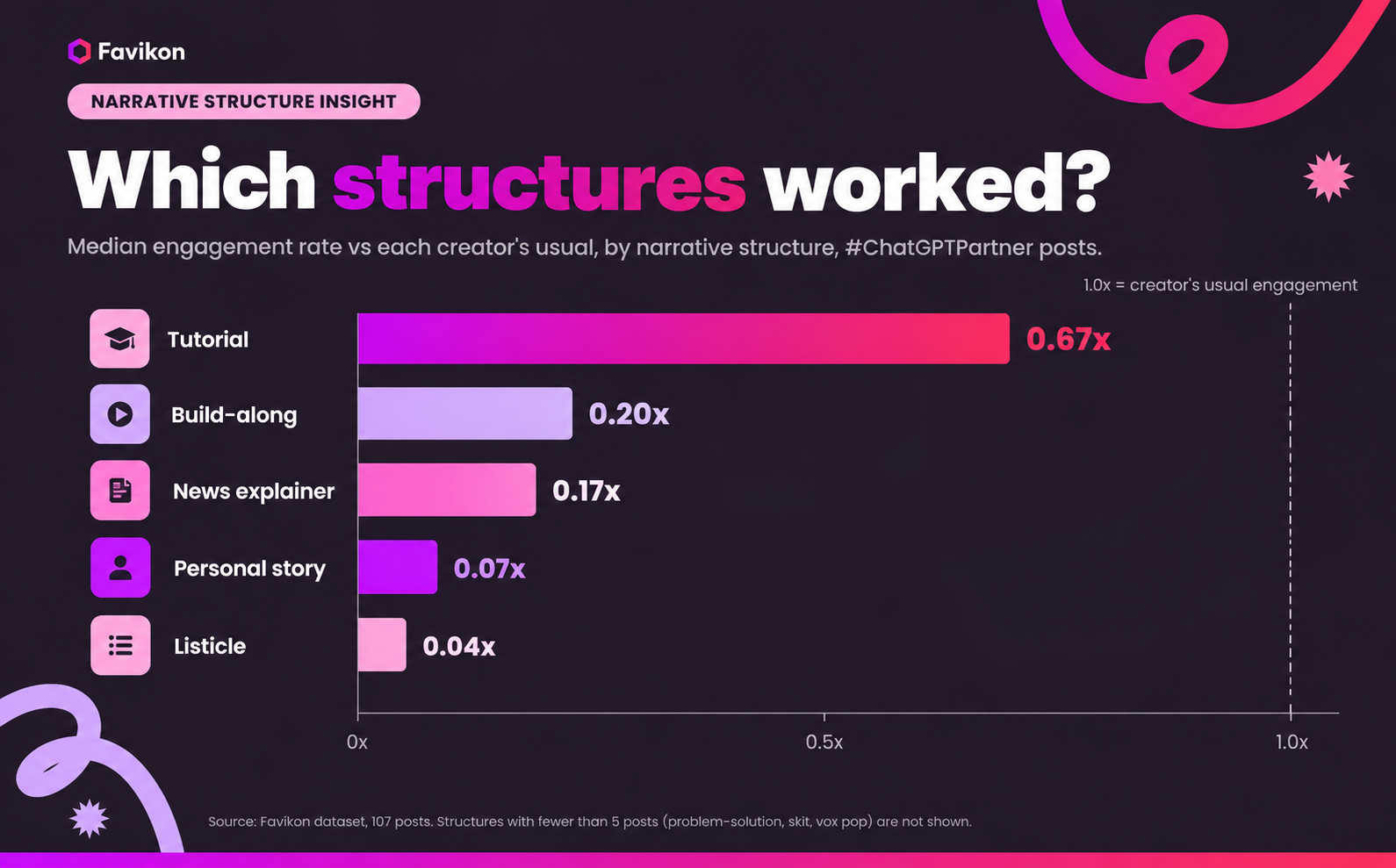
Like I said, each video is like its own story, so now we can take a look at the different structures to see which resulted in the most lift amongst the data set. Overwhelmingly, videos structured like tutorials proved to be the most effective in generating engagement. This standout stat affirms what I said earlier about sponsored content doing well if it addresses a pain point for the viewer. Tutorial videos earned a median lift of 0.67x, and made up 9 of the 19 posts that beat 1.0x. The formats that feel more like content for content's sake did worse: listicles landed at 0.04x, news explainers at 0.17x and personal stories at 0.07x.
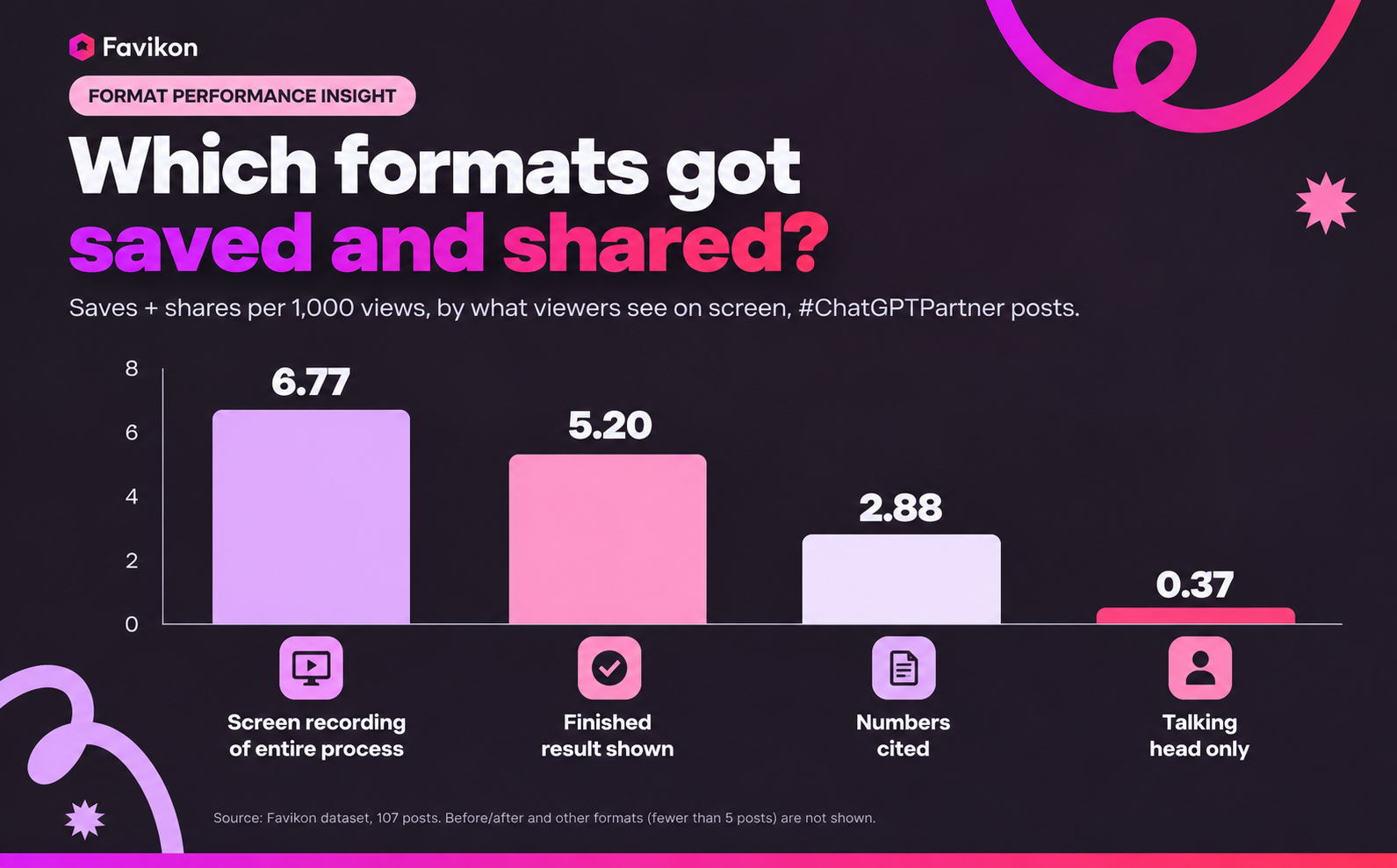
The same logic shows up in what viewers actually see on screen. The most common format by far was the talking-head-only video: 41 of the 107 posts (38%), which together brought in 51% of all views. But people rarely saved or shared them. They earned just 0.37 saves and shares for every 1,000 views, and a median lift of 0.07x, far below a creator's usual engagement. Videos with a screen recording earned 6.77 saves and shares per 1,000 views, and videos that showed the finished result (an image, a plan, a piece of writing) earned 5.20. That is roughly 14 to 18 times more saves and shares than a talking head. Visuals give viewers something to latch onto, and they make the transition to using the product itself feel seamless, because people can watch the exact steps and picture themselves doing the same. A talking head, on the other hand, can only describe the product, which leaves it abstract and hard to picture using.
A tutorial that stuck with me was Michelle Lawson's (@michellescomputer) video on Instagram in which she shows her viewers how to build a digital wardrobe that picks your outfits, inspired by a movie she loved as a kid. She walks through the whole process step by step on screen: cloning an open-source repository, pasting the link into Codex and letting it set everything up. She does this by including a screen recording of her computer above her head as she explains her process.
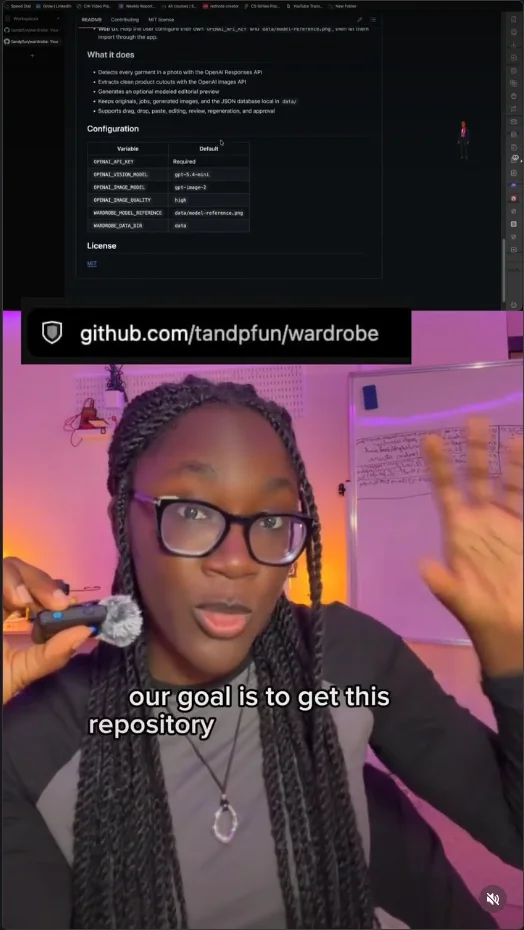
One thing I loved is that she reminds viewers it is "really easy to do, even if you're not a coder," which shows how this campaign is pushing the boundaries of who can use these tools. The video itself is also a super novel application of AI, pairing the operating system with the fashion world. It earned 0.77x her usual engagement.
Watch Michelle's digital wardrobe video
5. Real Voices Offering Real Value
The last piece of the puzzle is tone, and honestly, it might be the most important one. In order to compare the tone across all the videos in the data set, I coded every post for how the creator sounded. These categories were divided into humorous, casual, educational, analytical, hyped, or aspirational. Even though hype was the most common tone that influencers took on in these videos (42 of 107 posts, 39%), it was actually the second worst performing tone out of the 6 at just a 0.09x median lift. Despite it being so common in our data set and online, the over-hyped influencer voice comes off inauthentic and the numbers show that.
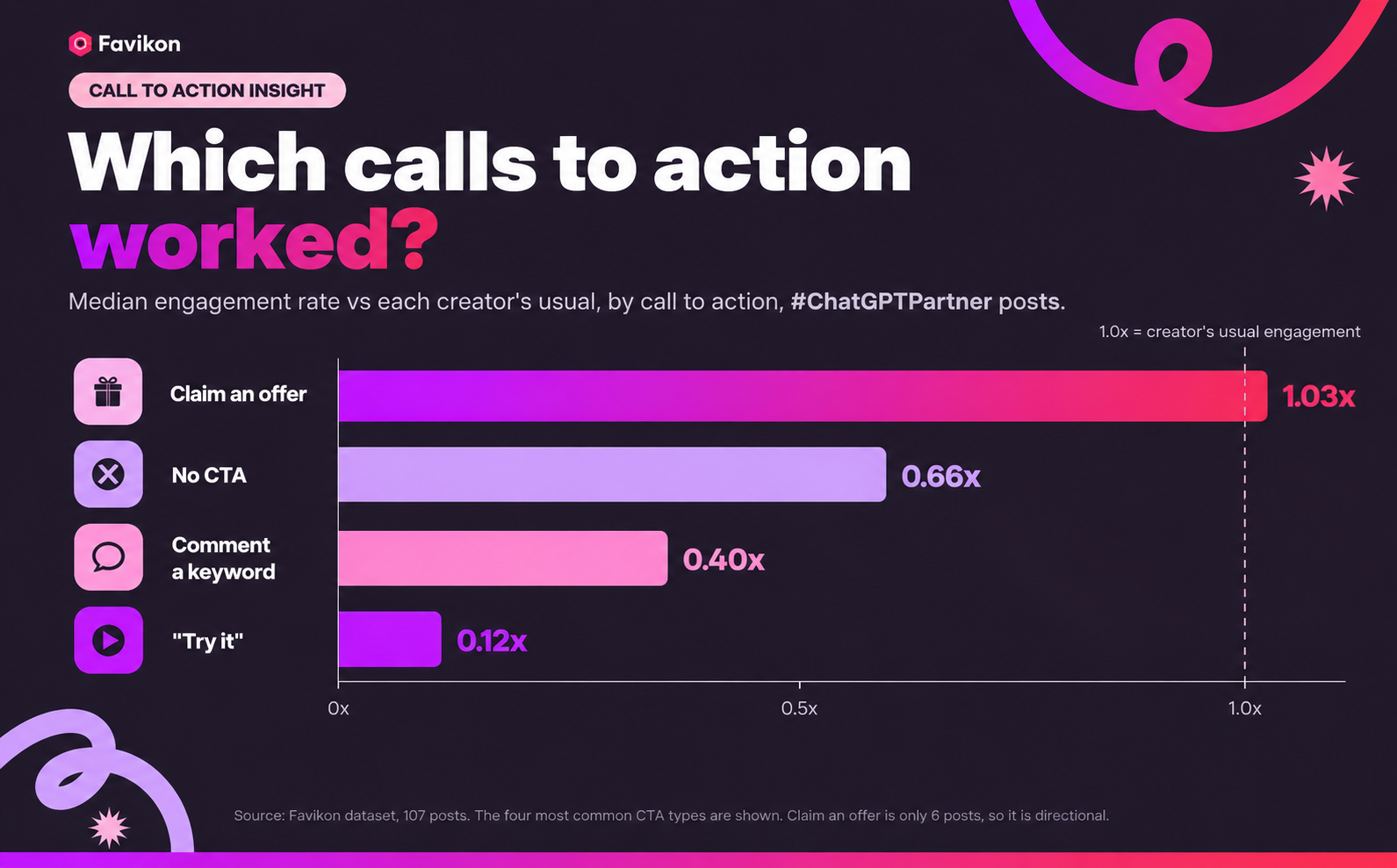
What performed leagues better were posts that allowed influencers to be themselves. Humorous and casual tones saw the most significant lift, at 0.94x and 0.56x respectively. Personality only gets you so far, though. The best briefs also give creators something valuable to offer their viewers. There were four different types of calls to action: claiming a free offer, commenting a keyword, a simple "try it," and no call to action at all. Claiming a free offer unsurprisingly won out. The videos that presented free offers earned a median lift of 1.03x, compared with 0.66x for no CTA, 0.40x for a keyword and just 0.12x for "try it."
A great example of everyday tone and a free offer being used in tandem is Sharlize True's (@sharlizetrue_) Instagram video in which she stops students on her college campus to ask what the last thing ChatGPT helped them accomplish was. It feels like a conversation between friends, not a commercial. In her caption, she gives eligible US students four months of ChatGPT Plus for free. It earned 1.58x her usual engagement, the third-highest of any post in the dataset.
What This Means for Your Next Creator Campaign
The posts that beat the average can teach us a lot. Creative applications of the product in untraditional niches earned promising engagement, which says to get creative with the influencers you hire. Think outside the box.
Second, hooks are everything, so make sure yours doesn’t sound like a bland sales pitch or a newsreel. At the same time, weave your product into the video so it works alongside the creator’s voice and existing interests.
Third, tactical tutorials take you far. On-screen visuals proved much stronger than talking-head videos alone.
Lastly, personality is good, but paired with tangible value like a free offer, it’s great.
Methodology: How We Pulled the Data
We found all public #ChatGPTPartner posts on TikTok and Instagram through Google, 174 posts in total, and kept the 128 that were actually about ChatGPT. After removing OpenAI's own accounts and posts outside the program, we analyzed 107 posts from 78 creators and matched the creators to their Favikon profiles. Each post's engagement was compared with the creator's average over the past month: 1.0x means a typical post for that creator. Group results use the median, and because Instagram counts plays as views, platforms are compared by lift rather than raw engagement. We also coded each post for its hook, structure, product role, tone, on-screen format and call to action. The data covers public posts as of October 19, 2026, and shows engagement only, not clicks, sign-ups or revenue.
Download the full dataset here → CHATGPTPartner Creative Dataset (IG + TikTok)
Others articles