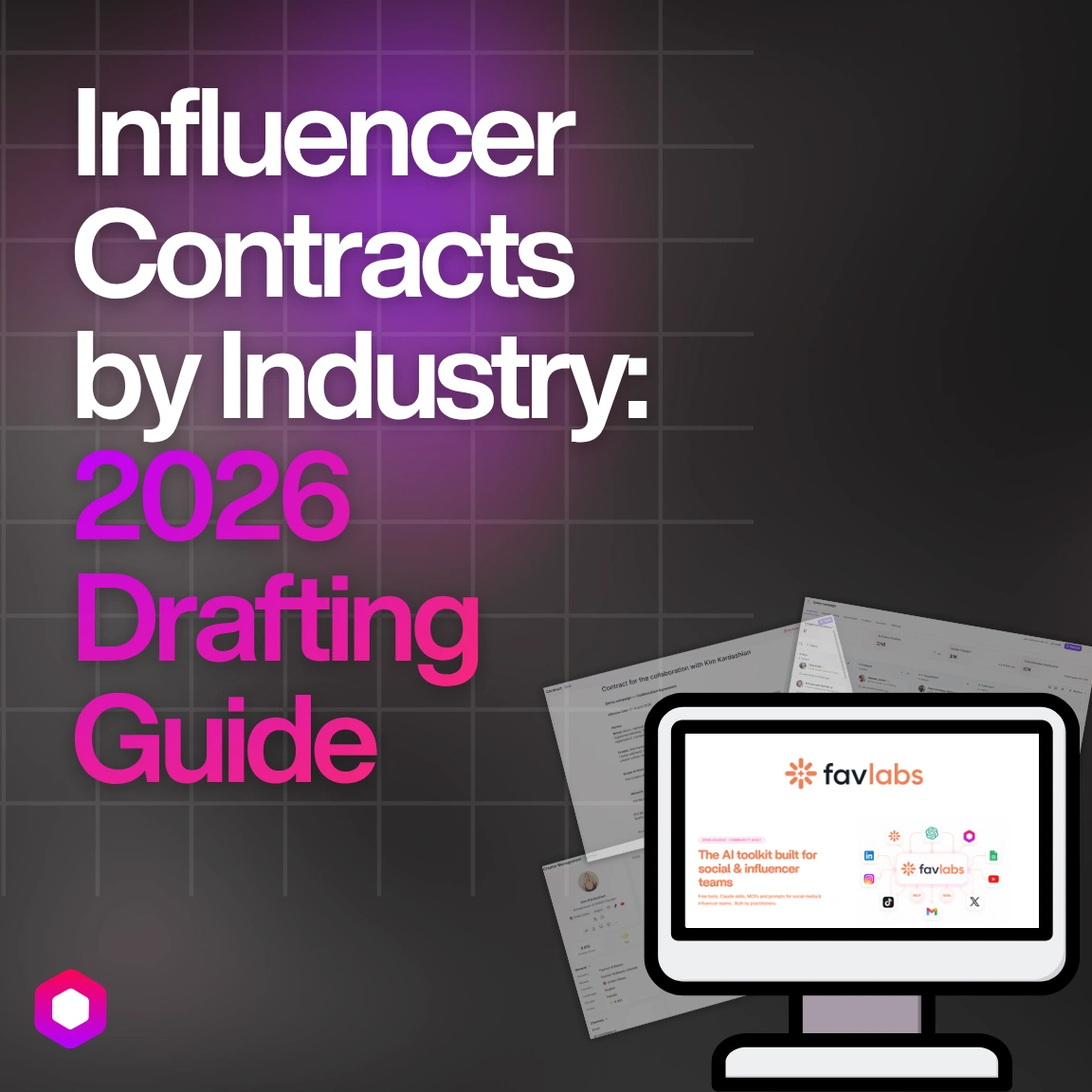
Influencer Contracts by Industry: What to Include, What to Skip, and How to Draft One in Minutes
A beauty brand and a fintech app don't need the same influencer contract. Here's what to include by industry, which clauses you can safely skip, and how to draft one in minutes.

Influencer Contracts by Industry: What to Include, What to Skip, and How to Draft One in Minutes
Skip the download-a-Word-doc advice. If you're running influencer campaigns professionally, you already know what a contract is. What you actually need to know is which of the 15 clauses floating around every "essential clauses" listicle apply to your deal, which ones are padding, and which ones will get you into real trouble if you leave them out.
That's what this guide does. It's organized by the two variables that actually change what belongs in a contract: industry (a supplements deal and a B2B SaaS deal need almost none of the same protections) and creator tier (a $150 nano-creator gifting post doesn't need the same document as a $75,000 celebrity ambassador deal). At the end, there's a tool that builds the calibrated version automatically — a downloadable Favikon Contract Generator skill for Claude and ChatGPT that asks you the right questions and drafts the contract itself, or you can generate and sign the same kind of contract natively inside Favikon without ever touching a separate template or e-signature tool.
The problem with every "free contract template"
Search "influencer contract template" and you'll find a dozen near-identical guides, this one included, until now: one generic 12-clause document, download the DOCX, fill in the brackets, done. That's not wrong, exactly. It's just built for nobody in particular.
The same template that protects a beauty brand running a $10,000 whitelisted ad campaign gets handed to someone doing a $200 gifted post with a nano-creator, and both parties end up with either too little protection or way too much friction for the deal size. Worse, generic templates tend to silently bundle things that should be priced and negotiated as separate line items — perpetual usage rights, paid amplification, exclusivity — because whoever wrote the template once just included everything, every time.
The clause-level research behind this guide (a mix of 2026 contract-law writeups, brand-side legal guides, and disputes surfaced in creator forums) converges on the same finding regardless of source: the expensive disputes cluster around three things — vague usage rights, uncompensated exclusivity, and missing disclosure language. Everything else is negotiable by deal. Those three aren't.
Personalize by industry first
Here's what actually changes clause-by-clause depending on what you're selling.
If you only take one thing from this table: the disclosure clause is never optional. It's the single clause every source reviewed for this guide agrees on, in every industry, at every deal size, in every market. FTC guidance in the US, the ASA/CAP Code in the UK, and France's ARPP all require the same basic thing — clear, conspicuous disclosure, not a hashtag buried in a block of twelve others. Some EU markets have started writing this into hard law rather than just advertising-standards guidance: France's Loi 2023-451, paired with a 2025 decree, makes a written contract legally mandatory above roughly €1,000 for influencer deals, and Spain has separate written-terms requirements for creators above a defined reach threshold. Treat that as a signal the direction of travel is toward more formal contracts, not fewer — and verify the current specifics with counsel in whichever market you're contracting in, since this is exactly the kind of detail that shifts year to year.
Then personalize by creator tier
The same clause list applied at every tier is where most generic templates lose credibility fast. A 15-clause agency-style document sent to a nano-creator for a $150 gifted post reads like overkill and can cost you the collaboration before it starts.
Nano creators and gifting-only deals: Keep it short. Scope of work, the disclosure clause, a basic usage-rights statement, and a compensation line (even if it's product-only — state the retail value) cover it. Skip exclusivity, indemnification, and formal dispute resolution; a plain notice-based termination line is enough.
Micro (roughly 15K–100K) and mid-tier (100K–1M): This is where most of the standard clause list applies as written — usage rights, a revision cap, a kill-fee structure, and exclusivity if it's relevant to the deal. Whitelisting terms become more common here, since brands running any paid amplification usually start testing it in this range.
Macro and celebrity (1M+, usually agency-represented): Treat this as a legal-review deal by default, not an exception. Deals at this scale are typically negotiated by agencies on both sides, so a strong draft is a starting point for that negotiation, not a final document. Indemnification, granular platform-by-platform usage terms, a named-stakeholder approval workflow, and milestone-based payment (signing, delivery, posting) all belong here.
The clause-by-clause breakdown: mandatory vs. optional
This is the part every generic template skips — it just lists 10-15 clauses with no indication of which ones are load-bearing.
Always include, regardless of industry or tier:
- Scope of work, as a table (platform, format, publish date, content summary) once there's more than one deliverable — not a paragraph. Vague scope is the single most common source of brand-creator disputes across every source reviewed for this guide, ahead of payment disagreements.
- Disclosure & compliance language. Non-negotiable, covered above.
- Compensation and payment terms, including when payment happens relative to posting (upfront, on approval, or split) — this alone resolves a large share of "we paid and they didn't post" and "we posted and never got paid" disputes.
- A basic usage-rights statement, even if it's the simplest version: organic reposting only, for a stated duration. The failure mode isn't usually that brands demand too much — it's that usage rights get left unstated entirely, and then a brand repurposes content into a paid ad six months later with no license to do so.
Include when the deal calls for it, not by default:
- Whitelisting / paid-usage rights, priced as a separate line item from the base content fee, not silently bundled in. If a brand is even considering running the content as an ad later, get this in writing now rather than renegotiating after the fact.
- Exclusivity, scoped to a category ("no other running-shoe brands") rather than a list of named competitors, and — this is the part brands skip most often — compensated separately. An uncompensated exclusivity restriction is a frequent source of dispute and, in some jurisdictions, may not hold up if challenged.
- A revision cap (two to three rounds is standard). "Unlimited revisions" shows up constantly in the disputes and complaints behind this research, almost always from the brand side, and it's worth pushing back on even when a brief specifically asks for it — it protects the timeline as much as it protects the creator.
- Kill fee / cancellation terms. There's no single market-standard percentage — sources range from 25% if cancelled before drafting starts up to 100% if cancelled after delivery — so don't default to a number you haven't actually agreed. Structure the tiers, fill in the percentages together.
- Indemnification, weighted toward whoever actually supplied the claim. If a brand hands a creator a script with specific product claims, the brand — not the creator — should carry the liability if that claim turns out to be wrong.
Usually skippable for smaller or lower-risk deals:
- Formal arbitration/dispute-resolution clauses — a good-faith negotiation clause covers most deals under a few thousand dollars.
- A dedicated morality clause — relevant for luxury, kids' products, or anything reputation-sensitive, unnecessary for most everyday DTC deals.
- Auto-renewal language — only relevant for retainer/ambassador structures, and even then, pair it with a clear non-renewal notice window rather than letting it renew silently.
Managing this across more than a handful of creators
All of the above assumes one deal at a time. It breaks down fast once you're running the same process across 30, 80, or 200 creators.
The failure mode isn't the clauses — it's operational. Someone's tracking contract status in a spreadsheet, chasing signatures over email, and re-typing the same creator details (handle, address, typical rate) into a new document every single time, because the last contract lives in a different tool than the creator's actual profile and campaign history. That's the same problem managing influencer relationships at scale runs into more broadly — contracts are just the sharpest edge of it, because a missed signature blocks a payment, which blocks a post, which blocks the campaign.
A creator CRM solves the "who are we even working with and what stage are they at" half of this — one system of record for every creator relationship instead of a spreadsheet per campaign. Pair that with an outreach platform for getting creators into the pipeline in the first place, and the contract step is the last remaining manual bottleneck once you're operating at any real volume.
How Favikon closes that gap
This is where Favikon's Collab Space comes in, and it's worth describing precisely rather than in marketing language, because what it actually does is genuinely different from "here's a template, fill it in."
Open a creator's profile inside a campaign, go to the Contract tab, and click New Contract. From there you have two options: generate from scratch with AI, or upload a PDF you already have. The AI option drafts a full contract using what Favikon already knows about that specific creator — their platform, their typical fee tier, and the campaign brief you've already written — instead of starting from a blank template. It fills in what it can and marks what it can't (brand legal name, signatory, exact dates) as [TO BE COMPLETED], so you're never left wondering what's actually been personalized versus what's still a placeholder.
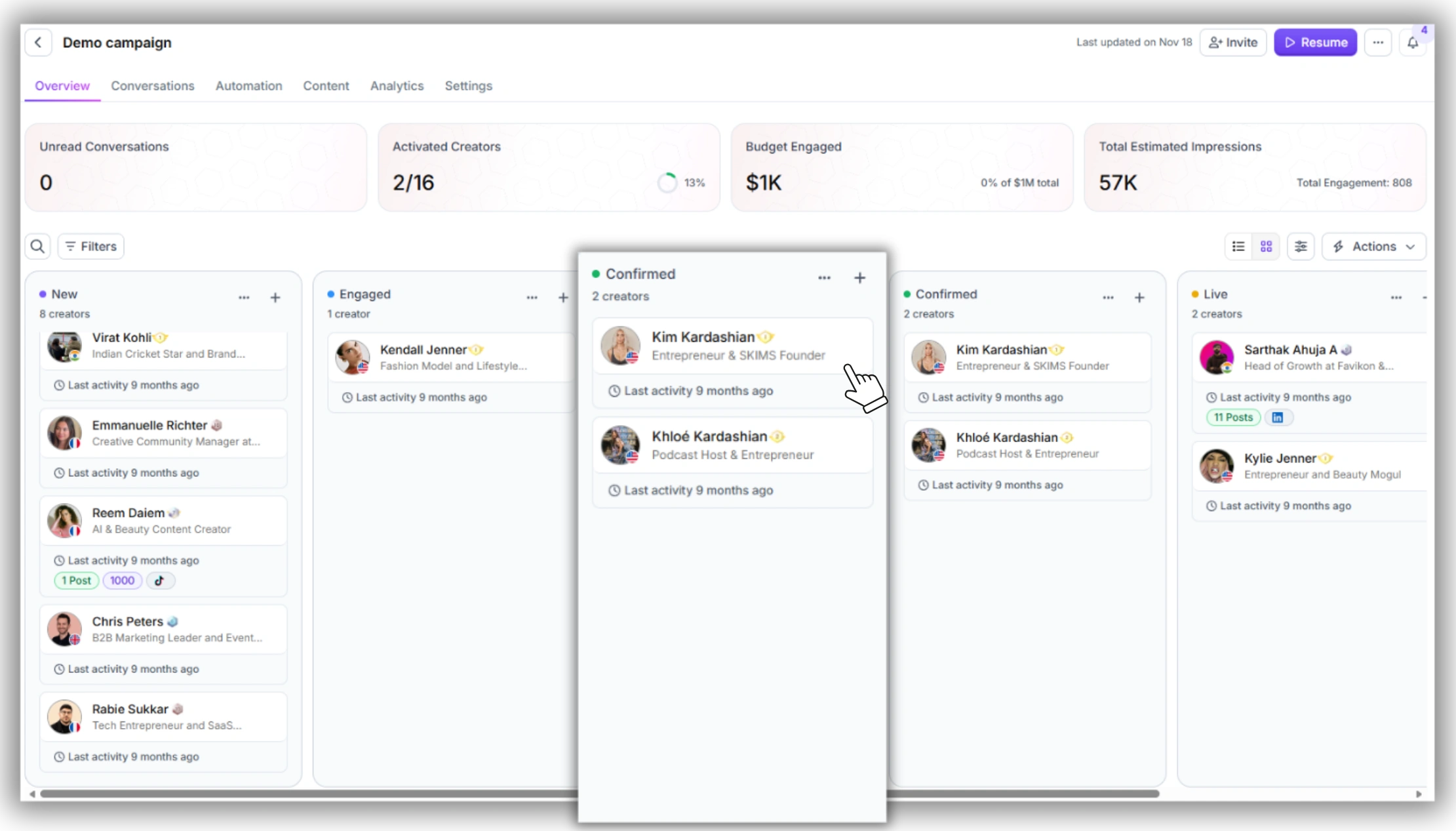
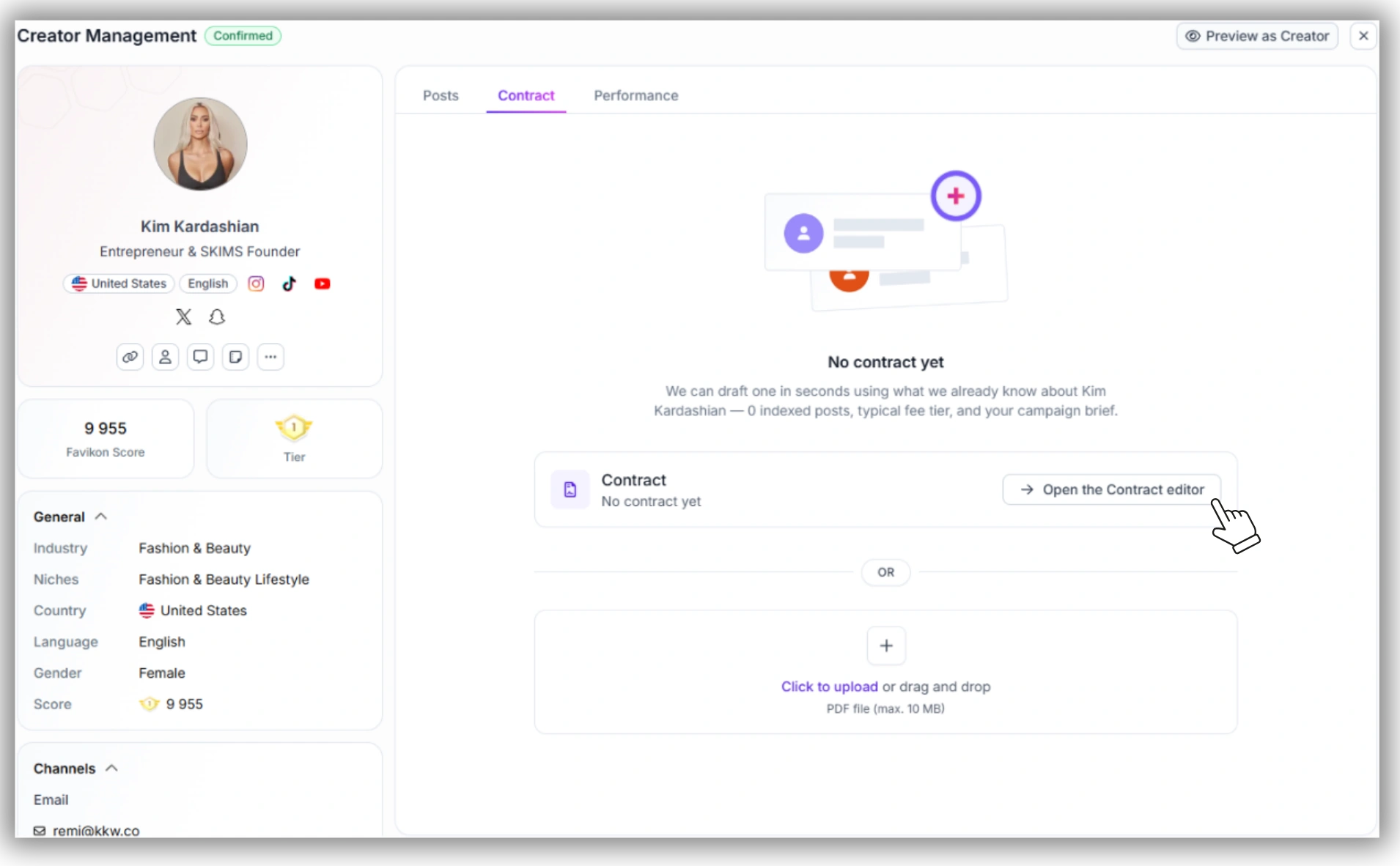
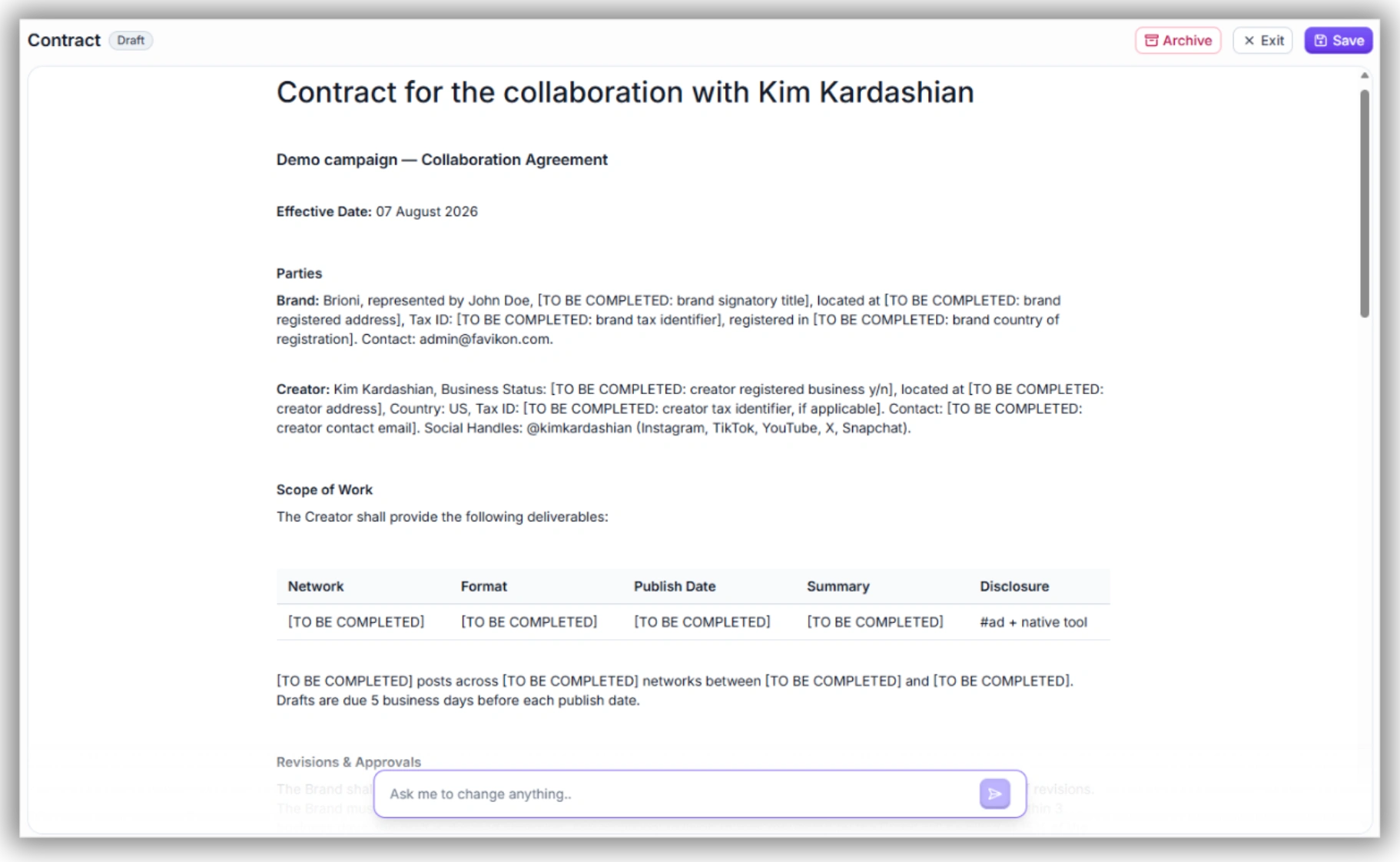
The draft itself is editable through a chat interface right there in the contract editor — "ask me to change anything" — so adjusting a revision cap or swapping in a different usage-rights clause doesn't mean re-drafting from scratch or switching to a Word doc to make edits.
Once it's ready, there's no separate step for e-signature. Contracts inside Collab Space carry legally binding, encrypted signatures with a full audit trail — draft, shared, viewed, signed, timestamped, both parties get the final signed PDF — which is the specific job DocuSign or Adobe Sign would otherwise be doing as a bolted-on second tool. Ad whitelisting status (not requested / requested / granted) is tracked alongside the contract rather than in a separate note somewhere. And because Collab Space is one shared space per brand-creator collaboration, the same place holds the contract, the post drafts and approval, the payment, and the performance results — the creator gets a simple view of their own side (read the brief, upload drafts, sign, see their own results), and nothing they can't see (other creators in the campaign, your internal notes, cost-per-click) leaks through.
For teams evaluating whether this actually replaces a template-plus-DocuSign workflow: it's built to. The Collab Space overview and the contracts, posts, and analytics breakdown go deeper into exactly how the access, signing, and tracking work if you want the full mechanics before switching over.
The Claude/ChatGPT skill: personalization without opening Favikon at all
Not everyone drafting a contract today is doing it from inside a campaign tool, and not every deal starts with a creator already in your system. For that, there's a second option: a free Contract Generator skill, built for Claude and usable in ChatGPT too, that runs the exact framework in this guide as a conversation instead of a static document.
Install it, and instead of handing you a blank template, it asks: what industry, what platform and creator tier, what deliverables, what usage rights, whether exclusivity is on the table, which jurisdiction. Based on the answers, it assembles the contract clause by clause from the same logic in the table above — pulling in the claims-substantiation language if you say "supplements," skipping the formal arbitration clause if you say "nano-creator, $200 gifted post," flagging a legal-review recommendation if you say "fintech" or "celebrity, agency-represented." Paste in a contract you've already received instead, and it runs the same logic in reverse — a red-flag check against the framework above, naming anything one-sided in plain language.
That's the actual difference from a downloadable template: a template is static regardless of who opens it. This skill reasons about the specific deal in front of you, the same way the personalization table earlier in this guide does, and it explains why it included or skipped each clause — because a pro filling out a contract should understand the reasoning, not just receive a finished document with no explanation of what changed and why.
Where to start
If the deal is straightforward — one creator, one campaign, usage rights and compensation already agreed — the fastest path is drafting it directly where the creator's profile and campaign brief already live, inside Favikon's campaign platform, and sending it for signature without leaving the tool.
If you're not ready to move the workflow into a platform yet, or you're drafting a one-off outside any campaign tool, the Contract Generator skill gets you the same calibrated output in a conversation.
Either way, the framework doesn't change: scope, compensation, and disclosure are never optional. Usage rights, exclusivity, and whitelisting get priced and written down explicitly instead of assumed. And how much contract you actually need scales with the deal in front of you, not with how many clauses a template happened to ship with.
Negotiating the terms before you get to drafting? How to productively negotiate with influencers and the fair-rates guide cover the conversation that usually happens right before this one — and the negotiation assistant skill in Favlabs handles the pricing side the same way this one handles the contract.
Others articles