The Complete B2B Influencer Pricing Guide 2026: Benchmarks, Geography, Industry & Format
B2B influencer pricing varies based on audience, industry, location, and content format. This guide shares current benchmarks to help you estimate costs, compare rates, and build a realistic campaign budget.

B2B Influencer Pricing Guide 2026: Rates, Benchmarks & Costs
Download the full PDF report here.
Most sponsored B2B posts land between $200 and $2,000 (Favikon, 136-influencer dataset), with a transacted LinkedIn median of $798 across 135 real client deals (Favikon, 2026).
Geography moves the number more than most buyers expect: Austria out-prices both the UK and the US (Margo Laz, ~200 collaborations), APAC LinkedIn CPMs run 30–60% below North America (The Smarketers, via ContentGrip), and Favikon's 125-creator survey spans $550 (UK) down to $155 (India).
Industry moves it further still — the same creator profile can cost 3x more depending on the vertical: FinTech audiences command £341 CPM vs £122 for marketing (Margo Laz), and tech creators quote a +60% median premium over the all-niche average (Janney AI, 353 real negotiations).
Format matters as much as follower count: a carousel adds +20–35% over a text post, video +40–80% (ContentGrip), newsletter placements run 1.5–3x (Influencer Advisory), and a speaking slot costs ~4x a sponsored post (Favikon survey, n=125).
Follower count sets a floor, not a price — the biggest movers are engagement, authority, niche, format and deal terms, and first quotes typically settle 15–43% below the initial ask (Janney AI, 50,000+ negotiations).
TL;DR — what you'll learn in this guide
• Core benchmarks: what a sponsored B2B post actually costs, what moves the price (7 levers), and the 6 pricing models creators and brands actually use.
• By geography: real median prices by creator country, why scarce markets like Austria out-price the US, and how to arbitrage location without wrecking ICP fit.
• By industry: which verticals pay the most per impression, why tech costs more per engagement than any other category, and a 30-second test for whether a niche premium is worth paying.
• By content type & platform: the full price ladder from a text post to a keynote, transacted medians across 7 platforms, and which formats to negotiate on CPM vs. on value.
How much does a sponsored B2B post cost in 2026? 💰
Across Favikon's dataset of 136 LinkedIn influencers (200 to 700,000 followers), single-post prices range from $10 to $7,500 — but roughly 81% of creators fall between $200 and $2,000 per post.
That range is corroborated from three independent directions. Igor Gorbenko, who runs influencer sponsorships at Ahrefs, reports that most LinkedIn creators the company sponsors in the marketing niche charge $500–$2,000 per post (quoted in the Favikon dataset above). Sam Cassman's compilation of 300+ B2B campaigns (Toksta, April 2026) converges on $400–$2,000 for a single sponsored LinkedIn post. And Mark Richard, founder of the LinkedIn agency Obvious, who has priced 2,000+ sponsored posts at a $50 CPM rule, lands most deals at $200–$2,000, averaging ≈ $700.
Favikon's own 2026 client collaboration data (149 records, 135 after cleaning) puts the transacted LinkedIn median at $798 per post — a useful anchor because these are prices brands actually paid, not rates creators declared.
Section A — Core Pricing Benchmarks
Do follower counts still set the price? 📊
Yes — but far less than rate cards suggest. Followers set a floor, not a price. In Favikon's client data the jump above 100K followers is real (the median roughly triples to $2,000). Below 100K, something counterintuitive happens: nano creators (<10K followers) out-price micro creators.
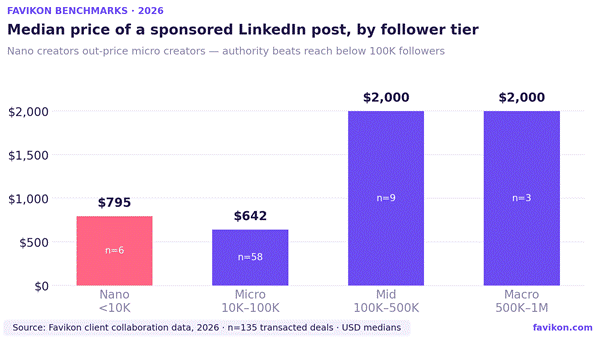
The nano premium is executive-driven: that segment is dominated by CEOs, founders and senior B2B experts. One example from Favikon's data: an 851-follower LinkedIn profile charging $2,400 per post — a SaaS customer-success expert whose audience is exactly the buying committee.
Practitioner data shows the same dispersion everywhere. Sarah Adam, Head of Influencer Marketing at Wix, sent one identical brief to 20 Instagram creators and got 20 different quotes: $12,000 from a 600K-follower creator and $2,700 from a 160K-follower creator, for the same deliverables (via Cassman, 2026). Benjamin Fredj, CEO of the YouTube agency Kast, documented two creators in the same 100K–500K tier across ~50 campaigns: one charged $700 with 335,000 average views, the other $15,000 with 6,650 — a CPM of $2 versus $2,256 for the same format.
📌 The counterintuitive one
In Margo Laz's analysis of ~200 B2B LinkedIn collaborations (Kudos Narratives, 2025), the most expensive tier was 250K–500K followers (£2,178 average) — not 500K+ (£1,247). Past that band, audience quality dilutes and prices actually fall.
Which platform costs the most? 🌍
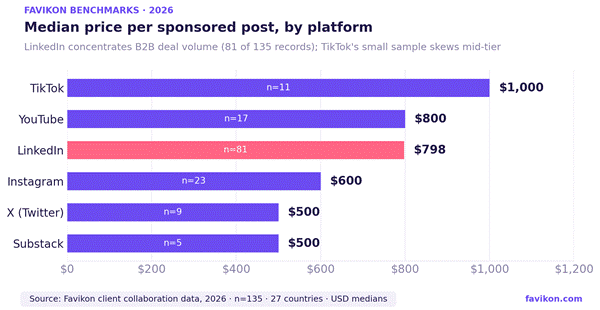
LinkedIn is where B2B budgets concentrate, and it carries a per-follower premium: ContentGrip's 2026 rate synthesis puts LinkedIn rates at 2–5x Instagram or TikTok per follower — not because engagement is higher, but because the audience is professionally verifiable. Brands pay for decision-maker density, not volume.
Geography moves the number more than most buyers expect. In Favikon's 125-creator survey, median sponsored-post prices run US $500, UK $550, France $300, India $155. And the US is not always the ceiling: Margo Laz's dataset shows Austria (£1,566) out-pricing both the UK (£947) and the US (£896) — thin creator supply commands a premium. APAC LinkedIn CPMs run 30–60% below North America (The Smarketers Q1 2026, via ContentGrip).
A post, a keynote, and a consulting hour are three different markets 🎤
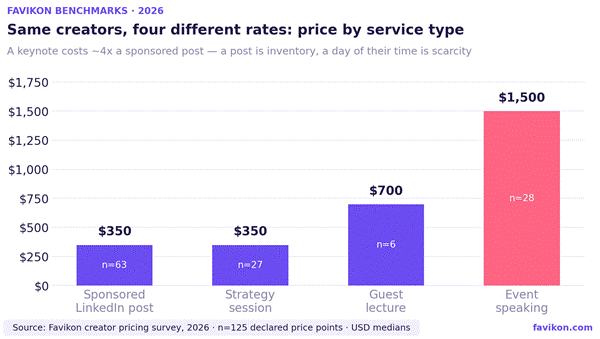
In Favikon's survey of 125 B2B creators, the median sponsored LinkedIn post and the median strategy session both sit at $350 — but event speaking commands $1,500, roughly 4x a post, among the same population of creators (Favikon survey, 2026). The logic: a post is inventory (a slot in their feed), a keynote is scarcity (a day of their time). Speaking and consulting also behave differently — a large share of speaking fees in the survey are simply "negotiable" or "price on demand." For services, B2B influencer pricing isn't a rate card; it's a negotiation.
Within feed content, format premiums are well documented: ContentGrip (2026) measures carousels at +20–35% over a text post, video at +40–80%, and newsletter co-authorship at 1.5–2x. Influencer Advisory's deal log (14 priced B2B creators, 2026) prices newsletter sponsorships at 1.5–3x the equivalent feed-post rate — subscribers are a stronger opt-in signal than followers.
What actually moves the price: 7 levers ⚙️
Favikon's own fair-price methodology starts from a follower-based baseline, then multiplies it by engagement rate and authenticity — a highly engaged, verified-authentic creator is worth 2–3x what raw audience size suggests. The full lever set, with where each number comes from:
Rate card vs. real price: the negotiation gap 🤝
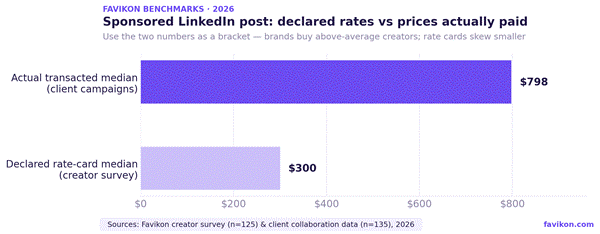
Two Favikon datasets frame the honest answer: creators' declared LinkedIn rate-card median is around $300, while the transacted median in client campaigns is $798 — brands buy above-average creators, and declared rates skew smaller. Then comes negotiation: across 50,000+ negotiations tracked by Janney AI, final rates averaged 43% below the creator's initial ask (human negotiators average 15–20%). Founder Romàn Czerny (Gojiberry) put it plainly after a $1,250 five-creator test: prices often drop two to three times if you simply push back with data (via Cassman, 2026).
Three rules before you sign:
• Always compute CPM: (post rate ÷ average views) × 1,000. Obvious negotiates everything at ~$50 CPM on average impressions — which lands most LinkedIn deals at $200–$2,000.
• DM several creators in the niche first to build your own baseline — niches differ wildly, and the first quote is rarely the price (Gorbenko/Ahrefs method, via Favikon).
• Trade value instead of grinding the fee: repurposing rights, bundles, or longer commitments unlock discounts creators are happy to give — 71% of creators offer discounts for longer-term partnerships (Janney AI, 2026).
The 6 pricing models B2B influencers actually use 🧾
B2B influencer pricing isn't one market — it's media buys, professional services and performance deals wearing the same label. The six models in the data:
• Flat sponsored post — the dominant model; a fixed fee per piece of content (63 of 125 rows in Favikon's survey).
• Newsletter placement — tiered by slot position, with bundle discounts for repeat runs (Favikon survey; Influencer Advisory).
• CPM-negotiated — fee = (average impressions ÷ 1,000) × agreed CPM; the Obvious method on LinkedIn, standard on YouTube.
• Performance / affiliate — commission or discount-code attribution; suits long B2B buying cycles (Tipalti payment-structures taxonomy, 2026).
• Pay-per-qualified-click — Naano's marketplace model: €1.90–€2.90 per qualified click, no retainer (312 campaigns, Q1 2026).
• Speaking & consulting — day rates and advisory hours; negotiated, not published (Favikon survey, 2026).
Section B — Pricing by Geography
What creators charge, country by country 🌍
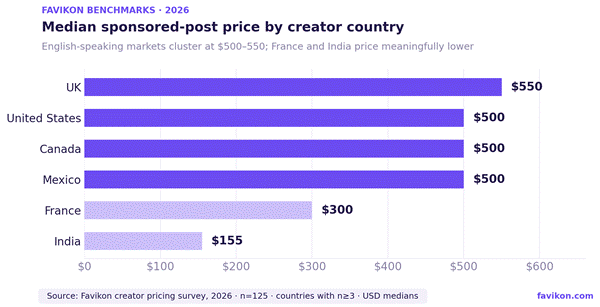
Favikon's 2026 survey shows a two-tier structure: the US, UK, Canada and Mexico cluster at a $500–$550 median, while France ($300) and India ($155) price meaningfully lower. Means run higher than medians everywhere (the US mean is $961) because every market has a thin top tier of premium creators pulling the average up.
The Austria surprise: small markets, big prices 🇦🇹
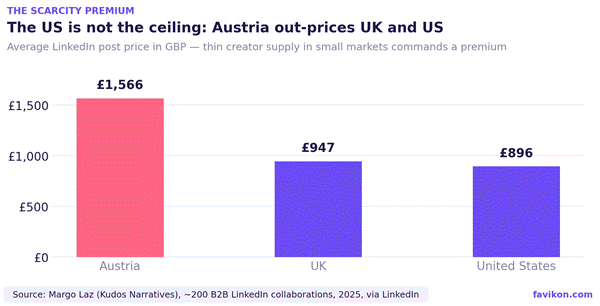
Here's the counterintuitive finding buyers keep missing. In Margo Laz's analysis of ~200 B2B LinkedIn collaborations, Austrian creators averaged £1,566 per post — 65% above the UK (£947) and 75% above the US (£896). The US has the deepest creator supply in the world; competition keeps prices efficient. In a market with a handful of credible B2B voices, those voices name their price. Expect the same dynamic in the Nordics, Switzerland, and the Gulf.
The flip side: APAC LinkedIn CPMs run 30–60% below North America (The Smarketers Q1 2026, via ContentGrip) — if your ICP includes APAC decision-makers, the same budget buys substantially more reach.
The European market has its own numbers — in euros 🇪🇺
Most benchmarks are USD and US-centric. The exception is Naano's Q2 2026 benchmark report — first-party production data from 312 campaigns and 1,847 sponsored posts on the European B2B LinkedIn market (Q1 2026). Its cost-per-qualified-click medians by vertical: marketing-ops and sales-tech €16, devtools €19, HR-tech €20, vertical SaaS €21 — with an implied cost-per-SQL around €530, versus €1,200–€1,800 reported on LinkedIn Ads for comparable audiences. For European buyers, creator-led spend is not just cheaper per post; it's cheaper per outcome.
A dollar-and-euro market, wherever the creator lives 💱
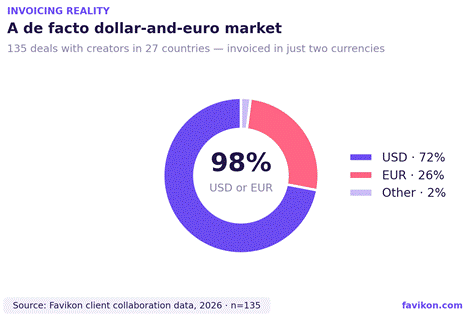
Across 135 real collaborations with creators in 27 countries, 98% of deals were invoiced in USD or EUR (Favikon, 2026). Practical consequences: budget in one of the two, expect creators everywhere to quote in them, and remember that FX shifts quietly reprice your international creator roster between quarters.
Geographic arbitrage — done right 🧭
Cheaper markets are only a bargain if the audience still matches your ICP. Three rules keep the arbitrage honest:
• Buy the audience's location, not the creator's. An Indian creator with 40% US enterprise followers is a US-market buy at an India-market price — the best deal in B2B. Always check audience geography before quoting.
• Pay scarce-market premiums only for scarce-market ICPs. Austrian rates make sense if you're selling into the DACH mid-market; they're a tax if your buyers are in Texas.
• Sanity-check with CPM, not country. (Rate ÷ average impressions) × 1,000, compared against your target market's benchmark — geography explains the benchmark, but the math decides the deal.
Not sure what a specific creator's geography is really worth? Favikon's free Influencer Price Calculator factors in audience location alongside engagement and authenticity.
Benchmark table: pricing signals by region 📋
Section C — Pricing by Industry
Which verticals pay the most per impression? 🏦
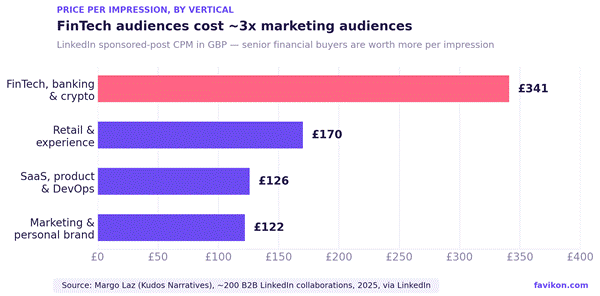
Per-impression pricing is where the sector gap is most visible. In Margo Laz's dataset of ~200 B2B LinkedIn collaborations, FinTech, banking and crypto audiences price at £341 CPM — roughly 3x marketing (£122) and SaaS (£126) audiences — even when follower counts look identical. A senior financial-services buyer is worth more per impression: deal sizes are larger, compliance narrows the creator supply, and few creators credibly reach CFOs or risk officers.
Scarcity compounds this. ContentGrip's 2026 synthesis flags cybersecurity, supply chain and enterprise fintech as structurally premium niches: the pool of creators with genuine practitioner credibility is tiny, and buyers outnumber them.
The tech premium, quantified 💻
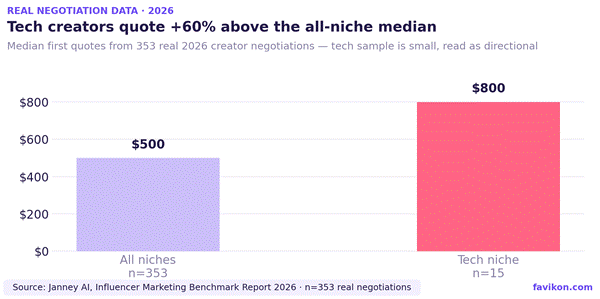
Across 353 real creator negotiations analyzed by Janney AI in 2026, the median quote across all niches was $500 — but tech creators quoted a $800 median, typically ranging $500–$2,300 (n=15, so treat as directional). Janney's Rate Card 2026 goes further: finance, legal, medical and B2B SaaS creators command 2–5x lifestyle rates, and tech/finance YouTubers with 100K subscribers often quote like lifestyle creators with 500K — the audience is high-income and high-intent.
Why tech costs more per engagement than any other industry 📉
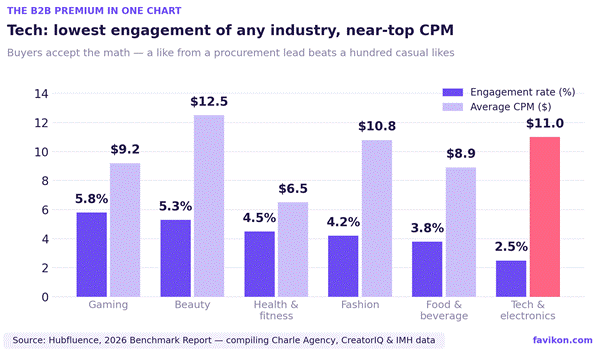
This is the chart to internalize before budgeting. In Hubfluence's cross-industry benchmark, tech and electronics audiences engage the least (2.5% vs 5.8% for gaming) yet cost nearly the most per thousand impressions ($11.00 CPM, behind only beauty). Hubfluence's read: tech lags because product cycles are longer and audiences research-shop before buying. Buyers accept the math anyway — a like from a procurement lead is worth more than a hundred likes from casual scrollers.
Favikon's pricing analysis frames this as an audience purchasing-power ceiling: a cybersecurity creator whose followers are security executives can charge far more than a career-advice creator with the same audience size, because followers who are job seekers can't sign contracts. The exception proves the rule — for low-priced products with wide ICPs, cheaper broad-audience creators can be exactly right.
Is a niche premium worth it for you? A 30-second test ✅
• The ICP-density rule: if ≥30% of the creator's audience is someone your sales team would want a meeting with, the rate almost always makes sense (Dinda Anandita, Content Collision, via ContentGrip 2026).
• The deal-size rule: premiums scale with contract value. A 3x CPM is trivial at a $50K ACV and ruinous on a $500/year self-serve product.
• The supply check: get quotes from 3–5 creators in the niche before anchoring — thin-supply niches have wide spreads, and quotes consistently skew below headline estimates (Janney AI, 2026).
Benchmark table: what to expect by vertical 📋
Section D — Pricing by Content Type & Platform
The format ladder: what each premium looks like 🪜
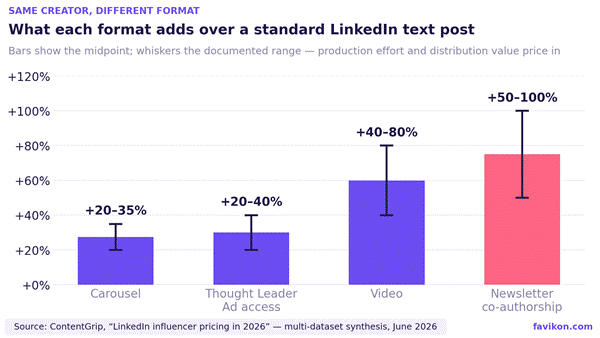
Production effort and distribution value both price in. ContentGrip's 2026 synthesis measures carousels at +20–35% over a text post, video at +40–80%, Thought Leader Ad usage at +20–40%, and long-form or newsletter co-authorship at 1.5–2x. Influencer Advisory's deal log (14 priced B2B creators) prices newsletter sponsorships at 1.5–3x the equivalent feed-post rate — a subscriber is a stronger opt-in signal than a follower, and opens and clicks are directly measurable.
Content types beyond the feed: podcasts, webinars, whitepapers 📄
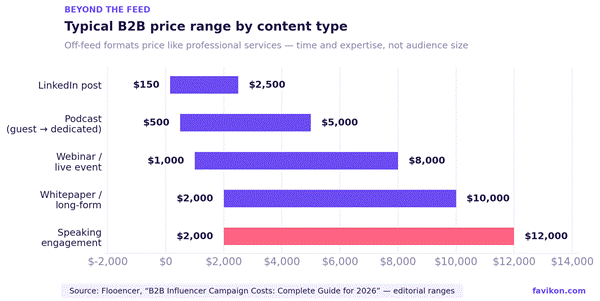
Once you leave the social feed, prices stop tracking audience size and start tracking time and expertise. Flooencer's B2B cost guide — the only 2026 source that prices off-feed B2B formats — brackets whitepaper collaborations at $2,000–$10,000 (priced like consulting work), webinars at $1,000–$8,000 (prep plus live delivery), podcasts at $500–$5,000 from guest spot to dedicated episode, and speaking at $2,000–$12,000 as a day rate plus travel. These are professional-services prices wearing an influencer label.
Platform by platform: what brands actually paid 📱
LinkedIn dominates B2B deal volume (81 of 135 records) at a $798 median. TikTok's $1,000 median comes from a small, mid-tier-heavy sample (n=11) — directional only. On YouTube, Janney AI's Rate Card 2026 prices dedicated videos at roughly 2.5x an integration, with Shorts the cheapest format; and niche technical channels justify extreme CPMs — Influencer Advisory documents a DevOps YouTube creator (1.45M subs) quoting $13,000–$20,000 for a 60-second integration on ~65K average views — a $199–$289 CPM that brands like F5 NGINX keep paying because it reaches the exact engineers evaluating the category. (Chart already shown in Section A — same underlying Favikon collaboration dataset.)
Cheat sheet: how to negotiate each format 🧩
Frequently Asked Questions
On geography
1. Why would an Austrian creator cost more than an American one?
Supply. The US has thousands of credible B2B creators competing on price; Austria has a handful. When local brands need local voices, scarcity sets the rate — the same mechanism that makes niche verticals expensive (Margo Laz, 2025).
2. Is it fair to pay creators differently by country?
Prices track markets, not effort — the honest approach is to benchmark against the creator's audience value. A creator in a low-cost country reaching US executives deserves US-market pricing; the CPM math handles this automatically and keeps negotiations fair on both sides.
3. How do I check a creator's audience geography before paying?
Ask for their analytics screenshot, or check their Favikon profile — audience-quality and geography signals are exactly what separates a bargain from a mistake.
On industry
1. Why do fintech influencers cost more than SaaS influencers?
Audience value and supply. A fintech creator's followers include senior financial decision-makers with large budgets, and compliance requirements shrink the pool of creators who can credibly post about regulated products. Both push prices up (Margo Laz, 2025; ContentGrip, 2026).
2. Should I avoid expensive niches with a small budget?
Not necessarily — expensive niches often convert better. A $2,000 post reaching 5,000 CFOs can outperform a $500 post reaching 50,000 generalists. Match the premium to your deal size, not your total budget.
3. How do I know if a niche quote is fair?
Compute CPM — (post rate ÷ average views) × 1,000 — and compare against the vertical benchmarks above, not all-industry averages. Or let Favikon's free price calculator do it from the creator's real engagement and authenticity data.
On content type & format
1. Why does video cost up to 80% more if short posts perform well?
Production time, editing, and higher perceived risk for the creator — a video flop is more visible than a text flop (ContentGrip, 2026). If the premium doesn't fit, carousels capture much of the engagement upside at a third of the premium.
2. Is a newsletter placement worth 2–3x a feed post?
Often yes for conversion goals: subscribers opted in, opens are measurable, and trial-to-paid conversion from opted-in professional lists typically beats social (Influencer Advisory, 2026). For pure awareness, feed posts deliver cheaper reach.
3. Should I pay extra for usage rights?
Only if you'll actually repurpose. Usage rights and exclusivity add 20–50% (Cassman, 2026; Janney Rate Card) — but creator copy consistently beats brand copy in retargeting A/B tests with 1.5–3x CTR lifts (Naano, Q1 2026), so if you run paid social, the premium usually pays for itself.
4. How much should you budget for a first campaign? 💸
Flooencer's 2026 B2B cost guide recommends a $15,000–$25,000 pilot — 3–5 creators across tiers, with 20–30% reserved for production and paid amplification. Nicole Ponce, who leads influencer marketing at Semrush, pegs a proper B2B creator program at $20,000–$25,000 per month including paid boosting (via Cassman, 2026). Smaller $5K tests are possible with nano creators, but a portfolio beats a single bet: Mike McConnon (Perplexity) estimates ~30% of posts flop and one exceptional winner carries the entire ROI.
5. Find the fair price for any creator — free
These benchmarks are medians; your creator is a specific case. Favikon's free Influencer Price Calculator combines rate data, engagement rate, follower count, geography and the Favikon Authenticity Score to estimate a fair price for any profile — in any country, niche or format — before you open the negotiation.
Others articles

.png)