What Is the Best SaaS Influencer Marketing Agency?
The right SaaS influencer marketing agency can help brands find relevant creators, run campaigns, and connect partnerships to business results. This guide compares leading agencies and what to look for based on strategy, creator networks, pricing, and campaign goals.

What Is the Best SaaS Influencer Marketing Agency?
I get asked this question a lot, usually in some version of "who should we actually hire for creator marketing?"
I run GTM and marketing at Favikon. We build the software layer for influencer marketing, which means I do not run campaigns for brands. What I do instead is sit one level above the work. I see which agencies pull the biggest SaaS logos, I read their case studies, I interview their founders on our YouTube channel, and I watch the data on which creators and formats are actually moving numbers.
That vantage point is useful and it is also limited, so let me be upfront about it. I have not been a client of most of these agencies. I have worked directly with one of them, and I will say so when I get there. Everything else here comes from published case studies, interviews I have personally conducted, and what I see in creator data.
One more thing before the list. There is no single best agency. There is a best agency for your launch, your budget, your platform, and your stage. I will tell you which is which.
First, a Naming Problem: Why SaaS Calls It "Creator-Led Growth"
If you search for a SaaS influencer marketing agency, half the results will not use the word "influencer" anywhere on their site. They will say creator-led growth, creator marketing, or B2B creator partnerships instead.
This is not agencies being precious about vocabulary. There are three real reasons.
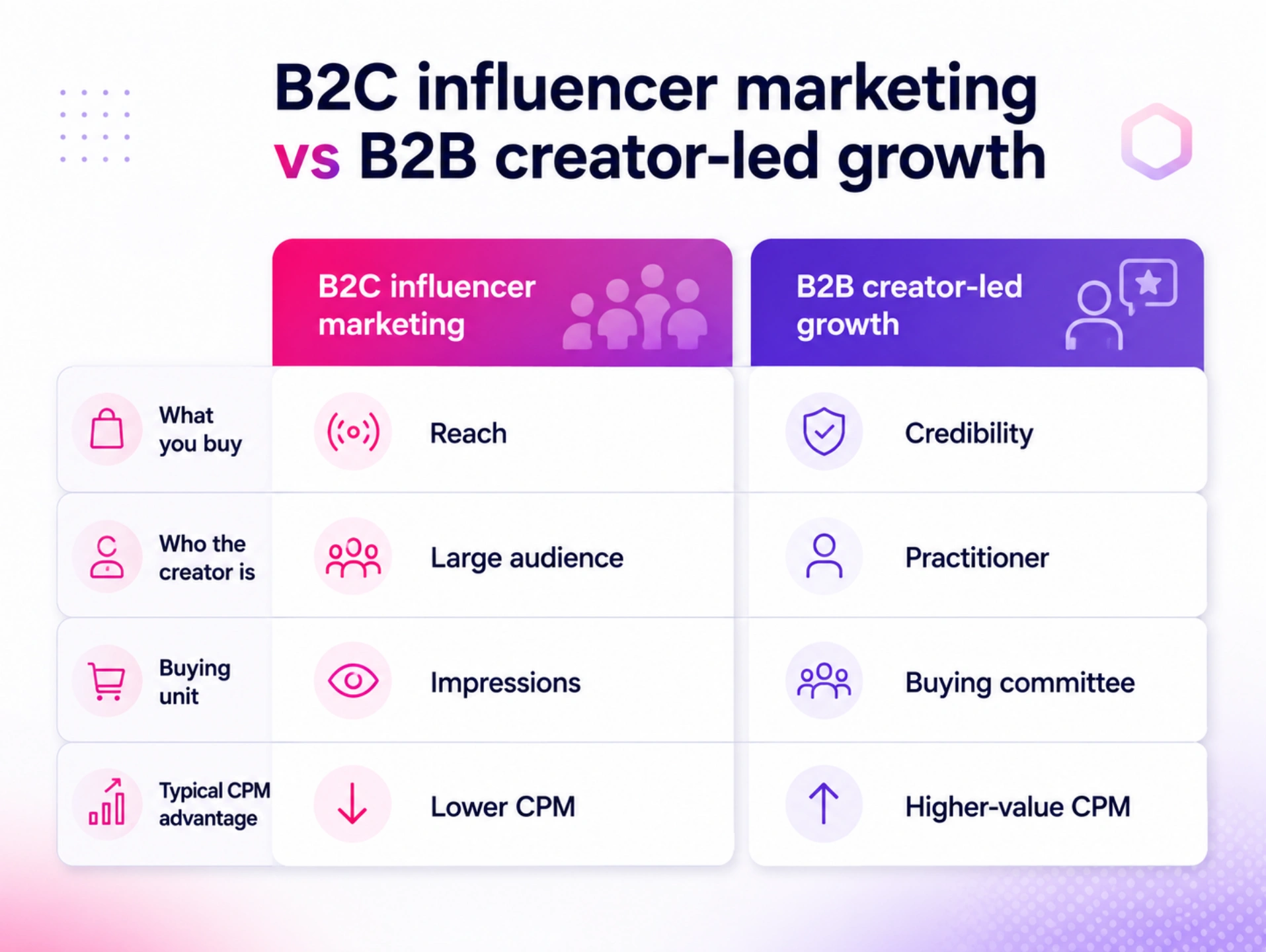
The word "influencer" carries B2C baggage. In consumer marketing, influencer usually means a person with a large audience promoting a product they may or may not use. In SaaS, the person you want is a practitioner. A demand gen lead with 8,000 followers who actually runs the workflow your product replaces. Calling that person an influencer misdescribes what you are buying. You are not buying reach. You are buying the credibility of someone who does the job.
The buying committee is the reason it works. SaaS deals are not impulse purchases. Six people read a post, one of them books the demo, and the other five nod along in the internal Slack thread three weeks later. Creator content works in B2B because it lands with the whole committee at once. That is a growth motion, not a media buy, and the label reflects it.
The economics are different enough to need a different word. On LinkedIn, sponsored creator posts running as thought leader ads come in at roughly 15 to 20 percent of average LinkedIn CPM. That is a distribution advantage, not an influence one. When your ad unit is cheaper because it is a real person's post, you are running a growth channel, not a sponsorship.
So when you read "creator-led growth agency," read "SaaS influencer marketing agency." Same discipline, different name, and the name change tells you something true about how the work is done.
If you want the full mechanics before you go shopping for an agency, our SaaS influencer marketing playbook and the ultimate guide to B2B influencer marketing cover the model end to end.
The Five Agencies Worth Knowing
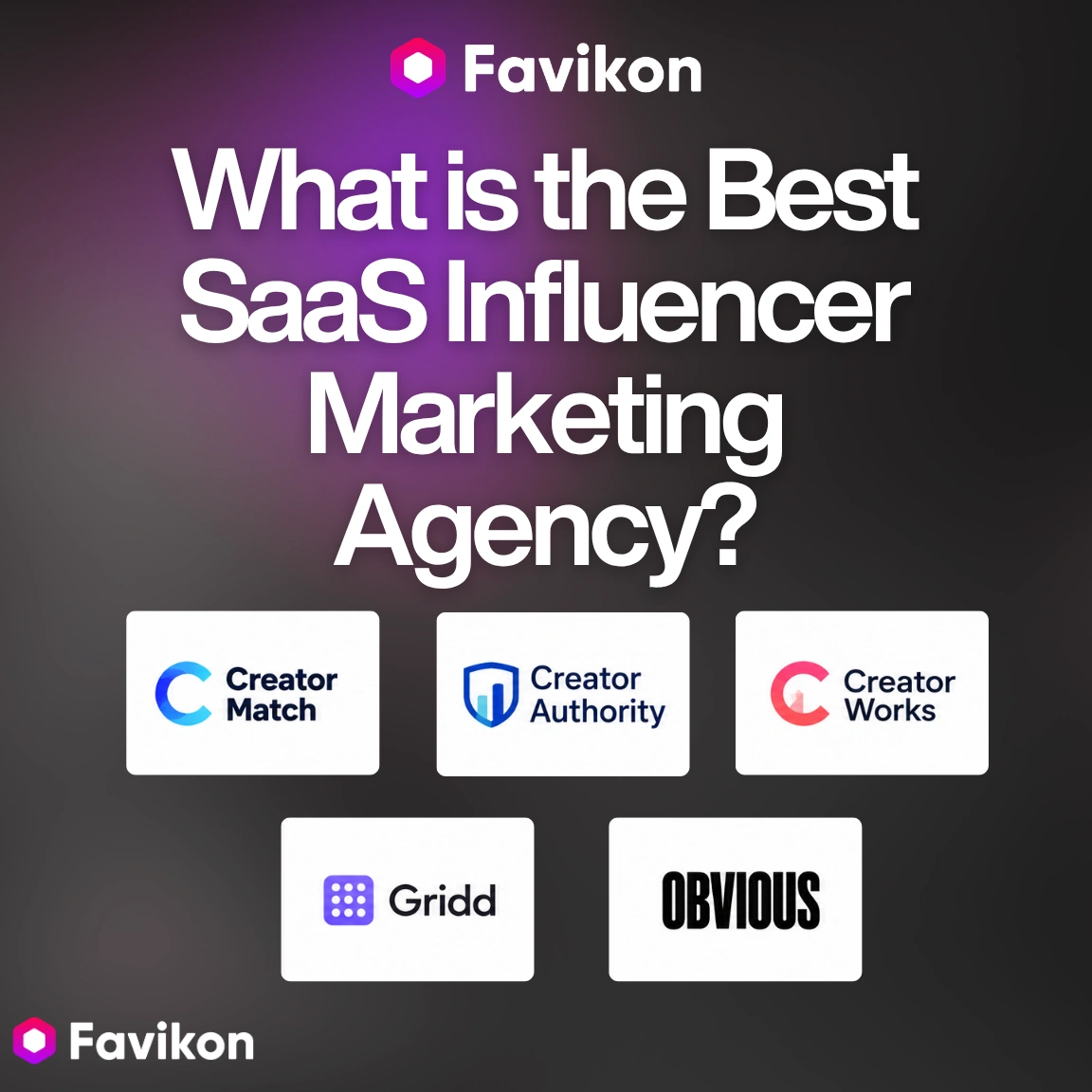
These are in no particular order. I am not ranking them because the ranking depends entirely on what you are trying to do. What they share is a genuinely strong presence among top SaaS and tech brands, and enough published work that you can verify the claims yourself.
1. Creator Match
Founder: AJ Eckstein Based in: New York City Best for: Big, culture-making LinkedIn campaigns for brands that already have some name recognition
Creator Match is probably the most visible LinkedIn creator agency in the space right now, and AJ has built that visibility deliberately. He writes for Fast Company, teaches a LinkedIn Learning course with over 200,000 students, and speaks at TEDx and keynote events. That matters more than it sounds. In a category where most agencies are invisible, having a founder who is himself a creator changes what he can broker.
The client list is the strongest evidence. Creator Match has run campaigns for Notion, HubSpot, Wix, Semrush, Adobe, Fiverr, Anthropic, Lovable, Gusto, Zapier, Teal, Scribe, Riverside, HeyGen, Opus Clip, beehiiv, Teachable, AG1, Acorns, BetterHelp, and Stanley. That spread from B2B SaaS to consumer brands is unusual, and it shows up in the creative.
What they have actually delivered
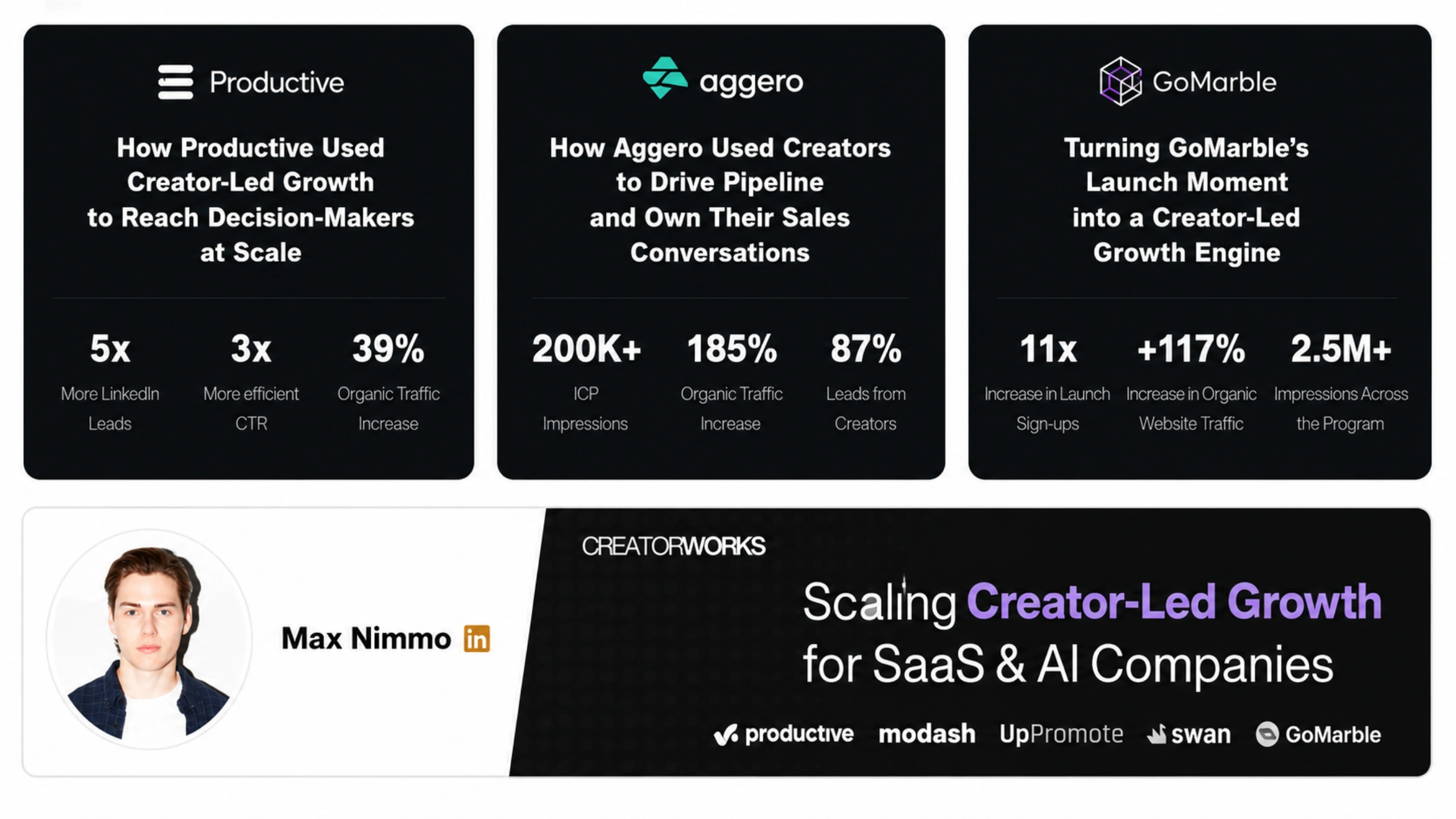
The Notion Faces campaign is the one everybody in this industry references. Notion Faces had existed internally for years as employee avatars. Creator Match turned that into a public moment.
The mechanic was simple and very well executed. Fifty creators simultaneously swapped their LinkedIn profile pictures for cryptic "LOADING..." images. Teaser posts built anticipation and pulled in over 40,000 views on their own. Then on launch day, 50+ creators posted at once around a New Year theme with custom Notion Faces.
The published numbers: a three-week campaign, 50+ LinkedIn creators, 60+ pieces of unpaid UGC from people who were not in the campaign at all, and 20,000+ engagements. Notion followed up by sending creators physical gift boxes, which for a B2B software company is not something you see often.
Notion's own team went on record. Lexie Barnhorn, Head of Social and Influencer Marketing, said she had already recommended the team to friends who reached out. Danielle Ito, their Influencer Marketing Manager, noted the team executed the whole thing in about a month, over the holidays.
The HubSpot work is a better example of the pipeline side. Creator Match ran a campaign for HubSpot for Startups covering their AI GTM Strategy report and the Million Dollar Pitch competition. Seven posts, 1.51M combined creator followers, 1.47% engagement rate. HubSpot reported more report downloads and, more importantly, higher quality applications for the pitch competition. Creators included Zain Kahn, Jade Bonacolta, Tom Alder, Connor Gillivan, Nathan Hirsch, and Rowan Cheung.
Where I would use them
If your goal is a moment. A launch, a report, a competition, a brand play that needs to be unignorable in the feed for a week. If your goal is a slow always-on lead engine with tight attribution, one of the others below is a better fit.
2. Creator Authority
Led by: Brendan Gahan (CEO and Co-Founder), with Mandi Hopper as Co-Founder and COO Based in: Ventura, California Best for: Brands that want a systematic, measurement-first LinkedIn program from someone who has done this for 18 years
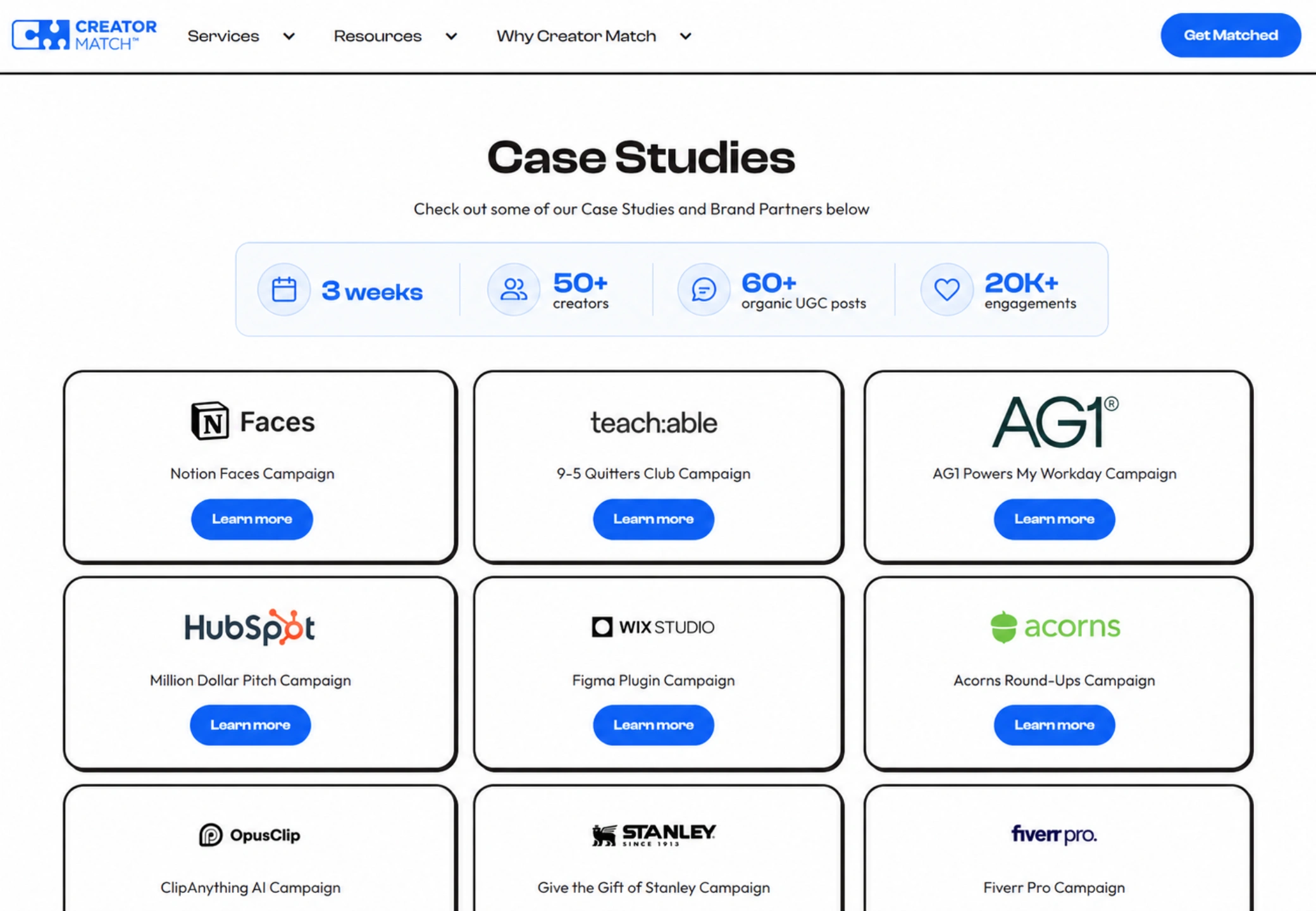
Creator Authority is a certified LinkedIn Marketing Partner, which is a real distinction and not many agencies in this space have it. Brendan spent 18 years in social and creator marketing before this, including a run as Partner and Chief Social Officer at Mekanism, where he played a key role in the agency's acquisition by Plus Company in 2022.
Their published client wall includes Notion, SAP, The Washington Post, Upwork, Sprout Social, Dropbox, and Canva. Brendan has also run LinkedIn campaigns for Klaviyo.
Why I rate his thinking specifically
We interviewed Brendan for our channel and turned his process into a full breakdown: the LinkedIn influencer playbook used by Notion and Klaviyo. A few things in there changed how I think about this category.
He picks one goal and refuses to pick two. His line was that "you can do anything, but you can't do everything." Leads or awareness. Not both. The campaign structure that follows is completely different depending on which one you choose, and most brands try to hedge and end up with neither.
He does not use follower count in creator selection at all. He looks at impressions, but only to work out budget. Selection is entirely about whether the creator has genuine category expertise and whether their audience actually trusts them. This is only possible because the model runs on paid amplification, so distribution is bought rather than borrowed.
The paid layer is the whole economic argument. Thought leader ads on LinkedIn come in at roughly 15 to 20 percent of average LinkedIn CPM, sometimes less. You are boosting content an audience already trusts instead of running cold creative. That is where the efficiency comes from.
He acts on the 80/20 fast. A few weeks into a campaign, one or two creators are usually clearly outperforming. His answer is not to fix the underperformers. It is to cut them and move the budget to whoever is working.
That last point sounds obvious and almost nobody does it, because moving budget mid-campaign means admitting a selection call was wrong.
Where I would use them
If you want a program run properly, with a real measurement layer, and you care about doing it the way an 18-year veteran does it rather than the way a growth hacker does it.
3. CreatorWorks
Founder: Max Nimmo Based in: London Best for: SaaS and AI companies that want speed, AI-assisted creator sourcing, and thought leader ads run properly
I will disclose this one: Max is a friend. I am including CreatorWorks because the work stands up, not because of that, and I will point out exactly where they are less proven than the others.
CreatorWorks is young, and the logo wall is smaller: Productive, GoMarble, Modash, Swan, UpPromote, Hopae, and Aggero. You will not find SAP or HubSpot on it. What you will find is a small team moving faster than agencies three times their size, largely because they have built AI into the workflow rather than bolting it on.
We published a case study on how CreatorWorks works and the number that stuck with me was creator sourcing dropping from around seven hours to about 45 minutes per campaign. Max runs lookalike search off two or three North Star creator profiles and expands from there, rather than starting from a blank search every time.
The results they publish
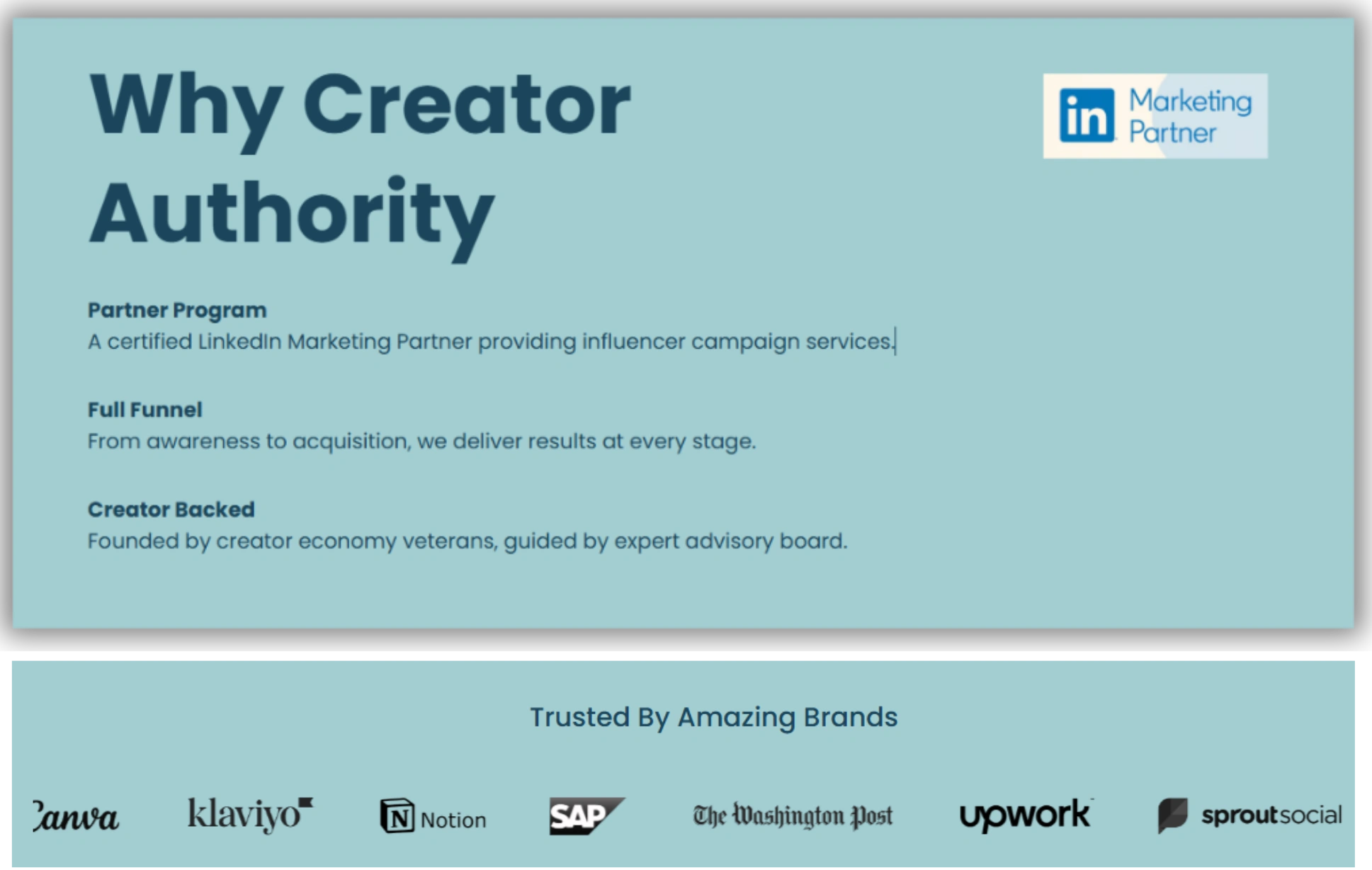
Productive launched their biggest ever product update on a fixed date. CreatorWorks onboarded 10+ creators across three cohorts mapped to actual buyers, went live in about 12 days, and reported 5x more leads from LinkedIn, 3x more efficient CTR than brand ads, 100K+ launch day impressions, and a 39% increase in organic website traffic. The detail I like most: the amplified creator posts became the best performing ads in Productive's ABM program, ahead of 500+ other creatives.
Aggero went from near-zero brand awareness to 200K+ ICP impressions at a sub £60 CPM, a 185% organic traffic increase in three months, 2x daily organic brand search volume, and 87% of leads attributed to creator activity.
GoMarble ran a launch wave that turned into an always-on program: 11x increase in launch sign-ups, +117% organic traffic, 2.5M+ impressions at around a $20 CPM, and 100+ creatives licensed out of the organic program and repurposed into paid.
What actually stands out
Thought leadership ads. Most agencies treat paid amplification as a checkbox at the end of the campaign. CreatorWorks treats organic creator posts as a live creative test, then licenses the winners and runs them as paid. That GoMarble number, 100+ validated creatives fed into paid from an organic program, is the version of this I have not seen many other agencies do at all.
Where I would use them
Launches, AI companies, and any team that wants to move in weeks rather than quarters. If you need an agency with a decade of enterprise logos behind them, this is not that yet.
4. OBVIOUS
Led by: Marc Richard, CEO and co-founder Based in: Paris, operating across France, wider Europe, and the US Best for: European tech companies, and anyone who cares more about attribution than applause
OBVIOUS is the strongest foothold in the European tech ecosystem I know of, and Marc is the person I would point to if someone asked who takes ROI most seriously in this category. Their client work includes Pipedrive and Lusha.
The distinguishing thing about Marc is that he does not consider the job done when the post goes live. Most agencies deliver a screenshot of impressions and invoice. Marc builds the attribution system first and then works backwards.
The numbers he works with
We ran a full case study on how OBVIOUS scaled their LinkedIn operation, and the operating detail is worth reading in full. A few things from it and from our interview:
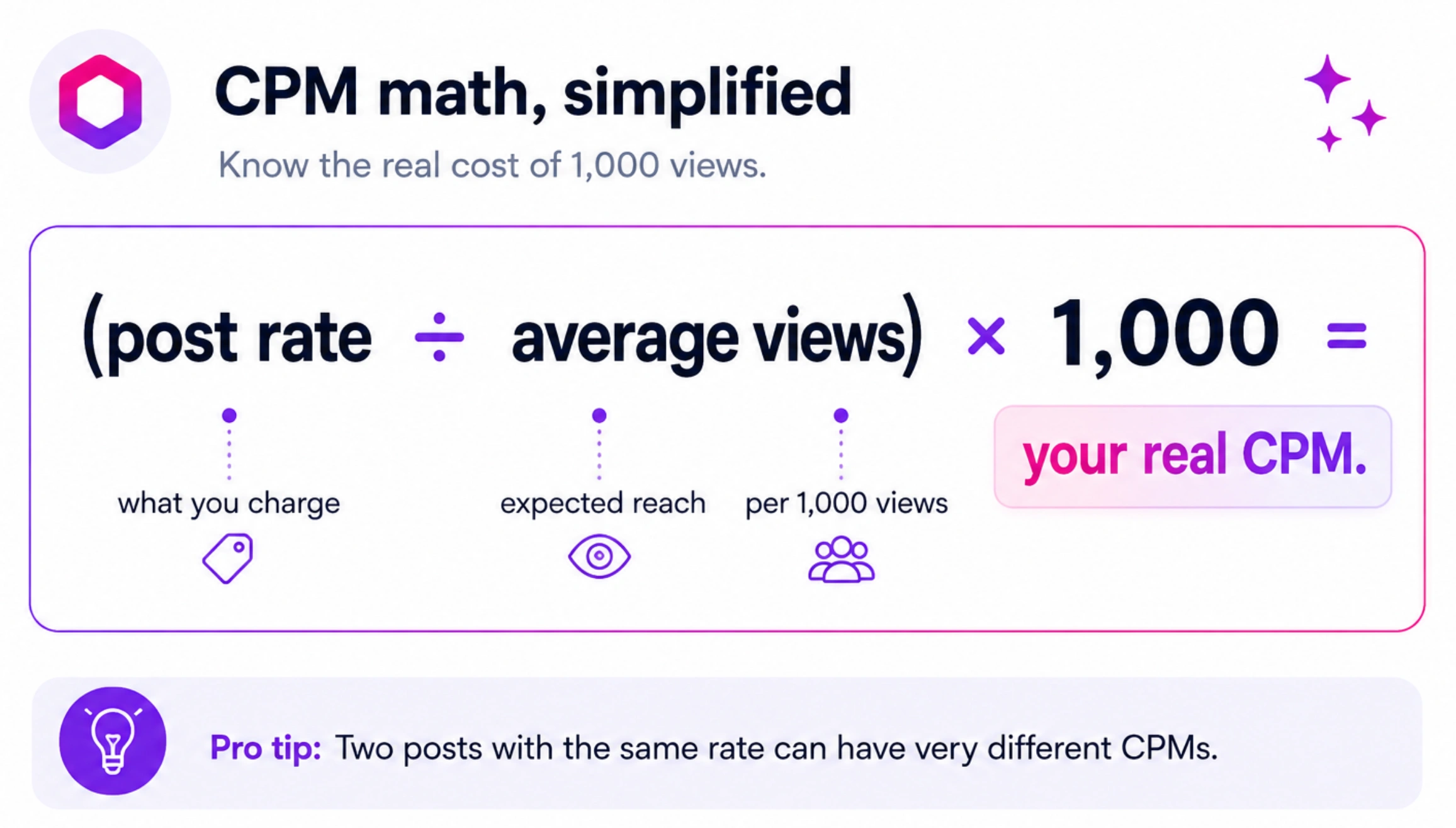
He negotiates everything on CPM math, not on rate cards. Marc has priced more than 2,000 sponsored posts against a roughly $50 CPM rule on average impressions, which lands most LinkedIn deals between $200 and $2,000, averaging around $700. On live campaigns his target range comes in tighter, at $30 to $40 CPM. If a creator's number does not work against their real average impressions, the deal does not happen.
He treats engagement pods as a budget leak, not a nuisance. His example: pay a creator $500, get 10,000 impressions, technically a $40 CPM, but almost no clicks because the engagement is pod-driven. The CPM looks fine and the campaign is worthless. He will not work with creators below a certain engagement quality threshold for exactly this reason.
He runs outbound off the campaign. This is the play I have stolen most often. After a creator post goes live, OBVIOUS pulls everyone who liked or commented, filters down to ICP, and works that list. In his experience roughly 25 to 30 percent of the people engaging with a well-targeted creator post are in the client's ICP. Most brands let that list evaporate.
His summary of what OBVIOUS is for: "generate leads, not brand awareness for our customers."
He runs a network of 800+ LinkedIn creators, mostly on retained relationships rather than sourcing fresh for each client, which is why he can move quickly on a brief.
Where I would use them
European SaaS, French market specifically, and any team whose CFO wants to see attribution rather than reach. If you want a viral moment, this is not the shop.
5. The X (Twitter) Launch Agencies
This is a completely different category and I want to be clear that I am mentioning these, not endorsing them broadly. The space is young, quality varies a lot, and I have first-hand experience with exactly one of them.
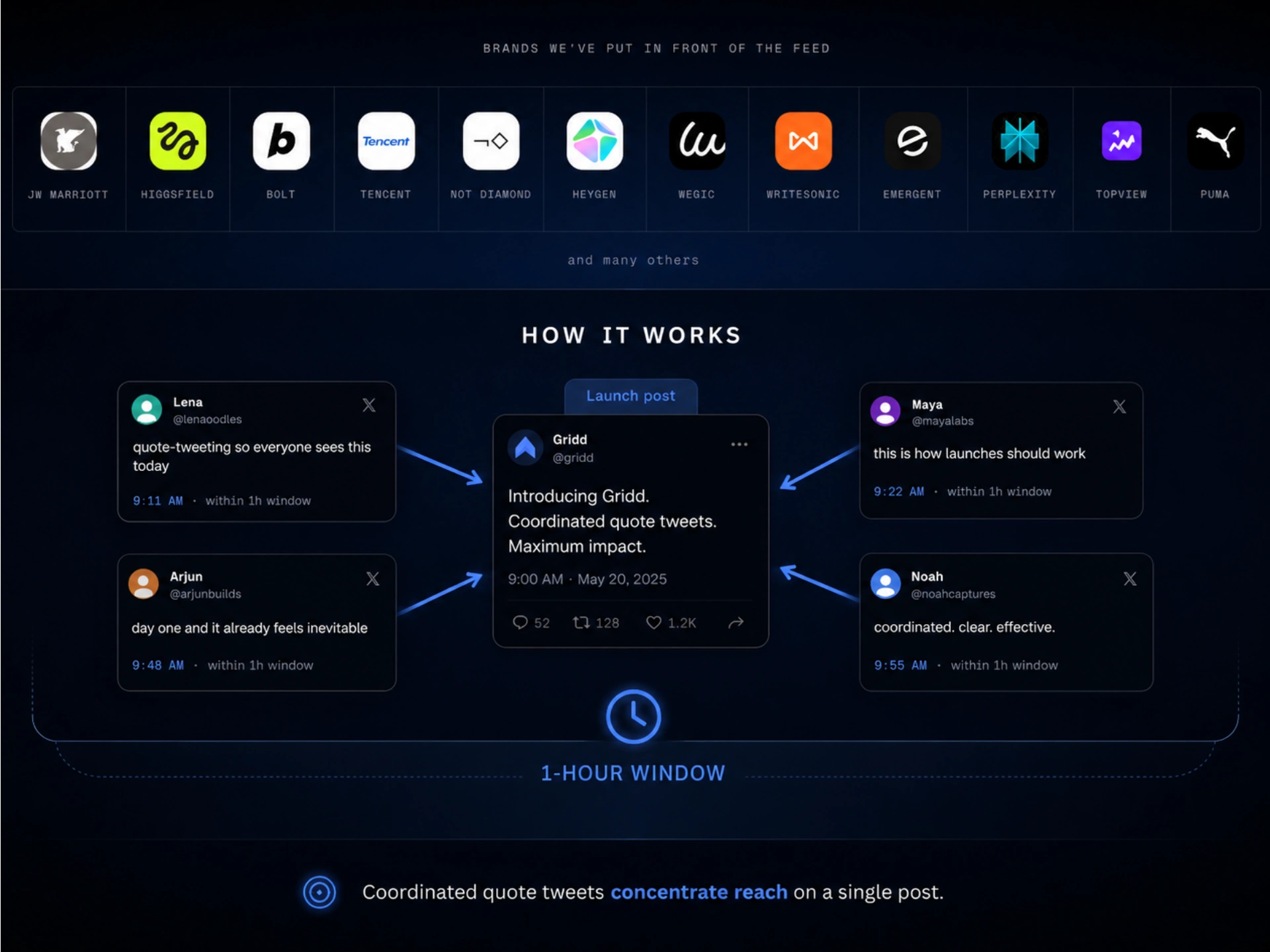
Where the four agencies above build programs, X launch agencies do one thing: they get a coordinated wave of creators to amplify your launch inside a short window so the algorithm reads it as one event instead of seven separate ads. They are essentially a pool of creators who have figured out how the timeline works.
I worked with Gridd for a product launch. They coordinated creator posts around our launch and we ended up with over 100,000 views on the video. That is a real number from a real campaign, and I would use them again for a launch.
Their model is a roster of 500+ vetted creators on X. You post your launch, you pick who makes the cut against your budget, and the selected creators quote tweet your original post inside the same window so the reach compounds on one post rather than scattering. Flat fee, rates quoted upfront, every quote tweet disclosed. Gridd is run by Madni and Sidd, and their published brand list includes Perplexity, Bolt, HeyGen, Higgsfield, Tencent, Writesonic, and Emergent.
Where I would use them
Product launches. Specifically AI and developer tool launches, where X is genuinely where the audience is. This is a spike tactic, not a growth channel. Do not confuse the two, and do not expect attribution.
So Which One Should You Pick?
Here is how I would actually decide.
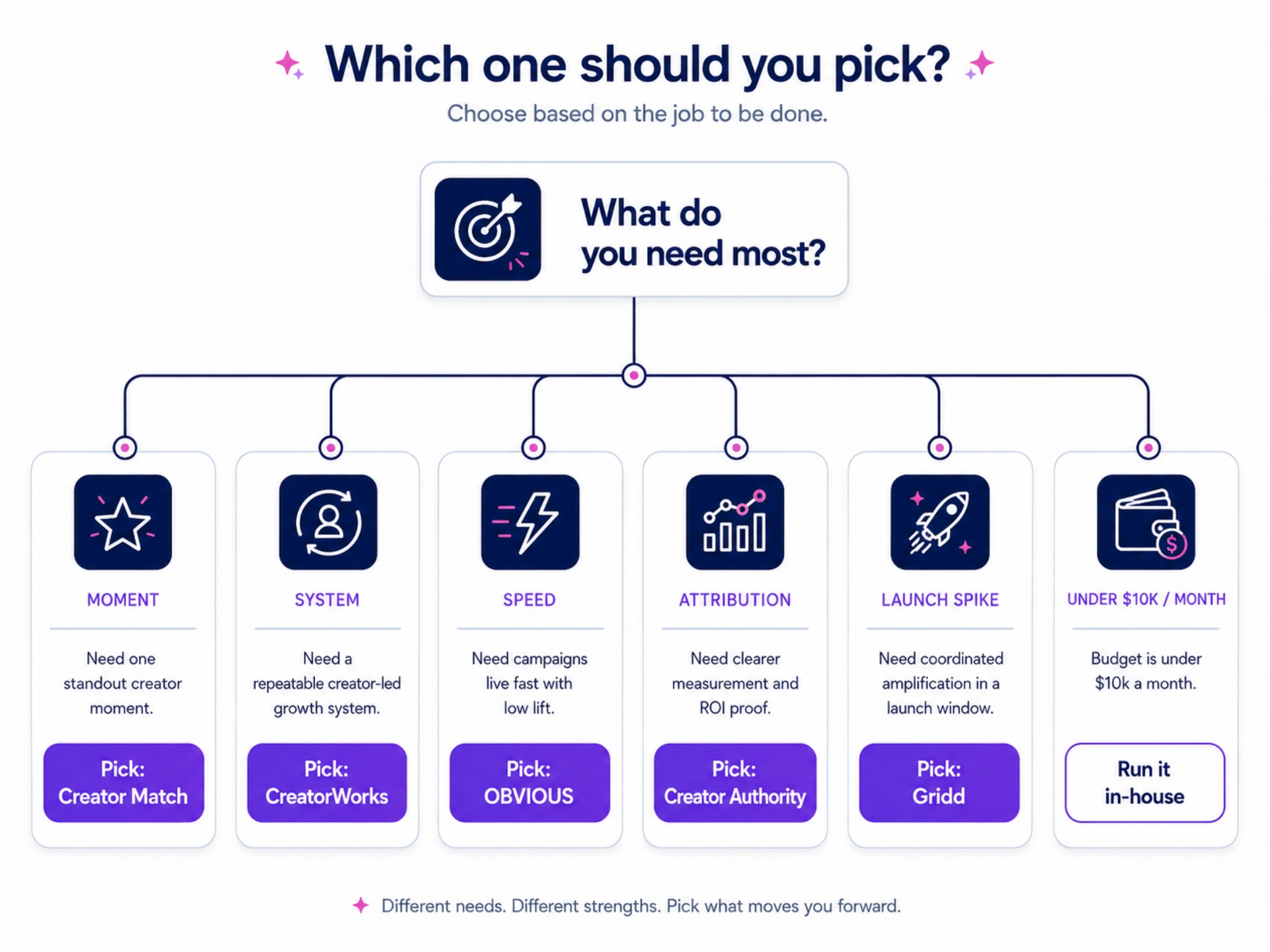
Pick Creator Match if you want a moment. A launch, a report, a competition, something with enough creative ambition that people screenshot it. They have the biggest creator bench and the strongest brand roster.
Pick Creator Authority if you want a systematic program from someone with the longest track record, run as a proper measurement exercise with paid amplification at the center.
Pick CreatorWorks if you are a SaaS or AI company that needs to move fast, and you want thought leader ads treated as a first-class part of the program rather than an afterthought.
Pick OBVIOUS if you are European, or if the thing standing between you and a budget approval is attribution.
Pick an X launch agency if you have a launch date, an AI or dev tool product, and you want a spike on the timeline.
And there is a fifth option that nobody selling you agency services will mention: run it yourself. If your budget is under roughly $10,000 a month, an agency retainer eats a large share of what should be going to creators. We wrote a full guide on running influencer marketing in-house because a lot of SaaS teams at that stage are better off with a platform and one person owning it.
That is what Favikon is built for. Find LinkedIn creators who match your ICP, check their authenticity scores before you pay anyone, and run the campaign end to end without a spreadsheet. Every agency on this list uses tooling like this. Two of them use ours.
If you are still deciding whether creator marketing is the right channel at all, start with the ultimate guide to B2B influencer marketing. If you are already sold and just need to know what to pay, our 2026 B2B influencer pricing guide has the transacted benchmarks, and the attribution guide covers how to prove any of it worked.
→ Explore the B2B Influencer Marketing Platform
Disclosures
I lead GTM and marketing at Favikon, an influencer marketing and creator analytics platform. OBVIOUS and CreatorWorks are Favikon customers and we have published case studies with both. Creator Authority contributed to a Favikon editorial breakdown. Max Nimmo of CreatorWorks is a personal friend. I have worked directly with Gridd as a paying client. I have no commercial relationship with Creator Match. None of these agencies paid to be included and none reviewed this piece before publication.
Others articles