Are We Measuring Creator Influence Wrong? Followers vs. Engagement vs. Authority Score
Favikon Tracker data from 197 Payments & Fintech creators shows that follower count, engagement rate, and Authority Score can tell very different stories about creator influence. Here’s what these gaps mean for marketers and why follower count alone may not be enough.
%20Mosashvili.png)
Are We Measuring Creator Influence Wrong?
Based on Favikon Tracker data from the Payments & Fintech niche: 4,579 posts across 197 creators, tracked April–July 2026.
You can size up almost any creator in five seconds: check the follower count, glance at views if you're feeling thorough, done. This dataset says that five-second read misses most of the picture. Reach, engagement, and authority behave like three separate things and sometimes they pull in opposite directions on the same account.
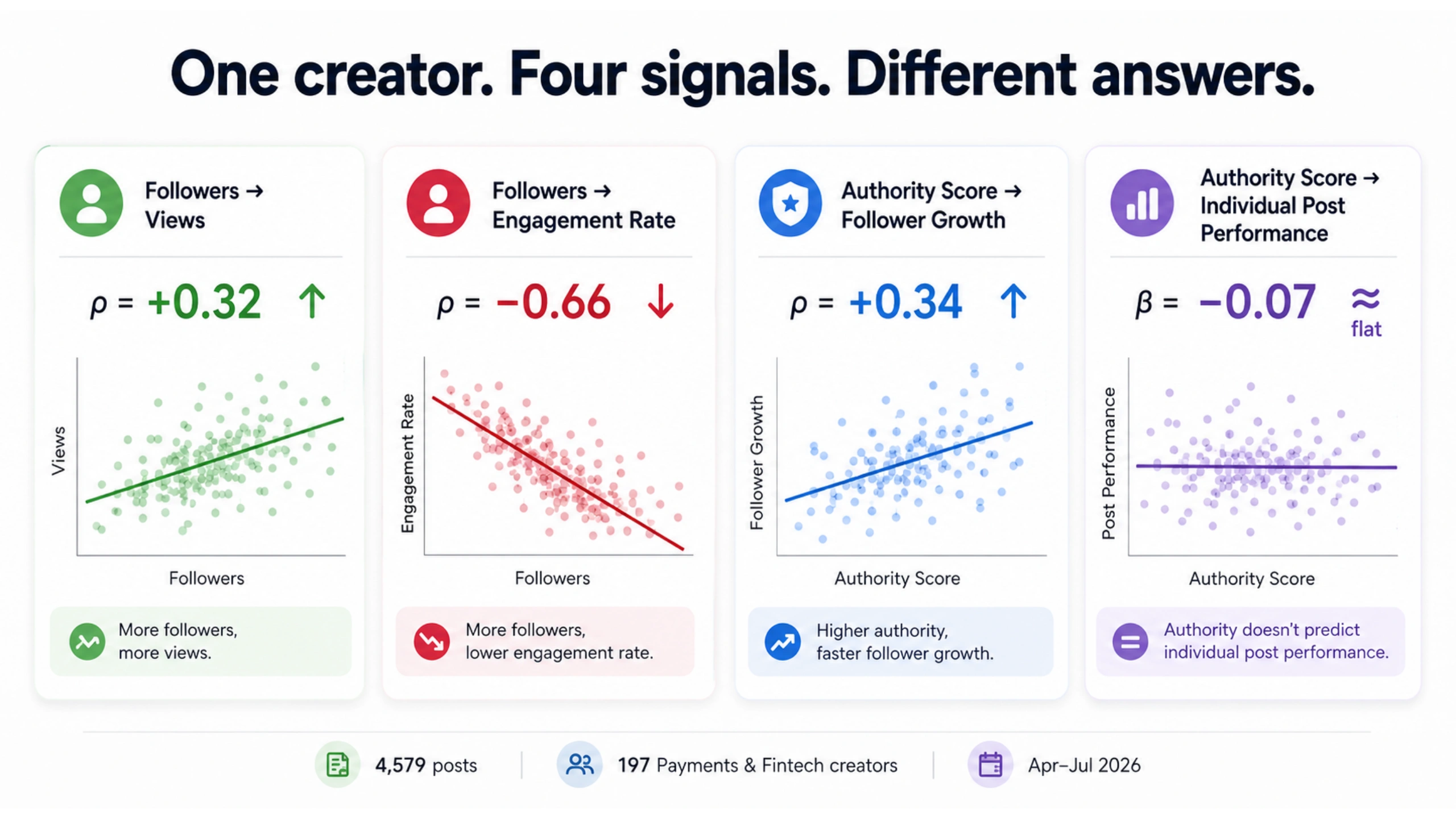
Four correlations make the case.
1. Followers → Views: ρ = +0.32
Bigger accounts get seen more. Not a surprise, and worth naming first because it's the one number that behaves the way everyone assumes it does. But +0.32 is moderate, not commanding - it leaves a lot unexplained. Plenty of smaller accounts in this dataset out view much bigger ones on individual posts, and plenty of large accounts post things that go nowhere. Follower count buys you odds, not outcomes. Treat it as a loose ceiling on potential reach, not a guarantee of it - the rest of the gap between could be seen and was seen is coming from somewhere else entirely, and this correlation alone doesn't tell you where.
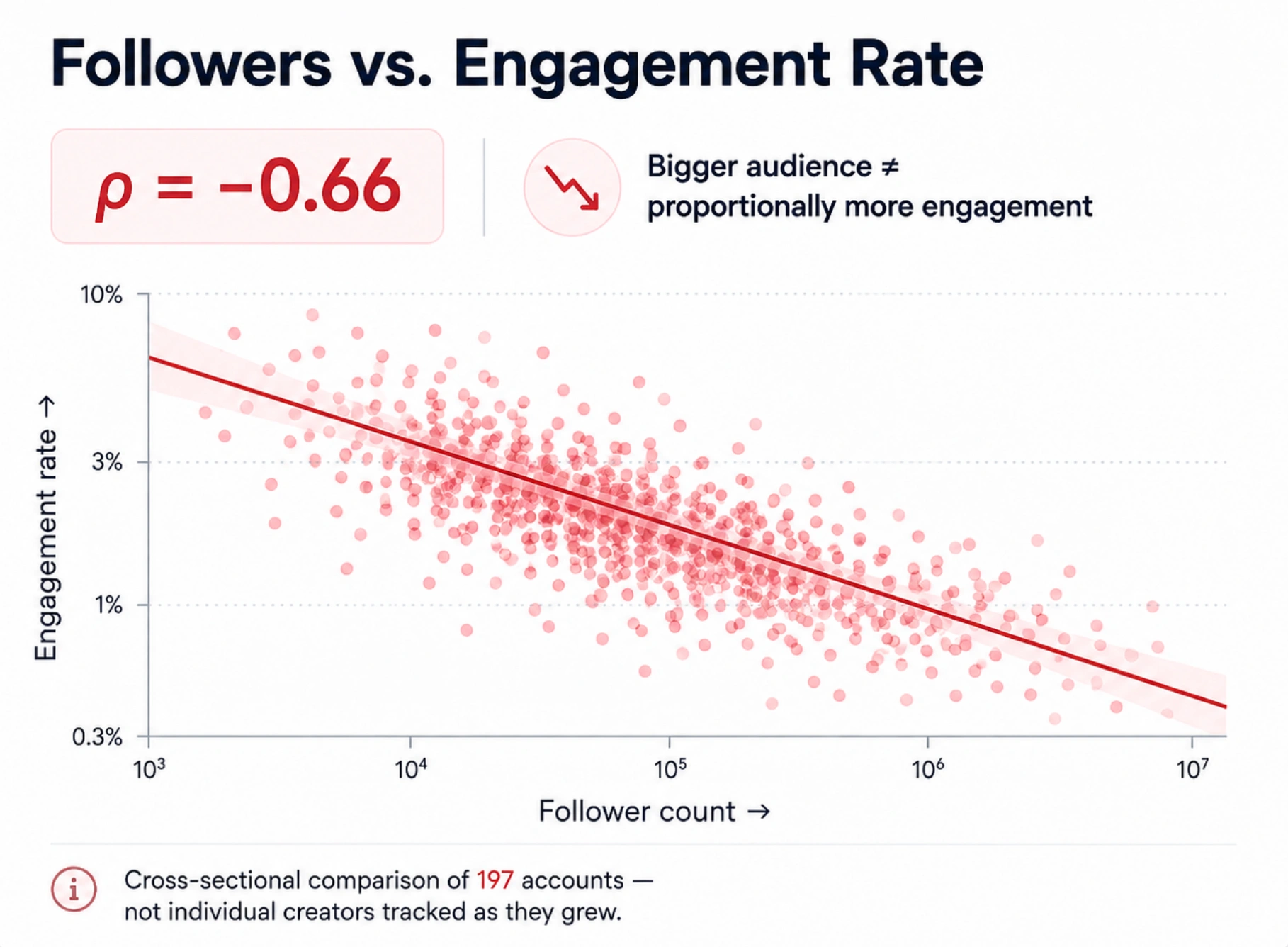
2. Followers → Engagement Rate: ρ = −0.66
Here's the one to actually sit with. The strongest correlation in the entire dataset, and it runs opposite to what most people assume. Across the account sizes in this sample, bigger accounts consistently show a lower share of viewers engaging - liking, commenting, sharing. A creator with 200,000 followers isn't worse at engaging people than one with 8,000. They're reaching more people who are, proportionally, less likely to respond to any given post.
Worth being exact about what this is. It's a comparison across 197 different accounts of different sizes, measured in the same four-month window - not one account tracked as it grew. A −0.66 tempts you to picture a single creator's engagement rate sliding as their following climbs. That's not what was measured. What was measured is that, in this snapshot, bigger accounts had lower rates than smaller ones.
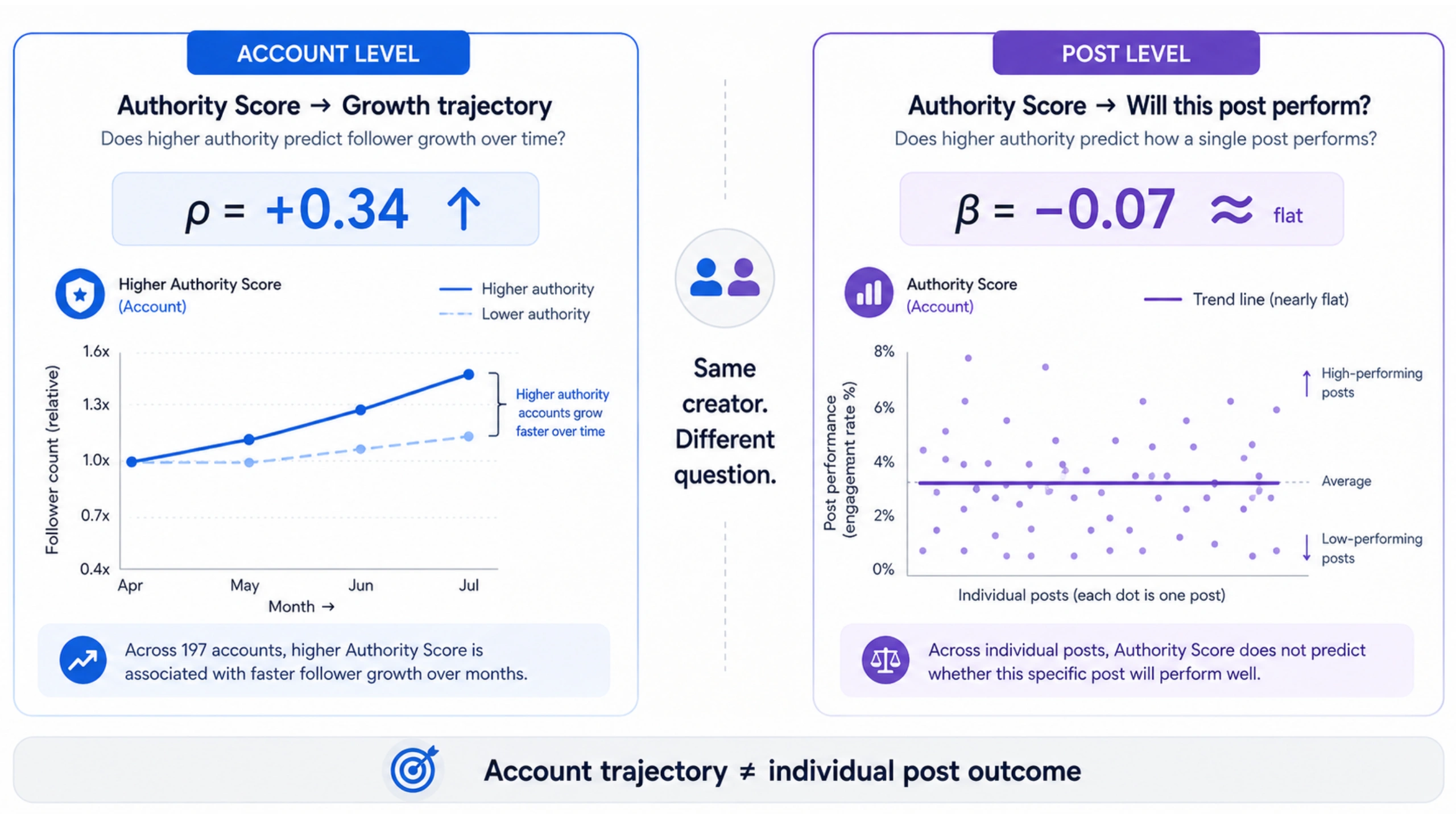
3. Authority Score → Follower Growth: ρ = +0.34
Favikon's Authority Score — a composite standing separate from raw follower count — is associated with the growth accounts showed during this window, regardless of how many followers they already had going in. A small account with a high score and a large account with a high score both shows the same association with growth.
That independent of existing follower count part is what makes this number matter. If Authority Score were repackaged follower count, that independence wouldn't show up. It does, which means the score is tracking something that doesn't collapse into size. That's a meaningful distinction for anyone using Authority Score as a shorthand - it isn't standing in for big account, it's picking up a separate sign the follower count alone can't give you.
4. Authority Score → Individual Post Performance: β = −0.07 (flat)
Once you control for follower count, Authority Score tells you almost nothing about whether any single post did well. If anything, the relationship tips slightly negative.
Looks like it should contradict finding three. It doesn't - they're answering different questions at different resolutions. Finding three is about the account's growth pattern across the whole window. Finding four is about one post on one day. An account can have a strong score-to-growth association and still publish a post that falls flat, because that's simply not what the score tracks at the individual-post level in this data. The two findings sit next to each other without conflict once you separate account trajectory over months" from "one post's fate.
What This Adds Up To
Line up the four and nothing points the same way. Followers predict views but predict engagement rate in reverse. Authority Score predicts growth but says nothing about any given post. Influence isn't one number pretending to be four things - it's four different things, and most people are only checking one of them.
Reach, engagement rate, and authority-as-growth are distinct signals here, sometimes moving in direct opposition. Any single metric used alone - follower count, views, engagement rate - is describing one axis of a creator's standing, not the whole thing. The −0.66 alone should kill the assumption that these numbers move together across accounts of different sizes. They don't. If anything, they move apart, and the four correlations above are the specific evidence for that, not just a general impression.
What This Isn't Saying
It isn't saying small accounts are more authentic, and it isn't saying engagement rate is the truer metric while reach is the vanity one. That's the tempting misread of a correlation this strong - turn a −0.66 into a morality tale about big accounts being somehow worse. The data doesn't support that. A negative correlation tells you two things move in opposite directions across the accounts measured. It doesn't crown a winner, and it doesn't explain the mechanism. A lower engagement rate at scale could come from any number of mechanical realities about content reaching a colder, less-invested audience as it spreads wider - plausible, but not something this dataset confirms. It has the correlation. It doesn't have the why, and it's worth resisting the urge to fill that gap with a tidy explanation just because one would feel more satisfying than the data doesn't say.
The Practical Read
Check one number on a creator and you'll get misled, because these four numbers don't agree with each other.
Followers count alone tells you about reach and quietly implies a comparatively lower engagement rate - nothing about whether the account's Authority Score points toward continued growth. Engagement rate alone tells you how one audience responded in one window - nothing about growth trajectory. Authority Score alone tells you about that growth association - nothing about whether last Tuesday's post landed with anyone. Each metric, checked alone, is a partial read wearing a complete one's clothes.
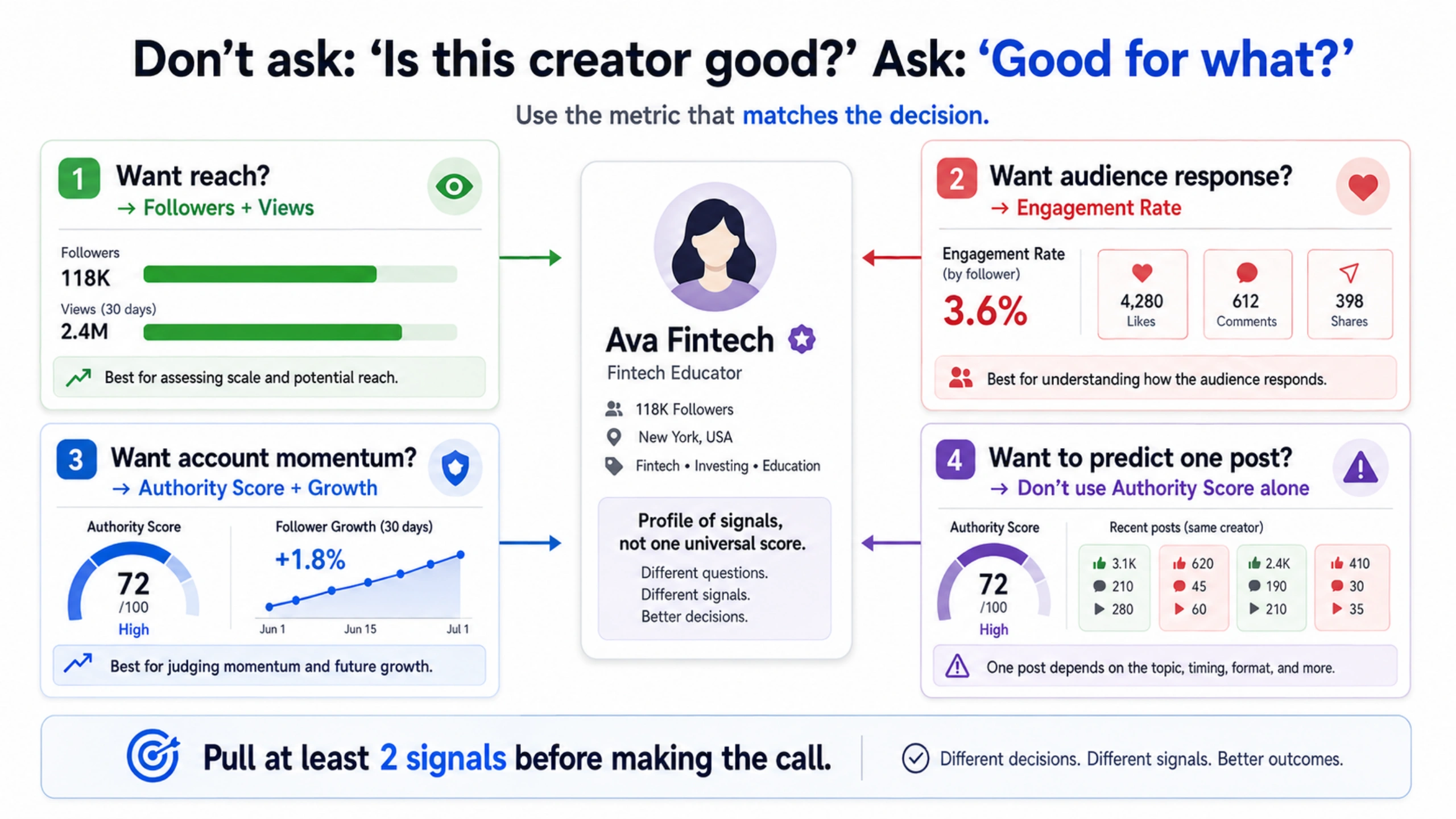
The fix: pull at least two of these four before drawing a conclusion about a creator and expect them to disagree. That disagreement is the finding. Vetting a creator's full profile rather than a single stat is the fastest way to catch this in practice.
This pattern is specific to Payments & Fintech creators in this window - worth testing before assuming it holds elsewhere. Four months, one niche, 197 creators. Real sample, strong correlation, but a cross-sectional snapshot of one industry at one point in time, not individual accounts tracked over years. Whether it holds in other niches, other platforms, or over a longer stretch is genuinely open.
Others articles