Best B2B Social Media Platforms for 2026
Which social media platforms are worth using for B2B marketing in 2026? This guide compares the top options, what each is best for, and where your team should focus.

There is no "best" B2B social media platform. Stop looking for one.
Every year I get some version of this question from founders and marketing leads. "Which platform should we be on?"
It is the wrong question. The honest answer is that the best platform depends on your team size, your budget, your patience and whether you have a person who can write.
What I can do is rank them by effort-to-return, which is what people actually mean when they ask.
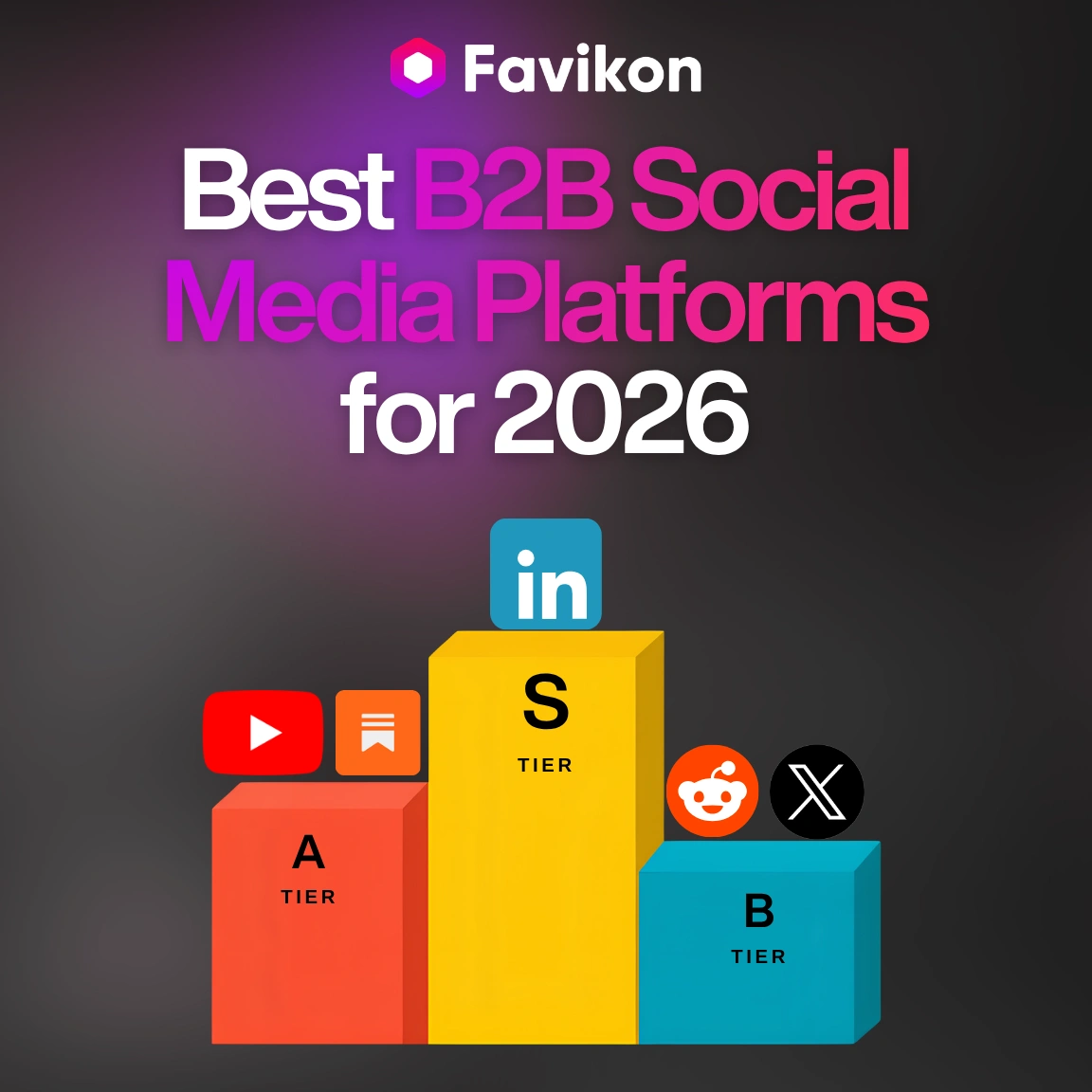
So I tiered them. S tier, A tier, B tier. Based on running Favikon's channels for over two years, plus the data I could find to check my own bias.
A word on the data first. I have cited studies where they exist. Where the number is a self-reported marketer survey rather than measured revenue, I say so. A lot of B2B social media "statistics" floating around are agency blog posts citing each other, and I have tried not to add to that pile.
How I tiered these
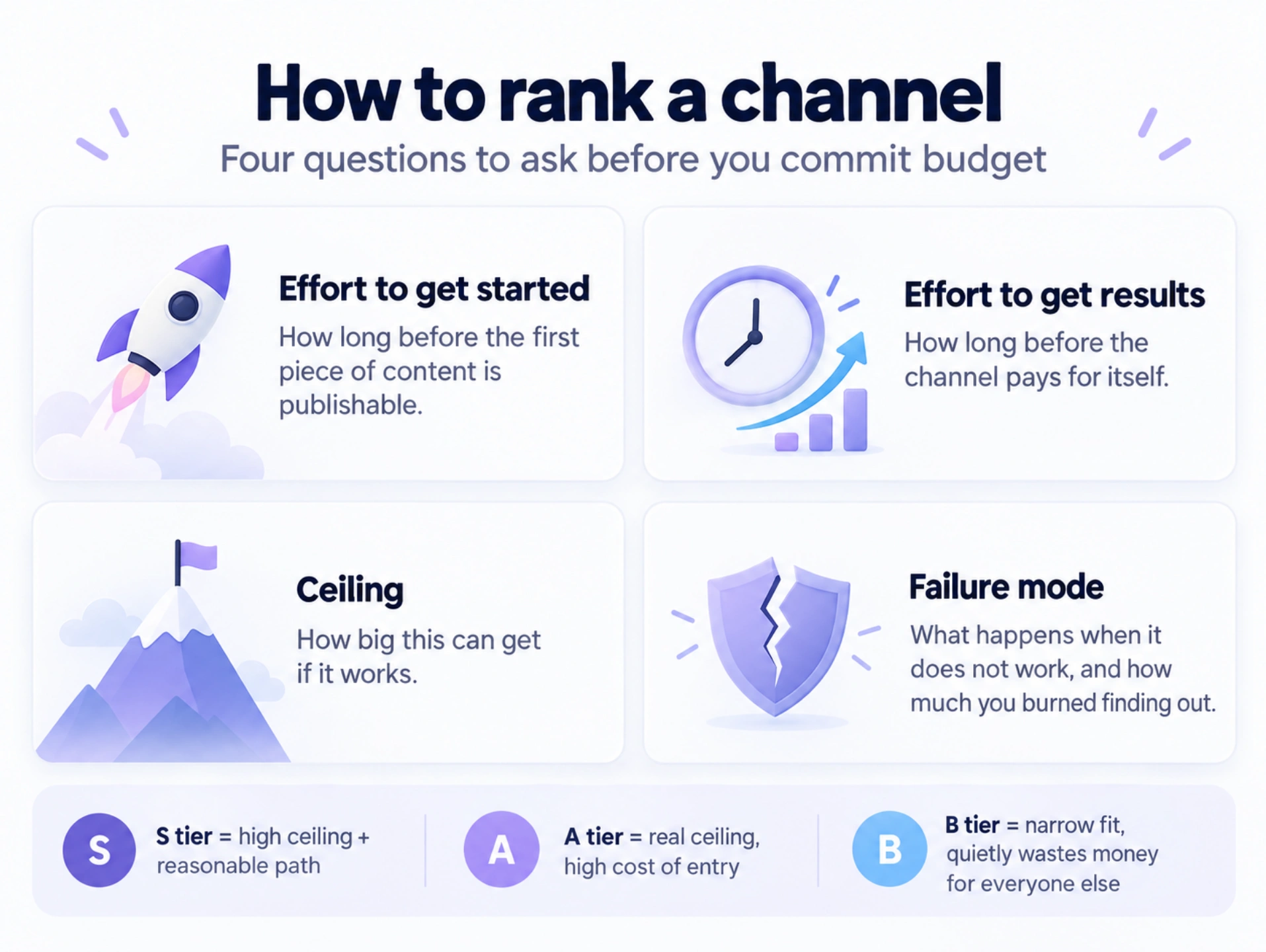
Four things:
- Effort to get started. How long before the first piece of content is publishable.
- Effort to get results. How long before the channel pays for itself.
- Ceiling. How big this can get if it works.
- Failure mode. What happens when it does not work, and how much you burned finding out.
S tier means high ceiling and a reasonable path to get there. A tier means the ceiling is real but the cost of entry is high. B tier means it works for a narrow set of companies and quietly wastes money for everyone else.
S Tier
LinkedIn is the OG of B2B social and it is not close. The Content Marketing Institute's B2B benchmark research has found 85% of B2B marketers naming LinkedIn as the platform that delivers the best value, with Facebook a distant second at 28% and YouTube at 22%. Only 7% named X.
That is a survey of marketer opinion, not measured pipeline. But when the second-place answer is a third of the first-place answer, the direction is not in dispute.
Here is how the platform actually behaves in 2026.
Do not build a company page
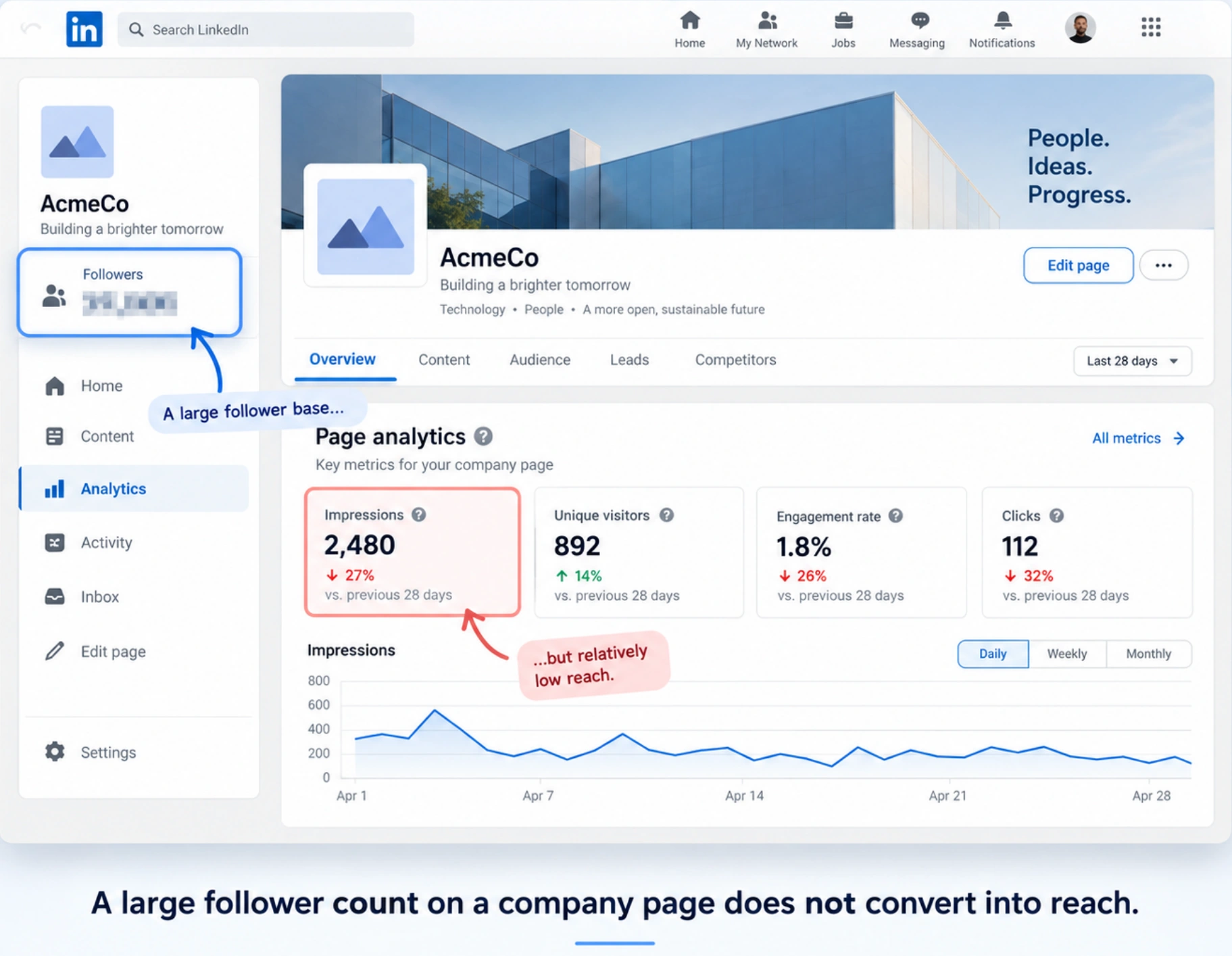
This is the single most common mistake I see. Teams spend a quarter building a company page and get nothing.
The numbers back this up hard. The Algorithm InSights 2025 Report, which analysed 1.8 million LinkedIn posts, found company page organic posts now reach about 1.6% of their own followers. In 2021 that figure was 7%. Company page content makes up somewhere between 1% and 5% of what people actually see in their feed.
Reach is weak. Click-through is weak. Both.
We have 140k followers on Favikon's LinkedIn page. Most of them are creators who followed us for our rankings content, not buyers. It is a vanity number and I treat it as one.
Build a personal brand instead
Personal profiles do not hit the same wall. A personal post seeds automatically to first-degree connections, and that early engagement is exactly what the ranking system looks for. Company pages only have followers, which is a much weaker distribution signal.
The gap shows up in paid data too. In ZenABM's 2026 LinkedIn benchmark analysis, covering 161,256 ads across 211 companies, Thought Leader Ads (which sponsor a post from an individual's profile) hit a 2.68% median CTR at $2.29 CPC. Single image ads from company pages: 0.42% CTR at $13.23 CPC.
Same platform. Same targeting. Roughly six times the click-through at a fifth of the cost, purely because the post comes from a human face.
If paid distribution shows that gap, organic shows it too.
Use it for outreach as well as content
LinkedIn is one of the few places where content and outbound live in the same product. Someone reads your post, you show up in their notifications, then a connection request lands. That sequence works. A cold connection request with no content behind it does not.
If you are running creator outreach specifically, we wrote up the mechanics of comment-then-connect-then-collab in the ultimate guide to B2B influencer marketing.
Ads are hard, then they work
LinkedIn ads have a brutal learning curve. Average CPC sits somewhere in the $5.26 to $8.50 range depending on whose 2026 benchmark you read, with median cost per lead around $110. C-suite targeting pushes CPC past $24.
That is expensive enough that most teams quit in month two.
The teams that stick with it get somewhere, because the targeting is genuinely unmatched. You cannot filter by job title and company size anywhere else at this quality. Dreamdata's analysis of 66 million sessions found LinkedIn delivering positive B2B ROAS at 121%, against Google Search at 67% and Meta at 51%.
My advice: do not start with ads. Start with organic, find out which of your messages people actually respond to, then put money behind the ones that worked.
Creator-led growth is the best lever on this platform in 2026
This is the part most teams have not caught up to.
You do not have to build the audience yourself. You can rent it from people who already have one, and in B2B that is dramatically cheaper than it sounds.
The 2025 Edelman-LinkedIn B2B Thought Leadership Impact Report, based on a survey of 1,934 global business executives, found 53% of decision-makers saying that when thought leadership is strong, brand recognition matters less. Read that again if you are a small company competing with an incumbent. The report also found that more than 40% of B2B deals stall on internal misalignment, and that 95% of "hidden buyers" (finance, legal, procurement, the people who never talk to your sales team) become more receptive to outreach after strong thought leadership content.
That is the whole argument for creator partnerships in one paragraph. You are not buying reach. You are buying credibility with people your SDRs will never reach.
It works best in tech. Vector, a B2B SaaS company, turned a $12,000 LinkedIn creator campaign into $1.1 million in pipeline in three months. We broke the whole thing down in the Vector case study.
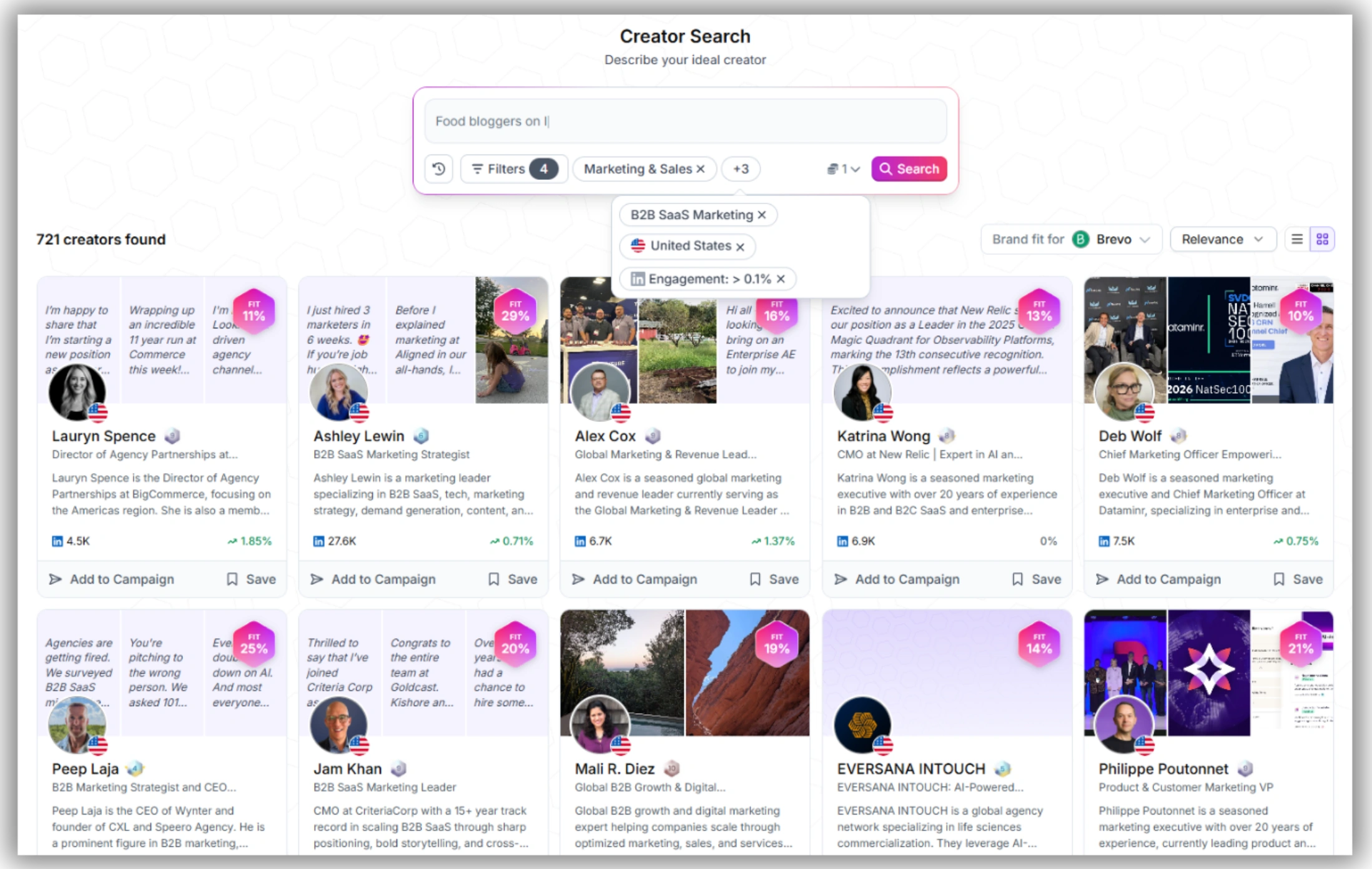
If you want to start here, our LinkedIn influencer finder is the fastest way to build a shortlist, and the B2B influencer price calculator will tell you whether the rate you have been quoted is sane. For the full playbook, read how to find LinkedIn influencers.
It is still a social media platform
This is where technical companies fail. They post like it is a documentation site.
Plain, boring, technically correct content will not travel on LinkedIn. You need a mix. Real opinions, things that went wrong, numbers from your own work, occasional posts that are just human.
Master hooks. The first two lines decide everything, because that is all anyone sees before deciding whether to hit "see more". Earlier Edelman-LinkedIn research found that 55% of buyers move on if a piece of thought leadership does not hold them in the first minute.
Master storytelling. A specific story about one customer beats a generic post about your category every single time.
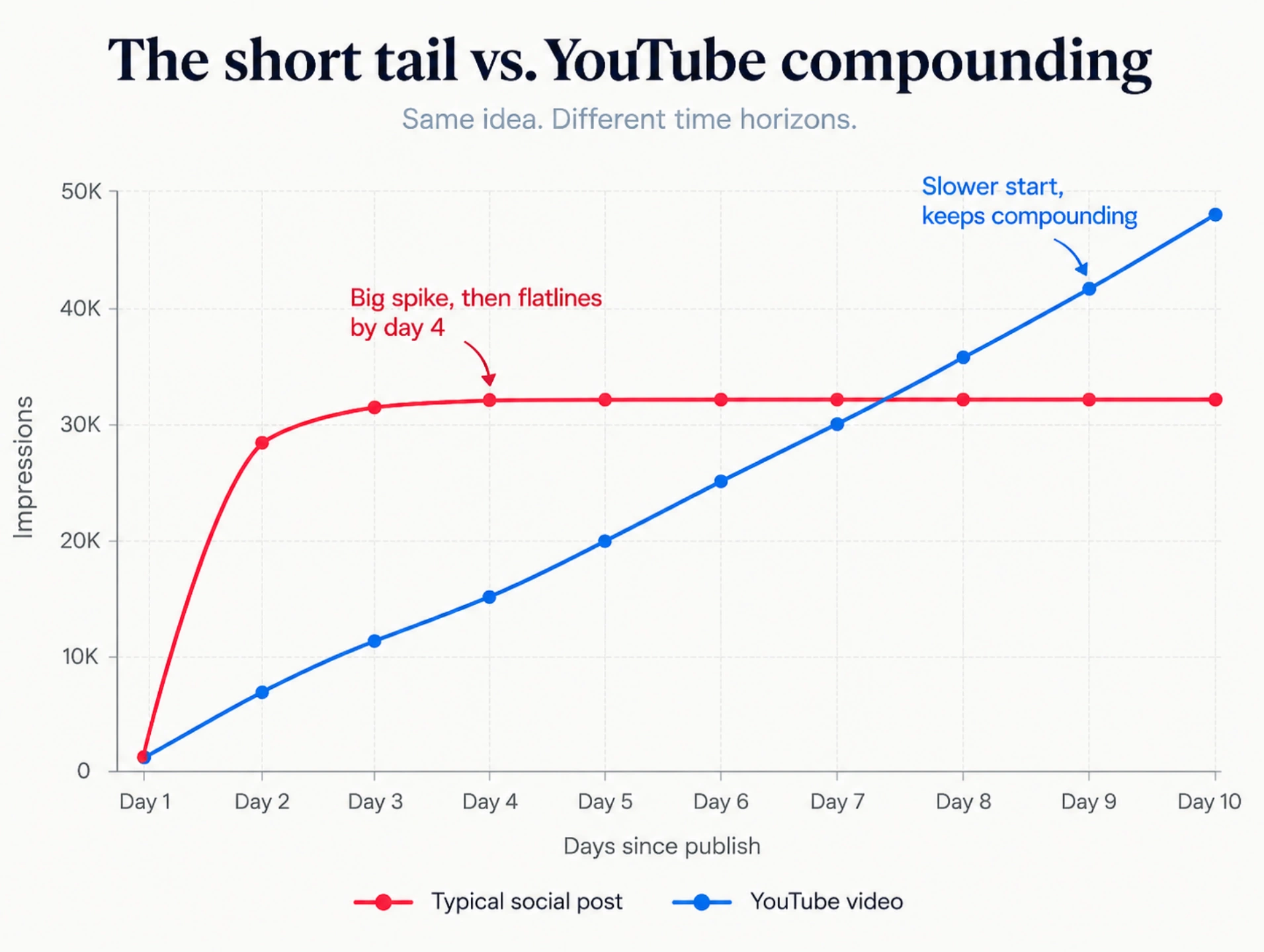
Going viral is easy. The tail is short.
You can go viral on LinkedIn far more often than on any other B2B platform. The threshold is low compared to YouTube or X.
But the tail is brutally short. A post that does 200,000 impressions is dead in 72 hours. There is no search layer catching it afterwards, no recommendation engine resurfacing it six months later.
And one viral post will not get you what you want. I have watched posts hit huge numbers and produce zero demos. Distribution is not demand. The compounding effect on LinkedIn comes from posting consistently for six to twelve months so that the same 400 relevant people see you repeatedly, not from one spike.
LinkedIn verdict: highest ceiling, most forgiving learning curve, best creator ecosystem in B2B. It earns S tier by a wide margin. Related reading: B2B LinkedIn strategy.
A Tier
YouTube
YouTube is the highest-quality channel in B2B and the one I would recommend least often. Both things are true.
It is a very high effort channel
You need a team. Realistically a script writer, a presenter, an editor and someone who understands thumbnails. One good video can take five to seven days end to end.
Low effort content is not rewarded here. On LinkedIn a scrappy post can outperform a polished one. On YouTube a scrappy video just does not get watched. Retention is the metric that governs everything, and retention is a production problem before it is a content problem.
We run Favikon's channel with a freelancer, Megan Mahoney of Scaled By Influence, and we are at roughly 900 subscribers. That number is honest about how slow this is.
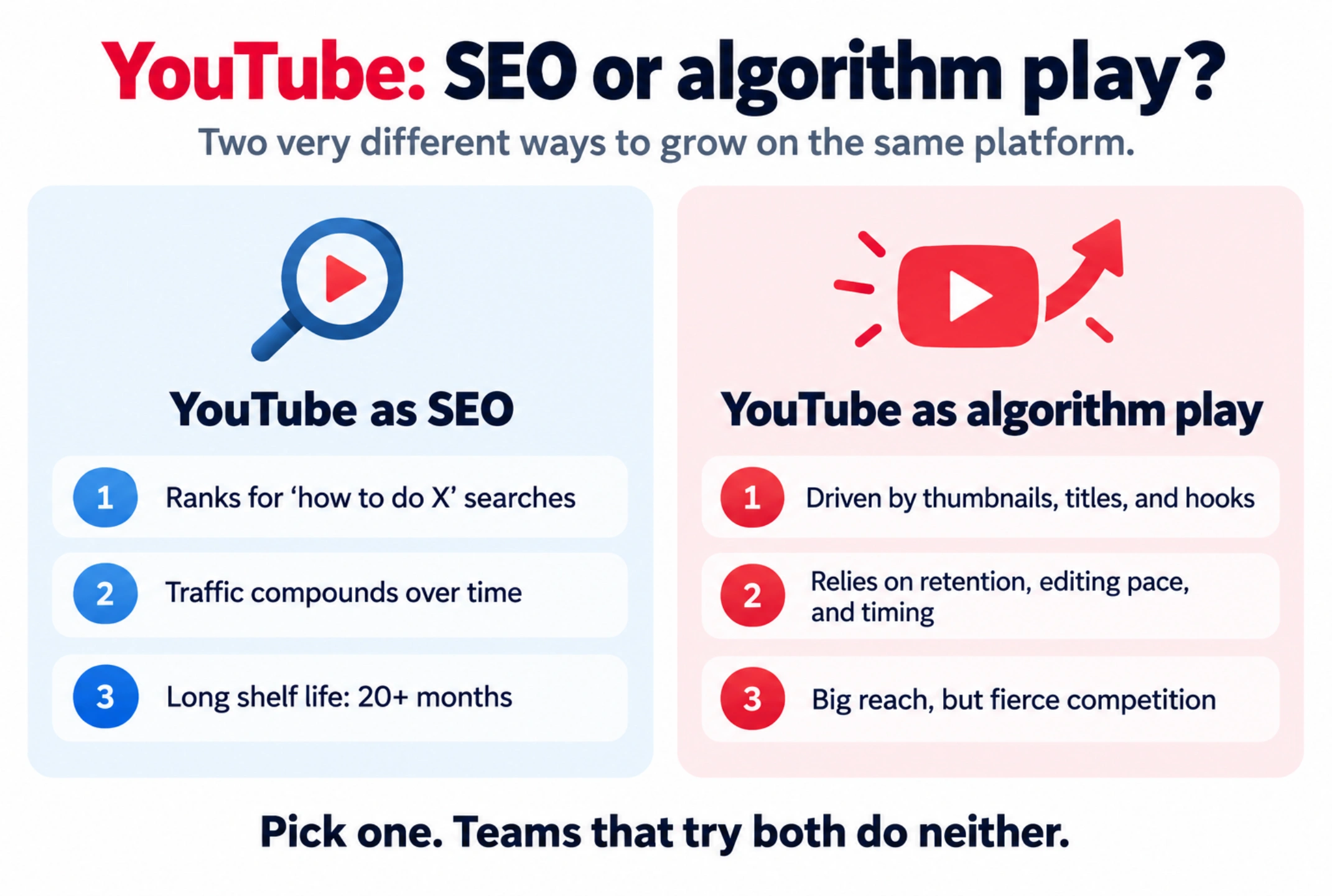
It is a dual play, and you have to pick
YouTube is two channels wearing one trench coat.
Play one is SEO. People search "how to do X" and your video ranks. This is predictable, compounding and boring. Long-form YouTube content has an average shelf life of over 20 months, which is a different universe from LinkedIn's 72 hours.
Play two is cracking the algorithm. Thumbnails, titles, hooks, retention curves, editing pace. This is where the big numbers are and where most B2B teams get destroyed, because they are competing for attention against creators who do this full time.
Pick one. Teams that try both do neither.
The audience is real and the intent is high
This is why it stays in A tier despite the cost. DemandSage data puts 51% of B2B buyers using YouTube to research purchases before deciding. Whitehat's compiled 2026 figures put 70% of B2B buyers using video in purchase decisions and 59% of senior executives preferring video over text when researching solutions.
Treat those as directional. They are survey figures, not measured revenue. But the behaviour is easy to verify yourself: search your own category and watch how many comparison and walkthrough videos exist. Buyers are watching those before your SDR ever emails them.
You can also track affiliate and referral clicks properly on YouTube, which makes attribution cleaner than most social channels.
Working with creators here is expensive
A high-effort sponsored video takes a creator weeks. Price reflects that. Where a LinkedIn post might transact around a few hundred dollars, a serious YouTube integration is a different budget line entirely.
The upside is that the video keeps selling. Igor Gorbenko at Ahrefs has said their sponsored videos continue generating sales for months after publication. That is the opposite of the LinkedIn tail problem.
Results do not compound fast
Give this eighteen months. If you cannot commit eighteen months and a real budget for research, editing and equipment, do not start.
Talk to the wallet
Here is the thing nobody tells you about B2B YouTube. You are not on LinkedIn where people scroll for professional identity. On YouTube people click because they want something.
If you want to cross the 10k view line, the video has to promise money. How to make more of it, how to land more deals, how to stop losing budget. Not "our approach to data hygiene". Nobody clicks that.
YouTube verdict: best for teams with headcount and budget. A tier because the ceiling is genuinely high and the content compounds, but the barrier to entry disqualifies most companies reading this.
Substack and newsletters
Run it under a person's name
Not "The [Company] Weekly". Under a human's name, with their face and their opinions.
Same logic as LinkedIn. People subscribe to people. A newsletter with a company name in the title reads as marketing before anyone has opened it.
I built our newsletter, unsponsord, this way. Practitioner interviews, one guest per issue.
Quality has to be genuinely high
There is no algorithm to game and no half-measure. Every issue lands in an inbox or it does not. Curated benchmarks and original data get the best numbers of any newsletter format, at around a 35% open rate and 5.8% CTR, but they also take five to eight hours per issue. Company and product update newsletters sit near the bottom at about 18% open rate.
That gap is the whole story. Effort in, opens out. There is no shortcut.
You have to import the audience
This is the part people skip. Newsletters do not have discovery. There is no For You feed.
Bring subscribers from LinkedIn, from your customer emails, from your CRM, from conference lists. Every single subscriber has to be recruited from somewhere else. Treat the newsletter as a destination, not an acquisition channel.
Give real value or do not bother
Original insight. Data nobody else has. Opinions with a name attached. If your newsletter is a roundup of links that already went viral, you are competing with a person's Twitter feed and losing.
Commit for a year before you judge it
Audience builds linearly. Going viral is close to impossible. Healthy monthly list growth for a newsletter under 500 subscribers is 8% to 20%, dropping to 2% to 5% once you pass 5,000.
Compound that out and you will see why a year is the minimum honest evaluation window.
The strategic upside nobody talks about
Newsletters published on crawlable sites like Substack and beehiiv can improve your visibility in Google and in LLMs. Nicole Ponce, who leads influencer marketing at Semrush, has made this point directly: search engines and language models are both shifting toward thought leadership content and toward brands mentioned by credible people. A newsletter on an indexable domain is a public, citable artefact in a way that a LinkedIn post is not.
That is a real reason to pick Substack over a pure email tool.
For sourcing partners, see how to find Substack influencers. For how newsletters compare against other paid placements, see our B2B channel comparison.
Newsletter verdict: A tier. Slow, high quality, fully owned, and the only channel here where you are not renting your audience from an algorithm.
B Tier
X (Twitter)
I want to be fair to X, because it does work for a specific slice of companies. It just is not the slice most people reading this are in.
The algorithm changed, again
In January 2026 X replaced its recommendation system with a Grok-powered transformer model and open-sourced it. The old system counted engagement signals. The new one reads the post.
That killed a lot of the old playbook. Thread-engagement pods, reply farming and retweet chains generated the interaction counters the old heuristics measured, but they do not produce the semantic relevance the new model looks for.
It also means most advice published before 2026 is now wrong, including advice from people with large followings.
Most of the feed is hype
Open X as a B2B marketer or a tech person and look at what you actually see. Hot takes, funding announcements, AI doom, engagement bait.
That is the environment your content competes in. Nuance loses.
Bots and dead engagement
A meaningful share of what looks like engagement is not human. If your metric is impressions, X will flatter you. If your metric is pipeline, it will not.
It works for tech, SaaS and dev tools. Not much else.
This is the honest boundary. If you sell developer tools, infrastructure or something a technical person adopts personally, X has a real audience. Industry benchmark data shows X engagement holding up in the technology vertical while sitting near zero almost everywhere else.
If you sell to HR, finance, logistics or procurement, your buyers are not there. Facing that early saves a year.
Note also that on B2B lead attribution, X consistently lands around 12% to 13% of social-sourced leads against LinkedIn's 80%.
It is pay to win
The path to a following on X is not tweeting every day. That will actually slow you down, because volume without distribution trains the model on your low-performing content.
The path is other people's audiences. Pay creators to quote-tweet you. Get retweeted by accounts that already have reach. Reply to large accounts where their audience will see you. External links lose a large share of reach, so the value is in being seen inside the platform, not in driving clicks out of it.
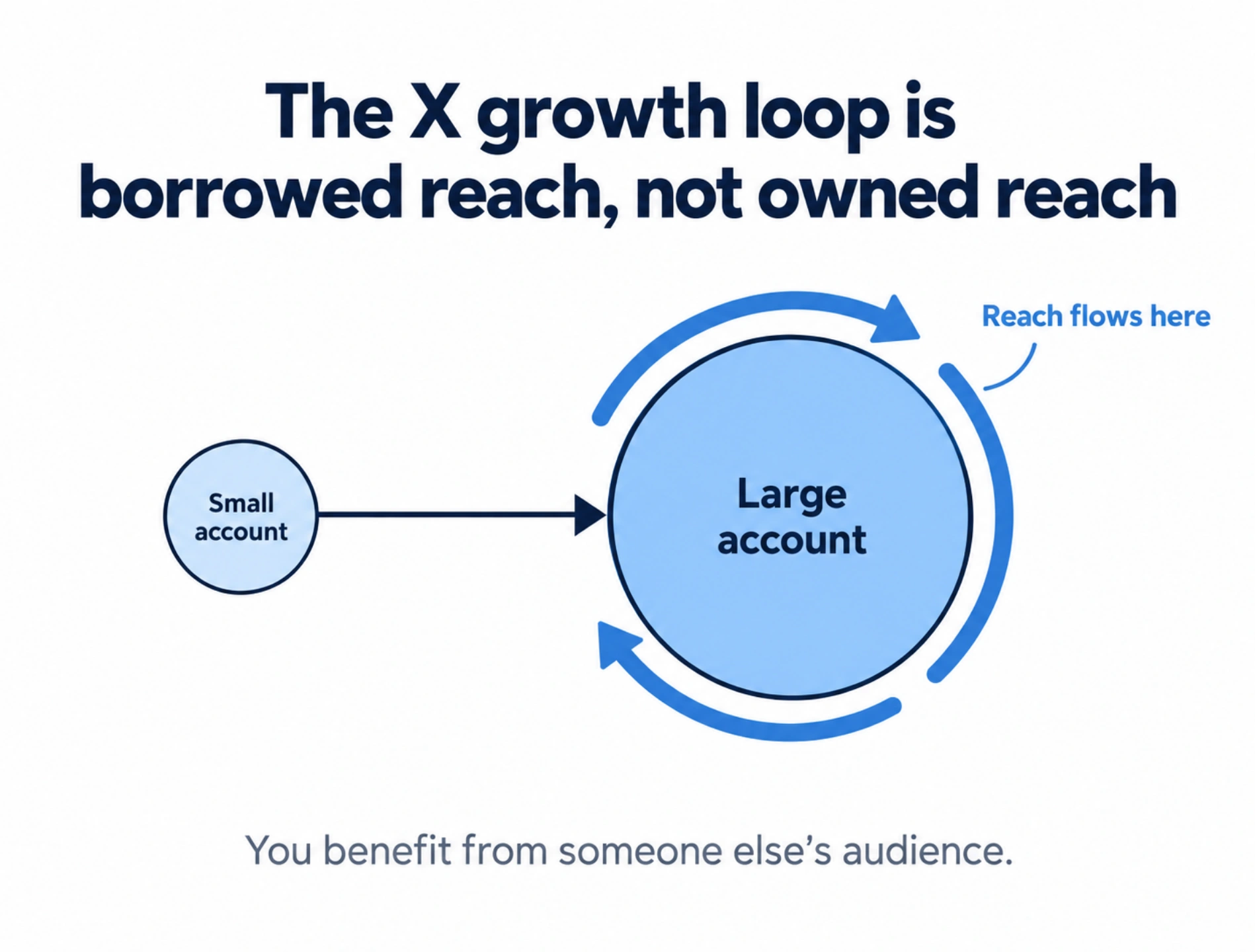
If you go viral, it will not be for your expertise
This is the uncomfortable part. Viral on X is shallow by design. Broad, punchy, slightly contrarian. Deep niche expertise does not travel.
So the strategy is to talk about what is already going viral and attach yourself to trends, which is a very different job from building authority.
X verdict: B tier. Real for developer-facing companies, a slow leak of budget for everyone else.
Reddit is the most interesting channel on this list and the easiest to get catastrophically wrong.
It is the last place with authentic conversation at scale
That is genuinely valuable. People on Reddit say what they actually think about your product and your competitors. The conversations are real, unfiltered and increasingly visible in AI search results. Google and OpenAI both hold data partnerships with Reddit, which means Reddit threads are a direct input into what language models say about your category.
If someone asks ChatGPT for the best tool in your space, Reddit is often where the answer comes from.
Most subreddits will ban you immediately
Reddit's content policy does not use the phrase "self-promotion". It governs it through Rule 8, which prohibits spam, defined as repeated or unsolicited actions that harm communities. Enforcement escalates from post removal, to a warning, to a temporary suspension, to a permanent ban. Reddit's transparency reporting shows 96.4% of content manipulation is detected automatically.
More importantly, Reddit is not one channel. It is a hundred thousand subreddits, each run by different unpaid moderators with different rules. r/SideProject welcomes what you built. r/SEO effectively bans tool mentions. r/startups only allows promotion in a weekly thread. r/Entrepreneur bans it in posts but tolerates it in comments.
Post the same thing everywhere and you will be permanently banned from at least one community within 90 days.
The three ways people are actually winning on Reddit
I will describe all three, including the one I do not endorse.
One: bot networks and covert promotion. Proxy accounts, aged karma, product mentions dropped into relevant threads at a rate that stays under the detection line. This is happening at scale, it is against Reddit's rules, and it works until it does not. When it is exposed, it is exposed publicly in the thread, and the brand damage sticks.
Two: owning the subreddit. Build or take over a community in your industry, feed it genuinely useful content, and cross-post to adjacent subs. This is slow, legitimate and durable. We run r/favikon. ROI has been unclear so far, and I will say that plainly rather than pretend otherwise.
Three: individual employees providing real value in other subs. Not the brand account. A named person with a real posting history who answers questions properly and mentions the product only when it genuinely fits. This is the highest-trust version and the hardest to scale, because it depends on one person actually knowing things.
Approach three is the only one I would build a plan around.
Reddit verdict: B tier for most companies, with a note that its strategic value in AI search is rising fast. If your buyers research in public, this may move up a tier within a year.
Where the data pushes back on me
I would rather flag the counter-arguments than pretend my tiers are objective.
The LinkedIn numbers are mostly self-reported. CMI's 85% figure is marketers saying LinkedIn delivers the best value, not a measurement of pipeline. Marketers may simply be most familiar with LinkedIn. The paid data (the Thought Leader Ads gap, the Dreamdata ROAS comparison) is stronger evidence than the surveys.
LinkedIn reach is falling for everyone, not just company pages. AuthoredUp data shows declines across all content types. Some analyses put views down roughly 47% and follower growth down around 42%. Personal profiles hold up better than pages, but "better" is not "good". If you start on LinkedIn today, the numbers you will hit are meaningfully lower than what people posted about in 2023.
YouTube's B2B statistics come from a small pool of sources. The 51% and 70% buyer-research figures get recycled across dozens of articles that all trace back to a handful of vendor surveys. I believe the direction. I do not believe the precision.
X may be underrated for developer tools specifically. Some industry benchmark sets put X engagement in the technology vertical above LinkedIn's. If you sell to engineers, my B tier placement is probably too harsh for you.
Reddit's tier is the least stable on this list. As AI search becomes a real discovery surface, Reddit's influence on what buyers get told is growing. If I write this again in twelve months, Reddit may well be in A tier.
The decision matrix
So which one is right for you
Short version, by team shape.
One marketer, no budget. LinkedIn only. Personal profile, not the company page. Post three times a week for six months before you evaluate anything. Do not open a second channel until this one works.
Small team, some budget, no video capability. LinkedIn plus creator partnerships. This is the highest-leverage combination in B2B right now, and the Edelman-LinkedIn data on hidden buyers explains why: you are buying credibility with people your sales team cannot reach. Start with the B2B influencer marketing platform to build the shortlist, and read the ultimate guide to B2B influencer marketing before you send a single outreach message.
You have one person with genuine expertise and a point of view. LinkedIn plus a newsletter under their name. The newsletter compounds and you own the list.
You have real headcount and an eighteen-month horizon. Add YouTube. Not before.
You sell developer tools. Add X. Your buyers are actually there.
Your category gets researched in public forums. Add Reddit, using the individual-contributor approach, not the brand account.
The mistake I see most often is not picking the wrong platform. It is picking four, doing all of them at 30%, and concluding that social does not work for B2B.
Pick one. Get it to work. Then add the next.
Others articles