How Much Influencer Marketing Platforms Actually Cost (Real Pricing, Not Request-a-Demo)
Finding software shouldn't require a sales call. In 2026, forward-thinking brands are ditching demo-gated traps for transparent platforms that publish upfront costs, monthly billing flexibility, and clear per-tier software benchmarks.

.webp)
Out of the 10 most-used influencer marketing platforms, only 2 publish their pricing. The other 8 make you book a demo first.
That's a problem, because comparison shopping is the entire job of a marketing buyer. When eight of ten vendors hide their numbers behind a sales call, you can't line them up side by side, which is exactly the work you're trying to do.
Let's fix that.
Here, we show you the real published prices where they exist, give sourced estimates where they don't, and break down the hidden costs that never make it into the headline number.
We can write it plainly because here at Favikon we publish our own plan pricing rather than gating it behind a sales call. See current Favikon pricing. The whole piece is that position in practice.
Influencer Marketing Platform Pricing: Key Takeaways
- Most platforms don't publish pricing: only 2 of the 10 most-used do, and the rest require a demo.
- The market splits into three tiers: published self-serve (roughly $150 to $500/mo), mid-market ($500 to $2,000/mo), and enterprise ($2,000 to $6,000+/mo).
- Most brands overpay, so choose your tier based on your annual influencer budget, not your company size.
- Watch the hidden costs: onboarding, API access, paid media integrations, credit overage, and annual lock-in.
- Monthly billing is a feature, so don't sign an annual contract on a channel you haven't validated yet.
- At Favikon, we publish our plan pricing with no demo required, and every plan includes a free trial. Start a free trial.
How Influencer Marketing Platform Pricing Actually Works
Influencer marketing platforms price themselves four different ways, and knowing which model you're dealing with tells you most of what you need before the first call.
Model 1: Tiered SaaS Subscription
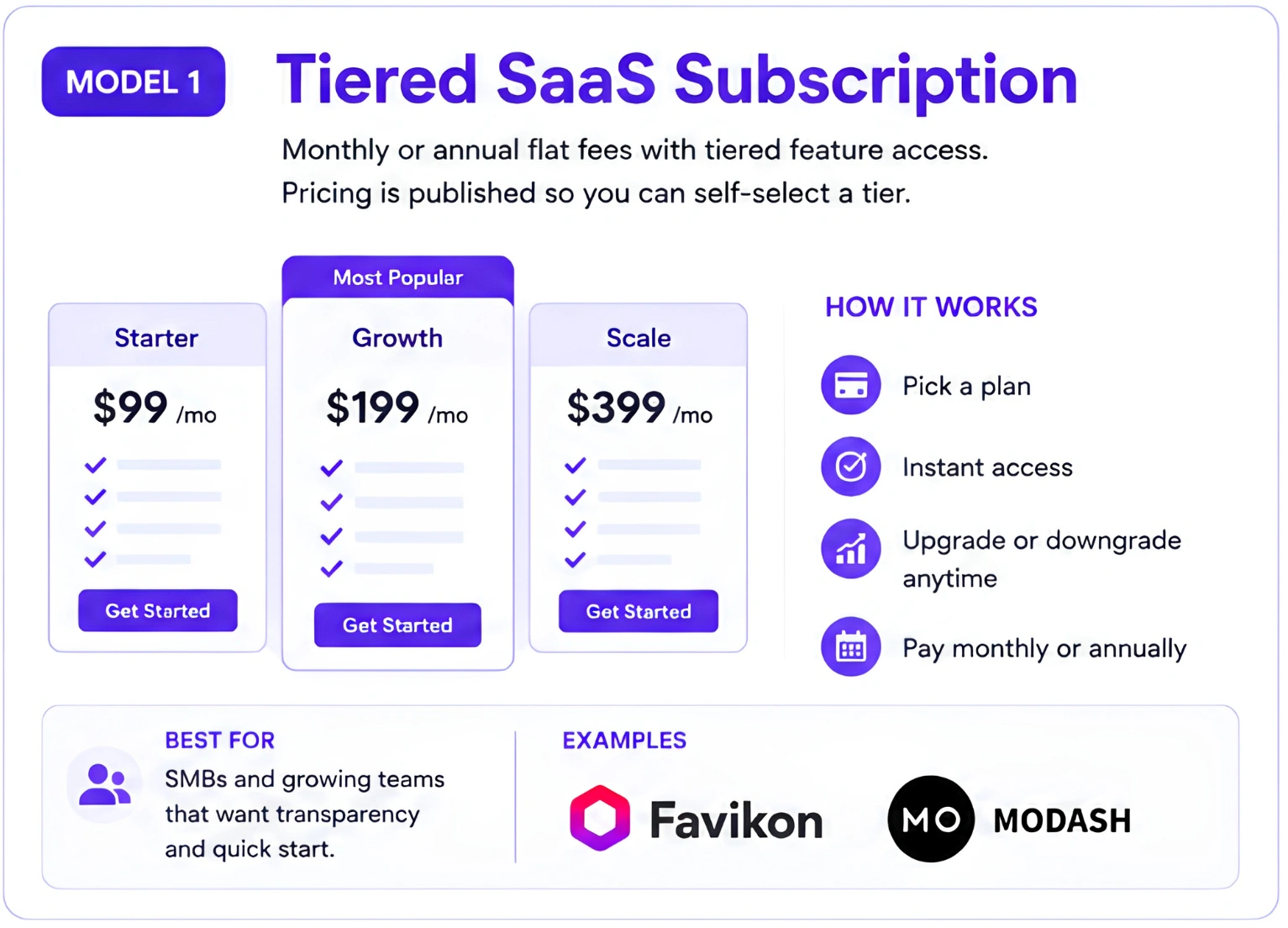
This is the most common and most transparent model: monthly or annual flat fees with tiered feature access. Favikon and Modash both run this way, with pricing published so you self-select a tier. It's the SMB-friendly model and the most common in 2026.
Model 2: Per-Seat Enterprise SaaS (Demo-Gated)
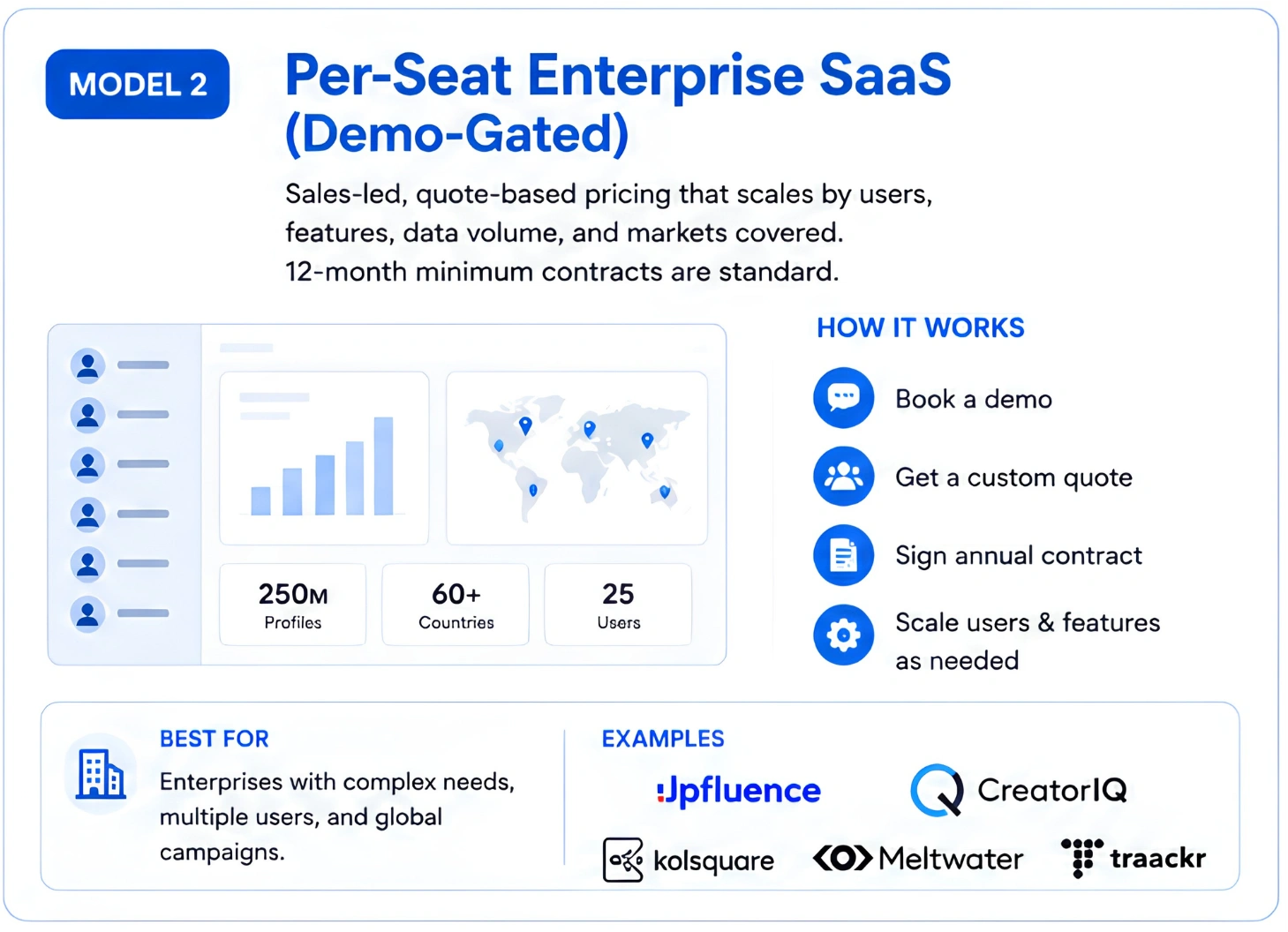
This model is sales-led and quote-based, with pricing that scales by users, features, data volume, and markets covered. Upfluence, CreatorIQ, Klear (Meltwater), Traackr, and Kolsquare sit here. Twelve-month minimum contracts are the norm.
Model 3: Freemium With Paid Upgrades
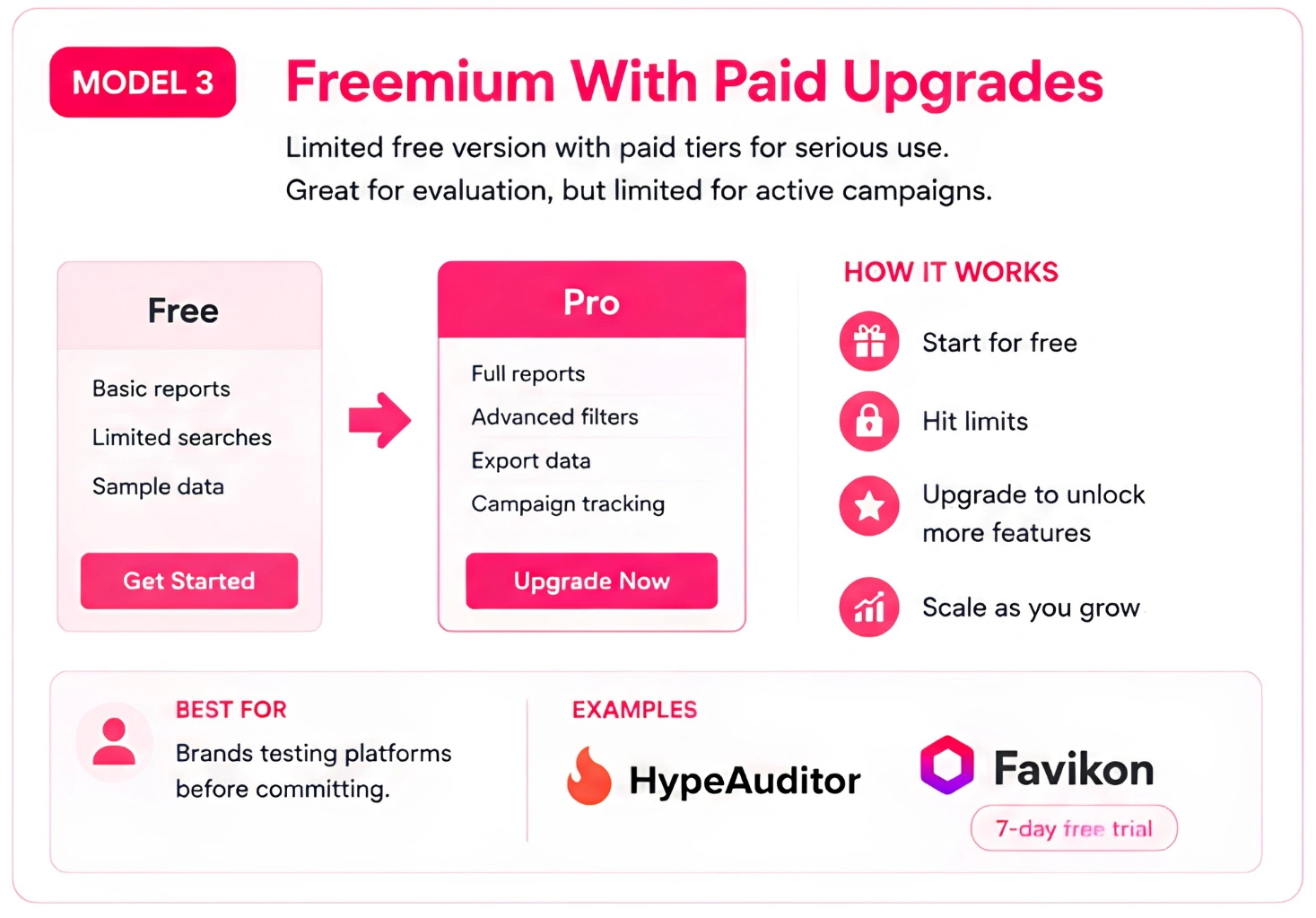
A limited free version with paid tiers for serious use. HypeAuditor offers free basic reports before its paid plans. Most brand-focused platforms, Favikon included, run a free trial rather than a permanent free tier. Free tiers and trials are useful for evaluation, but they're usually too limited to run active campaigns.
Model 4: Performance or Commission-Based
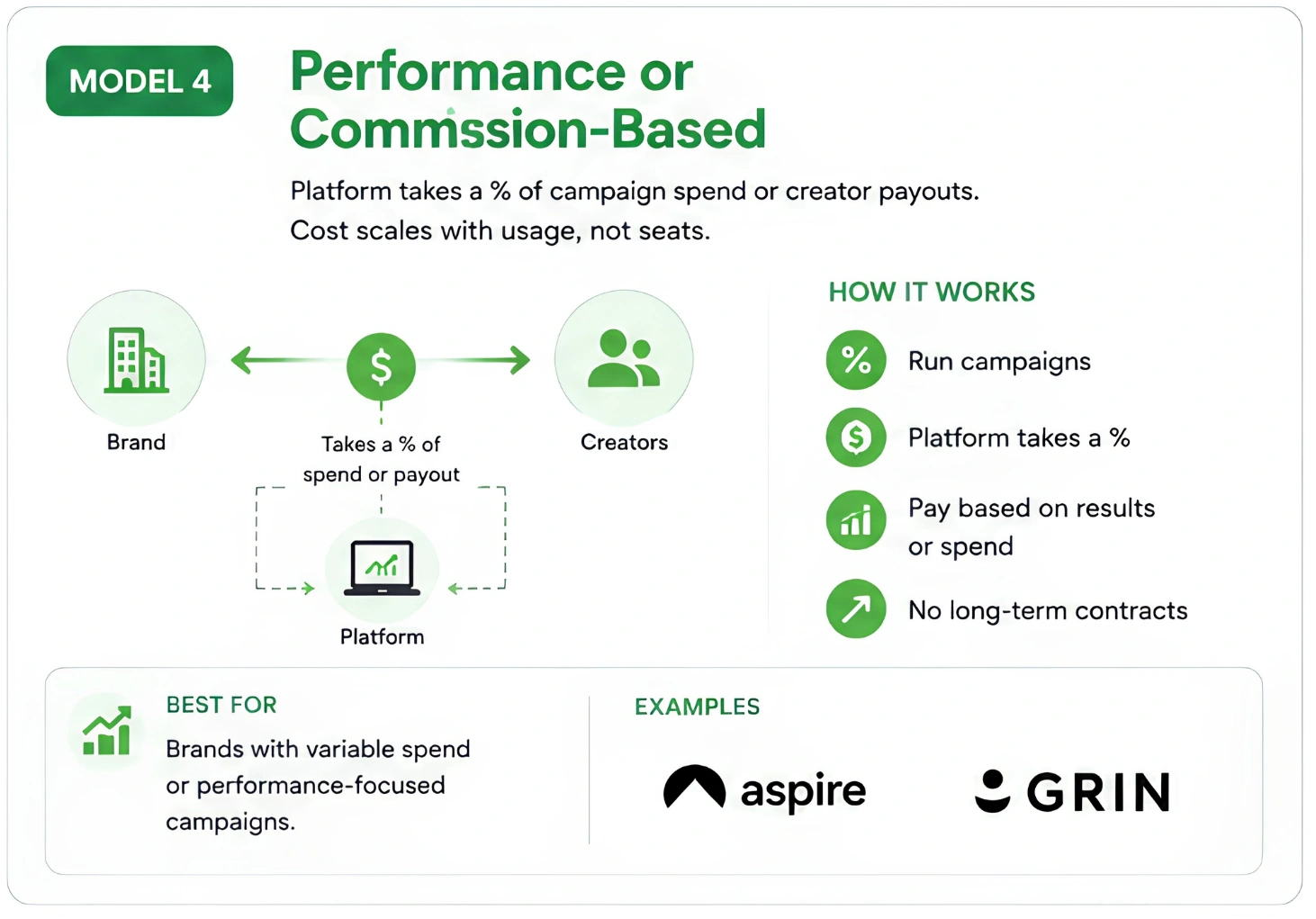
Here the platform takes a percentage of campaign spend or creator payouts, common in creator marketplaces and affiliate-led tools like Aspire and GRIN. Cost scales with usage instead of seats, which can be cheaper for low-volume brands and more expensive for high-volume ones.
What Drives the Price of an Influencer Marketing Platform
Six factors drive what you'll pay, and most price differences between platforms trace back to these. Knowing them helps you spot what you're actually paying for.
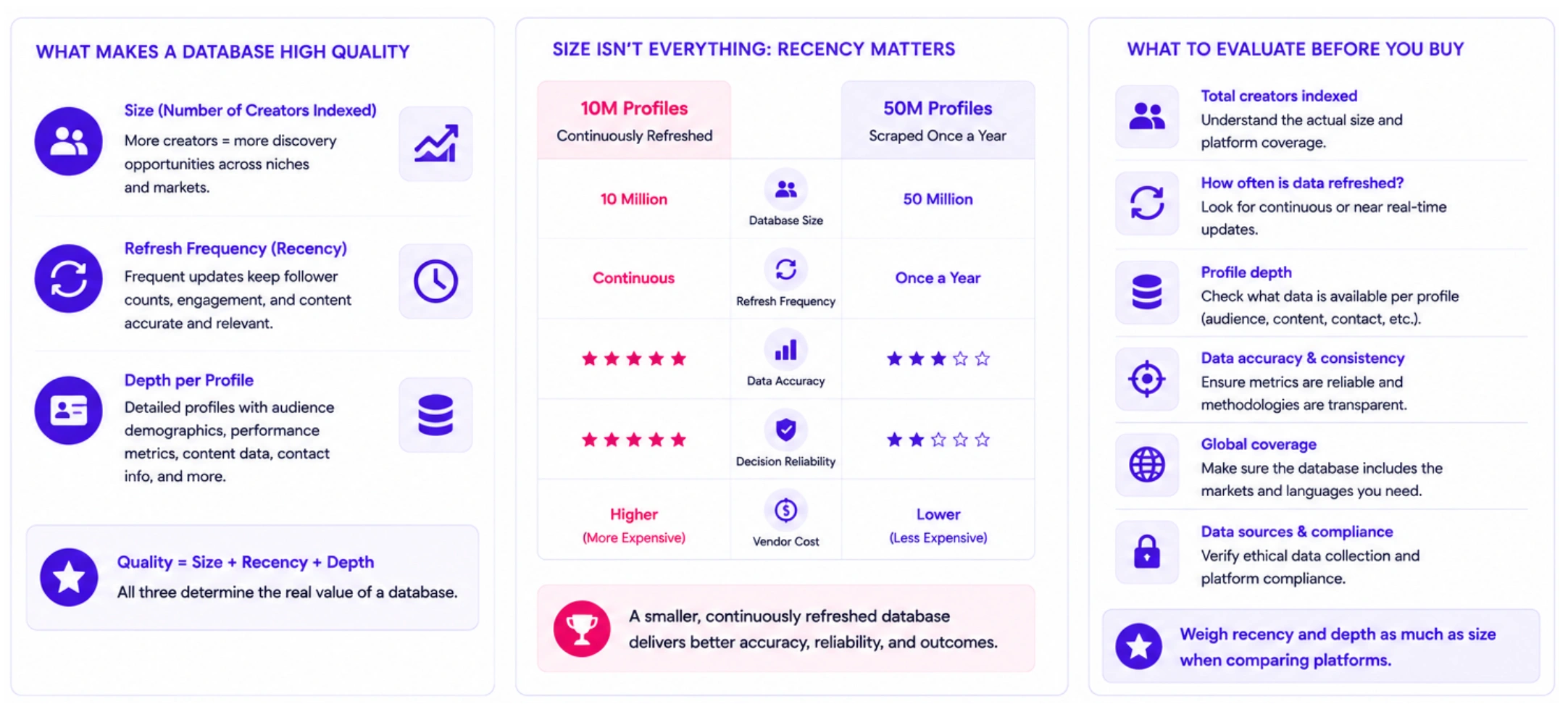
Driver 1: Database size and quality. It's the number of creators indexed, how often the data refreshes, and the depth per profile. A 10M-profile database with continuous refresh costs the vendor more than a 50M-profile database scraped once a year, so weigh recency, not just size.
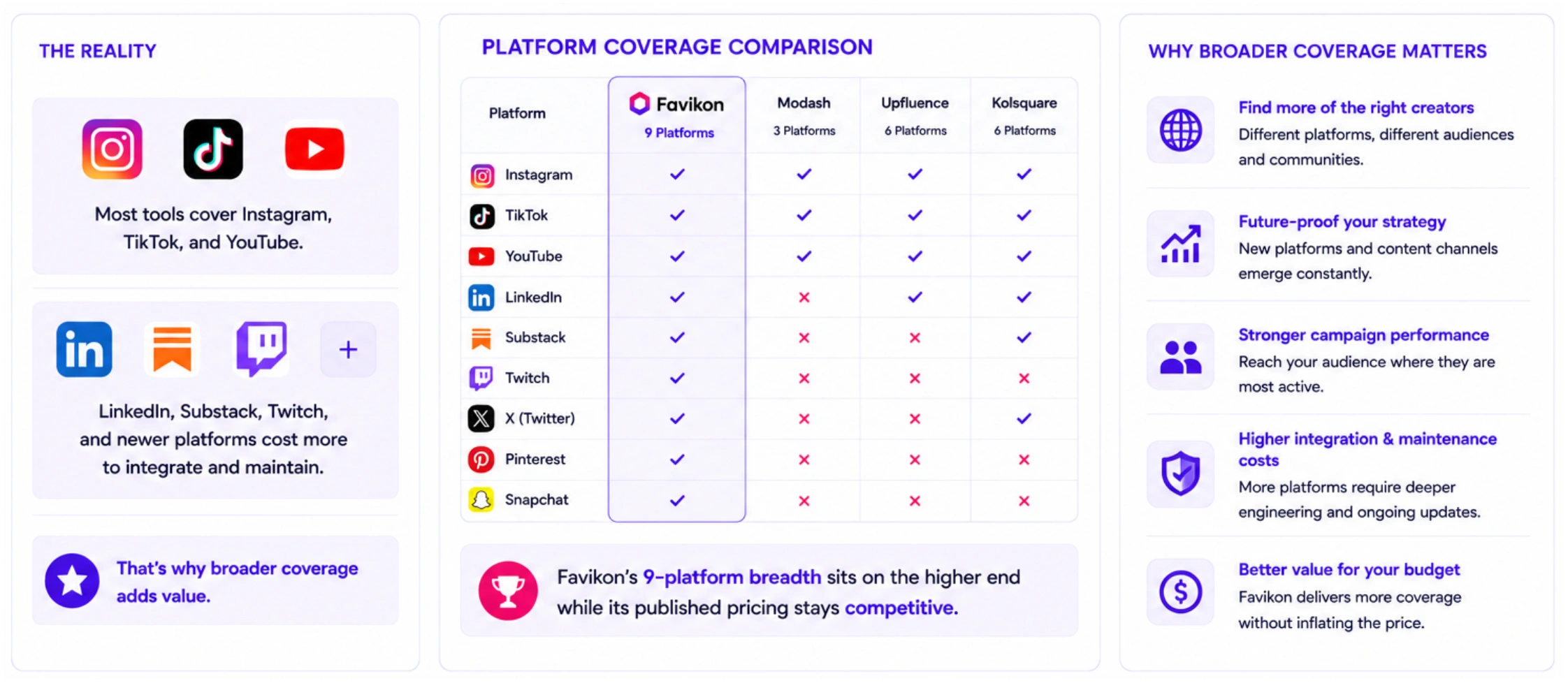
Driver 2: Platform coverage. Most tools cover Instagram, TikTok, and YouTube. LinkedIn, Substack, Twitch, and newer platforms cost more to integrate and maintain, which is why our 9-platform breadth sits on the higher end while its published pricing stays competitive.
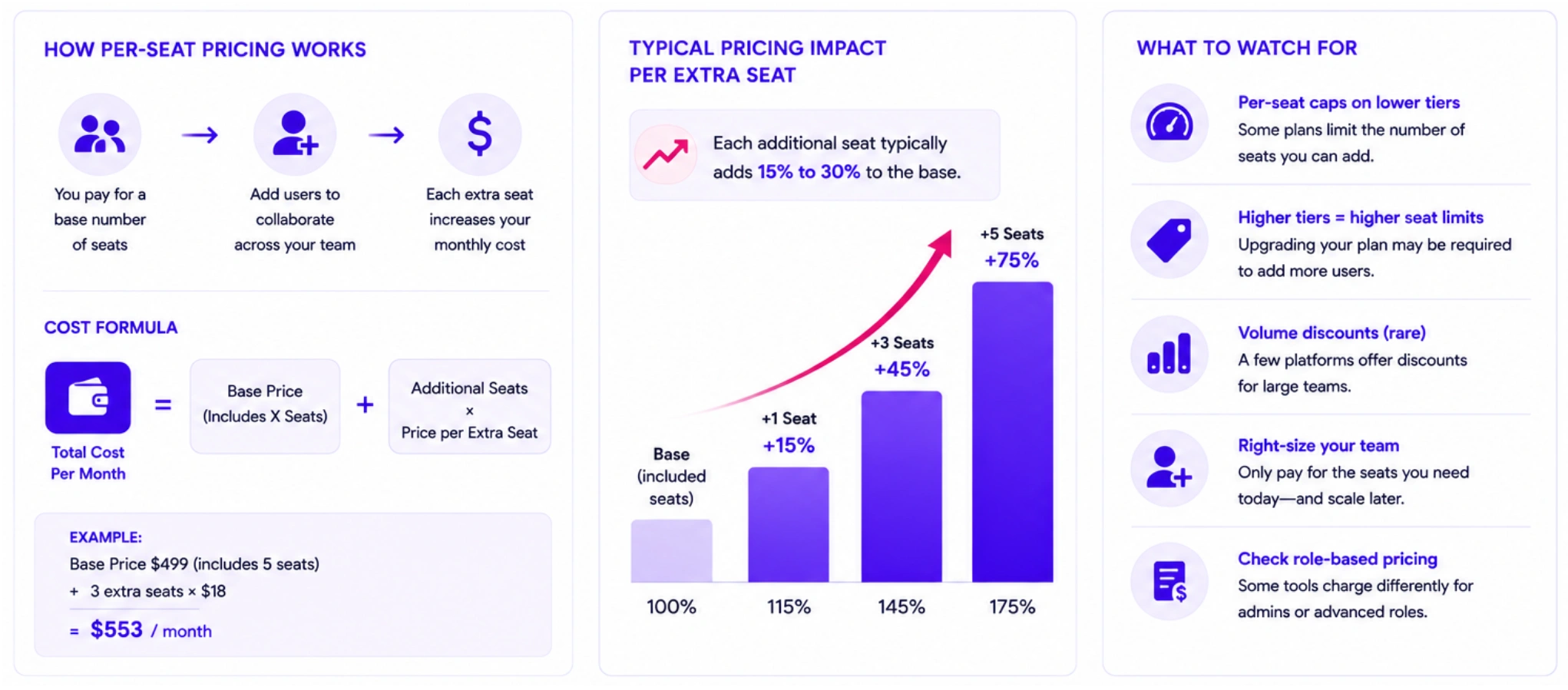
Driver 3: Number of seats. Per-seat pricing dominates enterprise tools, where each extra user typically adds 15 to 30 percent to the base. Watch for per-seat caps on lower tiers.
Driver 4: Credit consumption. Many platforms meter usage. A credit allowance sounds generous until each filtered search and each audience analysis draws it down, so read the credit table before signing.

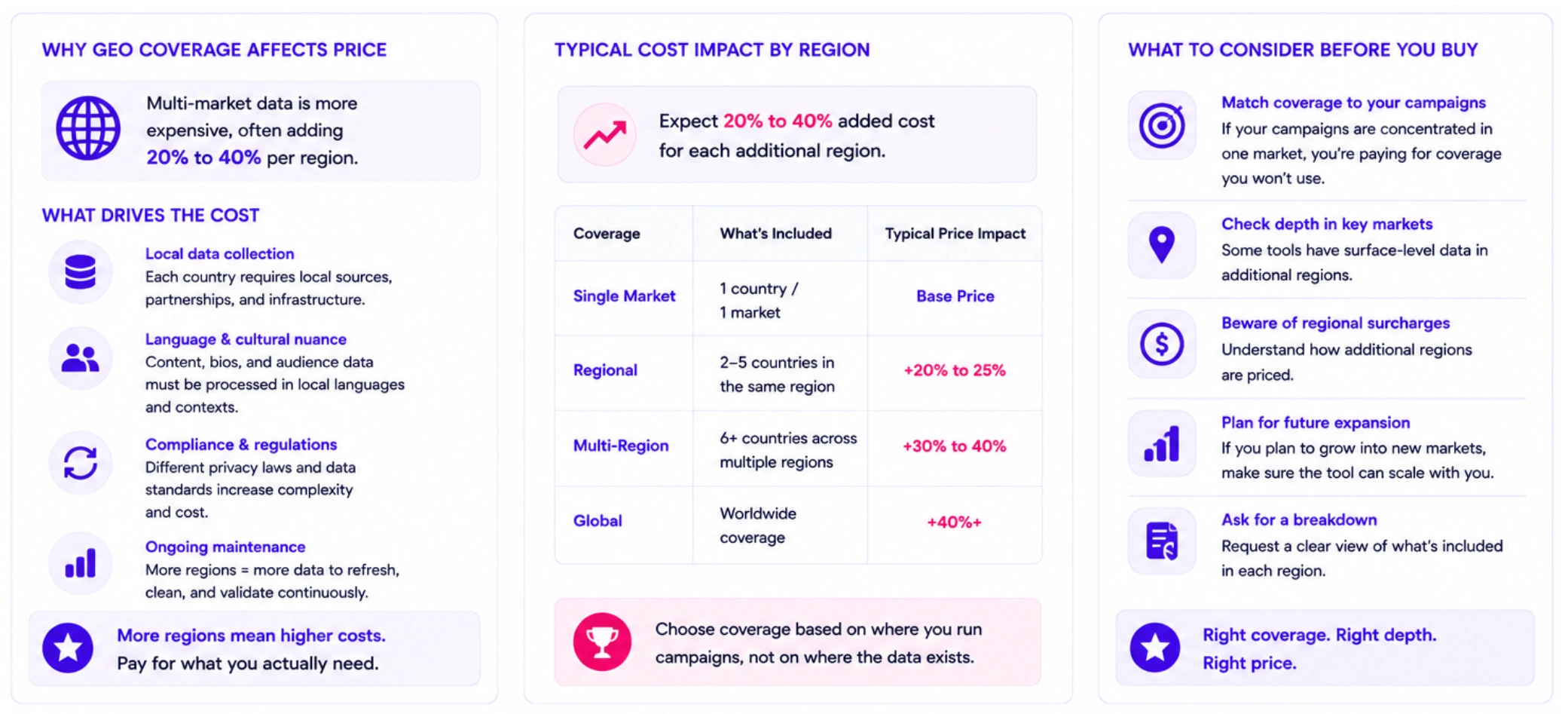
Driver 5: Geographic coverage. Multi-market data is more expensive, often adding 20 to 40 percent per region. If your campaigns are concentrated in one market, you're paying for coverage you won't use.
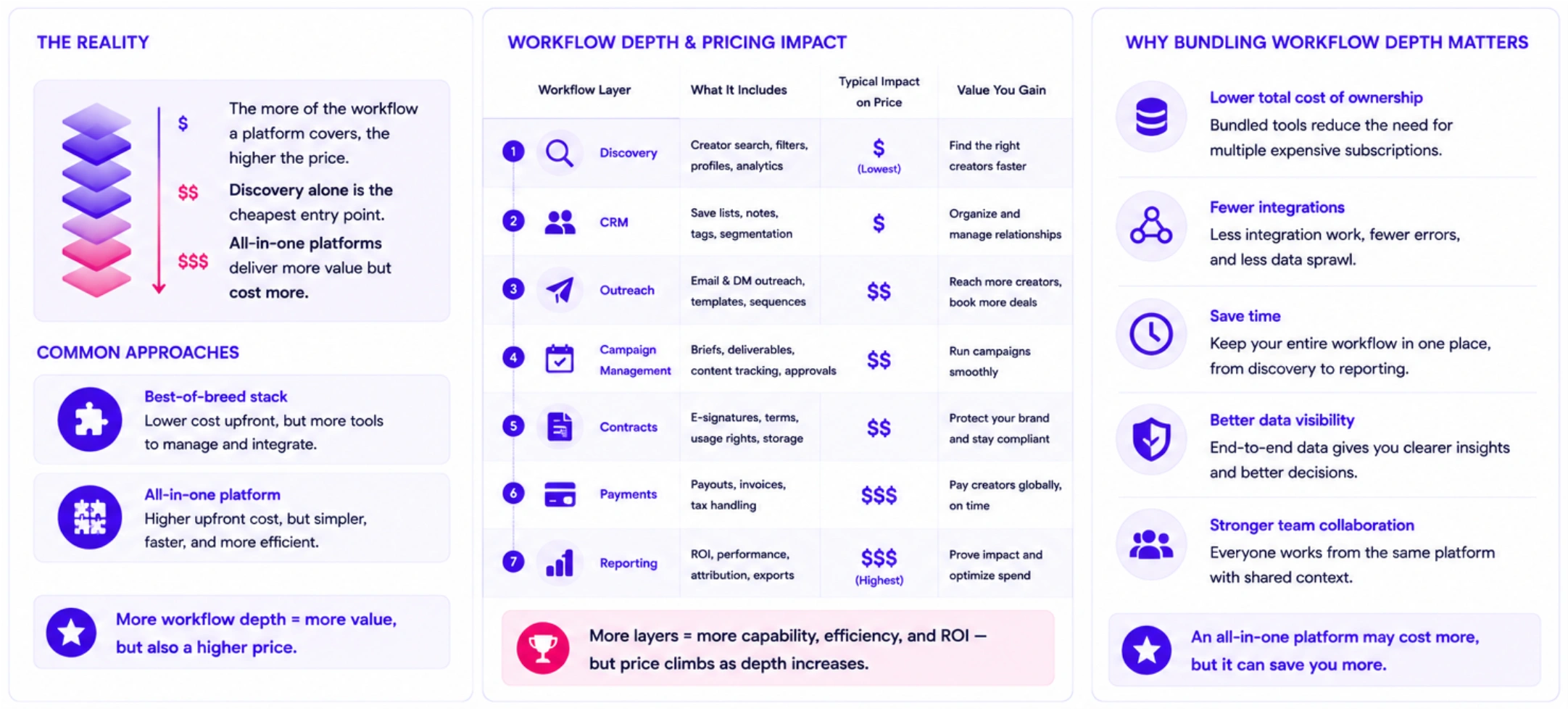
Driver 6: Workflow depth. Discovery alone is the cheapest entry point. Add CRM, outreach, campaign management, contracts, payments, and reporting, and price climbs fast, though bundled all-in-one tools can reduce stack complexity.
Hidden Costs to Watch For
Beyond the headline subscription, these add-ons show up often:
- Onboarding or implementation fees: $500 to $5,000 one-time.
- API access: $500 to $3,000/mo extra.
- Paid media integration (Meta, TikTok Ads): $300 to $1,500/mo extra.
- Affiliate tracking modules: often a separate product.
- Social listening or brand monitoring: typically a premium add-on.
- Overage charges on credits and seats, plus early-termination fees on annual contracts.
2026 Pricing Benchmarks for Influencer Marketing Software
Here are the real numbers, starting with the single most useful chart on this page: who publishes pricing, and who makes you book a demo to find out.
The Transparency Split: Who Publishes Pricing, Who Doesn't
*GRIN: a few third-party listings cite a transparent Lite tier near $399/mo, but most sources and aggregated contract data show custom, demo-gated pricing from roughly $2,000/mo on annual terms. Estimates for all demo-only tools are drawn from public G2 and Capterra reviews, Influencer Marketing Hub reports, and forum-disclosed quotes. Treat them as ranges, not quotes.
Of the 10 most-used platforms, only 2 publish full self-serve pricing: Favikon and Modash. The rest require a demo or a custom quote, and annual contracts dominate that demo-gated segment.
Monthly billing is largely a product-led (Favikon, Modash) phenomenon. If you want the head-to-head detail on the big two demo-gated names, our HypeAuditor alternative and Modash alternative pages lay it out.
The 3 Tiers of the Market (Real Numbers)
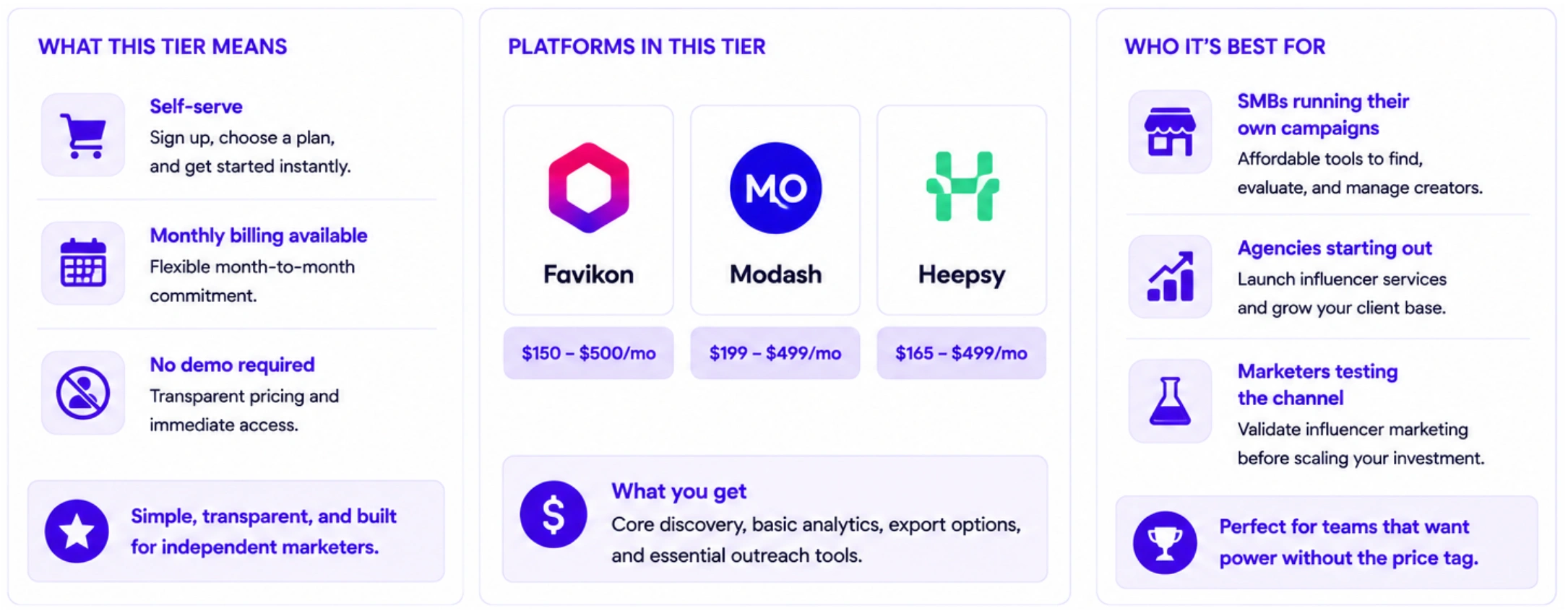
Tier 1: Published and self-serve (roughly $150 to $500/mo). Self-serve, monthly billing available, no demo. Favikon, Modash, and Heepsy live here. Best for SMBs running their own campaigns, agencies starting out, and marketers testing the channel before scaling.
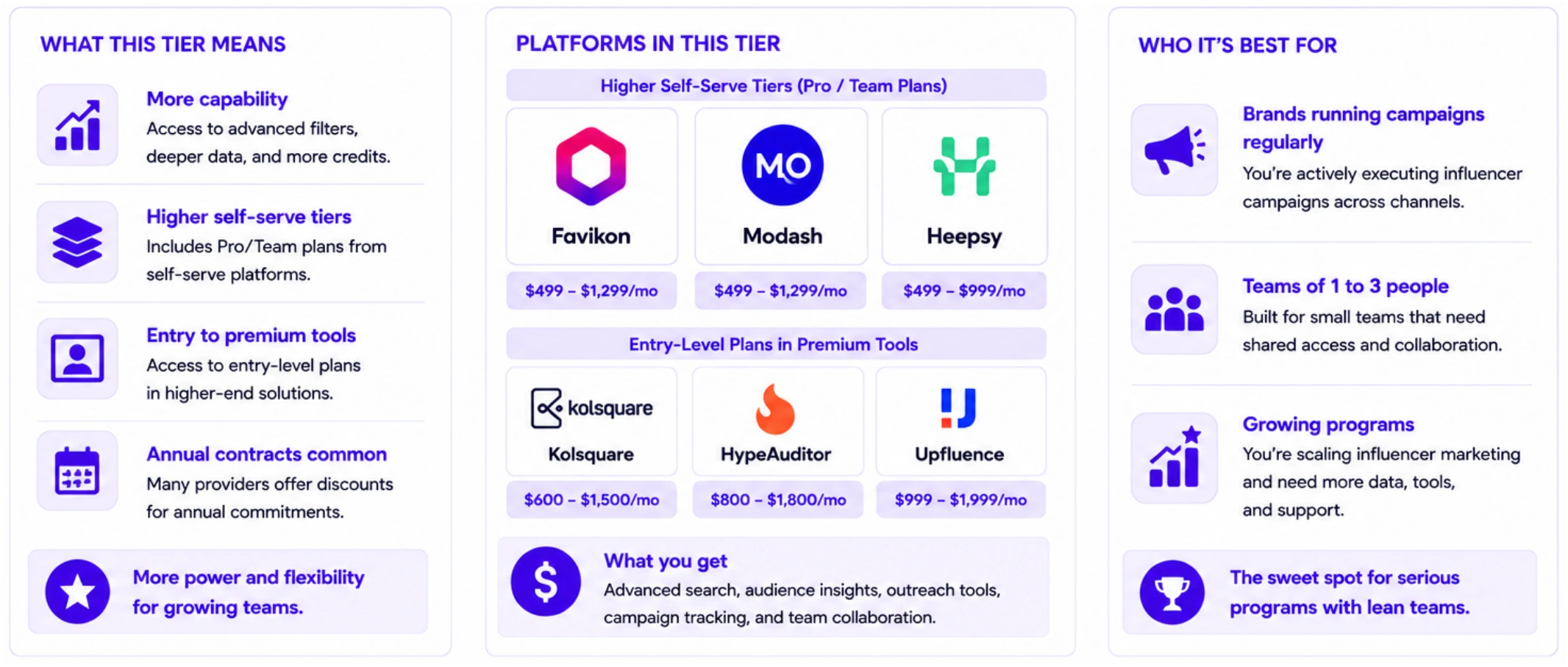
Tier 2: Mid-market ($500 to $2,000/mo). A mix of higher self-serve tiers and entry points into pricier tools. Annual contracts get more common here. Best for brands running campaigns regularly with one to three people on the tool.
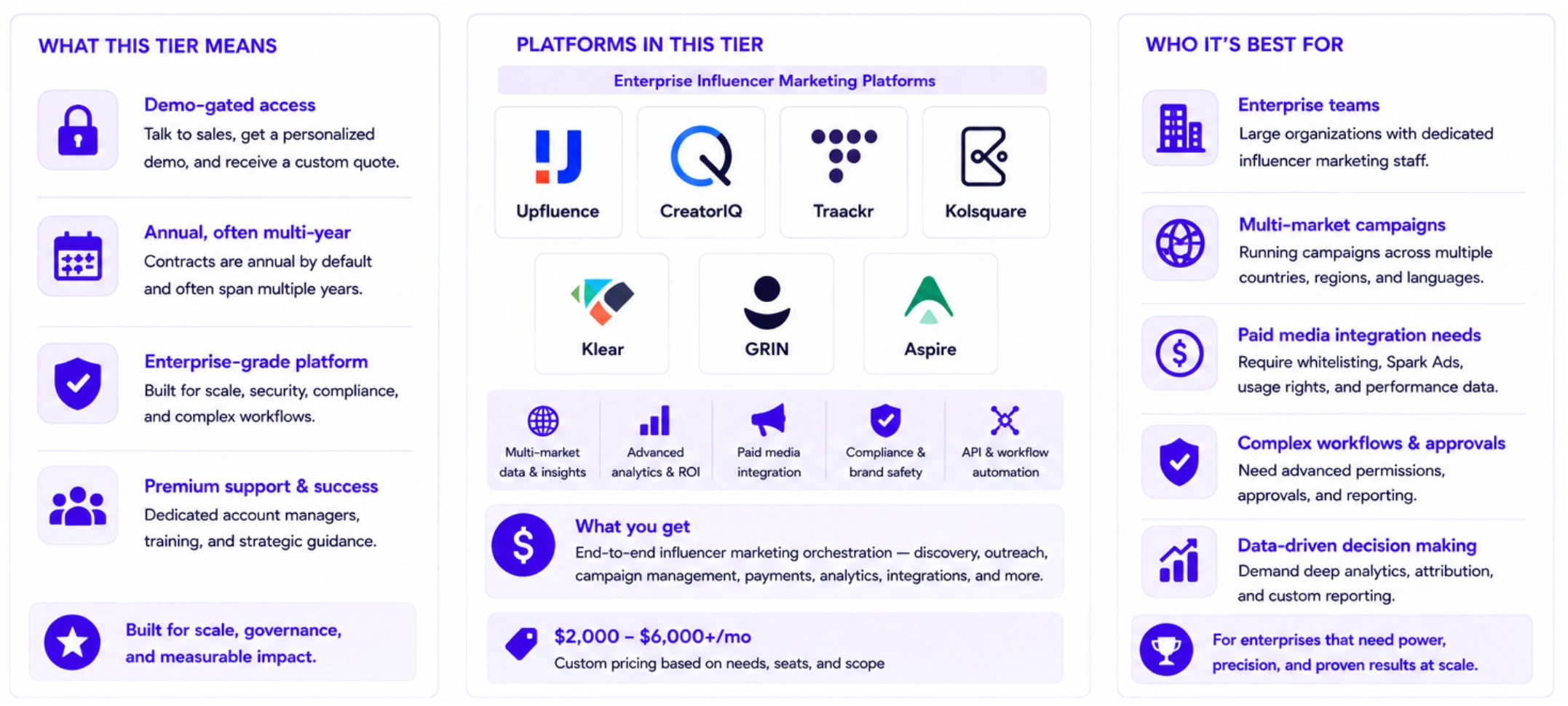
Tier 3: Enterprise ($2,000 to $6,000+/mo). Demo-gated, annual, often multi-year. Upfluence, CreatorIQ, Traackr, Kolsquare, Klear, GRIN, and Aspire sit here. Best for enterprise teams with dedicated influencer staff, multi-market campaigns, and paid media integration needs.
Pricing vs ROI Compared (When Each Tier Makes Sense)
The real question isn't "what does it cost?" It's "what does it cost per outcome?" A $2,000/mo tool that runs a $1M program is cheap; a low-cost tool sitting idle is expensive.
ROI Framework: Cost Per Outcome, Not Cost Per Month
The simple version: Platform ROI = (campaign value generated minus campaign cost minus platform cost) divided by platform cost. The platform fee is usually the smallest term in that equation, which is why over-indexing on monthly price is the wrong move. Match the tier to the budget it manages.
In Practice: A $12,000 Campaign That Returned $1.1M in Pipeline
The cost-per-outcome point is not theoretical. B2B SaaS company Vector ran a LinkedIn influencer program with a reported $12,000 budget and traced $1.1 million in pipeline to it within three months.
The spend went to a small set of credible, niche creators whose audiences were dense with demand-gen marketers and marketing executives, the exact ICP Vector sells to, rather than to high-follower generalists.
The lesson for tier selection: the platform fee was a rounding error against the outcome, and the winning variable was creator fit, not headline price.
ROI by Brand Stage (Illustrative)
ROI multiples are illustrative planning ranges, not guaranteed returns.
When Paying More Is Worth It
- You run multi-market campaigns and need consistent data quality across regions.
- You need paid media integration (Meta, TikTok Ads) directly from the platform.
- Your team needs API access to push data into BI or CRM systems.
- Compliance and brand safety are critical, as in regulated industries.
When Paying More Is Wasted
- You run fewer than three campaigns a quarter, so enterprise minimums lock you into capacity you won't use.
- Your team is one or two people, where per-seat pricing makes enterprise tools needlessly expensive.
- You focus on a single platform and don't need 9-platform breadth.
- You haven't validated influencer marketing yet, so a 12-month contract is a bet on a hypothesis.
How to Choose the Right Platform for Your Brand
Choosing well comes down to five questions, in this order. Answer them before you take a single sales call.
- What's your annual influencer budget? If it's under $50K, you belong in Tier 1. Don't let an enterprise rep talk you into a $30K/year tool to manage a $20K/year spend.
- What platforms do you actually need? If you need LinkedIn, your shortlist shrinks fast because most tools skip it. If you need Shopify and affiliate workflows, it shifts toward GRIN and Modash. Start with platforms, then price.
- How many people will use it? Per-seat enterprise tools punish small teams, while self-serve tools usually include one to three seats at base. Compare seat-adjusted price, not the headline.
- Can you avoid an annual contract? Monthly billing is a feature, not a default. If you're testing or scaling unpredictably, don't sign annual until you've validated the channel.
- Will the vendor publish pricing without a demo? If not, factor two to four weeks of sales calls and procurement into your evaluation cost. Demo-gated isn't free, it's just deferred cost.
Red Flags in Vendor Pricing Conversations
- Pressure to sign annual before you've run a real campaign on the tool.
- Vague answers about what's actually included in the base tier.
- Surprise add-on fees that only surface after the demo.
- Refusal to put a written quote in your hands until late in the cycle.
- "Custom pricing" that really means "we'll quote based on what we think you'll pay."
Why Favikon Publishes Its Pricing (and What It Costs)
At Favikon, we publish our pricing because we were built product-led from day one, as the B2B Influencer Marketing Platform. That means you can try it before you buy it, see the cost without filling out a form, and start a trial without a sales call.
Demo-gating isn't neutral. It moves the work of evaluation from the vendor onto you, the buyer, and it slows down a decision you should be able to make in an afternoon. Published pricing is a buyer-convenience signal: you can compare on your own terms.
Favikon's Pricing in Full
At Favikon, we publish our plans for brands openly, with monthly, quarterly, and annual billing and a free trial on every plan (no permanent free tier).
Because plan names and figures are updated from time to time, the current rates and what each plan includes are on the live pricing page.
What You Get on a Favikon Plan That Competitors Don't Offer
- LinkedIn and Substack coverage: Few platforms at this level cover B2B creator channels. You can find LinkedIn creators from your first plan.
- An Authority Score on every profile: Automated authority scoring, not manual auditing.
- 9 platforms total: broader than tools at several times the price.
- Monthly billing: available, with no annual commitment required.
Frequently Asked Questions
1. How much does an influencer marketing platform cost in 2026?
Influencer marketing platforms range from roughly $150/month for self-serve SMB tools to $6,000+/month for enterprise platforms. Most published SMB pricing sits between $150 and $500/month, while demo-gated enterprise tools typically run $2,000/month and up on annual contracts.
2. Why do most influencer marketing platforms hide their pricing?
Most platforms demo-gate pricing because a sales-led model lets them quote each buyer based on company size and perceived budget. The tradeoff for you is a slower evaluation and less ability to compare options side by side.
3. What's the cheapest influencer marketing platform?
Among the most-used platforms with published pricing, Favikon and Modash are the lowest self-serve entry points, both with monthly billing and a free trial. Heepsy also offers a lower-cost published tier.
4. Is there a free influencer marketing platform?
Most brand-focused platforms offer a free trial rather than a permanent free plan. Favikon includes a free trial on every plan, and HypeAuditor provides free basic reports. Trials are good for evaluation but usually too limited to run active campaigns.
5. Do I have to sign an annual contract?
Not always. Product-led tools like Favikon and Modash offer monthly billing with no annual commitment, while most demo-gated enterprise platforms require annual or multi-year contracts.
6. What's the average cost of an influencer marketing platform?
The practical average for an actively used tool lands around $200 to $1,000/month, depending on tier and team size. Enterprise deployments push well past that, often $25,000 to $50,000+ per year.
7. How much does Favikon cost?
Favikon for Brands publishes its plans openly, with monthly, quarterly, and annual billing and a free trial on every plan. For the current rates and what each plan includes, see the live pricing page at favikon.com/pricing.
8. What's the difference between SMB and enterprise platform pricing?
SMB pricing is published, monthly, and self-serve, usually in the low hundreds per month. Enterprise pricing is demo-gated, per-seat, and annual, typically $2,000/month and up, with onboarding and add-on fees layered on top.
9. What hidden costs should I expect?
Watch for onboarding fees ($500 to $5,000), API access ($500 to $3,000/month), paid media integrations ($300 to $1,500/month), credit and seat overages, and early-termination fees on annual contracts. Always ask for these in writing before signing.
10. Is a demo always required to get pricing?
No. Favikon and Modash publish full pricing online, so you can evaluate without a call. Most other major platforms require a demo to get a quote.
11. What's the best influencer marketing platform for small budgets?
For small budgets, a published, monthly, self-serve tool like Favikon or Modash fits best, especially if you need LinkedIn coverage or multi-platform reach. The key is matching tier to your annual influencer budget rather than overbuying.
12. What should I budget for an influencer marketing platform if I'm just starting?
If you're testing the channel with under $25K a year in creator spend, budget a low-hundreds-per-month Tier 1 tool, which is 5 to 10 percent of your budget. Avoid annual contracts until you've validated that influencer marketing works for you.
See Real Pricing, No Demo Required
You shouldn't need a sales call to find out what software costs. At Favikon, we publish our plans, offer monthly billing, and include a free trial on every plan.
Others articles