What Is EMV in Influencer Marketing? How to Calculate and Measure It
Earned media value (EMV) helps brands estimate the value of exposure generated by influencer campaigns. This guide explains how EMV works, how to calculate it, and how to use it alongside other metrics to measure campaign results.

What Is EMV in Influencer Marketing — And Why You Should Ditch It

If you've ever sat through a campaign wrap-up call, you've heard it: "This campaign generated $340,000 in Earned Media Value." It sounds impressive. It's also, most of the time, a number that means far less than it appears to.
This article breaks down what EMV actually is, why the industry leaned on it for so long, why it's a shaky foundation for real measurement, and what to use instead.
Part 1: What Is EMV, and Why Does Influencer Marketing Use It?
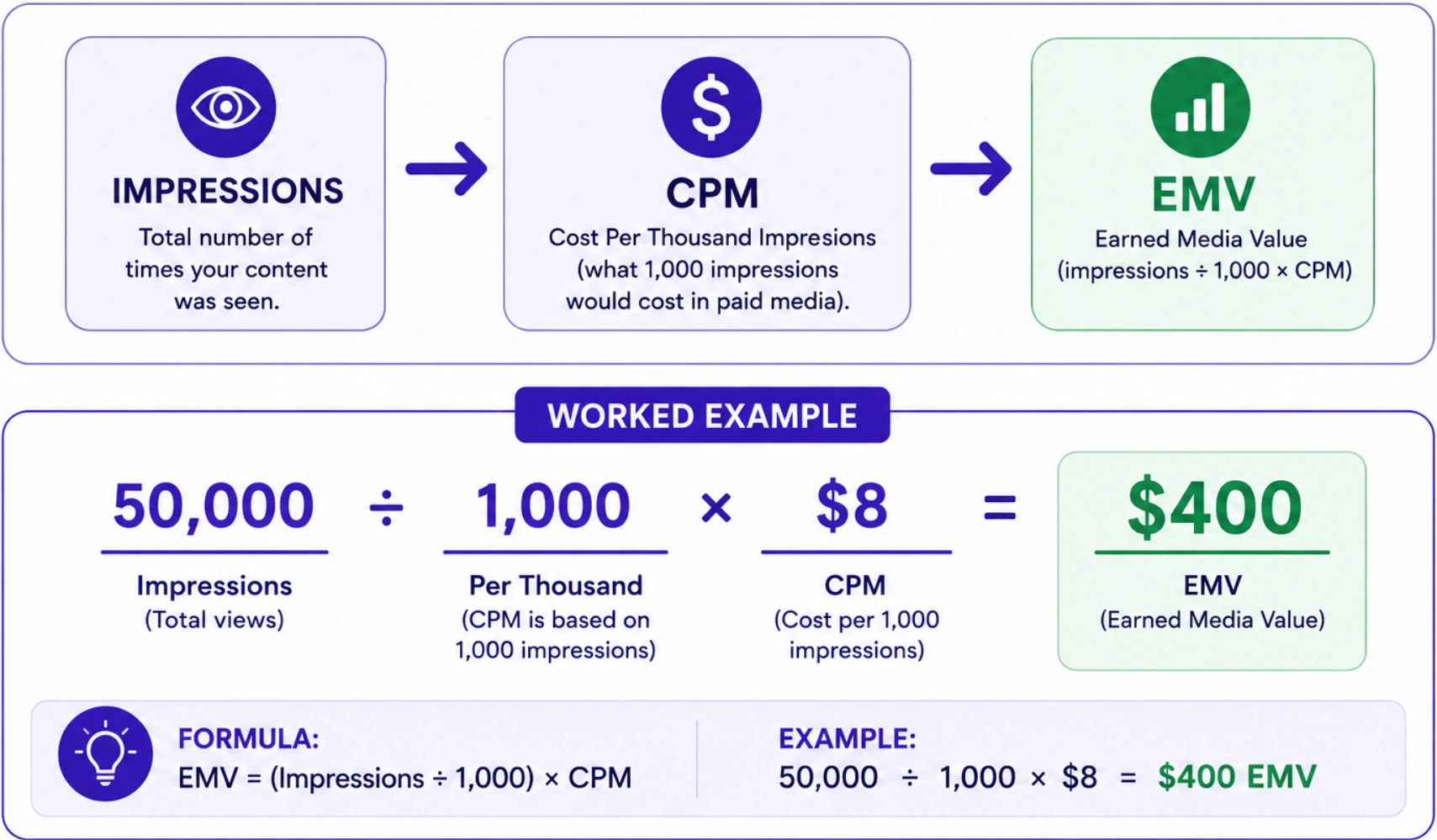
Earned Media Value (EMV) is an attempt to put a dollar figure on the exposure a brand gets from influencer content, without paying directly for that specific placement. The logic: if a creator's post reached 50,000 people for free, what would it have cost you to reach those same 50,000 people with a paid ad?
The basic formula looks like this:
EMV = (Impressions ÷ 1,000) × CPM
Some versions add weighted values for likes, comments, shares, and views on top of that base calculation, so a highly engaged post scores higher than one that just racked up passive impressions.
EMV didn't originate in influencer marketing. It's a direct descendant of Advertising Value Equivalency (AVE), a metric PR teams used for decades to justify earned press coverage by pricing it against ad space. When influencer marketing exploded, marketers borrowed the same logic and applied it to Instagram posts and TikTok videos instead of magazine placements.
Why did it stick around?
- It speaks finance's language. Telling a CMO "we drove $340,000 in EMV" lands better in a boardroom than "we got 4.8 million impressions and a 2.1% engagement rate."
- It's a fast budget-justification tool. It lets influencer teams frame organic reach against what the same reach "would have cost" in paid media.
- It's easy to calculate. One formula, one output, no need to explain funnels or attribution models.
That simplicity is exactly why it became the default. It's also exactly why it falls apart under scrutiny.
For a fuller picture of the metrics that sit alongside EMV in a healthy measurement stack, see Favikon's guide to influencer marketing KPIs.
Part 2: Why EMV Is Flawed
1. It borrows ad-world math for actions that aren't ad-world actions
EMV's core assumption is that an impression is an impression, and its value can be priced like a paid ad slot. But paid media buying and organic influencer content don't behave the same way.
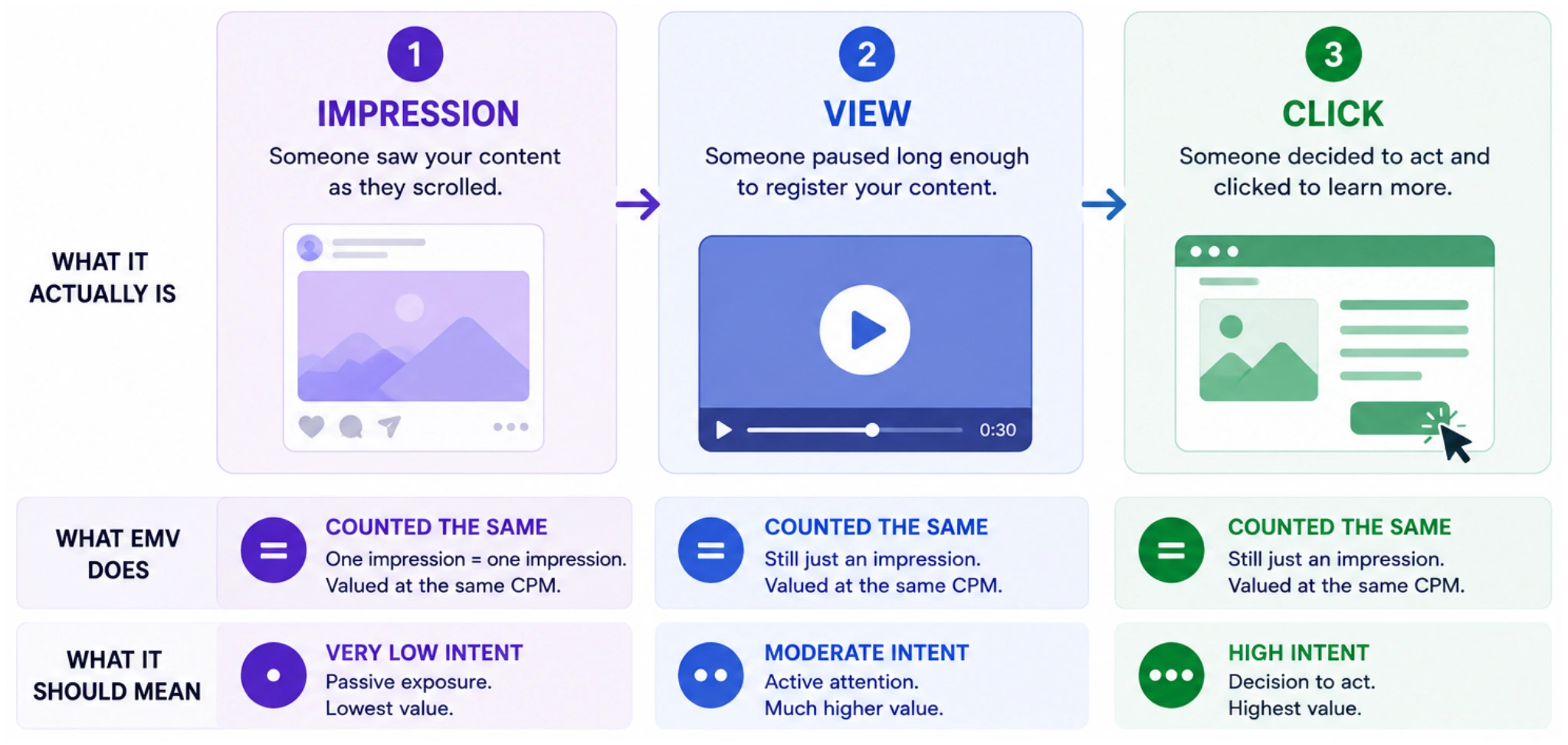
An impression is passive. Someone scrolled past. A view means someone paused long enough to register the content. A click is a decision to act. These are three completely different levels of intent, and EMV formulas routinely blend them into one dollar figure using a single CPM rate borrowed from advertising.
The problem compounds because a paid ad impression is bought and guaranteed placement. An organic influencer impression is earned attention inside someone's feed, next to a friend's vacation photos and a meme. Pricing the two identically assumes they carry equal weight with the viewer. They don't. Brandwatch notes that EMV treats all mentions equally, whether the reaction was praise or a viral complaint — the formula can't tell the difference, and it definitely can't tell the difference between a scroll-past and a genuine click.
2. One EMV formula can't hold across industries, geographies, and audiences
CPM benchmarks aren't fixed numbers. They shift by platform, by vertical, by country, and by audience quality. Tanke's breakdown of EMV points out that an impression in a luxury fashion placement isn't equivalent to an impression on a sponsored Instagram Story, yet a single CPM benchmark applied across contexts overstates the value of the lower-quality placement.
Platform CPMs alone already vary wildly. One widely cited breakdown pegs Instagram around $7.50, YouTube around $10, TikTok around $5, and LinkedIn around $12 — and that's before accounting for country, niche, or audience income level. A beauty campaign in the US and a B2B SaaS campaign in Southeast Asia are not going to realistically share a CPM, but most EMV tools apply one anyway.
This is why Contentgrip's honest EMV guide calls out the lack of a universal formula as a structural problem, not a minor inconsistency: every platform, agency, and tool applies its own benchmarks, and the resulting variation is large enough to change the story a report tells.
3. Other reasons the industry is walking away from EMV
- It's a vanity metric that's easy to inflate. Aspire's take on EMV is blunt about this: EMV highlights impressions and engagement, and both are easy to inflate with bots or purchased engagement. Raise the assumed value of a comment, and the total jumps, with nothing about the actual campaign changing.
- It descends from a metric PR already abandoned. Traackr traces EMV's lineage back to Advertising Value Equivalency, a metric the Institute for Public Relations dismissed years ago as misleading. Influencer marketing effectively revived a discredited PR metric under a new name.
- High EMV and zero revenue can coexist. A post can generate an eye-catching EMV number while driving no clicks, no sign-ups, and no sales. EMV measures exposure value, not business outcomes — a distinction that gets lost the moment the number lands on a slide next to a dollar sign.
- It only explains success inside one campaign — and even there, it can mislead when comparing creators. Within a single campaign, EMV can be a fine directional signal: is earned media trending up, is this format outperforming that one. But the moment you compare Creator A to Creator B, the comparison breaks down if they sit on different platforms, post different formats, or reach different-quality audiences. A creator with a smaller, hyper-relevant niche audience can post content that drives real business results while showing a lower EMV than a creator with a bigger, less-engaged following whose numbers only look better because the raw impression count is higher. EMV can't correct for that — it just multiplies whatever impression count it's given.
Nick Uhnaf's LinkedIn piece on EMV makes a version of this same point: EMV is a reach-and-exposure estimate dressed up to look like a revenue figure. Treated as a rough gauge of attention, it's fine. Treated as proof a campaign made money, it falls apart — because it never measured money to begin with.
Part 3: So Why Is EMV Still Used?
Despite everything above, EMV hasn't disappeared. A few reasons:
- It's still the fastest way to get a single number into a slide. Marketing teams reporting up to finance or leadership need one headline figure, and EMV remains the path of least resistance.
- No single replacement has become the new industry default. ROI, ROAS, attribution modeling, and VIT-style frameworks are all gaining ground, but none has fully replaced EMV as the universal shorthand — so teams keep reaching for the metric everyone already understands.
- It's genuinely useful in a narrow, directional way. Tracked consistently over time, EMV can show whether earned media is growing, and it can help compare a creator's output against their fee. The failure mode isn't using EMV — it's using EMV alone.
- Legacy habits from PR carried over. Influencer marketing grew out of PR and social teams that already reported AVE-style numbers. EMV was the natural next step, and old reporting habits are slow to change.
- Agencies and platforms built reporting infrastructure around it. Once EMV is baked into a dashboard, a contract, or a client's expectations, ripping it out takes deliberate effort.
The honest position isn't "EMV is worthless." It's "EMV alone proves nothing about revenue, and treating it as your primary KPI will eventually get you a hard question from finance you can't answer."
Part 4: What to Measure Instead
If EMV shouldn't be the headline number, what should sit in its place? Favikon has three deep guides on exactly this:
- How to Measure Influencer Marketing — a full framework for building a measurement stack beyond reach and EMV, covering engagement quality, traffic, and conversion metrics.
- How to Measure Influencer Marketing Attribution: The Complete Guide — how to actually connect a creator's post to a sale, using UTM links, promo codes, and attribution models instead of an estimated exposure value.
- How to Build an Influencer Marketing Report — how to structure a report that leads with outcomes finance actually cares about, rather than a single inflated dollar figure.
Worth pairing those with two more practical pieces: how to calculate influencer marketing ROI and how to set clear goals and KPIs for your campaigns before you launch, so measurement isn't an afterthought.
At a glance, the alternatives worth building into your stack:
- Attribution links and unique promo codes — direct line from a post to a purchase
- CPA, CPC, CPV — cost per action, click, or view, tied to real spend
- ROAS — actual revenue generated per dollar spent
- Conversion rate and AOV — what happens after the click
- Share of voice and sentiment — for brand and awareness goals where a hard conversion isn't the point
Part 5: How Favikon Measures It All For You
Favikon doesn't ask you to choose one metric and abandon the rest. Inside Favikon's campaign analytics, you get reach, views, engagement, and EMV alongside cost metrics like CPM, cost per engagement, and cost per view, plus a creator-by-creator funnel from activation through to published content — all in one dashboard instead of stitched-together spreadsheets.
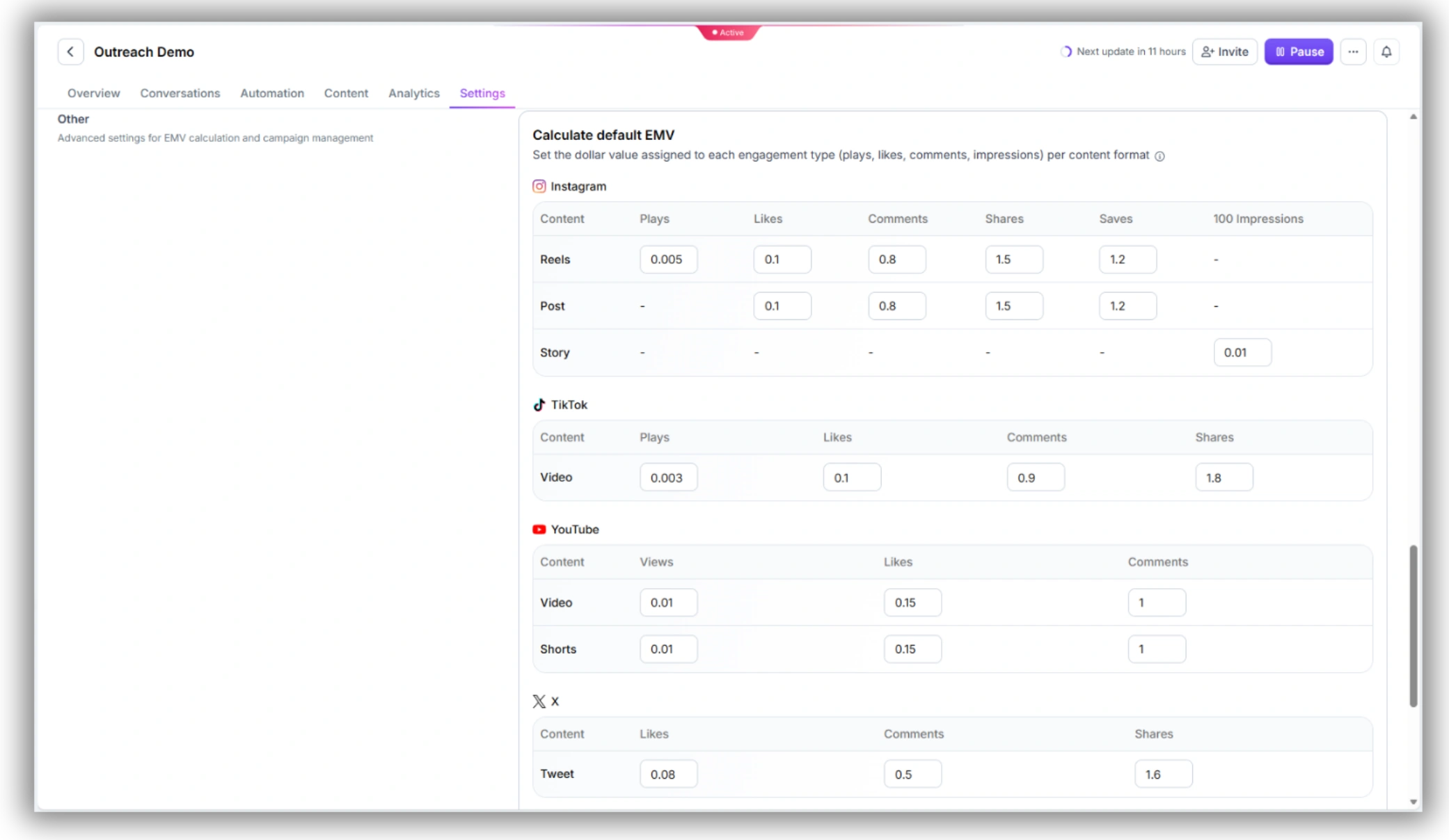
The key difference: you're not locked into a single, generic EMV formula. Inside your campaign settings, you can set your own dollar values for each engagement type — plays, likes, comments, impressions — broken down per content format. That means your EMV reflects your industry, your audience, and your platform mix, instead of a one-size-fits-all CPM that doesn't hold up under a second look. Full setup steps are in Managing Your Active Campaigns.
The takeaway isn't "never look at EMV." It's "don't let EMV be the only thing you look at, and if you're going to use it, make the formula yours instead of borrowing an assumption built for a completely different medium."
Others articles