The Best AI Agents for Marketing Teams in 2026
We tested six leading AI agents for marketing teams in 2026, comparing their strengths across automation, content, integrations, and creator marketing. Find the right platform for your team’s specific workflow and goals.


Every platform in your marketing stack added an AI agent feature this year. Most of them behave the same as before.
That's the problem with this category. An AI agent plans its own steps, selects the right tools for each step, and adjusts as conditions change. An automation with a chat interface just follows the path you already drew. Both say "agent" on the homepage, and the difference only becomes obvious once you're six weeks into a contract.
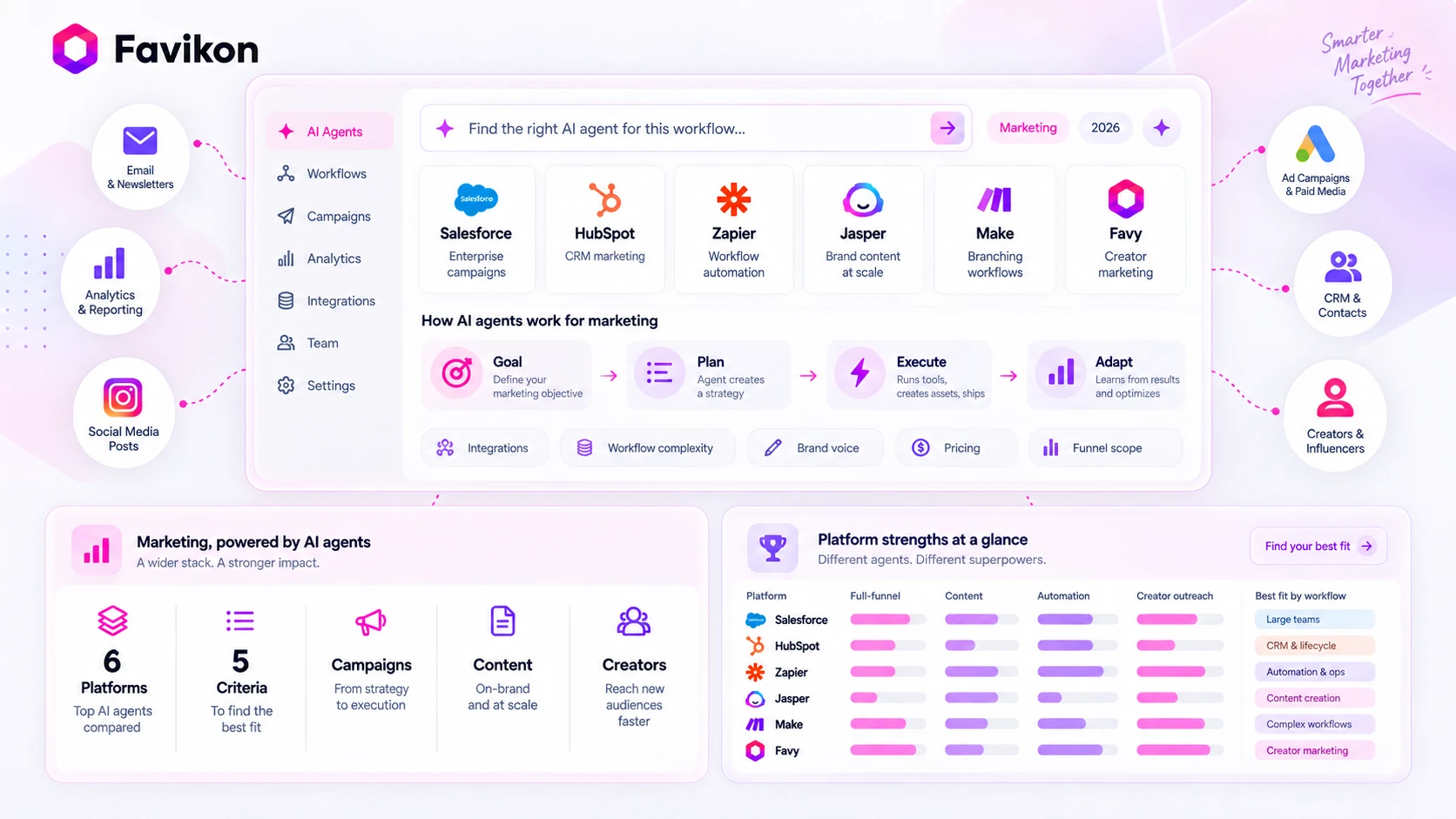
We tested a dozen platforms against marketing workflows and the same five criteria. Six made the list. They cover different ground, from full-funnel campaign orchestration to one specific workflow that no general-purpose tool handles as well.
Which one fits depends on your team's problem.
TL;DR: AI Agents for Marketing
- Most platforms calling themselves AI agents in 2026 are automation workflows with a new label, and the distinction matters before you evaluate anything.
- An agent pursues a stated goal, plans its own steps, and adjusts based on what it finds along the way.
- General-purpose platforms like Agentforce, HubSpot, and Zapier handle campaigns, content, and cross-stack workflows across the full funnel.
- Favy handles influencer marketing specifically: find, vet, price, and draft outreach in a single prompt across 10M+ scored creator profiles.
- Pick the platform built for the workflow your team needs to automate, and test it against one use case before committing to anything broader.
- Try Favikon free for 7 days to see Favy in action, no credit card needed.
How We Chose These Six Platforms
The best AI agent for a marketing team isn't the one with the most features. It's the one that fits the workflow you need to automate. A platform that runs complex campaign orchestration is useless if your bottleneck is creator outreach, and vice versa. We tested each platform against marketing use cases using five criteria that distinguish tools that work in production from those that look good in a trial.
Here's what we measured across all six platforms:
- Integration depth: How cleanly the tool connects to the marketing stack teams already run, including CRM, ad platforms, ESP, and analytics. A powerful agent that doesn't connect to your existing stack creates a parallel workflow your team won't maintain.
- Workflow complexity: Whether the platform can handle conditional branching and multi-step logic or whether it flattens complex campaigns into linear sequences. Most marketing workflows have branches. The tool needs to handle them. We weighted this more heavily for teams managing multi-segment campaigns, where a tool that flattens branching logic forces manual workarounds.
- Brand-voice fidelity: When the tool generates content, does it sound like the brand, or does it need heavy editing before anything ships? Output that needs a full rewrite before it ships doesn't save time.
- Pricing transparency: Whether the cost is visible before a sales call or only emerges after a demo. Hidden pricing makes budget planning nearly impossible before you commit. We weighted this higher than usual because hidden pricing actively delays evaluation for mid-market teams, which are the core buyers on this list.
- Funnel scope: Whether the platform covers the full marketing workflow or one specific slice of it. A tool optimized for one workflow isn't a weakness, but it matters that you know which workflow you're actually buying.
Quick Comparison: AI Agents for Marketing at a Glance
What Counts and What Doesn't as an AI Agent
The practical test is simple. Give it a goal and walk away. Does it figure out the next step on its own, or does it wait for you to tell it what to do? If it waits, it's not an agent.
Most tools calling themselves AI agents right now don't clear that bar. A chatbot with a new label still stops when you stop prompting. An if-then automation still breaks outside the path you drew. The industry term for this gap is "agent-washing."
An agent clears four bars: it starts from a stated goal, picks the right tool for each step, adjusts mid-workflow when conditions change, and uses outcomes from previous runs to inform the next one. Favy does this for influencer marketing. Give it one prompt to find creators in a specific niche. It finds them, vets them, estimates pricing, and drafts outreach in a single thread without you having to direct each step.
1. Favikon (Favy)
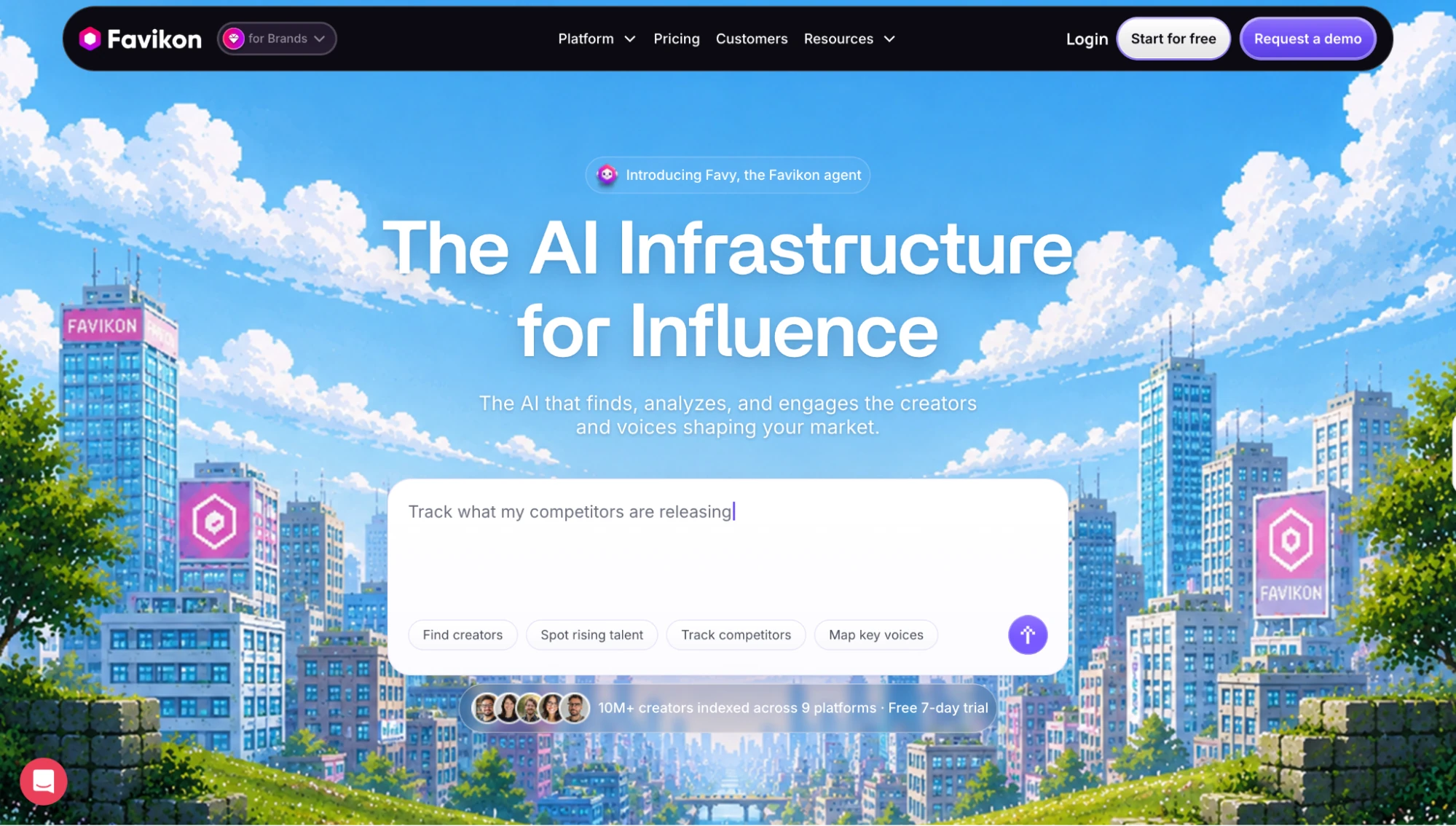
What is it? Favikon is an AI-powered influencer marketing platform built for discovery, vetting, outreach, and analytics in one place. Favy, its native AI agent, runs inside the "Ask Favy Anything" interface. On the Pro plan, it also connects to Claude, ChatGPT, Gemini, or any MCP-compatible assistant through its dedicated MCP tools. Give it one prompt to find creators in a specific niche, and it finds them, vets their authenticity, estimates collaboration pricing, and drafts outreach, all without leaving the interface.
Best for: Teams running influencer programs who want discovery, vetting, pricing estimates, and outreach handled from one interface.
Why I Picked It: A single prompt covers the full creator marketing sequence here: find, vet, price, and draft outreach, all in one thread. No general-purpose orchestration platform ships with a scored creator index, which is what makes that workflow possible. Every profile gets an Authority Score, so vetting happens in one query instead of a manual audit across platforms.
Features
- Multi-step agent execution covers the entire creator marketing workflow in a single prompt. Favy finds creators matching your criteria, checks Authority Score and Authenticity Score for brand safety signals, estimates collaboration pricing, and drafts outreach messages, all in one thread without switching tools.
- MCP access on the Pro plan extends Favy into Claude, ChatGPT, and Gemini through 43 dedicated tools. Marketing teams already working inside an AI assistant can run Favikon's full creator index from their existing chat window.
- Favy reasons over a creator index that no general AI agent can replicate. 10M+ scored profiles, 600+ AI niche categories across 9 networks. A generic AI searches the public web and guesses. Favy works from data built specifically for influencer marketing.
Limitations
- Favikon is built specifically for influencer and creator marketing, not general marketing orchestration. Teams that need broader cross-channel automation alongside their creator program can connect Favy to Zapier or Make via MCP.
- Teams running heavy-volume DTC product seeding with Shopify-native workflows will want to evaluate whether Favikon's current Shopify support fits their setup. Favikon isn't built for order-level Shopify automation, so high-volume seeding pipelines are typically a better fit for a platform designed around that specific workflow.
Pricing
Core starts at $199 per month. MCP access unlocks at Pro, starting at $299 per month. Enterprise pricing is custom. Every plan runs on usage-based pricing with no annual lock-in. All plans come with a 7-day free trial, and no credit card is required. There is no permanent free plan.
2. Salesforce Agentforce
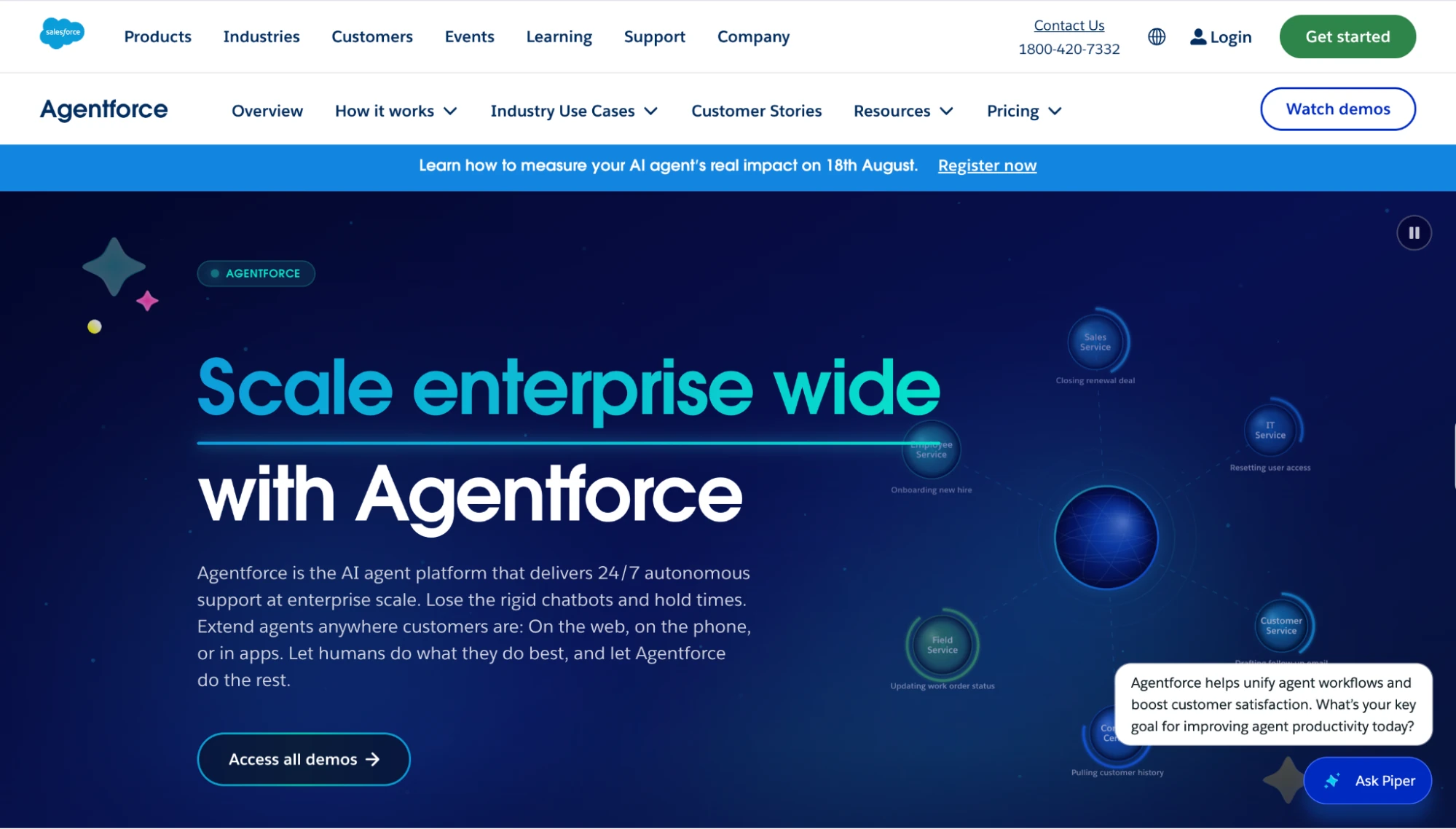
What is it? Salesforce Agentforce is Salesforce's AI agent suite, built directly into Marketing Cloud, Data Cloud, and Account Engagement. The flagship marketing agent is Campaign Optimizer. It generates audience segments, draft copy, and journey logic inside the platform, then adjusts campaigns based on performance data.
Best for: Enterprise teams already deep in the Salesforce ecosystem who want AI agents that work inside Marketing Cloud and Data Cloud without rebuilding anything.
Why I Picked It: If your marketing stack already runs on Salesforce, the integration depth is immediate. Agents connect to every Salesforce product you use from day one, with your full customer data already in place. They work from unified Data 360 profiles, so every personalization and journey decision gets made on complete customer context. Named marketing agents cover both brand and demand gen from one platform, each shipping with a defined scope and a specific job to do.
Features
- Campaign Optimizer handles the complete marketing lifecycle. Give it a campaign goal, and it generates audience segments, draft copy, and journey logic. Everything gets built and activated inside the platform, with no manual handoffs between tools.
- Data Cloud integration means agents work from unified customer profiles. Every segmentation and personalization decision runs on full customer context. That context pulls from CRM data, external sources, and behavioral signals, all consolidated before the agent acts.
- Named demand-generation agents cover B2B pipelines specifically. Piper handles sales development, Hunter runs prospecting, and Account Discovery identifies high-fit accounts. These are named, role-specific agents built for defined marketing jobs.
Limitations
- Configuring data permissions, agent topics, and guardrails requires a Salesforce-certified admin or an implementation partner. Plan for a partner-led implementation.
- The economics assume you're already a substantial Salesforce customer. Teams without existing Marketing Cloud and Data Cloud licenses will encounter a significant cost barrier before reaching the agent layer.
- Marketing Cloud Next pricing is not listed anywhere on the Agentforce pricing page. You cannot self-calculate the cost before a sales conversation, which makes budget planning harder before you commit.
Pricing
There's a free tier, but it covers only building tools. Actual agent usage starts at $500 per 100,000 Flex Credits. Marketing Cloud licenses start at approximately $1,250 per month for the basic tier, based on published third-party benchmarks. However, your actual cost depends on the modules and seat count already contracted. Factor that in before the Flex Credits conversation.
3. HubSpot Agent Hub
What is it? HubSpot Agent Hub is HubSpot's reorganized AI suite (formerly Breeze Agents), built around three named marketing agents. Campaign Agent takes a goal and builds the campaign. Content Agent generates blog posts, landing pages, and social content. Nurture Agent reads each contact's CRM history and tailors email follow-up from there. All three draw on the same HubSpot data your team already manages.
Best for: Teams using HubSpot as their system of record who want agents that run on their existing data from day one.
Why I Picked It: If HubSpot is already your system of record, agents connect to your full contact, company, deal, and content data from day one, with no separate integration to configure. Campaign Agent, Content Agent, and Nurture Agent collectively cover the core marketing workflow, so planning, content creation, and lead nurture all run from one platform.
Features
- Campaign Agent plans and launches campaigns from a single brief. Give it a target audience and an objective, and it generates the segment, copy, and channel mix. It reads your existing HubSpot contacts, companies, and workflows, so there's no manual data setup before it can act.
- Content Agent creates blog posts, landing pages, and social content directly integrated with the HubSpot CMS. Everything it generates sits inside the same workspace where your team edits and publishes.
- Nurture Agent handles email personalization for individual leads. It reads CRM data for each contact and tailors follow-up messages based on their engagement history.
Limitations
- The meaningful marketing agents come with paid Marketing Hub plans, with Professional starting at $890 per month billed monthly, or $800 per month billed annually.
- Agent Hub works on HubSpot data. If your audience data, ad performance, or behavioral signals live outside HubSpot, you'll need a separate orchestrator to pull them in.
- Campaign Agent and Nurture Agent do not have standalone product pages. Feature details are confirmed from the Marketing Hub overview, but specific workflow steps are harder to verify before you sign up.
Pricing
HubSpot Agent Hub features are available across paid Marketing Hub plans. Marketing Hub Starter starts at $7 per seat per month, while Professional starts at $800 per month, billed annually, and includes 3 Core Seats and 3,000 HubSpot Credits. Enterprise starts at $3,600 per month with 5 Core Seats and 5,000 HubSpot Credits. Additional HubSpot Credits cost $10 per 1,000 credits when paid monthly or $9 per 1,000 when paid annually.
4. Zapier
What is it? Zapier is a workflow automation platform that connects over 9,000 apps, letting AI take action across the tools your team already uses without switching platforms.
Best for: Teams with a sprawling, multi-tool stack who need AI to take action across all of it without switching platforms.
Why I Picked It: The 9,000+ app library covers more marketing tools than any other platform on this list, including long-tail tools most enterprise suites don't support. Copilot is a genuine no-code builder, so a marketing manager with no automation background can describe a goal in plain language and configure a working workflow. Every agent action also runs through a governed layer, giving marketing ops teams clear visibility into what's running and what's changed.
Features
- Zapier Copilot lets you describe a goal in plain language and builds the workflow for you. You tell it what you want to happen, and it brainstorms and configures the automation. No flowchart is required before you start.
- 9,000+ app integrations cover every major marketing tool and a long tail of smaller ones. Google, Salesforce, Microsoft, Klaviyo, Apollo, and HubSpot all connect natively, alongside hundreds of point solutions. That breadth is the main reason marketing teams reach for Zapier when their stack spans multiple vendors.
- Zapier MCP connects AI assistants like Claude and ChatGPT directly to your tech stack. From a single chat window, an AI can take governed actions across your connected apps.
Limitations
- Zapier is built for trigger-based automation. A multi-step workflow with branching logic gets harder to manage here than on a dedicated orchestrator. Make handles that kind of conditional complexity more cleanly.
- Zapier Agents is a separate product from Zap Workflows. If you expect the $19.99 plan to cover AI agents, it doesn't. Agents' pricing is an entirely separate billing system.
- Three products with three billing models mean costs can add up without a clear total before you've committed. Workflows, Agents, and Chatbots each bill independently.
Pricing
Zapier runs three separate billing systems. Zap Workflows starts free at 100 tasks per month, with paid plans starting from $19.99 per month billed annually. The Agent's product has its own plan, starting free at 400 activities per month and $33.33 per month billed annually for 1,500 activities. Factor in both if your marketing setup uses agents and workflows together.
5. Jasper
What is it? Jasper is a platform built exclusively for marketing content, organized around three layers: prebuilt agents that handle specific outputs, Content Pipelines that move work from brief to launch, and Jasper IQ, the brand intelligence layer that applies your voice and style rules to every output.
Best for: Content-heavy teams that need every blog post, email, and ad to sound like the brand without a manual editing pass each time.
Why I Picked It: Jasper IQ automatically applies brand voice, style rules, and audience profiles to every output your team generates. Teams that train Jasper IQ on their existing content report significantly reduced heavy editing time once the brand layer is in place. The agent library spans campaign briefs, blog posts, email sequences, landing pages, social campaigns, and GEO optimization, so most marketing teams won't reach the ceiling of what's available.
Features
- Jasper IQ is what separates this platform from a generic writing tool. You train it once on your existing content, style guide, and audience profiles. From there, every blog post, ad, email, and landing page the platform produces automatically inherits that voice, with no prompt required.
- A full library of prebuilt marketing agents covers the content lifecycle. The Campaign Brief Agent generates a complete campaign plan with goals and deliverables. The Blog Post Agent, Email Sequence Agent, Social Media Campaign Agent, and Landing Page Agent each handle a specific output type. The Optimization Agent consolidates SEO, AEO, and GEO research into one workflow.
- GEO (Generative Engine Optimization) tracks your brand's citation rate in AI answer engines like ChatGPT, Gemini, and Perplexity, then generates content to improve it. This is a named product with its own agent library and a free diagnostic tool.
Limitations
- Jasper covers the content creation step. It does not route leads, fire CRM updates, or orchestrate cross-platform workflows. Teams that need the full-funnel automation will pair it with Zapier or Make.
- Both the Pro and Business plans require a 12-month commitment when billed annually. GEO, Translation, and Research agents are locked to Business, with no monthly option for teams that need those capabilities.
- Some business plan features consume credits in addition to the seat fee, with costs varying by agent.
Pricing
Pro runs $69 per seat per month, or $59 per seat per month billed annually, with a 7-day free trial. Business pricing is custom and unlocks GEO, Translation, and Research agents, plus Jasper Grid and AI Studio. Some business plan features consume credits per action, priced separately from the seat fee.
6. Make
What is it? Make is a visual automation builder, and the canvas is the whole point. Every workflow gets built as a diagram on screen, with each step, condition, and branch laid out in front of you. For marketing workflows with conditional logic, you can see exactly what fires when, which path a lead takes, and where something broke.
Best for: Marketing ops teams building complex, multi-branch workflows where seeing exactly what the agent decided and why actually matters.
Why I Picked It: Branching logic is where Make outperforms simpler tools. Workflows that require a dozen conditional paths, such as routing leads based on firmographics, behavior, and deal size, remain readable on the canvas. Agent decisions are visible step by step in the Reasoning panel, and AI Agents are available on all plans, including the free tier, so teams can test agentic workflows without committing to a paid plan first.
Features
- The router module handles complex workflow branching directly on the canvas. Point it at a lead and set your conditions. Enterprise leads go to an AE, SMB leads get a self-serve email, and mid-market leads drop into a nurture sequence. Each branch is its own path, built and visible in the same diagram.
- 3,000+ app integrations cover the full marketing stack, including HubSpot, Salesforce, all major ad platforms, and 400+ AI apps. OpenAI, Anthropic Claude, Google Gemini, Perplexity, and Mistral all connect natively, so AI steps plug directly into existing automation scenarios.
- Make AI Agents (beta) bring step-level reasoning visibility to agentic workflows. A Reasoning panel shows every decision an agent makes, step by step, on the same canvas where the scenario runs. Make also ships Maia, a conversational builder that creates agents and scenarios through plain-language chat.
Limitations
- The learning curve is steeper than that of Zapier or HubSpot Breeze. A marketing manager with no automation background will spend time getting up to speed before building confidently.
- Make AI Agents are currently in beta. Core functionality is live, but the feature is still maturing. Teams building production workflows on agents should factor that in before going live with critical campaigns.
- Credit-based pricing scales with usage volume. High-volume workflows, especially those running AI steps across large contact lists, can consume credits faster than expected, making budget planning harder than with flat-rate seat pricing.
Pricing
Make runs three tiers. Free gives you 1,000 credits per month at no cost. The Make Plan starts at $9 per month, billed annually, with 5,000 credits, unlimited active scenarios, and full API access. Enterprise offers custom pricing, 24/7 support, and advanced security.
AI Agents vs. Marketing Automation: Where the Line Falls
The practical difference comes down to one question. Does the next step require a judgment call, or does it follow a fixed rule you already wrote?
Automation wins when the answer is always the same. A transactional confirmation email fires identically after every purchase. A compliance approval workflow must follow the exact path you drew, without deviation. Predictability is a feature in both cases, and automation delivers it at lower cost and complexity.
The crossover happens when the right action depends on what the system finds. Cross-channel personalization, multi-signal lead routing, and creator outreach that adapts per profile are all cases where fixed rules produce generic output. The context changes with every run, and automation can't account for that.
When in doubt, map the workflow first. Decision logic you can write as an if-then rule before starting belongs in automation. Anything that requires the system to evaluate what it finds is an agent's job.
Common Mistakes Teams Make When Adopting AI Agents
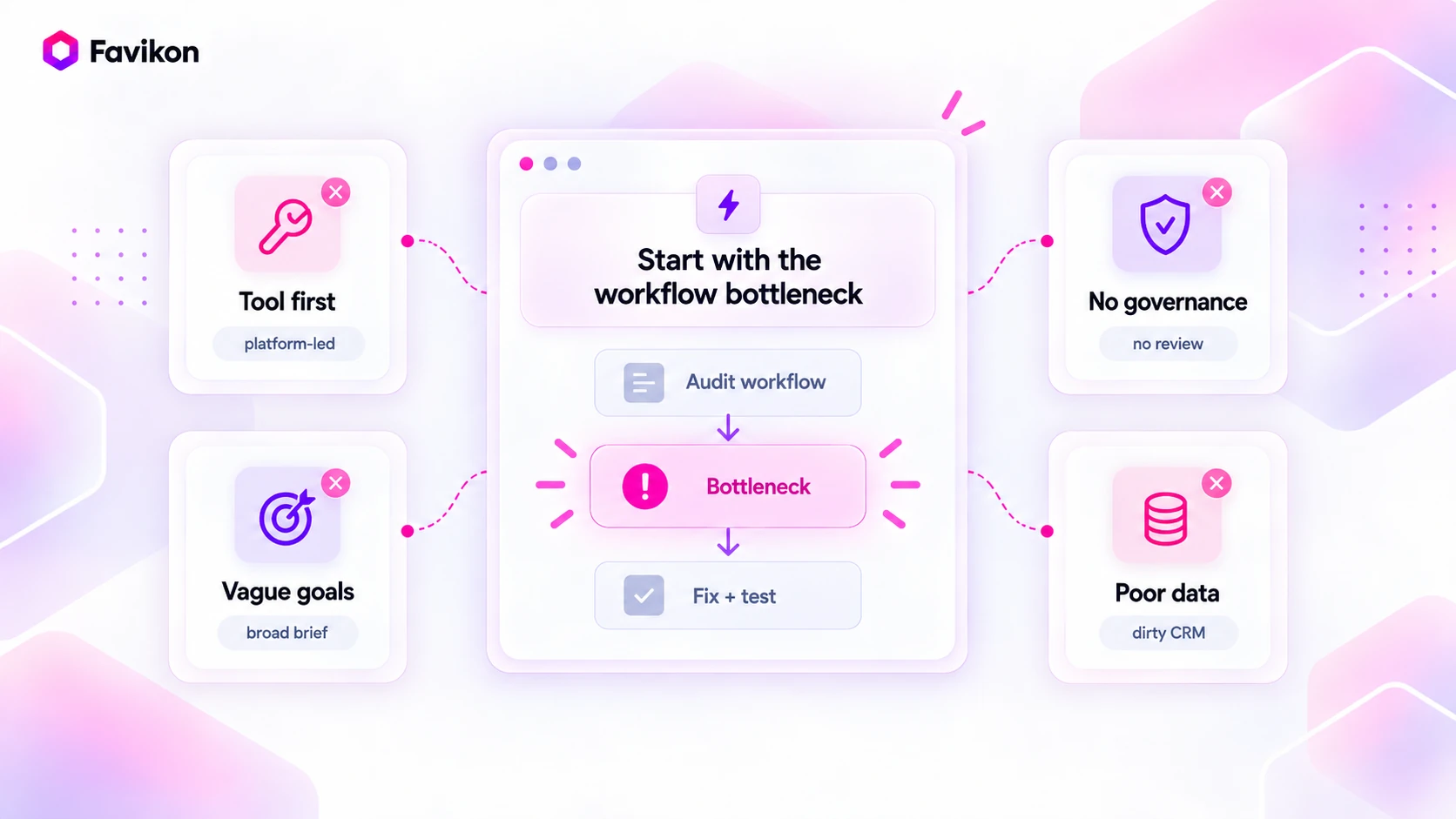
Committing to a platform before anyone has named the bottleneck is what most failed rollouts have in common.
Four patterns account for most of the failed rollouts:
1. Ignoring data quality: Every agent on this list is only as good as the data it reads. A CRM full of duplicate contacts and outdated job titles will produce poor outputs regardless of the platform. Clean the data first, then build the agent.
2. Assigning open-ended goals: "Improve our content output" produces mediocre results from any agent. "Draft one SEO brief per weekday" produces a working system. Narrow goals produce results, and broad ones generate noise.
4. Starting with the tool instead of the bottleneck: "Which AI agent should we buy?" is the wrong first question. The right one is the workflow that is eating the most hours with the least strategic payoff. No platform on this list is the right answer to a vague brief.
5.Skipping governance and approval workflows: Any agent that sends emails or publishes content needs a human checkpoint before it touches a live campaign. Teams that skip this step find out why they needed it during the first incident.
How to Choose the Right AI Agent for Your Marketing Team
The honest answer is that the right platform is whichever one plugs most directly into the data and tools your team already uses. Every platform on this list is excellent at one thing and limited in another. The decision is about fit.
Four questions do most of the work:
1. Where does your data already live? If 80% of your marketing data is in HubSpot, Agent Hub is the path of least resistance. Salesforce-native teams should look at Agentforce first. If your stack spans five tools with no dominant hub, Make or Zapier handles cross-stack orchestration more cleanly than either.
2. Is content or orchestration the bottleneck? If the team spends most of its time creating, Jasper solves a different problem from the others. If the bottleneck is workflow coordination across tools, look at Zapier or Make.
3. Does your team need creator vetting built in? Most platforms on this list treat influencer discovery as one channel among many. If creator vetting is your actual bottleneck, Favikon is the only tool here built for it.
4. How much technical capacity does the team have? Zapier and HubSpot Agent Hub are accessible to marketers with no automation background. Make requires configuration time. Agentforce needs a certified partner before it's production-ready.
Why Favikon Leads
After testing six platforms against the same workflows, one gap kept coming up: specificity. Agentforce, HubSpot, Zapier, Make, and Jasper all treat influencer and creator marketing as one channel among many. Favy's creator index scores authenticity before you reach out and estimates collaboration pricing from a single prompt, something none of the general-purpose platforms above are built to do.
That's not a gap you can prompt-engineer around. The underlying data simply isn't there. They're built for different jobs. But if creator vetting is part of your marketing stack, none of them can do what Favy does from a single query.
When Another Tool Wins for You
Favikon is built for creator intelligence across nine networks. If your program runs primarily on high-volume DTC product seeding with deep Shopify-native workflows, look for a platform purpose-built for that pipeline.
Creator payments also run outside the platform for now, so if in-platform payment workflows are a hard requirement, factor that into your evaluation. And if influencer marketing is one small part of a larger cross-channel orchestration problem, pair Favikon with Zapier or Make rather than looking for one platform to do both.
If Favikon Fits, Here Is What to Know
Start with one specific workflow during the trial. Creator discovery in your specific niche is the highest-return first test. Give Favy a niche and a target audience, and run the full sequence from discovery to outreach draft. That single use case is enough to tell you whether the platform fits your program.
The 7-day trial requires no credit card, so there's no friction to getting in. If your team already works inside Claude or ChatGPT, connect Favy via MCP on the Pro plan in week two. It puts Favikon's full creator index inside the AI assistant your team already uses daily, with no context-switching required.
Frequently Asked Questions
What Is an AI Agent in Marketing?
An AI marketing agent pursues a goal on its own, deciding which steps to take and adjusting as conditions change. Give it a campaign objective, and it figures out the path. That's what separates it from automation, which follows rules you pre-wrote, and from a chatbot, which only answers what you ask. The difference is judgment.
How Is an AI Agent Different From Marketing Automation?
Automation follows fixed if-then rules and never deviates from them. A marketing AI agent pursues a broader goal, figures out its own next steps, and adjusts when something changes mid-workflow. The simplest test: give it a goal and walk away. If it waits for your next instruction, it's not an agent.
How Much Do AI Marketing Agents Cost?
AI marketing agent costs vary widely by platform and workflow. Zapier and Make both have paid tiers starting under $20 a month. Jasper starts at $59 per seat per month, billed annually. Salesforce Agentforce is consumption-based with no published flat rate. Favikon starts at $199 per month, usage-based with no annual lock-in, for influencer and creator marketing.
Do I Need Engineering Support to Build One?
No, you do not need engineering support for most platforms on this list. Zapier, HubSpot Agent Hub, and Make are built for marketers to configure without writing code. Agentforce is the main exception, requiring a certified Salesforce partner before it's production-ready. For custom agent logic that goes beyond a no-code builder, some engineering involvement will be needed.
Can AI Agents Replace a Marketing Team?
No, AI agents handle repeatable execution well: drafting emails, scoring leads, pulling performance data. They don't set strategy, evaluate brand fit, or make judgment calls that carry real organizational risk. Teams that use agents effectively tend to report reclaimed hours on the creative and strategic sides.
Is Favikon an AI Agent for Marketing?
Yes, Favikon's AI agent, Favy, plans and executes multi-step tasks from a single prompt. It finds creators, checks Authority Score and Authenticity Score for brand safety, estimates collaboration pricing, and drafts outreach in a single thread without you having to direct each step. It also connects to Claude, ChatGPT, and Gemini via MCP on the Pro plan.
Others articles