The 8 Best GRIN Alternatives in 2026: Full Guide
Looking for the best GRIN alternatives in 2026? This guide compares eight influencer marketing platforms for creator discovery, outreach, tracking, and campaign management.


GRIN is genuinely good at what it was built for. If you're leaving, it's probably not because the platform failed you. It's because it was never designed for your use case.
The workflow GRIN was built for is a narrow one. A Shopify-first DTC brand, shipping product to creators every week, tracking revenue through affiliate links and promo codes. If that's your program, GRIN earns its price. If it isn't, you're looking at $500 to $1,500/month for the full creator management platform, which was built around someone else's problems.
Worth flagging before you compare. The free tier and the $200 Starter plan only cover Gia, GRIN's AI sourcing tool. The creator CRM, gifting workflow, and Shopify integration start at $500/month on the Growth plan.
Teams switch when pricing doesn't match the program size, when creator discovery caps out at Instagram, or when the DTC architecture just doesn't fit your use case. Here's all you need to know.
TL;DR: Best GRIN Alternatives in 2026
- GRIN's full creator management platform starts at $500/month and is built exclusively for Shopify-first DTC brands
- Favikon covers all nine major platforms, including LinkedIn, making it the default pick for multi-channel discovery
- Modash covers 250M+ profiles at $199/month with no annual contract, the strongest like-for-like swap for DTC discovery
- Aspire's inbound marketplace and first-party Meta and TikTok integrations make it the best fit for UGC and paid social programs
- If budget is the constraint, Heepsy has a free plan and paid tiers from $89/month
Start a free 7-day trial on Favikon, no credit card required
Quick Comparison: Best GRIN Alternatives in 2026
What is GRIN?

GRIN is a creator management platform built for direct-to-consumer and e-commerce brands. It handles the full lifecycle of an influencer program in one place: finding creators, managing relationships, shipping product, tracking affiliate revenue, and processing creator payments.
The defining feature is the Shopify connection. When a brand ships product to a creator, GRIN ties directly into the store, generates promo codes or affiliate links, and tracks which sales came from which creator.
Content goes into a central library for approvals, and campaign performance is visible in one reporting dashboard. For a DTC brand running dozens of gifting campaigns at once, that revenue loop between creator activity and actual sales is what makes the platform worth the cost.
GRIN is structured as a CRM for creator relationships rather than a searchable discovery database. Brands typically source creators outside the platform, bring them into the system, and manage everything from contracts and briefs to product orders and payouts inside one dashboard.
Creator payments, including 1099 processing for US creators, are handled natively. That full-lifecycle workflow is what makes it a strong fit for DTC brands running programs with dozens of active creators across multiple campaigns at once.
Why Teams Switch From GRIN
Most teams don't leave GRIN because it stopped working. They leave because the program outgrew what GRIN was designed for, or they realize mid-onboarding that it was designed for someone else. The platform is purpose-built for Shopify-first DTC brands with high gifting volume. Outside that use case, the friction shows up quickly.
Here's where most teams run into trouble:
- Entry-tier pricing: GRIN has a free tier, but it only covers Gia, their AI sourcing tool. The full creator management platform (GRIN Classic) starts at $500/month on the Growth plan, which includes up to 100 active creators. Teams that haven't yet validated influencer as a channel often find themselves at that $500 floor before they've proven the program works.
- Creator discovery: GRIN's AI creator search currently covers Instagram only. There's no LinkedIn layer, Substack coverage, or multi-platform database to search from scratch. Teams that need to find net-new creators across channels typically run into this in the first week.
- DTC-only architecture: Every layer of GRIN is wired to the Shopify workflow: gifting, promo codes, affiliate tracking, product seeding. If you're a SaaS company, a B2B brand, or an agency managing clients across verticals, that architecture doesn't translate. You end up paying for a system that's solving someone else's problem.
- PayPal-only creator payments: GRIN processes creator payouts through PayPal only. For international creators, that means absorbing foreign transaction fees on every payment. It's a friction point that rarely surfaces in demos but shows up in every campaign that includes non-US creators.
- Onboarding complexity: GRIN is a feature-rich platform, and reviews on G2 and Capterra consistently flag a congested interface, a slow setup process, and a learning curve that takes weeks rather than hours. Lean teams without a dedicated platform manager often find the time cost doesn't match the program size.
How We Chose These Alternatives
We looked at more than a dozen platforms before narrowing to eight. The filter was simple. Does this tool solve a problem GRIN doesn't? A platform that covers the same ground with a different interface didn't make the list.
Every tool was evaluated against the same five criteria:
- Creator discovery depth: How many platforms are indexed, and does LinkedIn coverage exist for B2B buyer audiences?
- Authenticity scoring: Does the tool surface fake-follower risk automatically, or do you have to go looking for it?
- Pricing and access: Is pricing published? Can you start a trial without a sales call?
- Campaign management: Can the platform track a campaign from outreach to conversion, not just discovery?
- Use-case fit: Which specific buyer is this built for. DTC, B2B, agency, or enterprise?
A few familiar names didn't make the cut.
Sprout Social Influencer is a capable platform, but influencer tools are secondary to a broader social management suite, making it a fit for existing Sprout users rather than a standalone alternative. Later Influence carries the same caveat. Impact.com is the right tool for performance partnerships and affiliate programs, but that's a different category than creator management. Limelight doesn't publish pricing, which makes any fair comparison difficult.
The eight tools that made the list each solve a distinct problem well enough to recommend for a specific situation.
1. Favikon: Best for Multi-Platform Creator Discovery
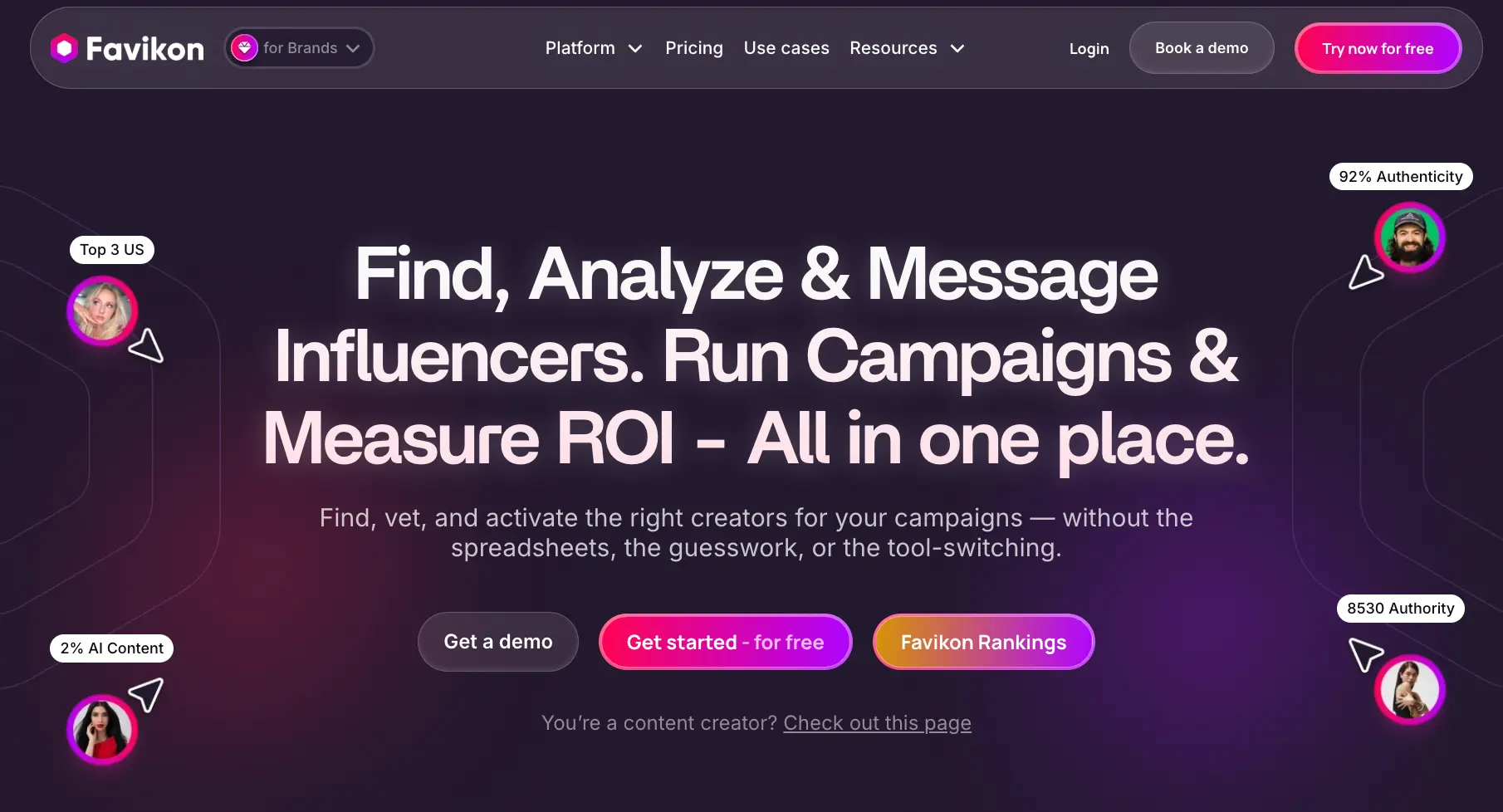
What is it? An AI-powered influencer marketing and creator analytics platform used by 10,000+ brands and agencies across 118 countries. It covers both B2B and B2C creator programs, including channels most platforms in this category don't index.
Best for: Marketing teams whose buyers live on LinkedIn, or any team running creator campaigns beyond Instagram and TikTok.
Why I Picked It: I put Favikon first because it's the only platform here built around multi-channel discovery from the start. GRIN indexes Instagram only. Favikon covers nine channels, including LinkedIn, Substack, and others most discovery tools skip entirely. If your creators live across multiple platforms, you need a platform built to find them all, not one that forces you to search each platform separately.
Features
- 10M+ profiles across 9 platforms: Instagram, TikTok, YouTube, X/Twitter, LinkedIn, Substack, Pinterest, Twitch, and Snapchat. The only platform here with full LinkedIn creator coverage and B2B niche classification.
- Authority Score and Authenticity Score on every profile across 600+ AI niche categories. Advanced filters for job title, company, and audience type (Pro and above) let you find creators by profession or industry, not just social handle.
- Creator CRM and outreach managed from one inbox, so shortlists, conversations, and campaign status stay in one place. Conversion tracking (Pro and above) ties creator activity to actual website traffic and conversions.
- Public creator rankings by country, niche, and platform give you a starting point for discovery without running a single search. GRIN has no equivalent. It's a management tool, not an intelligence layer.
- Lookalike search finds creators similar to ones already performing well in your program, across all 9 platforms. Once one creator converts, you can replicate that profile at scale.
Limitations
- No in-platform creator payments yet
- Shallower Shopify integration than GRIN or Modash, which limits fit for high-volume DTC product seeding
Pricing
Core is $199/month, or $159/month billed annually. Pro is $299/month, or $239/month billed annually. Enterprise is custom, with usage-based credits instead of per-seat pricing. 7-day free trial, no credit card required.
2. Modash: Best for Shopify-First DTC Brands That Need a Large Database
What is it? A Shopify-first influencer marketing platform built for in-house DTC teams. Over 2,600 brands use it to run creator programs across Instagram, TikTok, and YouTube, with access to a large creator database.
Best for: DTC brands that want a large searchable database, transparent pricing, and a full gifting-to-payment workflow with no annual contract.
Why I Picked It: What I appreciated testing Modash is how little friction there is before you see something useful. GRIN asks for a lot of trust upfront: a demo, a budget decision, and a contract before you've run a single search. Modash lets you start a trial and see results the same day. For DTC teams that need a large database at a fixed monthly cost with no contract, that difference matters more than any feature comparison.

Features
- 250M+ creator profiles across Instagram, TikTok, and YouTube, making it a large searchable database at this price range
- Shopify gifting, affiliate link and promo code tracking, and creator payments on the Performance tier (0% fee up to $10,000/year in payouts) all run from one dashboard
- Monthly billing on all plans, without any annual lock-in. The 14-day free trial needs no credit card.
Limitations
- Searches by platform account. A creator active on both Instagram and TikTok appears as two separate records, so cross-platform vetting requires manual deduplication.
- Campaign management and creator CRM are lighter than GRIN or Aspire for teams running complex multi-campaign programs.
Pricing
Essentials is $199/month billed annually ($299/month on monthly billing), up to 100 creators. Performance is $499/month billed annually ($599/month on monthly billing), up to 250 creators. Enterprise from $14,700/year, with usage-based credits available. 14-day free trial, no credit card required.
3. HypeAuditor: Best for Audience Fraud Detection
What is it? An influencer analytics platform built around audience quality scoring and fake-follower detection across 5 platforms. Used by consumer brands and agencies that prioritize creator vetting before any outreach or campaign spend.
Best for: Teams where verifying that an audience is real is the most critical step in the workflow.
Why I Picked It: I included HypeAuditor for a reason most people miss. It's not that it has fraud detection. It's that it built the benchmark every other platform in this list references when describing their own. That's a different category of credibility. If audience quality is your primary filter, I think this is where the vetting process starts, not where it ends up.

Features
- Audience Quality Score is the closest the industry has to a shared fraud-detection standard. Most platforms in this list reference it as their benchmark rather than the other way around.
- Free basic reports and audit tools available with no subscription. The free tier is genuinely functional; you can vet specific creators before committing to a paid plan.
- Competitor benchmarking tools show which creators' category rivals are already activating, useful for mapping the landscape before you build your own shortlist.
Limitations
- Only 5 platforms: Instagram, TikTok, YouTube, X, and Twitch. Limited for teams needing multi-channel or B2B creator discovery.
- Creator payments run through PayPal only. International creators absorb conversion fees on every payout, which creates friction for global campaigns.
Pricing
Free tier available with no credit card required ("Get started for free"). Paid plans are demo-gated. No public pricing is listed on the live pricing page.
4. Upfluence: Best for Brands That Want to Turn Customers Into Creators
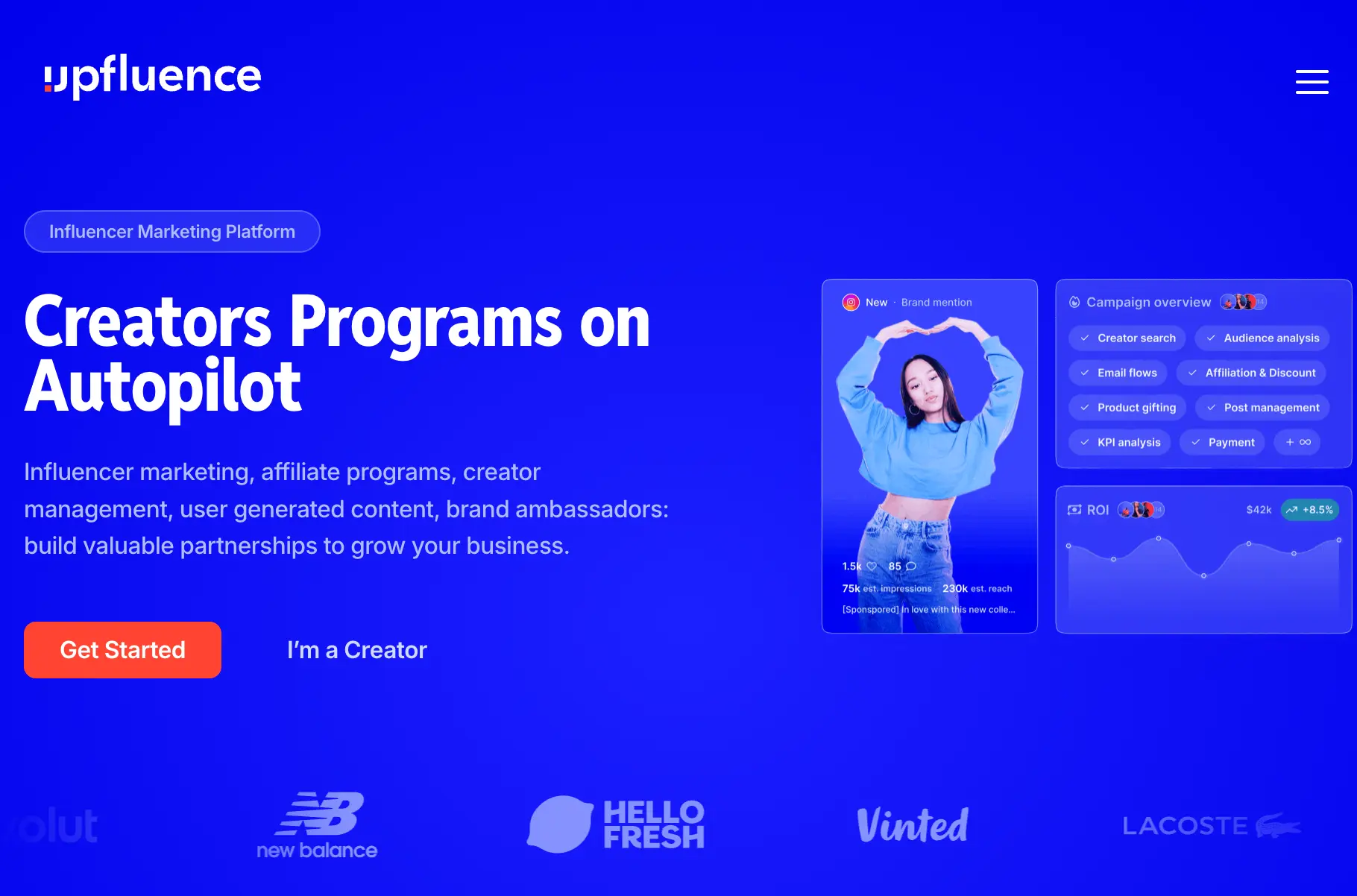
What is it? An influencer and affiliate marketing platform powered by Jaice AI, built for e-commerce and DTC brands. Used by Marriott, Universal, HelloFresh, Verizon, and Amazon. It runs on modular custom pricing with a 12-month minimum contract.
Best for: Shopify or Amazon brands that want to source creators from their existing customer base, or teams where Amazon is a primary sales channel and creator attribution matters.
Why I Picked It: What sold me is the sourcing logic. Scanning your customer database to find creators who already buy your product is unlike anything else in this roundup. Add the only native Amazon Attribution integration here, and the case gets specific fast. For brands where the customer base is the untapped creator pool, this isn't a GRIN swap. It's a different model.
Features
- CMS database matching connects to your Klaviyo, Shopify, or WooCommerce data and surfaces which existing customers already have social followings worth activating. These partnerships tend to convert better because the creator already knows and uses the product.
- Amazon Attribution is native and exclusive to Upfluence in this list. It's the only platform here that tracks influencer-driven sales directly on the Amazon marketplace, not just to a landing page.
- Fixed platform fee with no percentage taken from creator sales. The more revenue your creators drive, the less you pay proportionally, which is not how most platforms in this category are structured.
Limitations
- 12-month minimum contract, no public pricing. The free trial is configured after an initial call, not before. You won't know your cost until you're in a sales conversation.
- Creator payments (Upfluence Pay) are only available on the Autopilot plan, the most expensive tier. If payments are a core requirement, factor that into the total cost from the start.
Pricing
Custom-quoted, modular. Three plans: Find Creators, Scale Creator Programs, and Autopilot. No pricing published on the official site. 12-month minimum contract, no setup fee. Free trial after initial call. Book a demo at upfluence.com/pricing.
5. Aspire: Best for UGC Campaigns and Creator-Whitelisted Ads
What is it? A creator marketing platform for e-commerce brands covering influencer marketing, UGC for paid ads, ambassador programs, affiliate programs, and product seeding in one place. Used by M&Ms, Samsung, Dyson, HelloFresh, and Walmart.
Best for: Mid-market e-commerce brands building ambassador communities and scaling creator content into paid social ads, with the budget for an annual commitment.
Why I Picked It: Here’s my honest take. Aspire made this list because of the Meta allowlisting integration, not the marketplace model. Being able to run creator-whitelisted Partnership Ads from inside the platform, without manual permissions back-and-forth, is a workflow shortcut that matters at paid social scale. Most tools describe a UGC workflow. Aspire has a first-party API connection that actually executes it.
Features
- Inbound Creator Marketplace lets brands post campaign briefs and receive creator applications directly, which shifts the sourcing dynamic from outbound cold search to inbound screening.
- First-party API integrations with Meta and TikTok. Brands can run allowlisted Partnership Ads on Meta and Spark Ads on TikTok from inside the platform, without manual workarounds or third-party tools.
- Full campaign workflow in one platform, like creator discovery, product seeding, affiliate tracking, UGC collection, and performance measurement across paid and earned channels.
Limitations
- Demo required before any access. No public pricing and no self-serve trial on the official site.
- No LinkedIn creator discovery. Integrations cover TikTok, Meta, YouTube, Pinterest, and Shopify.
- The inbound marketplace is powered by registered creators only. For brands that rely on it as their primary sourcing method, the pool is limited to those who have opted in.
Pricing
No pricing published on the official site. All plans sold through a demo.
6. CreatorIQ: Best for Enterprise Teams With Brand Safety and Compliance Requirements
What is it? An enterprise creator marketing platform trusted by 1,300+ brands and agencies, including Nestlé, Unilever, Sephora, and Google. Powered by the Creator Graph, which processes 250 million+ social posts daily across 15 million+ creators worldwide.
Best for: Enterprise marketing departments running multi-country creator programs where brand safety infrastructure, governance, and deep system integration are the primary evaluation criteria.
Why I Picked It: I included CreatorIQ because some teams searching for a GRIN alternative have already outgrown the mid-market category entirely. GRIN and most tools on this list are solving the same tier of problem. CreatorIQ is solving a different one. If your program needs continuous brand safety monitoring and a Sprinklr integration, none of the other seven tools here are even in the conversation.

Features
- SafeIQ is CreatorIQ's multimodal brand safety module, designed to shift teams from reactive to proactive brand safety management. It monitors creator content continuously before and after activation.
- The Sprinklr integration brings owned, earned, paid, and creator data into a single measurement view, so creator program reporting stops living in a separate tool from the rest of the marketing stack.
- ExchangeIQ connects CreatorIQ to the tools enterprise teams already run: Shopify, Google Analytics, DocuSign, Tableau, Amazon, Sprinklr, and affiliate networks including CJ, Awin, and Rakuten. Creator program data flows into existing reporting and compliance infrastructure rather than requiring a separate workflow.
Limitations
- Designed explicitly for enterprise scale. The IDC positioning and the product breadth (SafeIQ, BenchmarkIQ, ExchangeIQ, Enterprise Governance, CreatorIQ Recruit, Convert, and Pay) signal who this is built for, and who it isn't.
- Requires a dedicated influencer marketing function to operate. Teams without that headcount and onboarding investment will pay for infrastructure they won't fully use.
Pricing
No pricing published on the official site. The pricing link in their navigation goes to a request form, not a rate card.
7. Traackr: Best for Global Brand Programs That Need Cross-Market Benchmarking
What is it? An AI-powered creator marketing platform that has been operating since 2009, serving hundreds of global brands across 70 countries. Used by L'Oréal, Sephora, Samsung, Lacoste, and Pandora.
Best for: Enterprise brand teams running multi-market creator programs who need standardized KPIs, competitive benchmarking, and visibility across regions in one place.
Why I Picked It: Most platforms in this roundup measure how a campaign performed. VIT measures how your program is performing relative to named competitors, normalised across markets. That's not a reporting feature. It's a strategic one. I think most teams don't need it. For the ones running programs across five or more markets simultaneously, I'm not sure what else they'd use instead.

Features
- VIT (Vitality of Influence Tracking) is Traackr's competitive benchmarking metric. It shows where your creator program leads, where it lags, and what your competitors are doing, surfacing retained, acquired, and lost creators across the category in one dashboard.
- Abigail Intelligence is Traackr's AI strategist. Feed it a campaign brief, and it returns a ranked creator shortlist with an activation plan per creator, so teams can go from strategy to launch faster without manual shortlisting.
- Shared KPIs and unified visibility across markets, with Shopify integration, global payments, and SSO available. Teams across regions operate from the same platform rather than reconciling results from separate tools.
Limitations
- Positioning as a "decision engine for creator marketing" signals the platform's strength is in intelligence and strategy, not high-volume campaign throughput. Teams that need to activate large creator rosters fast may find the depth-first approach slower than execution-focused tools.
- Client base and industry solutions are focused on consumer categories (Beauty, Fashion, Food & Beverage, Retail, Travel). No B2B use cases are documented on the official site.
Pricing
No pricing published on the official site. Book a discovery call at traackr.com/contact to discuss pricing and packages.
8. Heepsy: Best for Small Teams Running Their First Creator Campaigns
What is it? An influencer discovery and campaign management platform covering Instagram, TikTok, YouTube, Twitch, and LinkedIn across 11M+ profiles. It's the most accessible entry point in this list, with a free plan and paid tiers starting at $89/month.
Best for: Small brands and agencies testing influencer marketing for the first time who need a searchable creator database and a free tier to explore before committing a budget.
Why I Picked It: I included Heepsy because not every team evaluating GRIN alternatives has validated the channel yet. Most tools here assume you have. Heepsy doesn't. A free plan, LinkedIn coverage, and creator payments unlocking at $199/month means you can actually test before you commit. My honest take: if you're still deciding whether influencer makes sense for your brand, start here.
Features
- Free plan available with no time limit. You can search and preview creator profiles before entering payment details, which makes it the lowest-friction starting point in this list.
- Advanced audience filters, bulk outreach, and campaign tracking unlock on Plus ($199/month). The Starter plan covers core search and contact, which is enough to vet and shortlist creators for a first campaign.
- Fake follower detection is built into the search workflow, so authenticity checks happen as you discover rather than as a separate step.
Limitations
- 11M+ profiles is a fraction of what Modash or HypeAuditor index. For campaigns that need high discovery volume, the pool creates real constraints.
- Advanced audience filters (age, gender, audience demographics) are not included on the Free or Starter plan. Meaningful vetting capability starts at Plus.
Pricing
Free plan available. Paid plans: Starter $89/month, Plus $199/month (includes creator payments), Advanced $299/month. Annual billing saves up to 25%.
Pick the Platform Your Buyers Are Actually On
GRIN is a strong tool for what it does. If your entire influencer program lives in a Shopify gifting loop, you should probably stay on it. This guide wasn't written to convince you to leave a platform that's actually working for you. But if you're reading this, it probably isn't.
Maybe creator discovery caps out before you find the right people. Maybe your buyers are on LinkedIn, and the platform doesn't index LinkedIn at all. Maybe you're paying $500/month for infrastructure designed for a DTC brand when you aren't one.
The decision comes down to a single honest question: where do your buyers actually spend their time? If it's Instagram and TikTok, Modash gets you a large creator database at $199/month with no contract. If your creators live across multiple channels, including LinkedIn or Substack, Favikon covers all nine.
And if you're just testing the channel before committing real budget, Heepsy's free plan gets you in the door.
Start a free 7-day trial on Favikon, no credit card required. If it covers your channels, your buyers, and your use case, you'll know within the first search. And if you need gifting automation and Shopify product seeding alongside discovery, pair Favikon with Modash or Influencity.
Frequently Asked Questions
What Is the Best Alternative to GRIN for B2B Brands?
Favikon is the best alternative to GRIN for B2B brands. It's the only platform in this list with full LinkedIn creator discovery and B2B niche classification. Most GRIN alternatives are built for DTC and don't index LinkedIn creators at all.
Is There a GRIN Alternative With No Annual Contract?
Yes. Favikon, Modash, and Heepsy all offer month-to-month billing with no annual commitment required. Aspire, Upfluence, CreatorIQ, and Traackr all require annual contracts. If contract flexibility is a priority, filter your shortlist to the first three.
What Is the Cheapest GRIN Alternative?
Heepsy is the cheapest GRIN alternative, with a free plan and paid tiers from $69/month billed annually. Favikon starts at $199/month with a 7-day no-credit-card trial. GRIN itself has a free tier for its Gia AI tool, but the full creator management platform starts at $500/month.
What Are the Main Reasons Teams Switch Away From GRIN?
Three reasons account for most switches: the full creator management platform starts at $500/month, creator discovery is limited to Instagram only with no LinkedIn coverage, and the architecture is built entirely for Shopify-first DTC workflows that don't translate to other use cases.
Can Favikon Replace GRIN for a DTC Brand?
It depends. Favikon covers discovery across 9 platforms with GA4 conversion tracking, but doesn't have in-platform creator payments or Shopify gifting automation yet. DTC brands that rely on GRIN's gifting-to-payment workflow will find Modash a closer like-for-like replacement.
Others articles