What is Brand Lift in Influencer Marketing?
Brand lift shows whether an influencer campaign changes how people recognize, remember, or view your brand. This guide explains how to measure brand lift and use key metrics to evaluate campaign impact.

What is Brand Lift in Influencer Marketing?
Every influencer marketer has had this conversation. Sales are up, the campaign clearly worked, and then someone in the room asks: "but how much of that was actually the influencer?" Click-based attribution can't answer that, because most of what influencer content does never gets clicked at all. It gets seen, remembered, and it changes how someone feels about a brand before they ever search for it, ask a colleague about it, or type the URL directly into their browser weeks later.
That change in perception has a name: brand lift. It's one of the oldest concepts in advertising measurement, and one of the least understood when it gets applied to influencer marketing. This guide explains what brand lift actually is, why it's genuinely hard to measure well, and why more marketers are leaning on it anyway as last-click attribution keeps failing to credit creator content fairly.
If you're looking for a broader breakdown of every attribution method available to influencer marketers — not just brand lift — see Favikon's guide on how to measure influencer marketing attribution.
What Does "Brand Lift" Actually Mean?
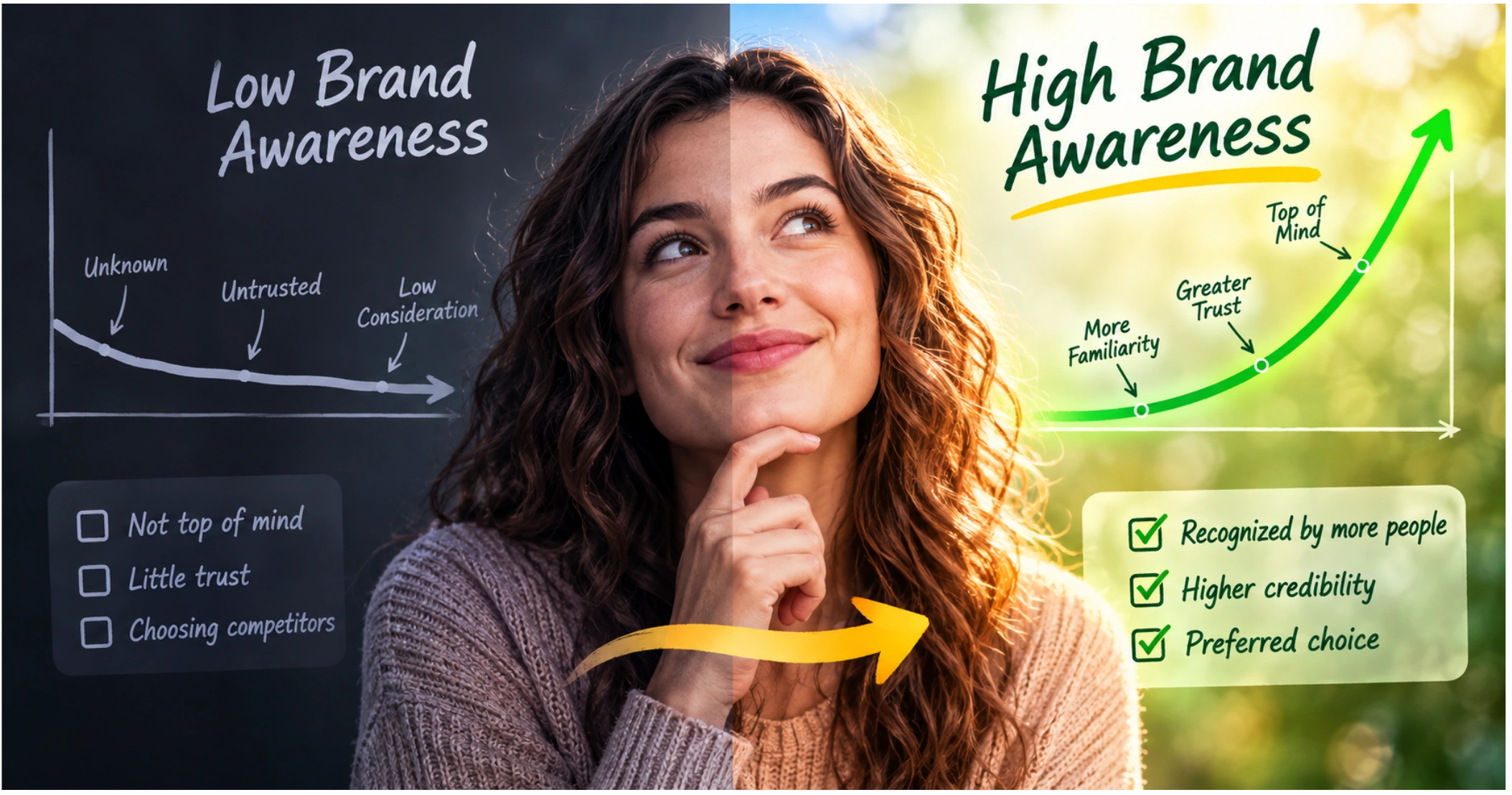
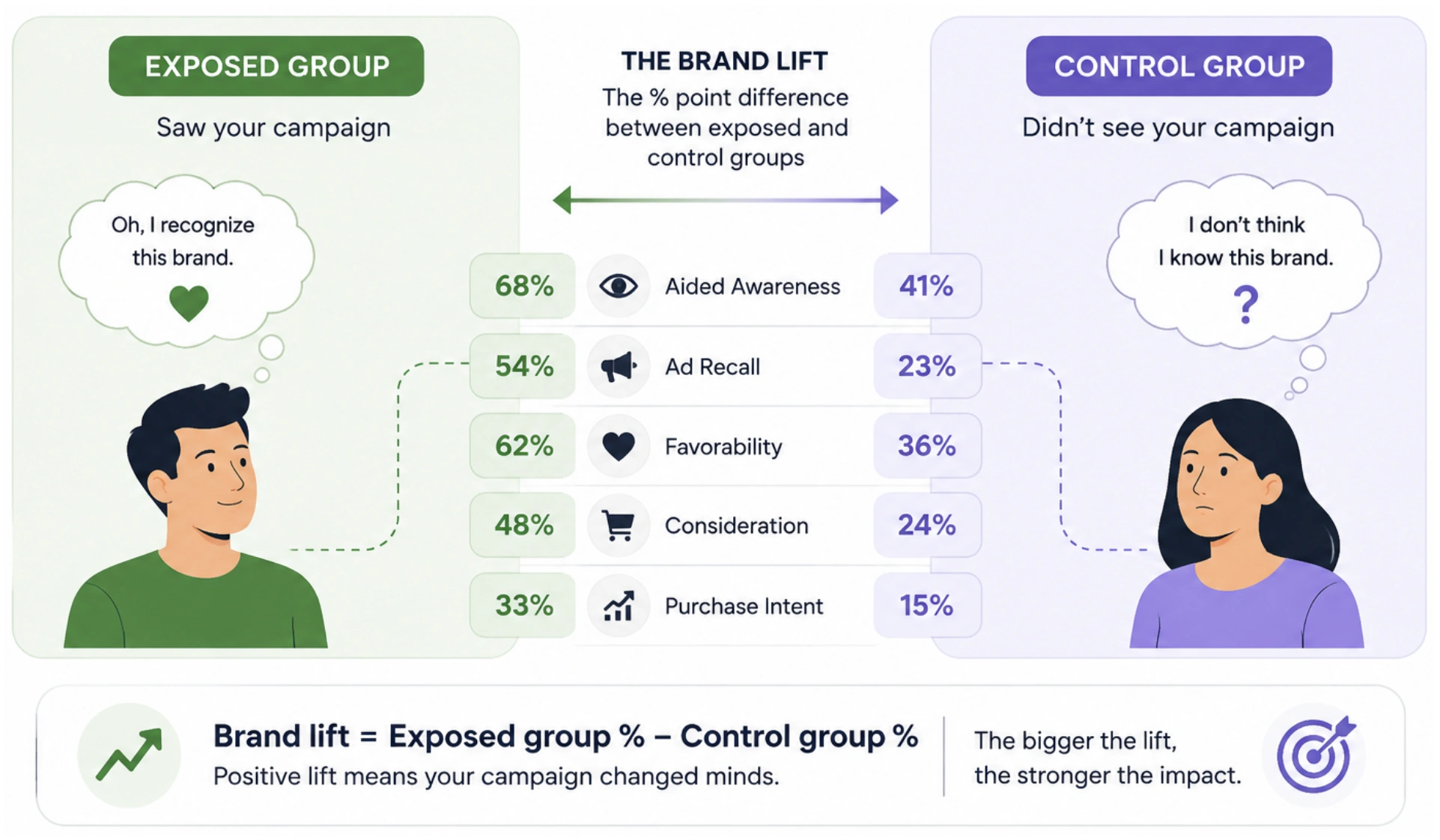
Brand lift is the measurable change in how people perceive a brand after being exposed to a marketing campaign, compared to people who weren't exposed. It's typically expressed as a percentage-point difference between an "exposed" group and a "control" group on things like:
- Aided and unaided awareness — do people recognize or recall the brand
- Ad recall — do they remember seeing the specific campaign
- Favorability / sentiment — do they feel more positively about the brand
- Consideration — would they consider the brand next time they're in-market
- Purchase intent — how likely are they to buy soon
Brand lift is not a single number pulled from a dashboard. It's the output of a comparison — exposed audience versus a similar, unexposed audience — which is exactly what makes it powerful and exactly what makes it difficult.
It's worth being precise about what brand lift is not. It isn't engagement rate, it isn't EMV (Earned Media Value), and it isn't conversions. Those are activity and output metrics — they tell you what happened on the post. Brand lift tells you what happened in someone's head as a result.
Why Influencer Marketing Needs Brand Lift More Than Most Channels Do
Last-click attribution assumes a straight line: someone sees an ad, clicks it, buys. Influencer content rarely works that way. Someone sees a creator's video, doesn't click anything, and converts through organic search, a retargeting ad, or a direct visit three weeks later. Last-click hands that credit to whichever channel happened to be there at the finish line — usually paid search or direct traffic — and the influencer campaign that actually started the journey gets nothing.
This is a well-documented structural problem, not a fringe complaint. Industry benchmark data puts average influencer marketing ROI in the range of roughly $5 to $6 earned per $1 spent, yet a large majority of marketers report their influencer efforts as highly effective even when the attribution numbers on paper look weak — a gap that mostly comes down to measurement, not performance. Nielsen's own research on emerging media measurement points to the same root issue: influencer marketing, podcasts, and branded content each produce metrics that don't translate cleanly across channels, which makes it hard to see the full-funnel picture using click data alone.
Brand lift fills that gap. It measures the part of the customer journey that happens before anyone clicks anything — the awareness and intent shift that eventually shows up as a branded search, a direct visit, or a sale attributed to some other channel weeks later.
Why Brand Lift Is Genuinely Hard to Measure
This is the part most "brand lift 101" content glosses over. Brand lift sounds simple on paper — survey people before and after, compare the difference — and in practice it's one of the more methodologically fragile metrics in marketing. A few reasons why:
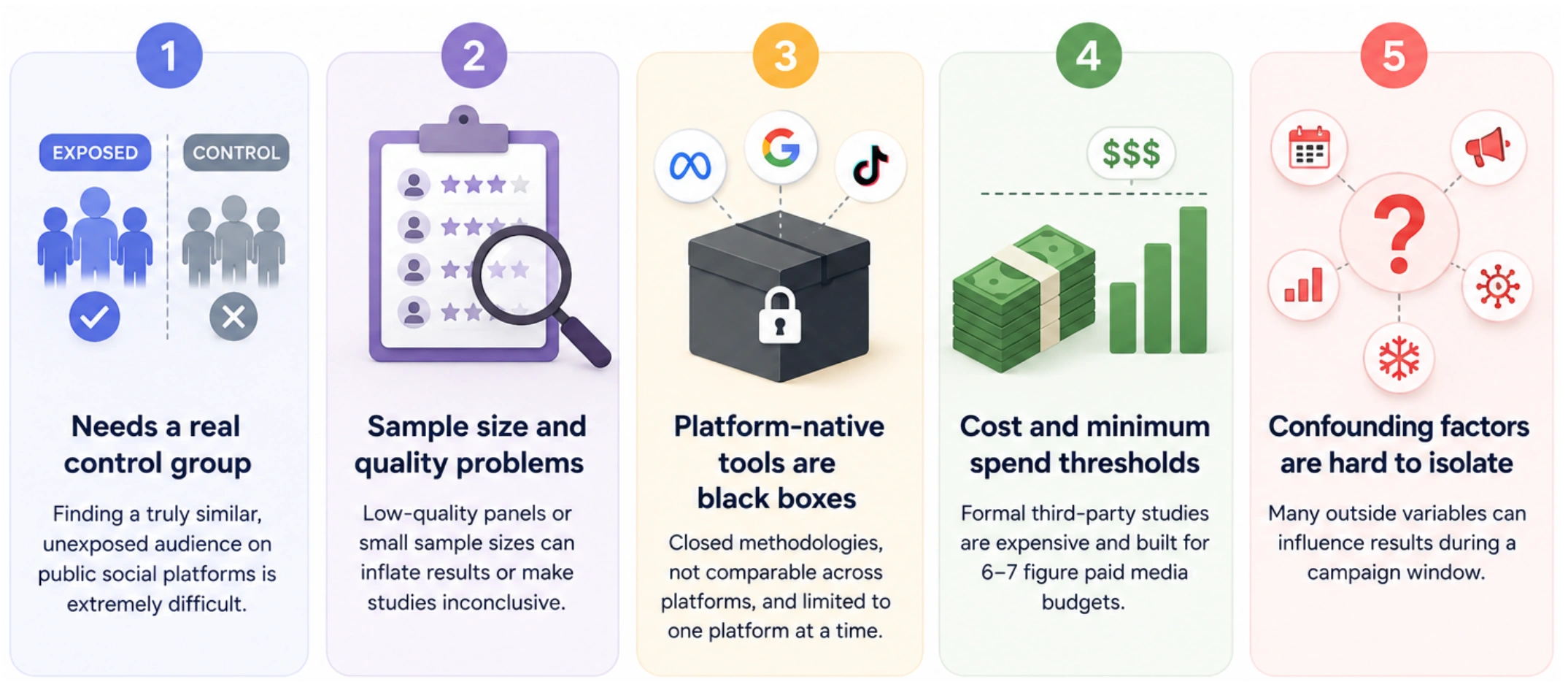
1. It needs a real control group, and most brands can't build one. A valid brand lift study compares an exposed audience to a genuinely similar, unexposed audience. For a brand running influencer content on public social platforms, isolating who wasn't exposed is close to impossible without a platform's own ad infrastructure or a third-party research panel.
2. Sample size and quality problems distort results. Studies that lean on incentivized survey panels risk pulling in "professional survey takers" who are optimizing for the reward, not answering honestly — which can artificially inflate recall and awareness numbers. Underpowered studies (not enough impressions or completed surveys) come back statistically inconclusive, and teams often can't tell whether that means "no lift" or "not enough data."
3. Platform-native tools are black boxes. Meta, Google, and TikTok all offer built-in brand lift tools, but they use closed methodologies, can't be compared apples-to-apples against each other, and only measure what happened inside that one platform. A creator campaign that spans YouTube, TikTok, and a newsletter can't be lift-tested as one campaign using platform-native tools alone.
4. Cost and minimum spend thresholds shut out most influencer budgets. Formal third-party brand lift studies (Nielsen, Kantar, DISQO-style panels) are typically built for six- and seven-figure paid media budgets. Most influencer marketing programs, even healthy ones, don't hit the spend or reach thresholds that make a formal study statistically sound or financially worth it.
5. Confounding factors are almost impossible to isolate. If brand awareness rises during a campaign window, was it the influencer content, a concurrent paid push, a competitor stumbling, seasonality, or a viral moment that had nothing to do with the brand's own marketing? Brand lift studies try to isolate a single variable in an environment that never holds every other variable still.
None of this means brand lift is unreliable as a concept. It means it's a research discipline with real methodological requirements, not a metric you can casually eyeball from a dashboard.
How Brand Lift Is Actually Measured
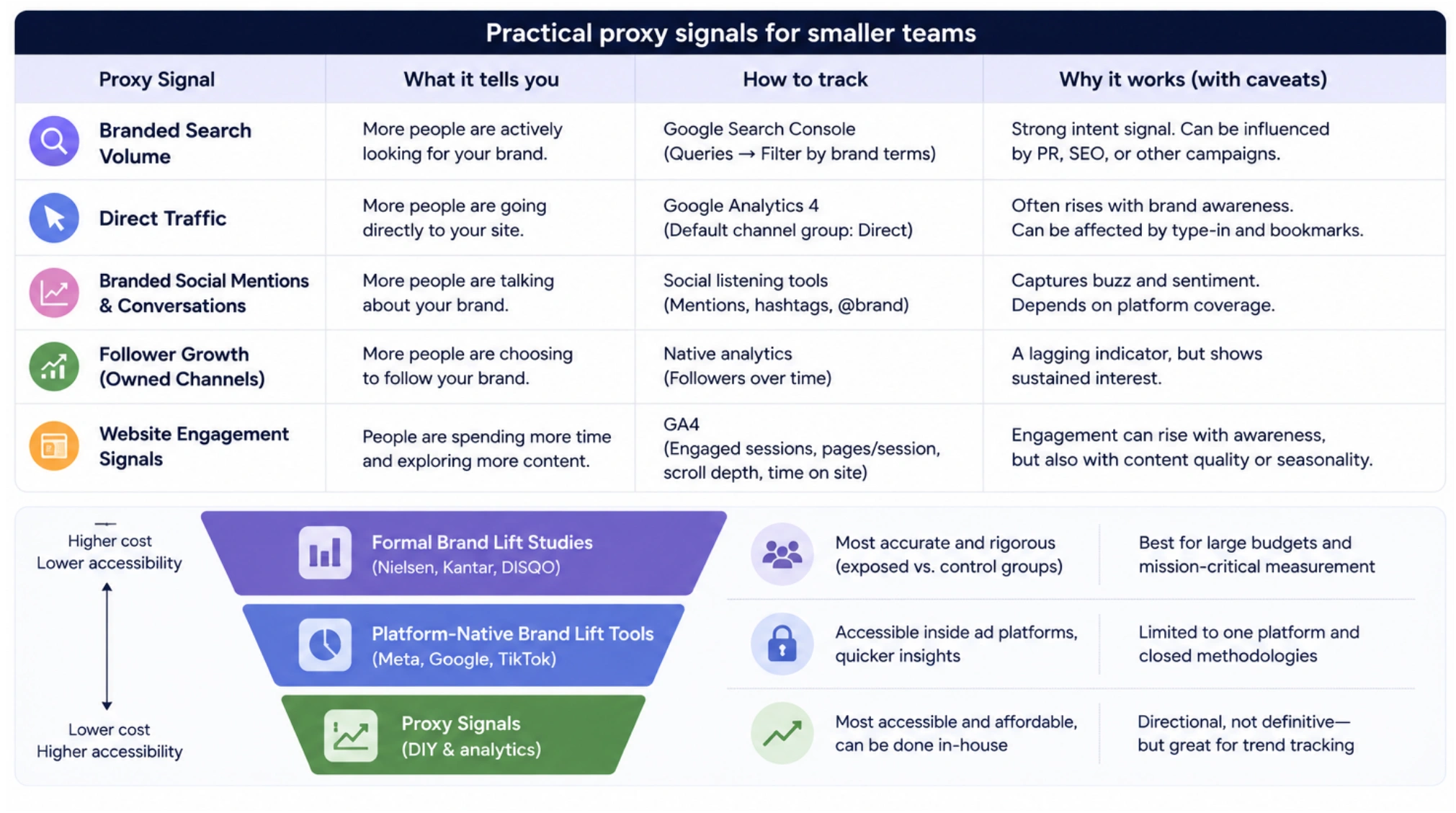
There isn't one method — there's a spectrum, from formal research to lightweight proxy signals. Here's how it breaks down in practice.
Formal brand lift studies (exposed vs. control)
The gold-standard version. A research provider — Nielsen, Kantar, DISQO, or a specialist like Happydemics — recruits or identifies an exposed group and a matched control group, surveys both on awareness, recall, favorability, and intent, and reports the statistical difference. This is expensive and built for larger campaigns, but it's the only method that can genuinely claim to isolate causal impact.
Platform-native brand lift tools
Meta, Google/YouTube, and TikTok all run their own in-platform brand lift studies for paid campaigns above a minimum spend or impression threshold. Useful if a brand is running boosted or paid-amplified influencer content through one of these platforms, but limited to that single platform's audience and closed methodology.
Proxy signals (what most influencer marketers actually use)
For the majority of influencer campaigns — which don't hit the budget or scale needed for a formal study — brand lift gets approximated using indirect but observable signals tracked before, during, and after a campaign window:
None of these proves causality the way a real exposed-vs-control study does. But tracked consistently, over multiple campaigns, they give a directional read on whether influencer activity is moving brand perception — which for most teams is the realistic, affordable version of brand lift measurement.
How smaller teams handle this in practice
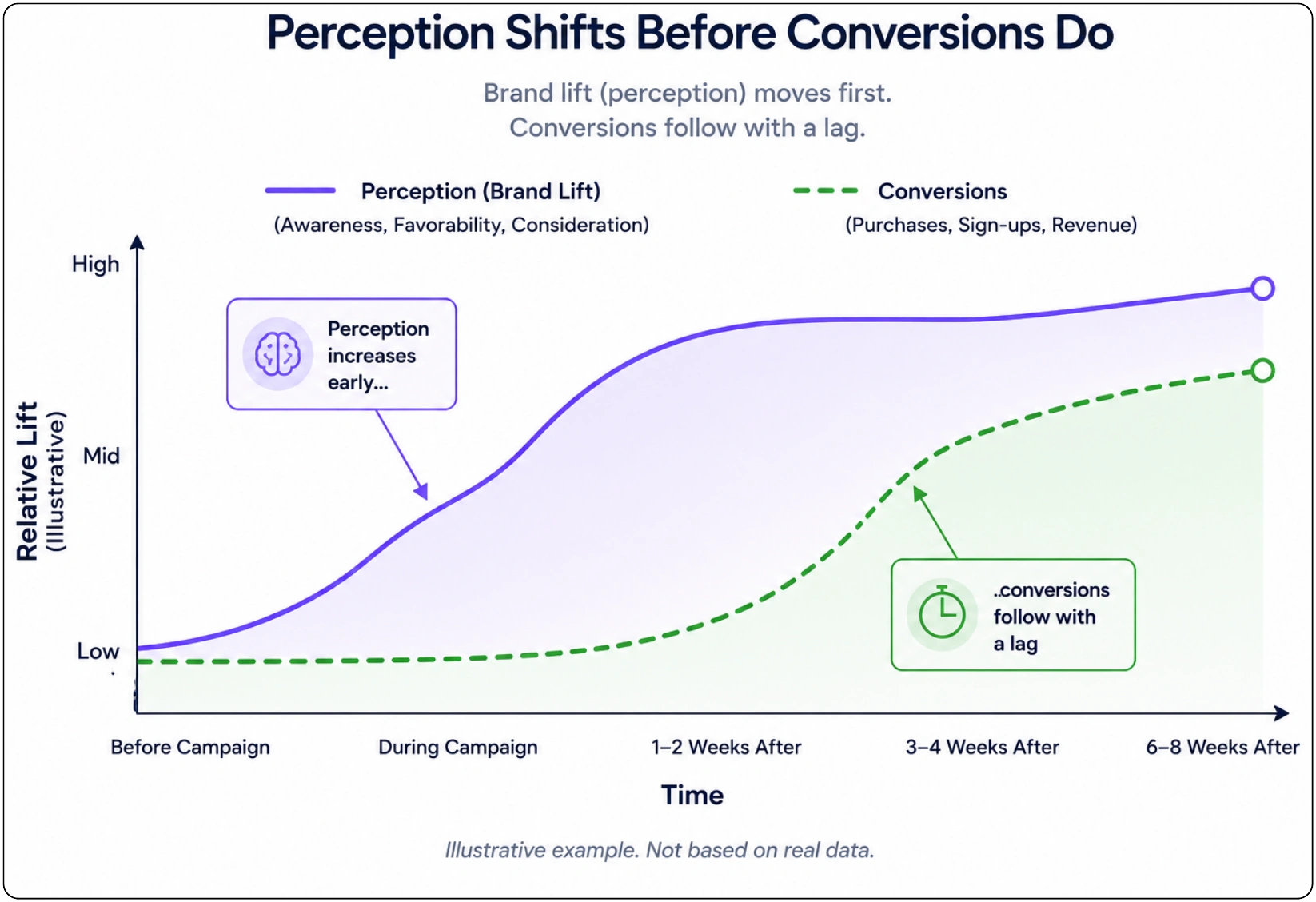
A brand running a handful of creator campaigns a month, without research budget, generally can't run a formal lift study — and shouldn't try to fake one. What tends to work instead, based on how practitioners discuss this in marketing communities: pick two or three proxy signals (branded search plus direct traffic is a common pair), establish a baseline in the weeks before a campaign, and track the delta during and for a few weeks after the campaign runs, since brand effects are frequently delayed. It's an approximation, not proof — but tracked consistently across every campaign, it turns into a usable trend line even without a formal study.
Brand Lift vs. Other Attribution Methods
Brand lift is one input into influencer attribution, not a replacement for the rest of it. For a full comparison of click-tracking, promo codes, multi-touch attribution, and incrementality testing, see Favikon's complete attribution guide. At a glance:
Why Brand Lift Is Becoming One of the Best Ways to Measure Influencer Attribution
Given everything above, it's fair to ask why brand lift is gaining ground rather than being abandoned as too messy. A few converging reasons:
Last-click is being actively deprioritized industry-wide. As third-party cookies phase out and multi-touch attribution gets harder to model with clean data, marketers are shifting toward layered measurement frameworks that treat awareness, engagement, and conversion as separate, complementary layers — rather than expecting one metric to explain the whole journey. Brand lift is consistently positioned as the layer that catches what conversion tracking structurally cannot.
Research on long-term marketing effectiveness keeps validating the upper funnel. Binet and Field's well-known IPA research on marketing effectiveness has argued that short-term, last-click optimization is one of the biggest drags on long-run marketing ROI — brands that protect awareness-building investment, even when it doesn't show up in an attribution model, tend to outperform over a 3-5 year horizon. That's a direct argument for treating brand lift as a legitimate budget-justification metric, not a soft one.
Influencer content is disproportionately a trust and awareness vehicle. Creator content works because of parasocial trust, not ad targeting precision. That trust effect shows up first as a perception shift — exactly what brand lift is built to detect — well before it shows up as a tracked conversion.
Proxy-based brand lift has gotten cheaper and more accessible. A formal Nielsen or Kantar study is still out of reach for most influencer budgets, but branded search tracking, social listening, and sentiment monitoring are now standard, affordable tooling. That's lowered the floor for teams to at least approximate brand lift, even without a formal study.
The honest framing: brand lift isn't becoming easy. It's becoming necessary, because it's the only measurement category built to capture what influencer content is actually good at.
Where Favikon Fits — and Where It Doesn't
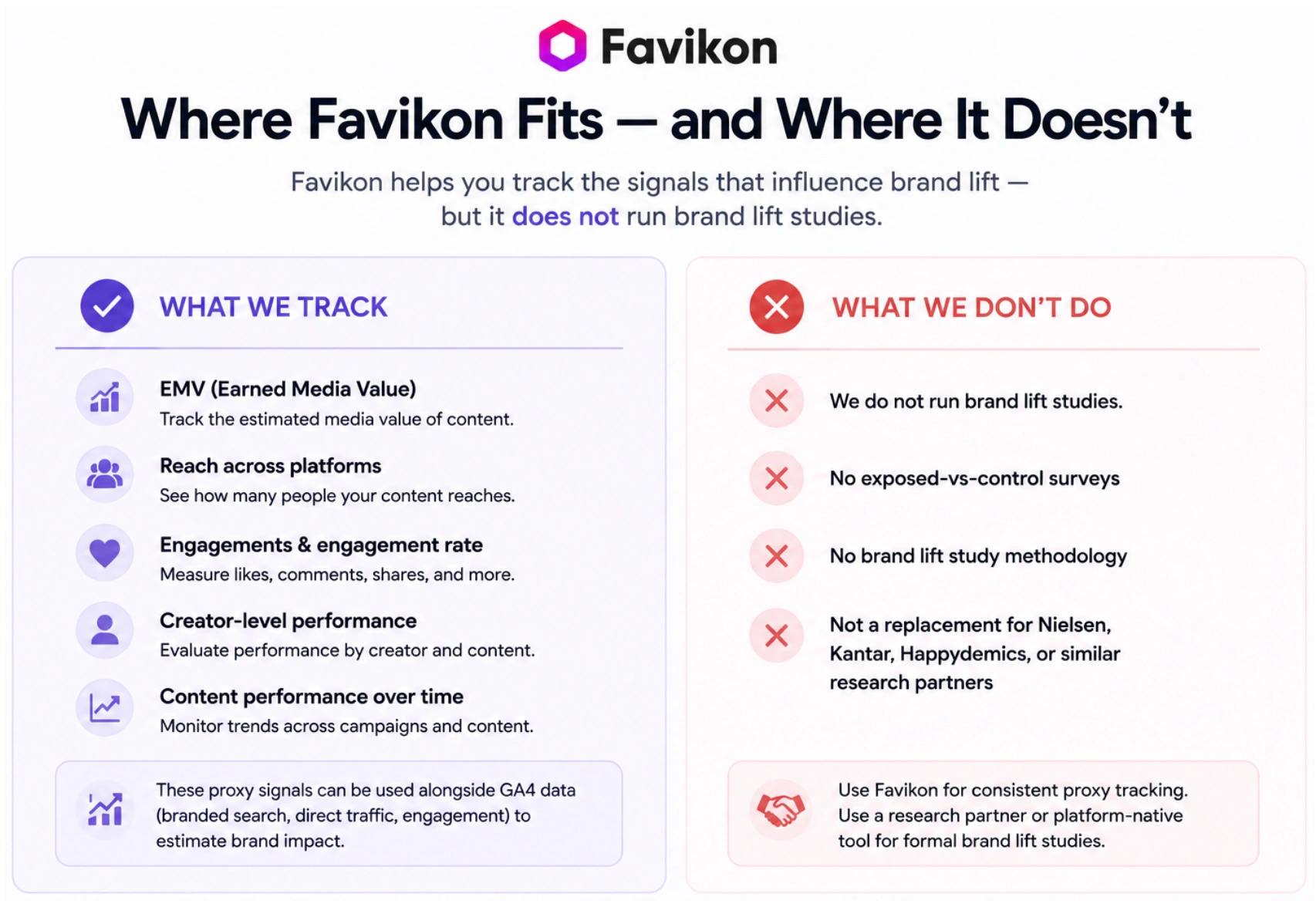
Being direct about this: Favikon does not run brand lift studies. There's no exposed-vs-control survey tool inside the platform, and nothing here replaces a formal Nielsen, Kantar, or Happydemics-style study if a brand needs statistically defensible proof of a perception shift.
What Favikon does support is the proxy-signal layer described above. Campaign tracking in Favikon captures EMV, engagement quality, reach, and creator-level performance across tagged content, which — tracked consistently over time alongside branded search and direct traffic from GA4 — gives teams a usable directional read on brand impact without commissioning a formal study. For teams running influencer content at a scale that justifies a real brand lift study, the right move is pairing that proxy tracking with a dedicated research partner or a platform-native tool, not trying to force a survey-based metric out of a campaign management platform that isn't built for it.
For teams building out full attribution and reporting workflows, see how to build an influencer marketing report and the SaaS influencer marketing playbook for attribution-window guidance specific to longer B2B sales cycles.
Key Takeaways
- Brand lift measures the change in perception — awareness, favorability, intent — caused by campaign exposure, not clicks or conversions.
- It's hard to measure well because it needs a real control group, sufficient sample size, and isolation from confounding factors — conditions most influencer budgets can't fully meet.
- Formal studies (Nielsen, Kantar, platform-native tools) are the gold standard but largely out of reach for typical influencer campaign budgets.
- Most influencer marketers approximate brand lift using proxy signals: branded search, direct traffic, social share of voice, sentiment, and EMV.
- Brand lift is gaining importance specifically because last-click attribution structurally can't credit influencer content, and awareness-first channels need a measurement layer built for what they actually do.
- No influencer platform, including Favikon, replaces a real brand lift study — treat platform analytics as a proxy layer, not a substitute.
Sources referenced
- Happydemics, The complete guide to running a brand lift study
- Marketing Evolution, The guide to measuring brand lift & optimizing brand perception
- Exverus, Brand lift studies: FAQs for CMOs
Others articles