Favikon Update : June 2026
Explore the June 2026 Favikon update, including new features, product improvements, and tools to help brands and creators work faster.


Favikon Methodology | Industries & Niches
How Favikon assigns creators to industries and niches — and what changed in the June 2026 taxonomy update.
June 16, 2026
This article is part of Favikon's methodology series explaining how creators are ranked and scored. See all articles here:
1. Favikon Methodology | Summary
2. Favikon Methodology | Tiers
3. Favikon Methodology | Algorithm
4. Favikon Methodology | Authority Score
5. Favikon Methodology | Influence Scores
6. Favikon Methodology | Authenticity Score
7. Favikon Methodology | Industries & Niches ← you are here
Favikon Methodology
Industries & Niches 🗂️
Every ranking on Favikon is relative. A creator's Authority Score, their leaderboard position, their discoverability — all of it is calculated within the context of a niche. Understanding how Favikon assigns industries and niches is foundational to understanding how the platform's rankings work.
This article explains the current categorization system: how industries and niches are structured, how the niche engine places creators, and what changed in the June 2026 taxonomy update.
The Two-Level Structure: Industries and Niches
Favikon organizes creators into two tiers.
Industries are the top-level groupings — broad professional or topical domains like Marketing & Sales, Tech & Software, Finance, or Health & Medicine. As of June 2026, Favikon has 31 active industries.

Niches sit within industries and represent more specific creator communities. Favikon currently has 529 active niches across those 31 industries.
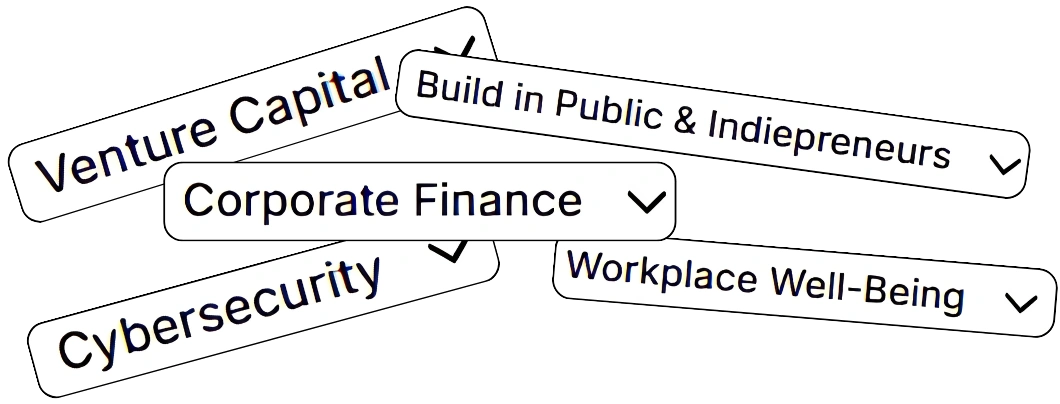
Every creator on Favikon is assigned one primary niche and up to two secondary niches. The primary niche is the main context in which their scores are calculated and where they appear first in Favikon Rankings.
Why Niche Assignment Determines Your Rank
Favikon's scoring system is relative, not absolute. As explained in the Algorithm article, Favikon uses the centile method: each creator's scores for engagement, reach, consistency, and content quality are ranked within their niche cohort. A creator in the 91st centile for engagement has higher engagement than 91% of creators in their specific niche — not across all of Favikon.
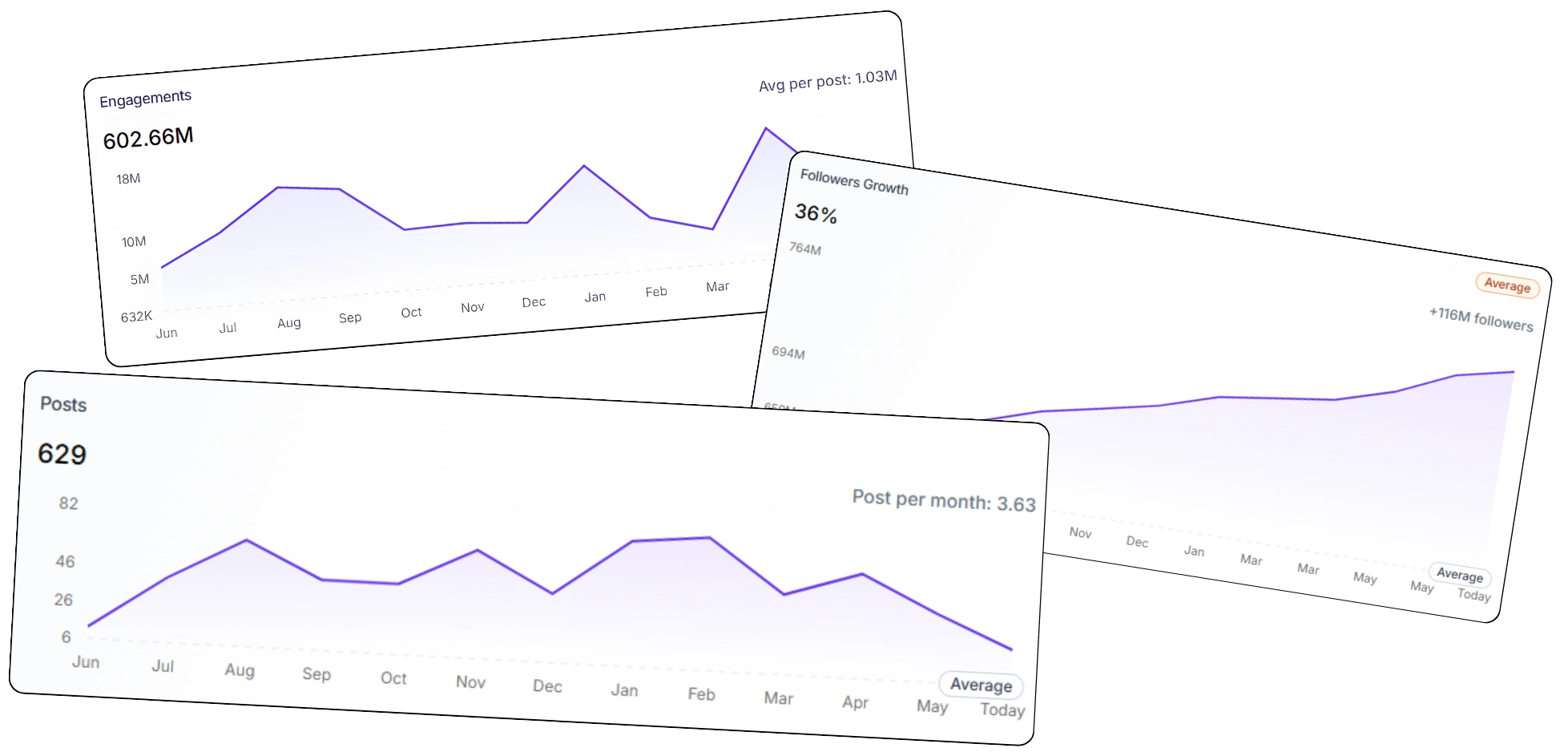
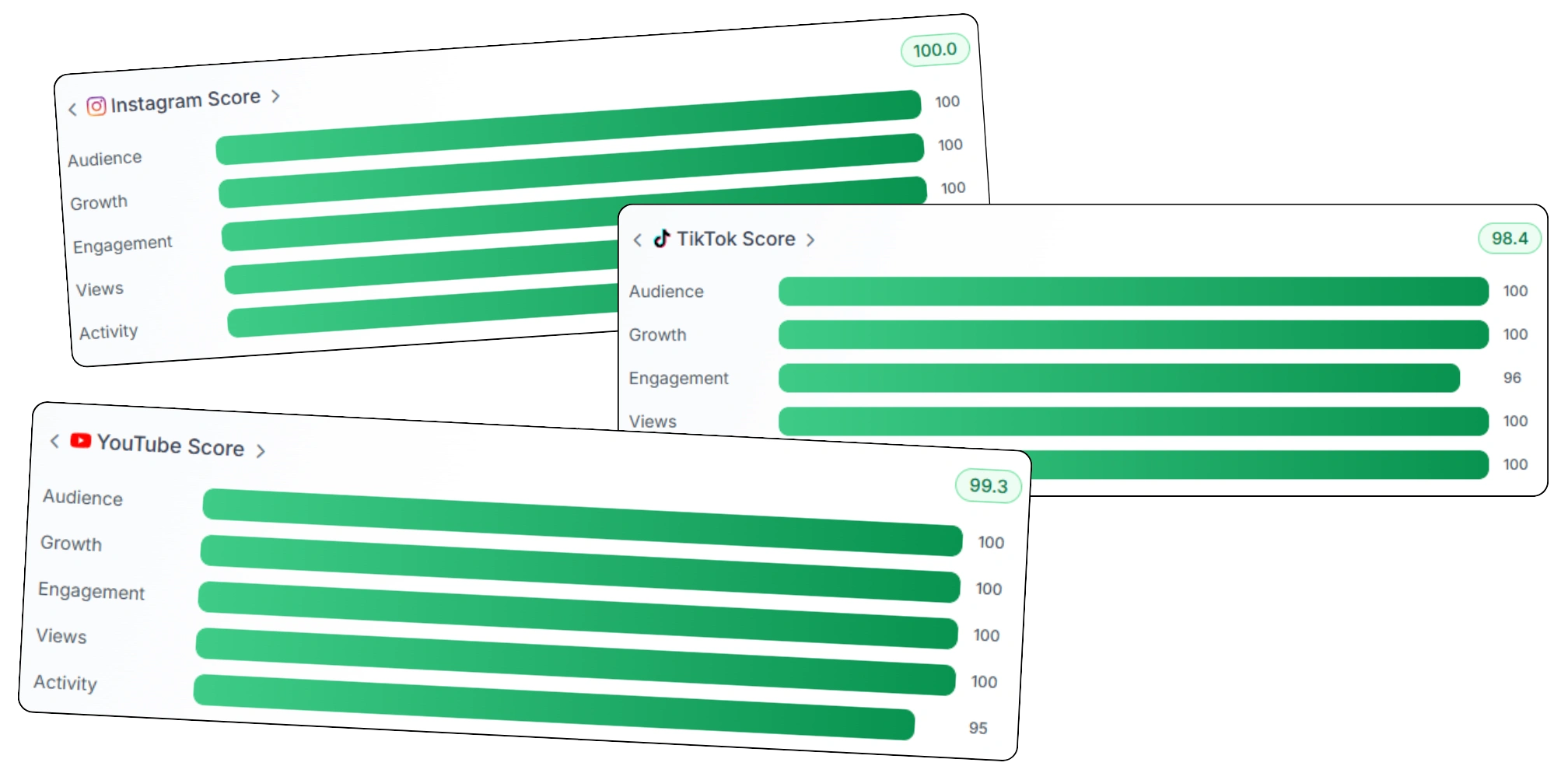
The practical implication is significant. A creator in a broad, overcrowded niche of 800 will have a very different ranking than the same creator placed in a precise niche of 80 where their content genuinely fits. The niche directly determines the competitive set that generates a creator's rank and Authority Score.
How the Niche Engine Works
Prior to the June 2026 update, niche assignment was based on manually defined category labels. It worked at modest scale but had a core limitation: categories reflected human assumptions about how creators should be grouped, not a measurement of how their content actually compares.
The current system is AI-driven throughout.
Step 1: Generating a creator description
The engine starts from a single sentence — the first line of each creator's description. This line is generated by analyzing the creator's content and bio, and it typically captures what that creator is best known for in precise terms.
Step 2: Turning descriptions into vectors
Each description is converted into a mathematical representation of its meaning — a vector that encodes the semantic content of that sentence in high-dimensional space. Creators whose descriptions have similar meaning end up with similar vectors.
Step 3: Grouping similar vectors into niches
Similar vectors are grouped together. These groups reveal the natural niches that exist across creators — communities defined by what creators actually do, not by labels assigned to them. Each creator is then matched to the niche their vector sits closest to.
What Changed in the June 2026 Taxonomy Update
The June 2026 update replaced Favikon's legacy taxonomy entirely. The previous system had approximately 520 niches in 34 loosely defined industry columns, built from manually assigned labels.
The new taxonomy introduced 529 niches across 31 industries, with every creator assigned through the niche engine rather than manual classification.
New industries created from scratch
The update recognized several creator communities that had no accurate home in the previous taxonomy.
Aviation is now a standalone industry with dedicated niches including Aviation Industry professionals, Pilots, Flight Crew, and Aerospace Engineering. These creators previously had no meaningful category.
Design is now a standalone industry covering UX/UI Design, Graphic & Brand Design, Interior Design, and adjacent niches.
HR & Workplace is now a standalone industry. Previously, HR practitioners and people operations creators were grouped under "Careers & Office" alongside unrelated content. The new system treats them as a distinct professional community with its own niches: HR & People Leaders, HRTech, Employer Branding Professionals, Talent Acquisition & Recruiting, and Corporate Learning & Development, among others.
Industries that were split
IT & Tech became two industries: Tech & Software (29 niches) and Engineering & Operations (10 niches). The separation reflects meaningfully different professional communities — a DevRel engineer and a supply chain consultant do not create comparable content even if both work in "tech."
Health & Medicine was separated from Wellness & Lifestyle Health, giving clinical and wellness content distinct homes rather than a shared category.
Arts & Culture was split into Entertainment & Culture and Visual Arts, recognizing that performance, media, and visual creative work serve different communities on the platform.
Broad niches that were subdivided
"AI & Machine Learning" was one niche. It is now five: AI & ML Engineering, AI & ML Researchers, AI Governance & Policy, AI Safety & Tech Ethics, and AI Workflow Automation. These represent distinct professional communities with different content patterns.
"Finance / Web3" became 21 finance niches — covering Corporate Finance & FP&A, Payments & Fintech, Accounting & Bookkeeping, International Tax Advisory, Sustainable Finance, Crypto Trading & Analysis, and more. Crypto and Web3 content was separated from professional finance content based on differences detected by the niche engine.
"Law, Media & Politics" was one combined category. It is now two separate industries: Law & Legal (11 niches) and Politics & News (16 niches).
New niches for previously unrepresented communities
The niche engine identified several professional communities that existed in the data but had no accurate category in the prior taxonomy. These include:
- DevRel / Developer Advocacy
- Revenue Operations & Sales Operations
- Compliance, Ethics & Governance
- LegalTech & Legal Entrepreneurs
- Employer Branding Professionals
- Corporate Finance & FP&A
- B2B SaaS Marketing
- B2B Sales Coaching
These communities have been active on LinkedIn for years. The 2026 taxonomy is the first time Favikon has had dedicated niches for them.
Consolidations
Where the old system had overlapping tags describing the same community from different angles, these were merged into a single niche. Creators in these cases may have a different label without any meaningful change to their actual placement.
One Primary Niche Per Creator
As of June 2026, every creator has one primary niche and up to two secondary niches. Previously, creators could appear across multiple niches with equal weight.
The primary niche is where the niche engine placed the creator as the strongest fit. Secondary niches reflect meaningful overlap where a creator's content spans adjacent communities.
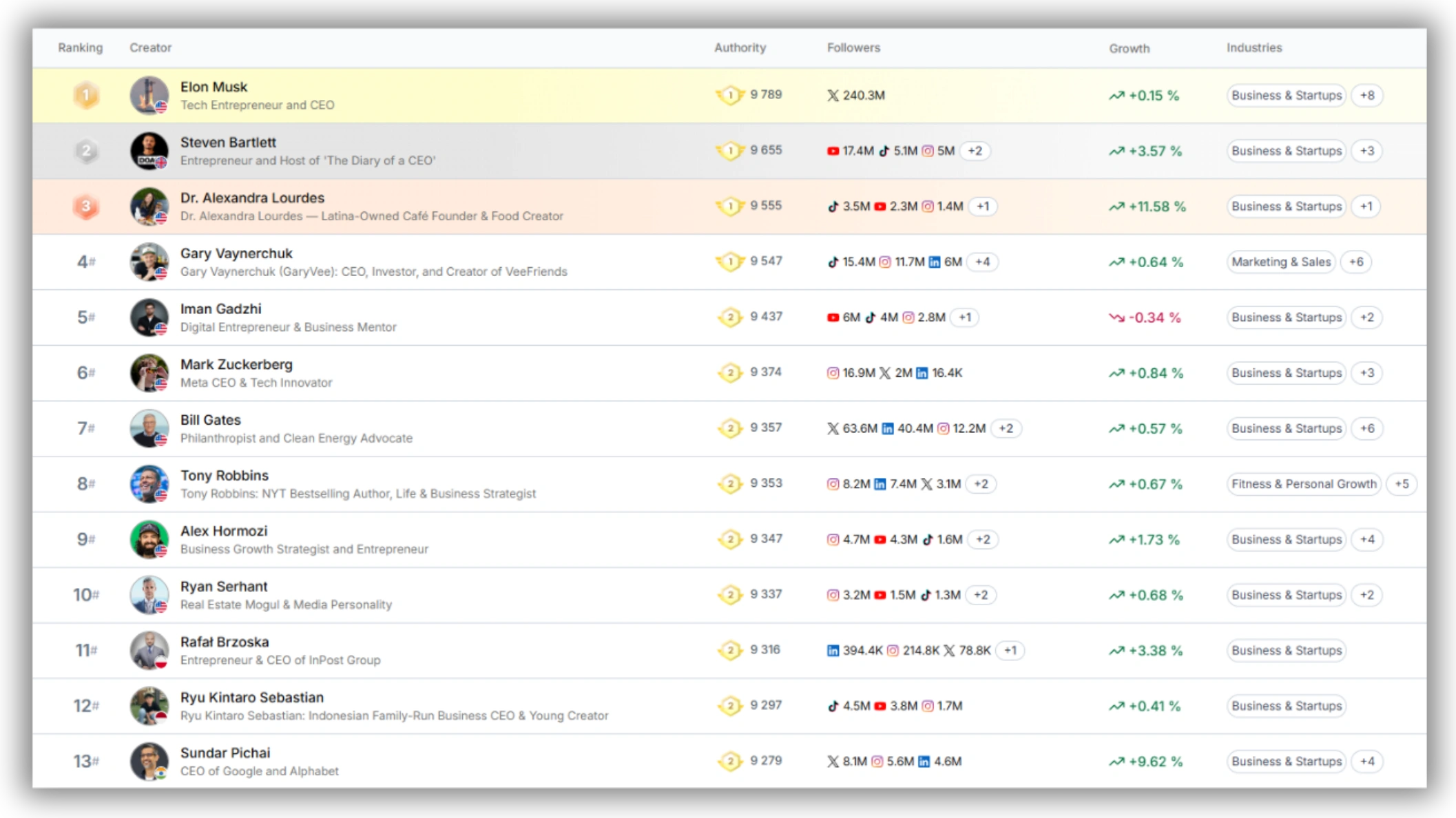
The primary niche is the default context for a creator's ranking and the first result when filtering by category in Favikon Rankings.
How Niche Connects to the Authority Score
The Favikon Authority Score is a composite score built from the Influence Score, Social Media Score, and Authenticity Score. As described in the Algorithm article, each component is computed relative to a creator's niche cohort using the centile method.
The Authority Score is not a fixed measure of absolute performance — it measures a creator's standing within their niche. Reassigning a creator to a different niche changes their centile position across every scoring dimension and therefore their overall score.
This is the direct mechanism behind the ranking changes produced by the June 2026 update. Creators did not change; the niche they are measured within did.
Frequently Asked Questions
Why did my Favikon ranking change after the June 2026 update? Rankings are calculated within your niche. If your primary niche changed as part of the taxonomy update, you are now being measured within a different, more precise peer group. Your Authority Score reflects your position within that new cohort.
How does Favikon decide which niche I belong to? The niche engine generates a description of your content and profile, converts it into a vector, and matches it to the closest niche. A second AI pass then reviews the 15 closest niches and confirms — or recalibrates — the initial match.
Can I change my niche? If you're not satisfied with the niche assigned to your profile, you can contact our support team at support@favikon.com to request a niche change.
Does being in a smaller niche hurt my ranking? No. Ranking is relative to your niche cohort. Being top 10 in a well-defined niche of 60 is a stronger and more precise signal than being ranked #200 in a broad niche of 800.
Where can I explore creator rankings by niche? All current rankings are available on the Favikon Rankings page.
Others articles