How to Find X (Twitter) Influencers: The Complete Guide
Finding the right influencers on X starts with looking beyond follower counts and focusing on relevance and engagement. This guide explains how to discover creators, evaluate their audience, and build stronger influencer campaigns.
.png)
%20Influencers.webp)
How to Find X (Twitter) Influencers: The Complete Guide (2025)
Finding the right X (Twitter) influencer for your campaign sounds simple. In practice, it takes longer than most marketers expect. X's search tools were built for content discovery, not creator vetting — and most blog posts on this topic gloss over why each method breaks down at scale. This guide doesn't.
Below you'll find every practical method available in 2025: native X search, Advanced Search operators, X Lists, developer-grade scraping APIs, and dedicated influencer platforms. For each one, we'll cover how it works, a step-by-step walkthrough, and — critically — what it cannot do.
Method 1: Manual Search on X
What it is: Browsing X natively — using the search bar, trending topics, and profiles — without any third-party tools.
Manual search is where most people start, and it's a reasonable first step for small-scale discovery or gut-feel validation. If you already have a shortlist of creator names, searching them directly on X takes thirty seconds per profile.
How to do it
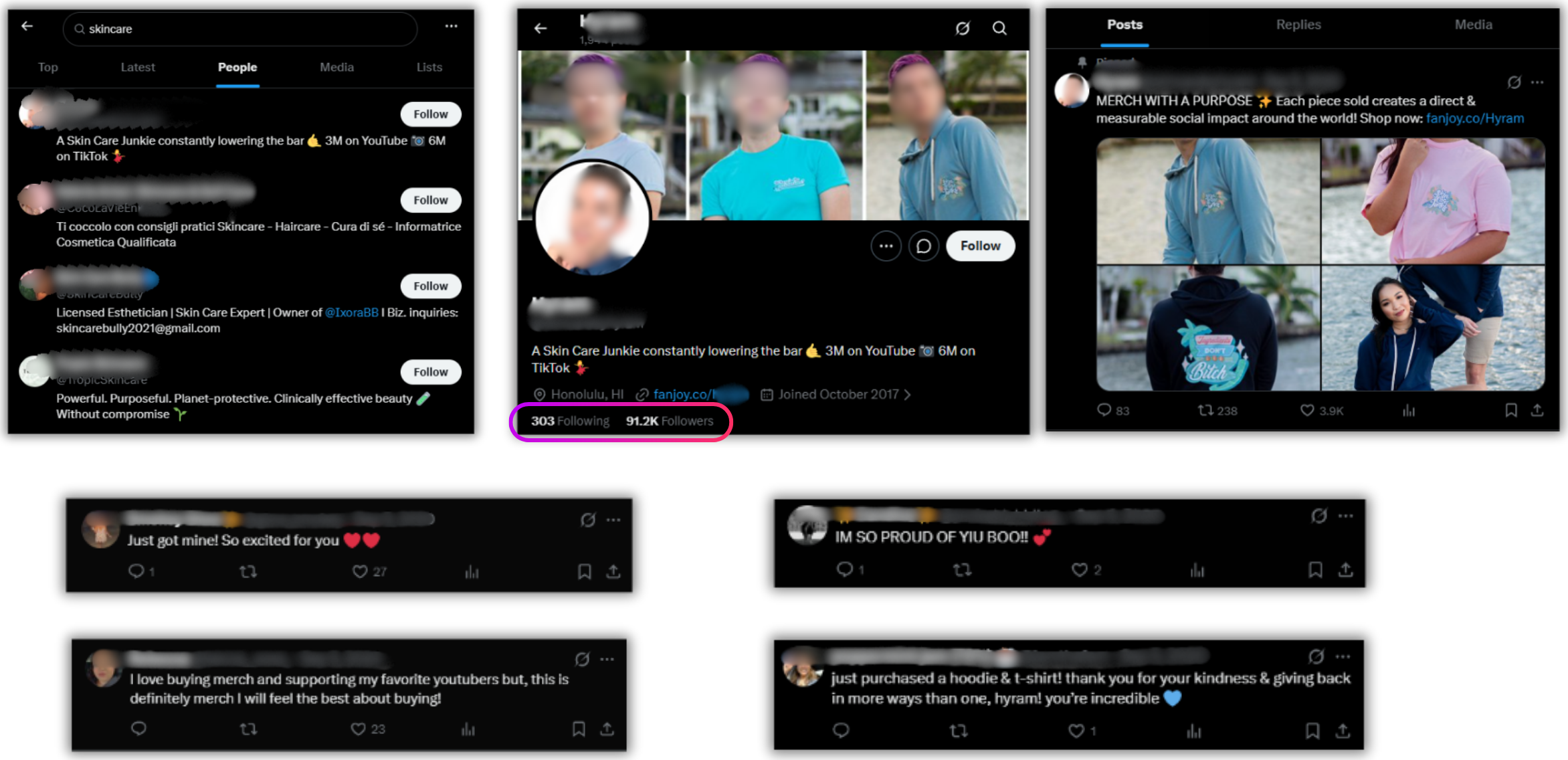
1. Go to x.com and type your niche keyword or creator name into the search bar.
2. Select the People tab to filter results to user profiles only.
3. Look at follower count, bio, pinned post, and recent engagement on the timeline.
4. Check the Replies tab on their profile — a creator with genuine engagement will have real two-way conversations, not just likes.
5. Browse their following list for a chain of related creators in your niche.
Why it may not be the best approach
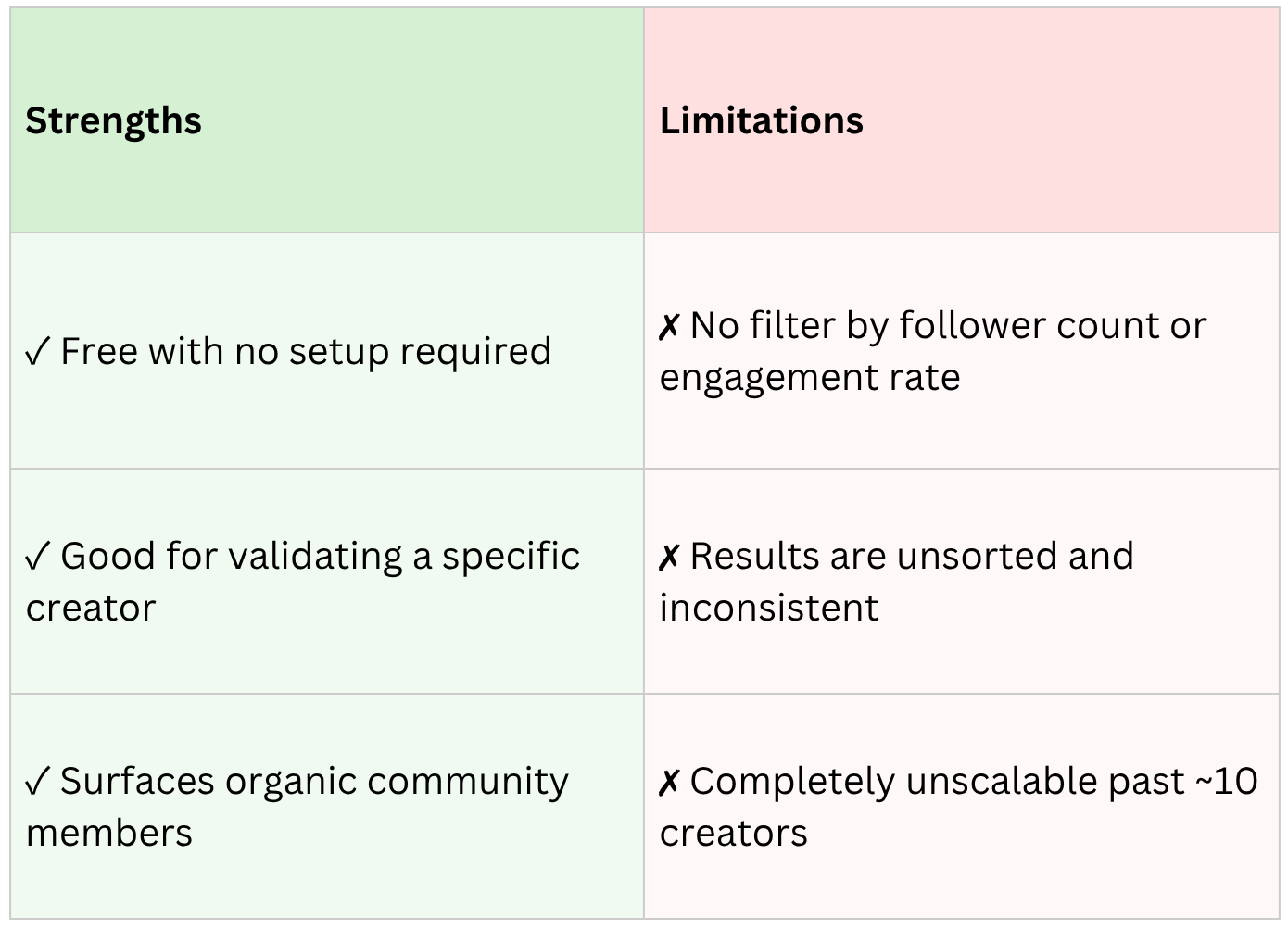
Manual search works for a list of ten creators. It breaks down quickly past that. X's native search does not let you filter profiles by follower count, engagement rate, niche, or audience location. You are essentially scrolling through unsorted results and using your own judgment on every profile — which takes time and introduces selection bias toward whoever happens to appear first.
Other top blogs recommend starting here, and that advice is reasonable for solo founders or micro-campaigns. But if you are a brand or agency running multiple campaigns simultaneously, manual search is not a workflow — it is a way to fill a weekend.
Method 2: X Advanced Search (With Operators)
What it is: A more powerful version of X's native search, available at x.com/search-advanced, that lets you combine filters and Boolean operators for targeted content discovery.
Advanced Search is the most underrated free tool on the platform. Most marketers use it at a surface level — typing a keyword and switching to the Latest tab. That barely scratches the surface of what operators can do.
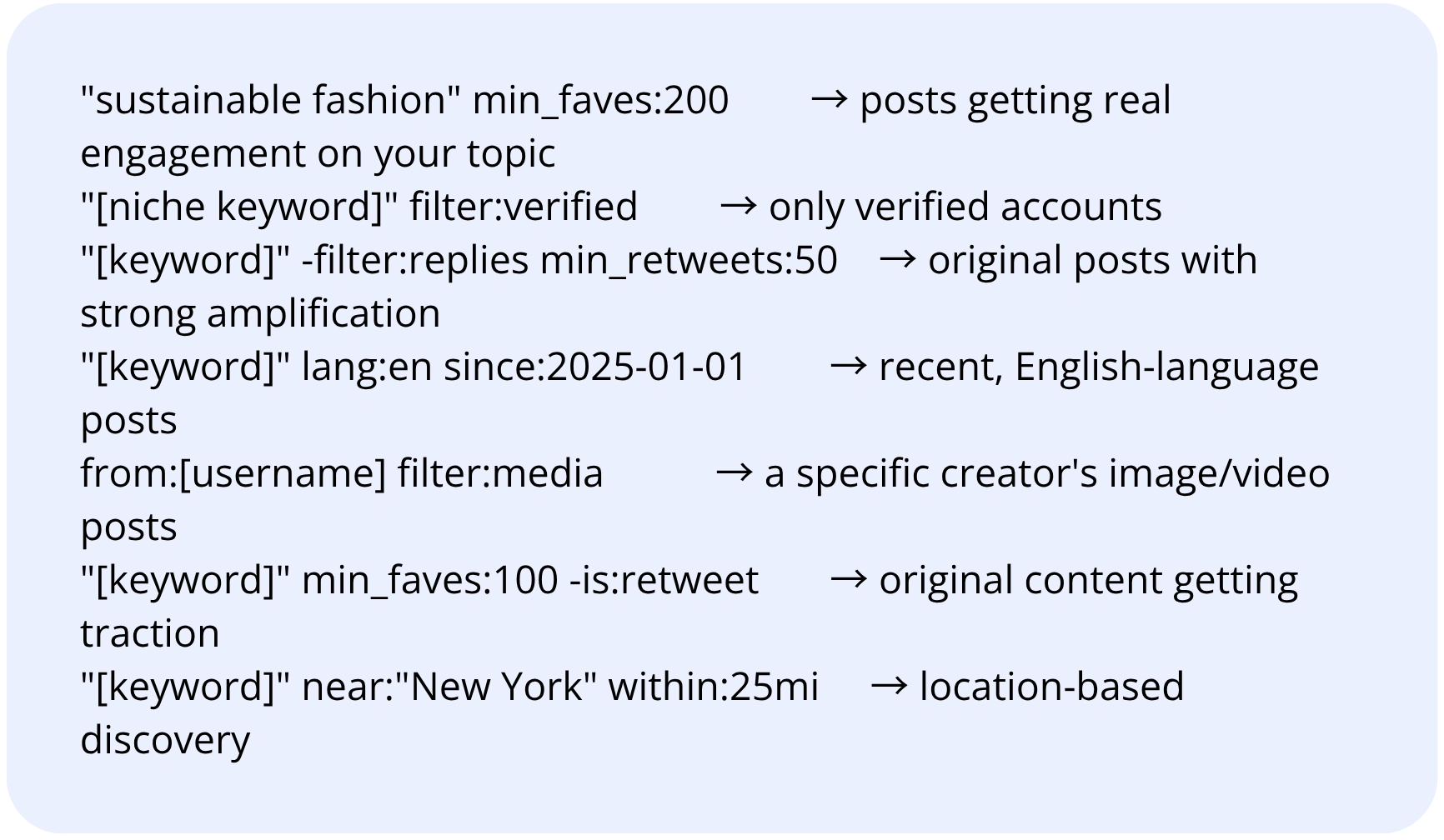
Key operators for influencer discovery
How to use the Advanced Search interface (step by step)
1. Go to x.com/search-advanced on desktop.
2. In the 'All of these words' field, enter your primary niche keywords.
3. Use the 'From these accounts' field to research a specific creator's content history.
4. Set a date range under 'Dates' to surface recent content only.
5. Click 'Search', then switch between Latest and Top to compare result sets.
6. Copy the resulting URL and bookmark it for recurring searches.
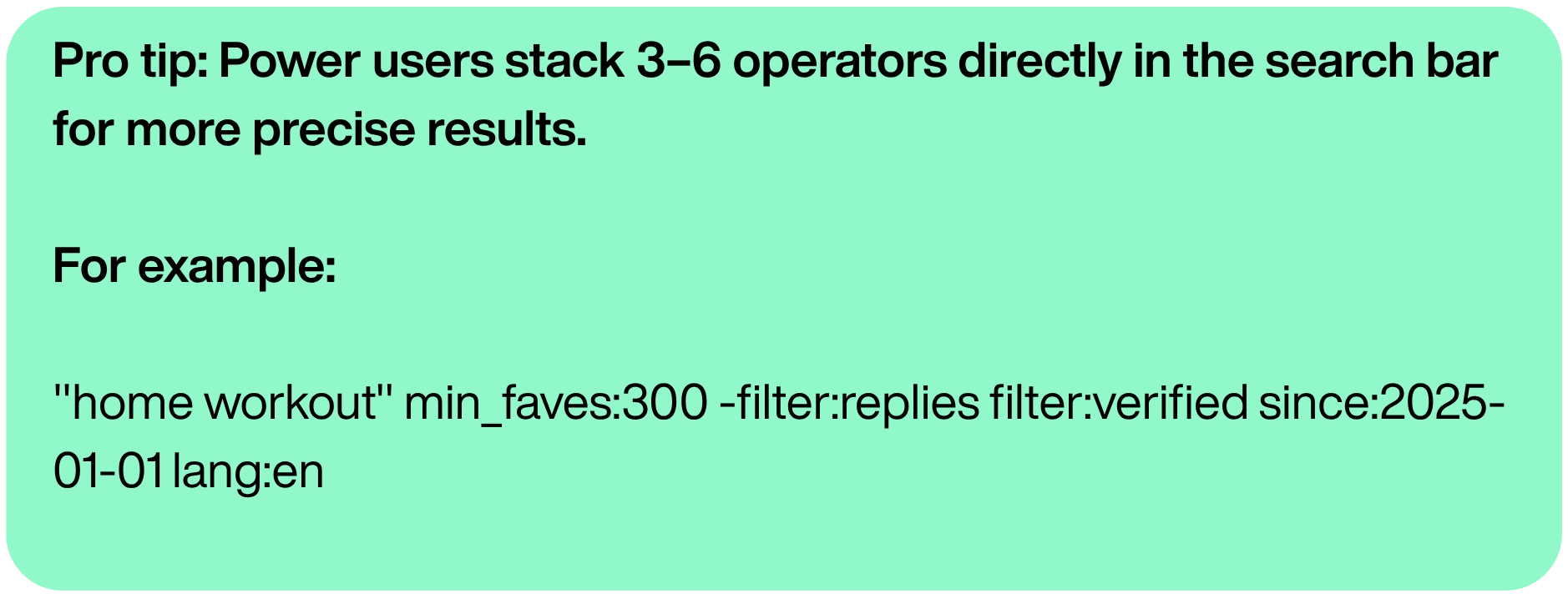
This surfaces recent, original, verified posts about home workouts getting real engagement — a strong proxy for active creators in the fitness niche.
Important limitations of X Advanced Search
Advanced Search is designed for finding content, not people. This is a fundamental constraint, and it is worth being explicit about:
• No profile-based filtering: You cannot filter by follower count, account age, posting frequency, or audience demographics. You are searching posts, not creators.
• No engagement rate: Seeing that a post has 500 likes tells you nothing about what percentage of the creator's audience engaged with it. A 500-like post from a 2,000-follower account is very different from the same number on a 200,000-follower account.
• No historical tracking: Advanced Search does not alert you when new results match your query. You have to check manually.
• Mobile limitations: X does not offer the full Advanced Search interface on mobile. The graphical form at x.com/search-advanced is desktop-only. On mobile you can type operators directly into the search bar, but this is far less intuitive.
• Deleted posts disappear permanently: Once a tweet is deleted, it vanishes from search results — so you cannot audit a creator's historical activity reliably.
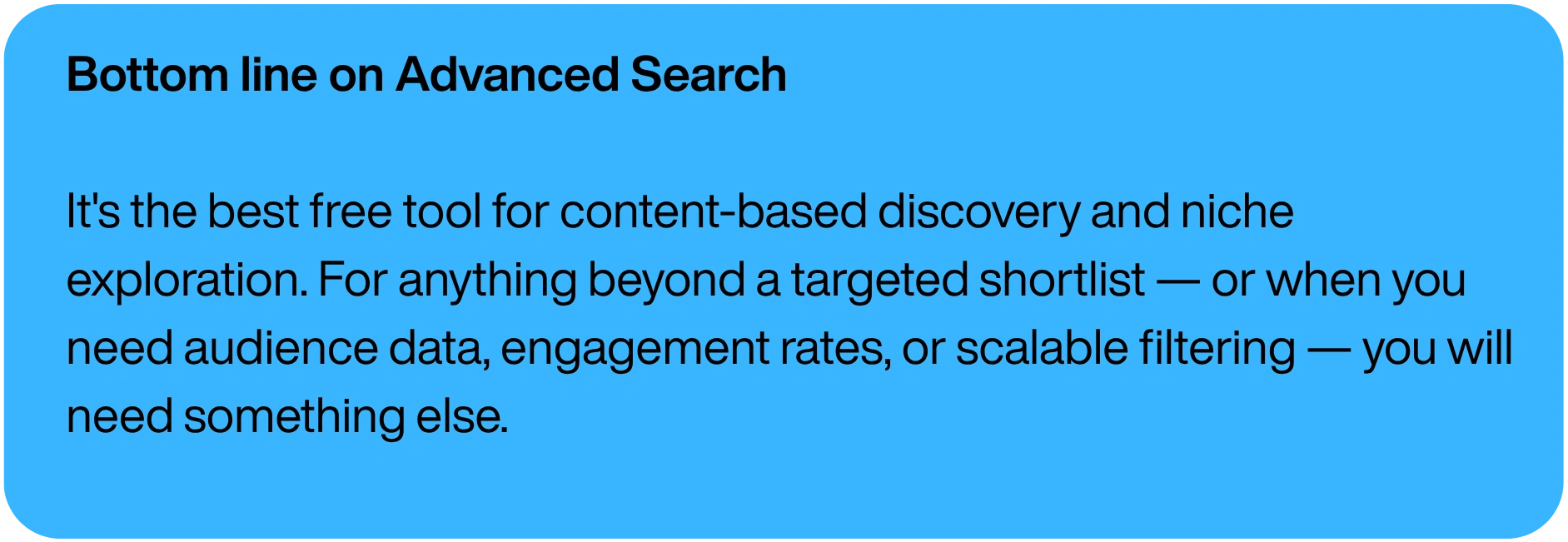
• Rate-limited at volume: Web search caps how many results you can retrieve per query. You cannot export data.
Method 3: Hashtag Exploration
What it is: Searching for niche-specific hashtags to surface creators who consistently post in your topic area.
Hashtag search is a variant of manual search, but with a more targeted starting point. Instead of searching creator names, you search for content — and then look at who's consistently posting quality content on that topic.
How to use hashtags for influencer discovery
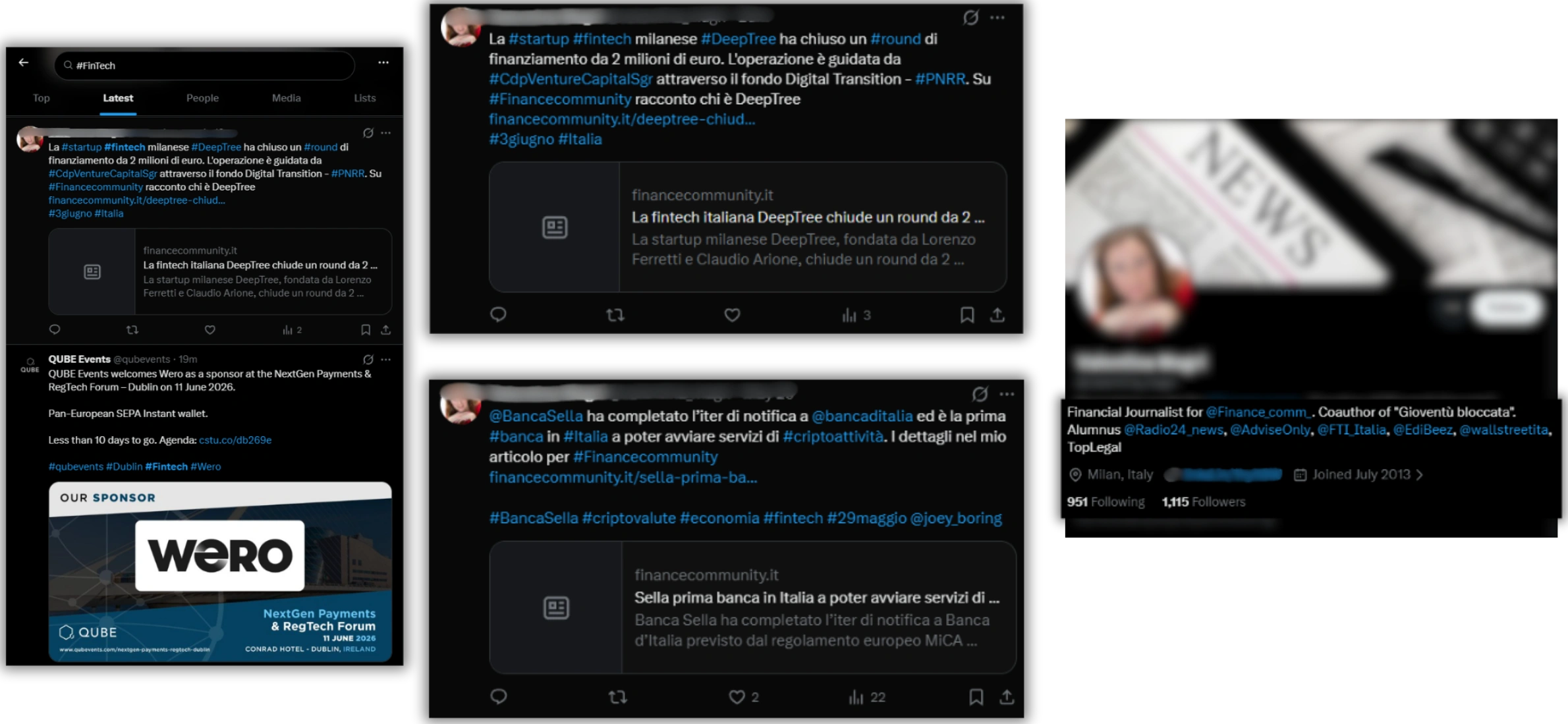
1. Search for your primary niche hashtag (e.g. #FinTech, #SustainableFashion, #B2BMarketing).
2. Switch to Latest to see the most recent posts rather than the most liked.
3. Identify accounts that appear repeatedly across several searches.
4. Check their profile to assess consistency, follower count, and engagement.
5. Search adjacent hashtags (e.g. #FintechStartups, #CryptoTwitter) to expand your pool.
The hashtag method works well for niche communities where creators tend to tag consistently — tech, finance, wellness, and sustainability are good examples. It is less reliable in fragmented niches where creators do not use consistent tags, or in consumer categories where trending tags get flooded with low-quality content.
The same profile-level limitations apply here as with Advanced Search: you can find creators this way, but you cannot filter, sort, or export them.
Method 4: Using X Lists for Influencer Discovery
What it is: Public curated lists on X that aggregate creators, thought leaders, and subject-matter experts by niche.
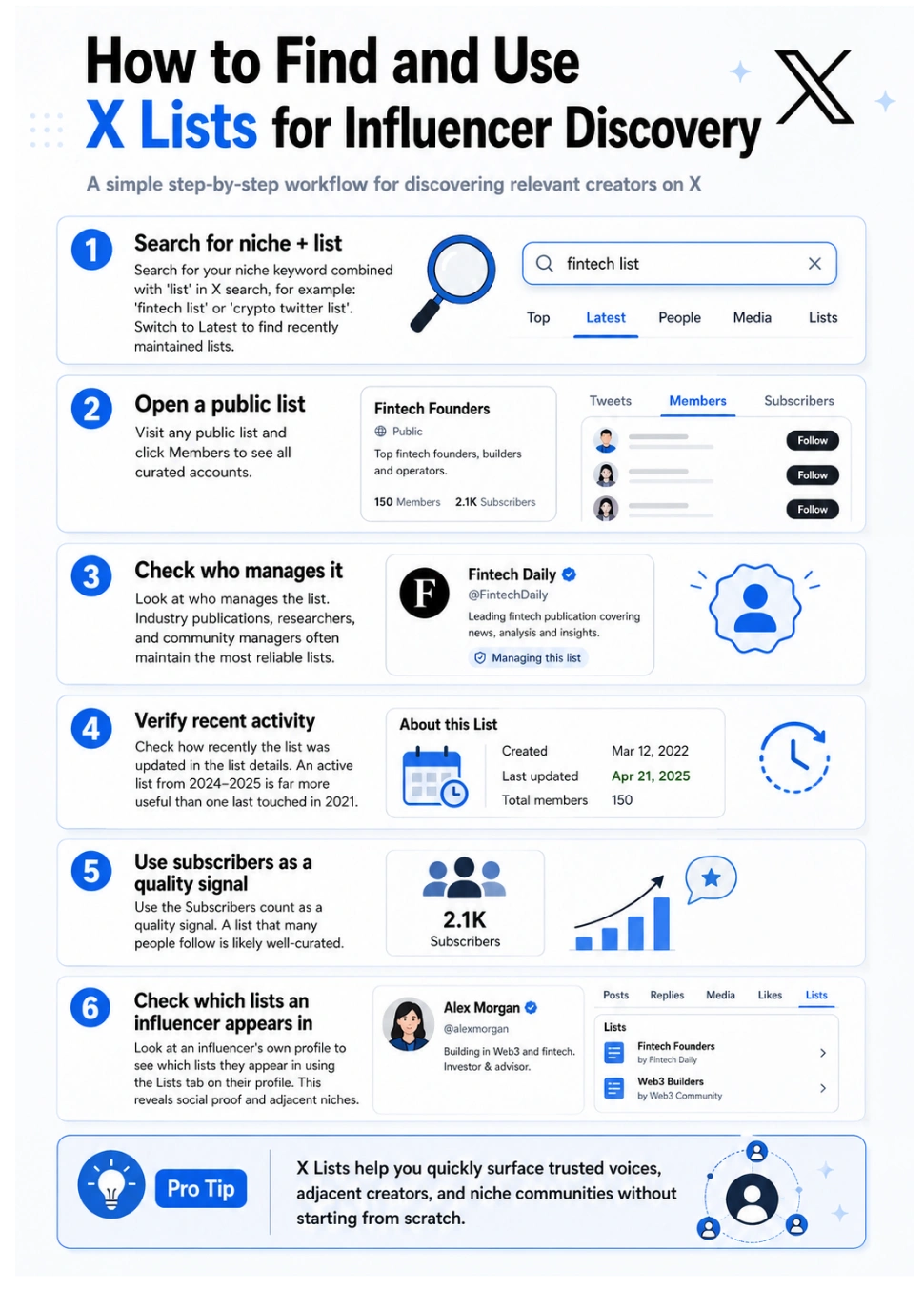
X Lists are genuinely underrated for influencer research. They represent crowd-sourced curation — real people have already done the work of identifying who matters in a particular space. If someone has built a list called 'Top AI Founders on X' or 'UK Sustainable Fashion Creators', that is a pre-validated shortlist you can work from immediately.
How to find and use X Lists for influencer discovery
Searching for lists via URL
You can also search for lists directly by URL pattern. X does not have a great native list-search interface, but advanced operators help:

Limitations of X Lists
• Lists are manually maintained by individuals — quality varies enormously. A list with 200 members from 2022 may contain 40% inactive accounts.
• There is no way to filter list members by engagement rate, follower count, or posting frequency from within X.
• Not all influencers appear in public lists, particularly micro-creators who have not been noticed by list curators.
• X's list search is not great — finding the right lists in the first place requires creativity with search operators.
Best use case for X Lists
Use them to build an initial longlist quickly in a well-defined niche. They are excellent for getting from zero to fifty candidate profiles in under an hour. Then layer on a verification step using engagement metrics before reaching out.
Method 5: Developer APIs — For Large-Scale Discovery
What it is: Programmatic data pipelines that extract X profile and content data at scale, using tools like Apify or custom scraping scripts.
If you are a developer, a data engineer, or a team that needs to build a recurring influencer monitoring pipeline, the manual methods above will not scale. This section covers the developer-grade approach to finding X influencers at volume.
Why X's official API is no longer viable for most teams
X dramatically changed its API pricing structure in 2023 and continued tightening access through 2024 and 2025. The free tier now provides very limited read access, and the paid tiers — starting at $100/month for the Basic tier — cap monthly tweet reads at levels that are too low for serious influencer research. Enterprise access runs to tens of thousands of dollars per month.
This has pushed most developers and marketing teams toward third-party scraping APIs that extract public X data without requiring official API credentials.
Apify: The leading option for X data at scale
Apify is the most mature platform for X data extraction in 2025. It offers a marketplace of ready-built 'Actors' (data extraction scripts) for different scraping tasks, all running on managed infrastructure so you do not need to maintain your own scraper.
Relevant Apify Actors for influencer discovery include:
• Twitter/X Profiles and Tweets Scraper: Extracts follower counts, bios, engagement metrics, and full tweet history without official API keys. Good for building profile datasets from a list of usernames.
• Twitter/X Scraper (keyword + hashtag mode): Searches by keyword or hashtag and returns posts with author data — letting you identify active creators in a niche. Supports advanced search operators natively.
• Twitter/X Followers Scraper: Extracts follower and following lists from any public account — useful for mapping communities around a seed creator and finding similar accounts.
• Influencer Discovery Actor: Searches across multiple platforms (Instagram, TikTok, LinkedIn, Twitter) by niche, hashtag, and engagement tier. Returns engagement rates and contact information.
A simple developer workflow
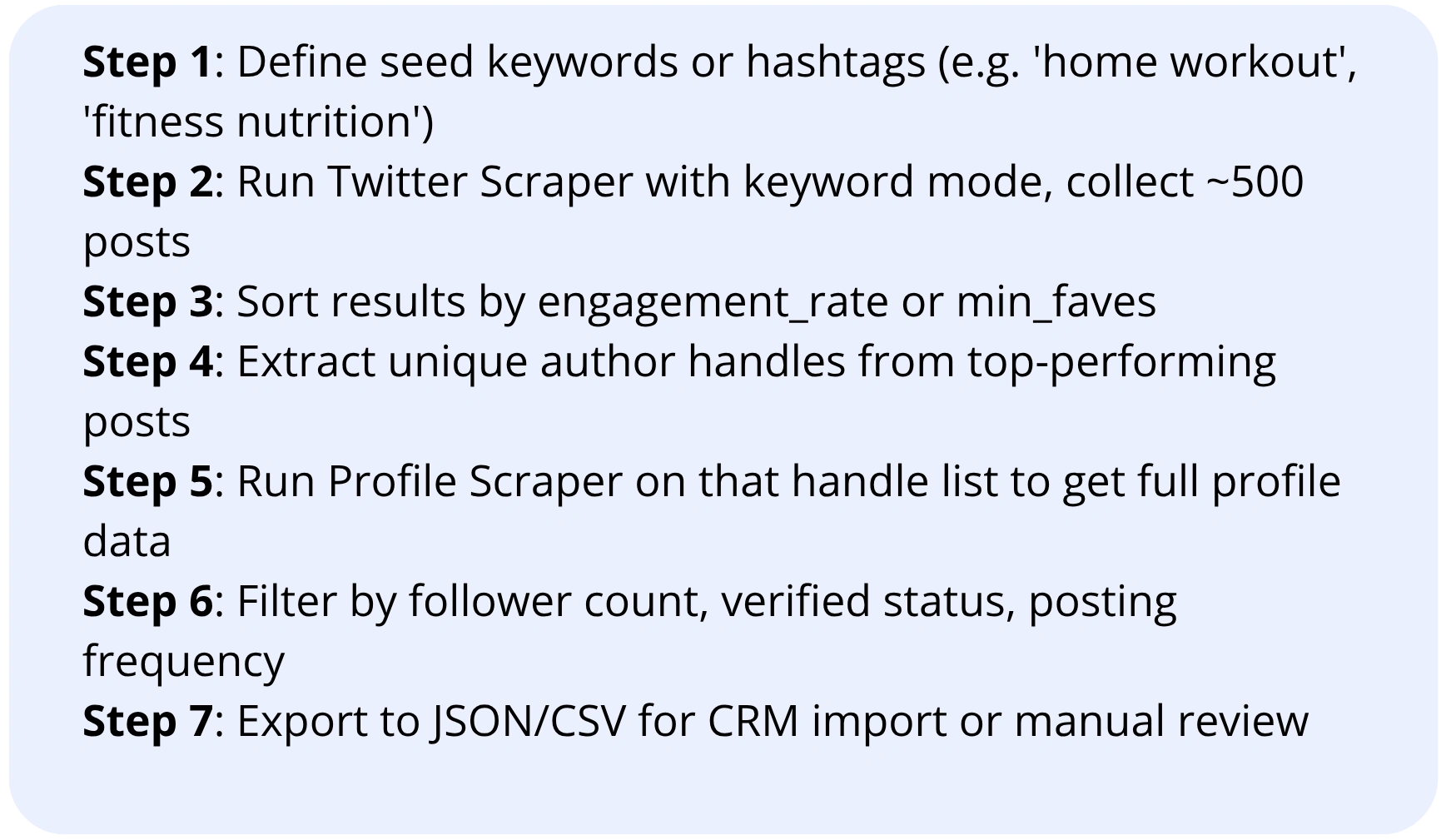
Other scraping APIs and tools
Apify is not the only option. Other approaches include:
• ImbueData Twitter User Data API: A dedicated Twitter user-data API designed for developers building analytics platforms or influencer-finder products. Provides a stable, reliable endpoint without the maintenance overhead of managing your own scraper.
• twscrape (Python, open source): A lightweight Python library for scraping X search results, profiles, and timelines. Requires managing your own X accounts for auth rotation but has no per-request cost. Suitable for in-house data teams.
• SocialBlade / third-party analytics APIs: Several analytics platforms offer API access to aggregated X data including follower growth trends and engagement averages — useful for enriching a creator database once you have a list of handles.
Important caveats for the API approach
• Legal and terms of service: Web scraping public X data occupies a grey area. X's terms of service prohibit scraping, though multiple courts have ruled that scraping publicly available data does not violate computer access laws. Review the legality for your jurisdiction and use case before building a production pipeline. GDPR compliance applies if you are storing personal data of EU users.
• Reliability: X actively works to block scrapers. Third-party tools like Apify update their methods continuously, but expect occasional downtime after X changes its internal APIs or rate-limit behaviour.
• No qualitative vetting: Even a well-built API pipeline gives you raw data — follower counts, engagement numbers, post history. It does not tell you whether a creator's audience is real, whether their brand fit is appropriate, or whether their content tone matches your campaign. That layer of vetting still requires human review or a purpose-built platform.
Method 6: Using Favikon to Find X Influencers
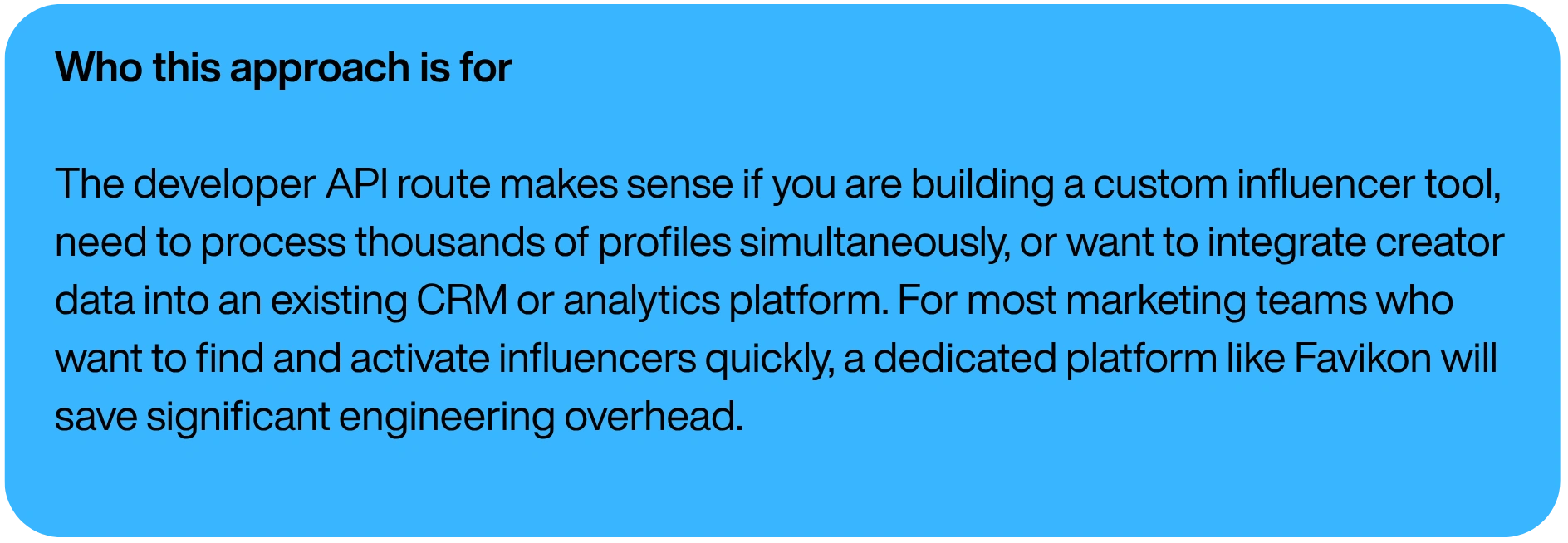
Favikon's influencer search tool is purpose-built for exactly this problem: finding, vetting, and activating creators across platforms — including X — without any of the overhead that comes with manual methods or developer pipelines.
What Favikon offers
Favikon indexes over 10 million creator profiles across Instagram, LinkedIn, YouTube, TikTok, and X. For each profile it tracks follower count, engagement rate, content themes, audience demographics, brand fit score, and historical performance — all updated automatically.
The AI-powered search lets you describe what you are looking for in plain language rather than wrestling with filter combinations. Type something like 'sustainability creators on X with an engaged female audience in the UK' and Favikon returns a filtered, ranked shortlist.
For X specifically, Favikon's dedicated Twitter influencer finder narrows the search to X-native creators, making it straightforward to compare options across niches, tiers, and geographies.
How to find X influencers on Favikon (step by step)
1. Sign up at favikon.com — a 7-day free trial is available with no credit card required.
2. Go to the Influencer Search tool.
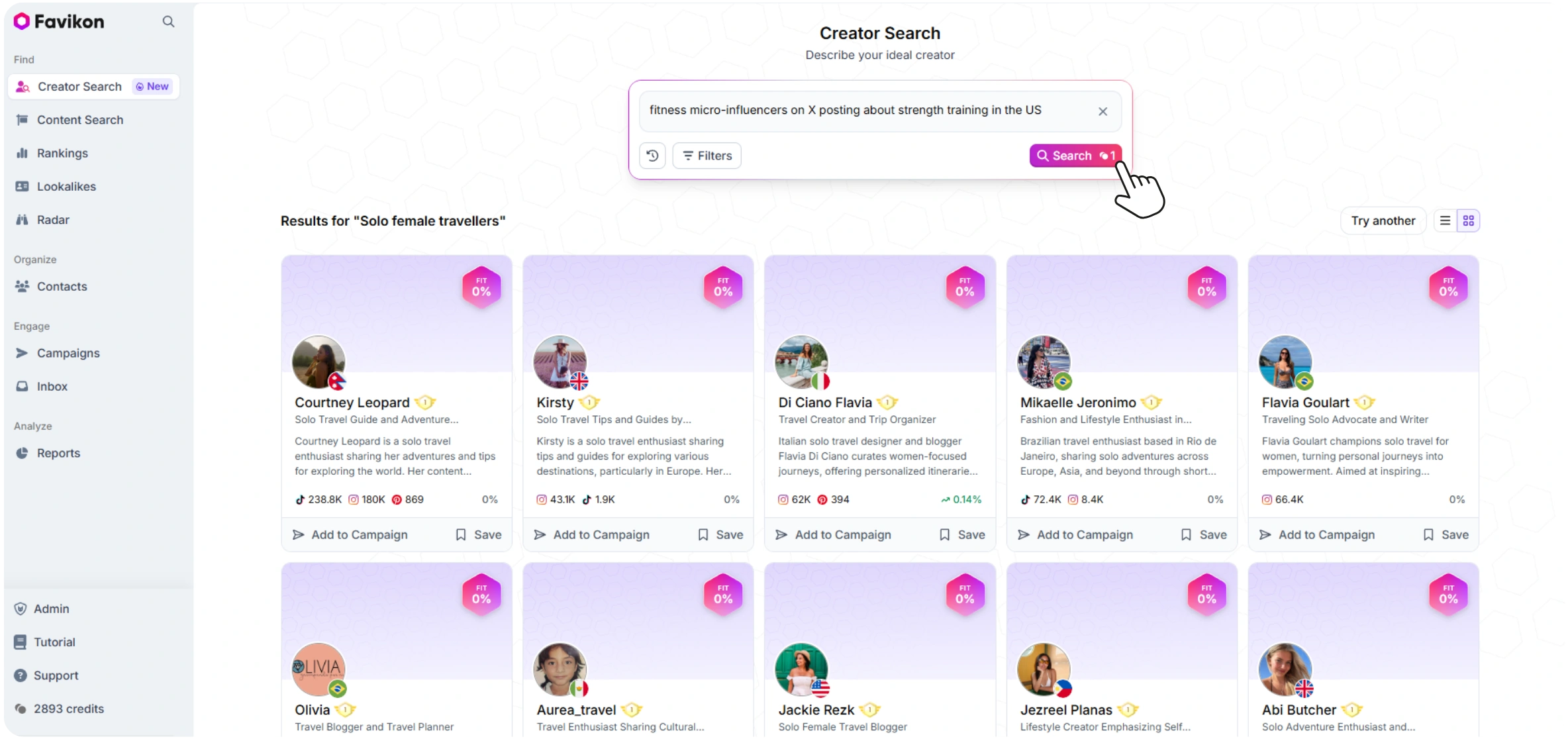
3. Type a plain-language description of your target creator in the AI search bar (e.g. 'fitness micro-influencers on X posting about strength training in the US').
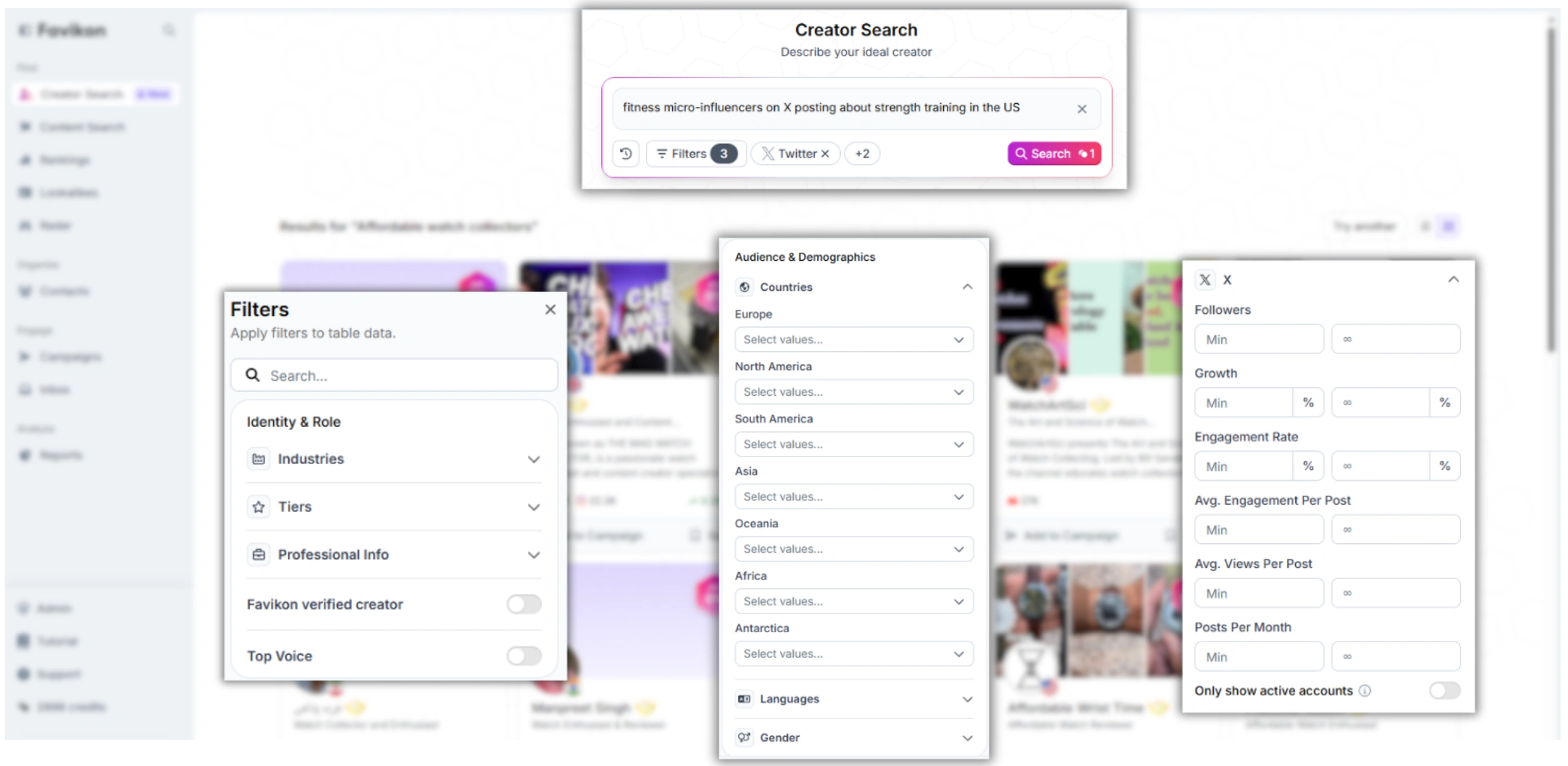
4. Apply additional filters — platform (select X), follower range, engagement rate, location, language — to narrow the results.
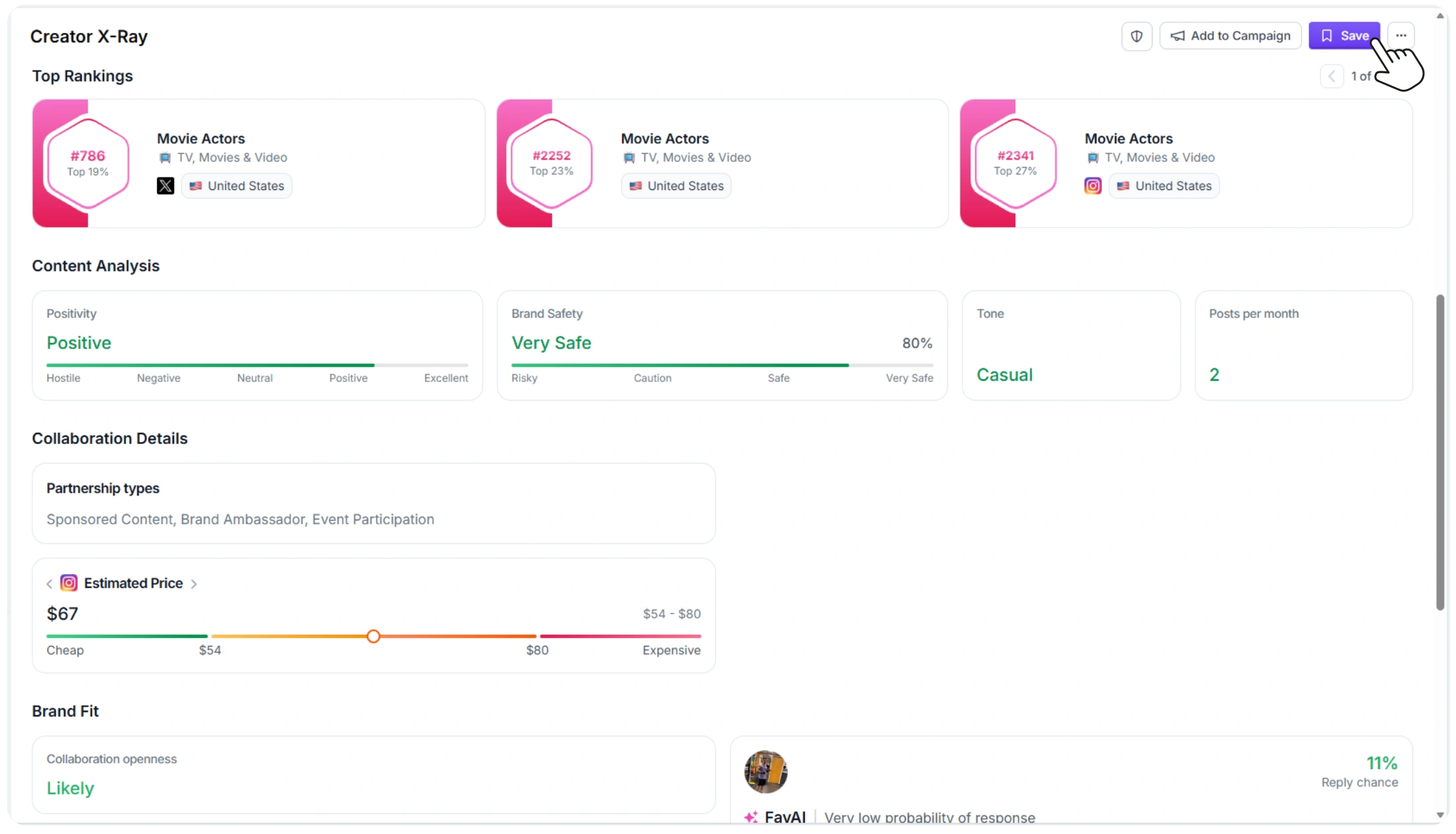
5. Review profiles directly in the platform: follower history, engagement trends, recent posts, audience breakdown, and brand fit score are all visible on a single screen.
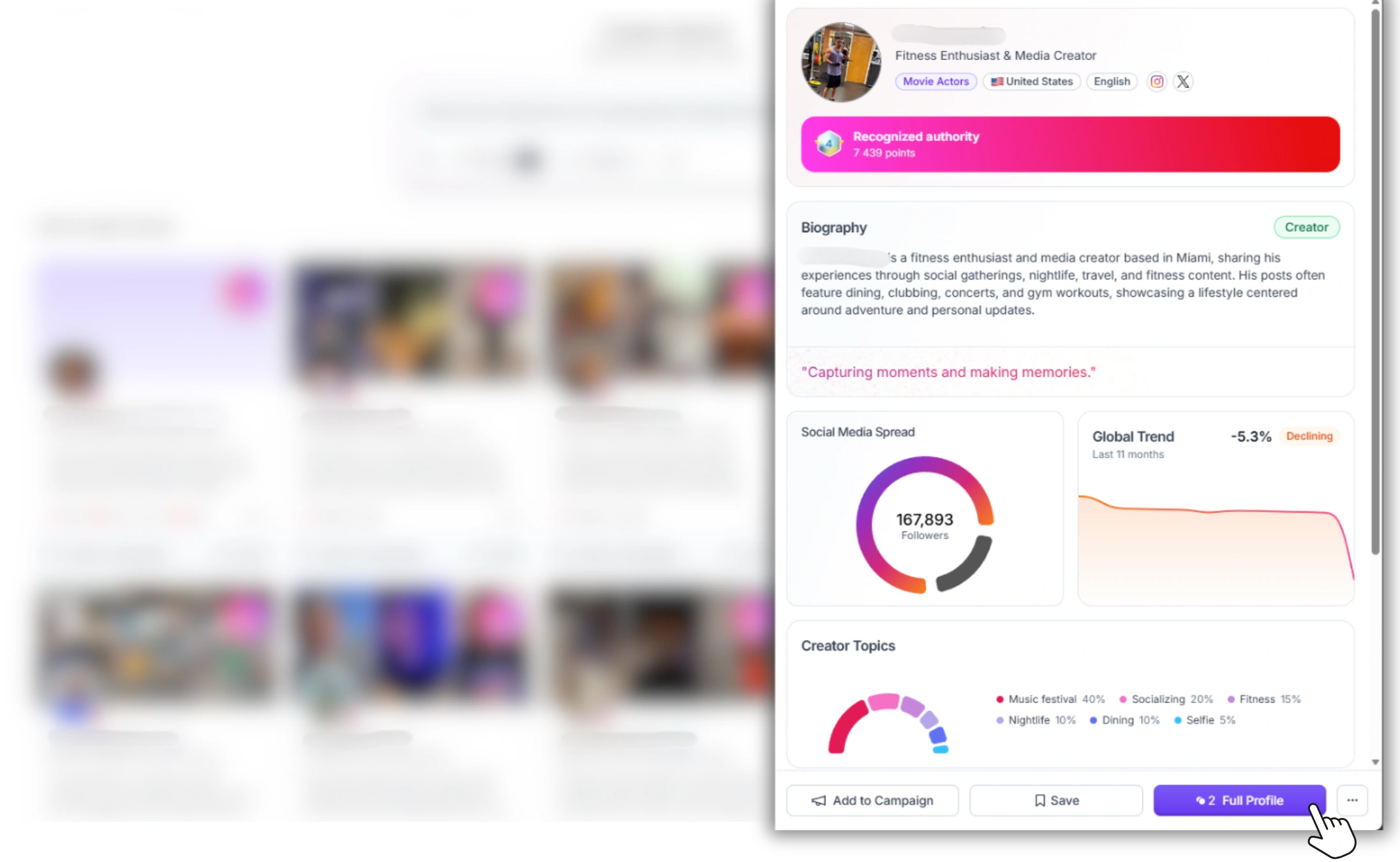
6. Save shortlisted profiles to a list, push them to a campaign, or export contact details.
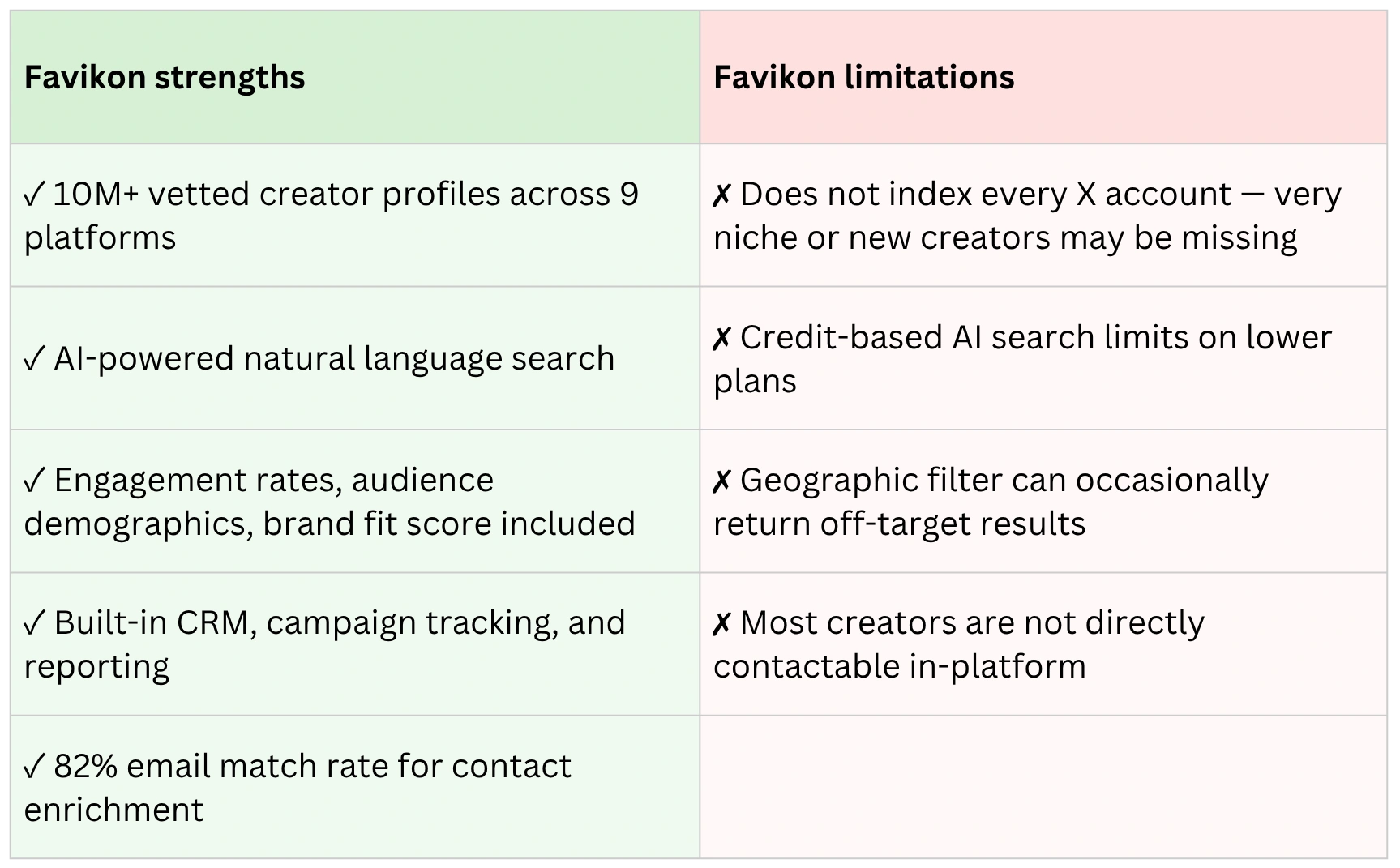
Favikon's limitations — what to know before you start
No platform has zero limitations, and being transparent about Favikon's constraints helps you decide where it fits in your workflow.
• Database coverage: At 10M+ profiles, Favikon is one of the larger vetted databases available. However, X has hundreds of millions of active accounts. Very niche micro-creators, recently active accounts, or creators in underrepresented languages may not yet be indexed. If you cannot find a specific creator in the database, Favikon may not have them — though the platform can add profiles on request.
• Credit-based AI search: Each AI search costs one 'favicoin' and returns 25 results. Starter plans include 50 favicoins per month (equivalent to 1,250 creator profiles in AI search). Heavy searchers should budget accordingly or consider higher-tier plans.
• Geographic filter accuracy: Third-party testing has found that geographic filters occasionally surface results from outside the requested location, particularly for niche + location combinations. Cross-checking location on individual profiles is good practice.
• Directly contactable creators: Of the 10M+ indexed profiles, around 25,000 creators on Favikon's Creator Plan are directly contactable via in-platform DM. Everyone else can still be found and vetted — outreach then happens via email or external channels.
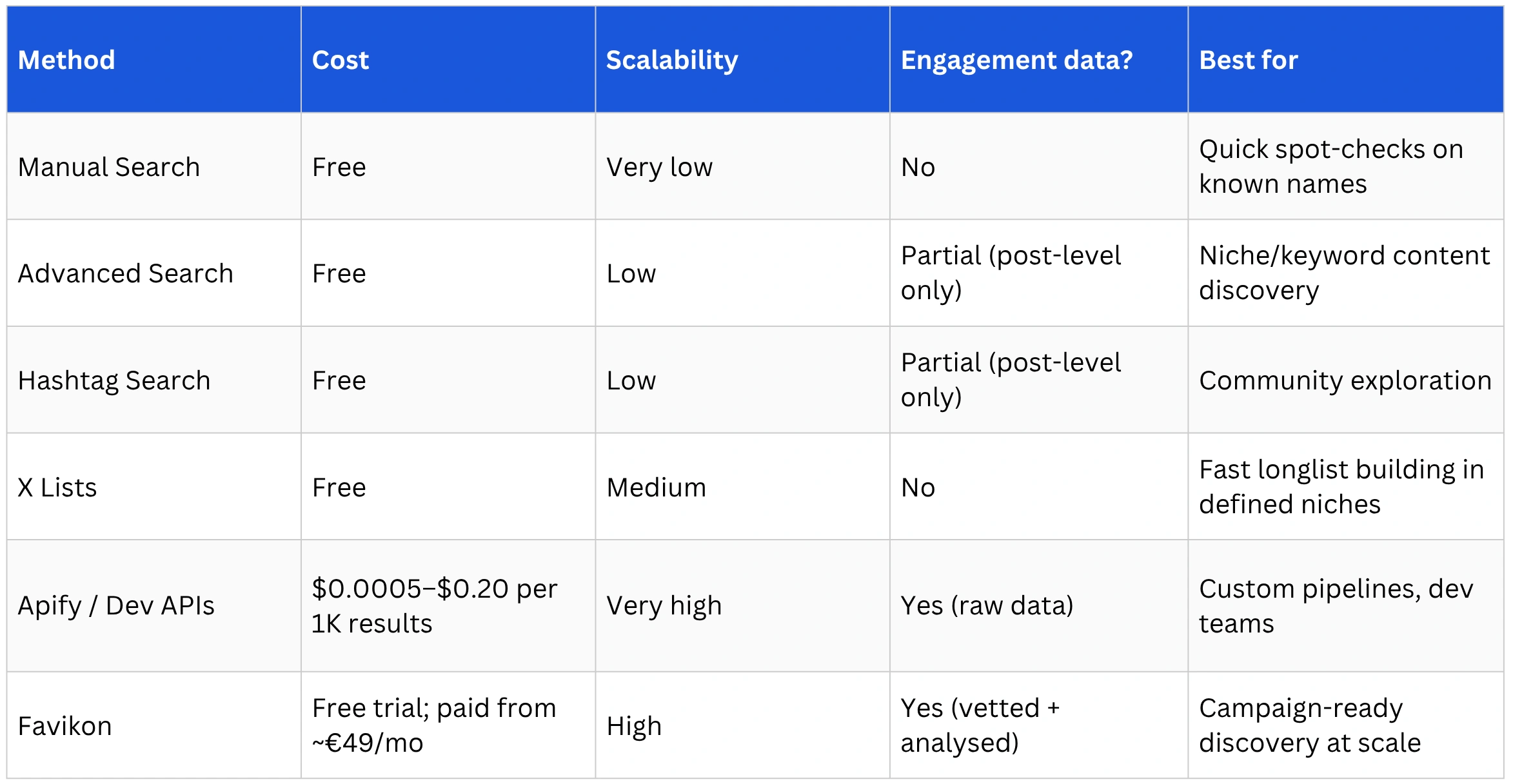
Comparison: Which Method Is Right for You?
Choosing the Right Approach for Your Campaign
No single method wins across every use case. The right choice depends on your team size, campaign frequency, and how much engineering overhead you can absorb.
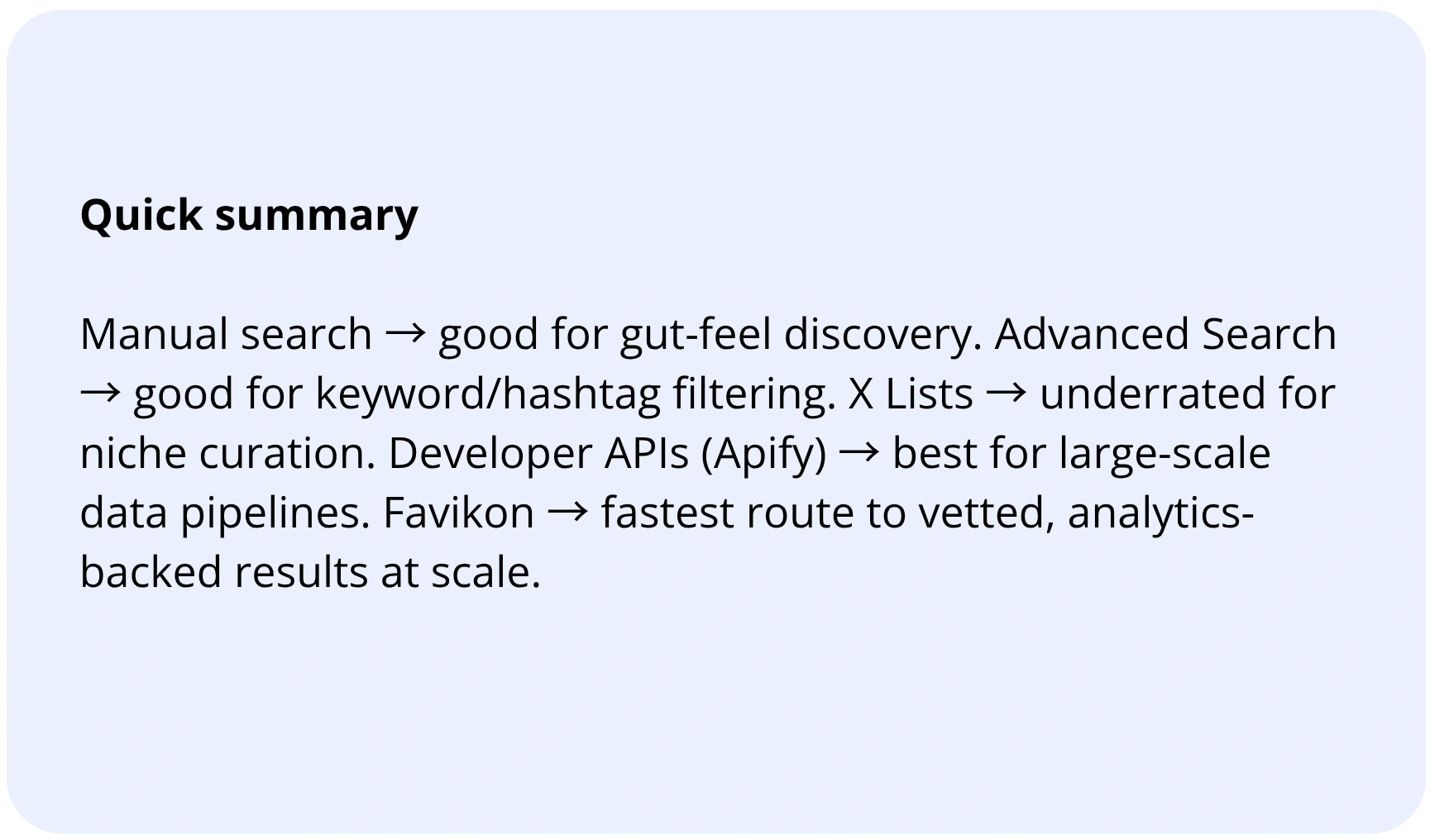
For most marketing teams running campaigns on a regular basis, the most time-efficient path is to start with Favikon's influencer search tool for discovery and vetting, then use Advanced Search operators or X Lists to supplement with niche creators that may sit outside any platform's database. Developer APIs are the right choice only when you need volume that no managed platform can deliver, or when you are building a custom tool.
If you want to start immediately, Favikon's free Twitter influencer finder is a no-commitment starting point that gives you a feel for what data-backed discovery looks like versus the manual alternatives.
Frequently Asked Questions
How do I find micro-influencers on X specifically?
Micro-influencers (typically 10,000–100,000 followers) are the hardest tier to find manually because they appear below the noise threshold of trending searches. The most reliable method is to use Advanced Search with a min_faves threshold low enough to surface engaged but mid-sized accounts (e.g. min_faves:50 to filter out inactive accounts without requiring viral-level reach), combined with a platform like Favikon where you can set a follower range filter directly.
Is finding X influencers free?
Manual search, Advanced Search, hashtag browsing, and X Lists are all free. Developer API scraping through Apify starts at fractions of a cent per result but adds up at volume. Favikon offers a free 7-day trial; the free Twitter influencer finder tool also lets you search without a paid plan.
How do I check if an X influencer's followers are real?
Follower counts on X can be inflated by purchased followers or bot networks. Signals of an authentic audience include: a follower-to-engagement ratio that makes sense (high followers with consistently near-zero engagement is a red flag), genuine reply threads rather than only likes, a follower growth curve that is gradual rather than spiking on a single date, and audience demographics that match the creator's stated niche. Favikon includes authenticity scoring and audience analysis to make this vetting faster.
Can I use X Advanced Search on mobile?
The full graphical Advanced Search interface at x.com/search-advanced is not available on X's mobile app as of 2025. You can type search operators directly into the mobile search bar to get similar results, but without the form-based interface. For full functionality, use X on a desktop browser.
What's the difference between finding influencers on X vs. Instagram?
X is primarily a text and conversation platform, which makes engagement quality different from Instagram's visual metrics. A high retweet count signals that content spread through networks — a strong virality indicator. A high reply count signals that content sparked conversation. Neither metric is directly comparable to Instagram's save rate or story views. When vetting X creators, prioritise reply-based engagement alongside likes and retweets to find creators whose audiences are genuinely active, not just passive scrollers.
Also See 👀
🏆 HOW TO SEARCH FOR ANY POST ON INSTAGRAM?
🏆 HOW TO FIND INSTAGRAM INFLUENCERS IN YOUR NICHE?
HOW DOES FAVIKON RANK INFLUENCERS?
Others articles