How the Favikon Score Works (With Real Examples)
The Favikon Score measures creator performance using four key factors: reach, engagement, audience, and consistency. Learn how each factor affects a creator's score, see real examples, and understand how Favikon ranks creators across social platforms.

How the Favikon Score Works
Every creator on Favikon has a score. It decides where they land in Favikon Rankings, which tier they're in, and how they show up when a brand goes looking for creators. A number with that much weight should come with the working shown.
So here it is. We've rebuilt the Favikon Score from scratch. It now runs on one formula, with the same weights for every creator on every network. I'll walk you through each part, then run the formula on two people you probably know, using their real numbers. You can check every step.
The formula in one picture
The Favikon Score is an influencer score built from four things:
- Reach (30%): how many people actually see your posts
- Engagement (30%): how many of them like, comment or share
- Audience (30%): how many people follow you
- Consistency (10%): how often you post
We then multiply the result by an authenticity factor. Real engagement earns a small boost, and fake engagement gets expensive.
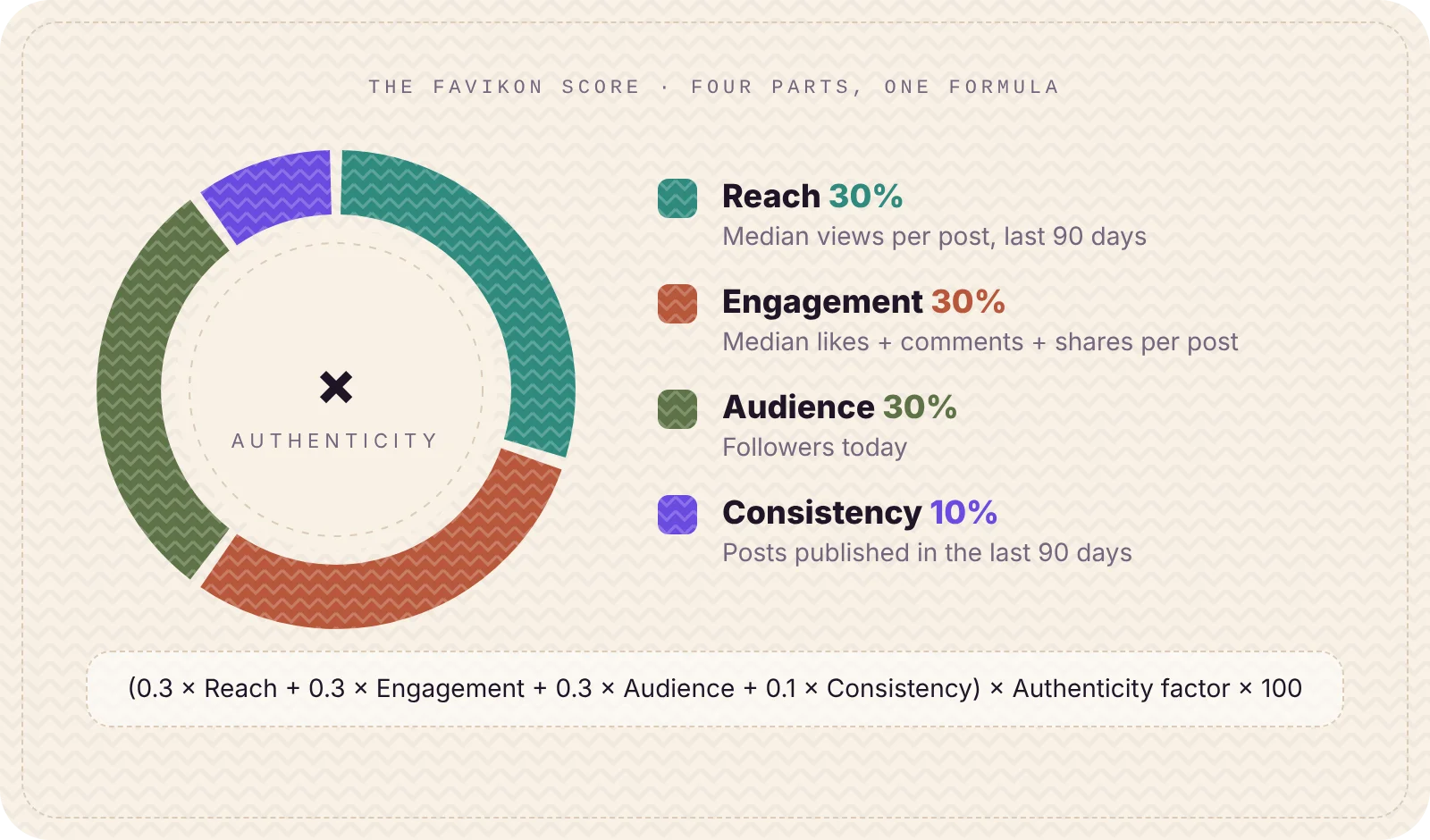
Each part is scored from 0 to 100, and the authenticity factor runs from ×0.50 to ×1.15. So a network score goes from 0 to 11,500 points. In the app it's rounded to the nearest point, so you'll see something like "8 320 pts".
One score per network
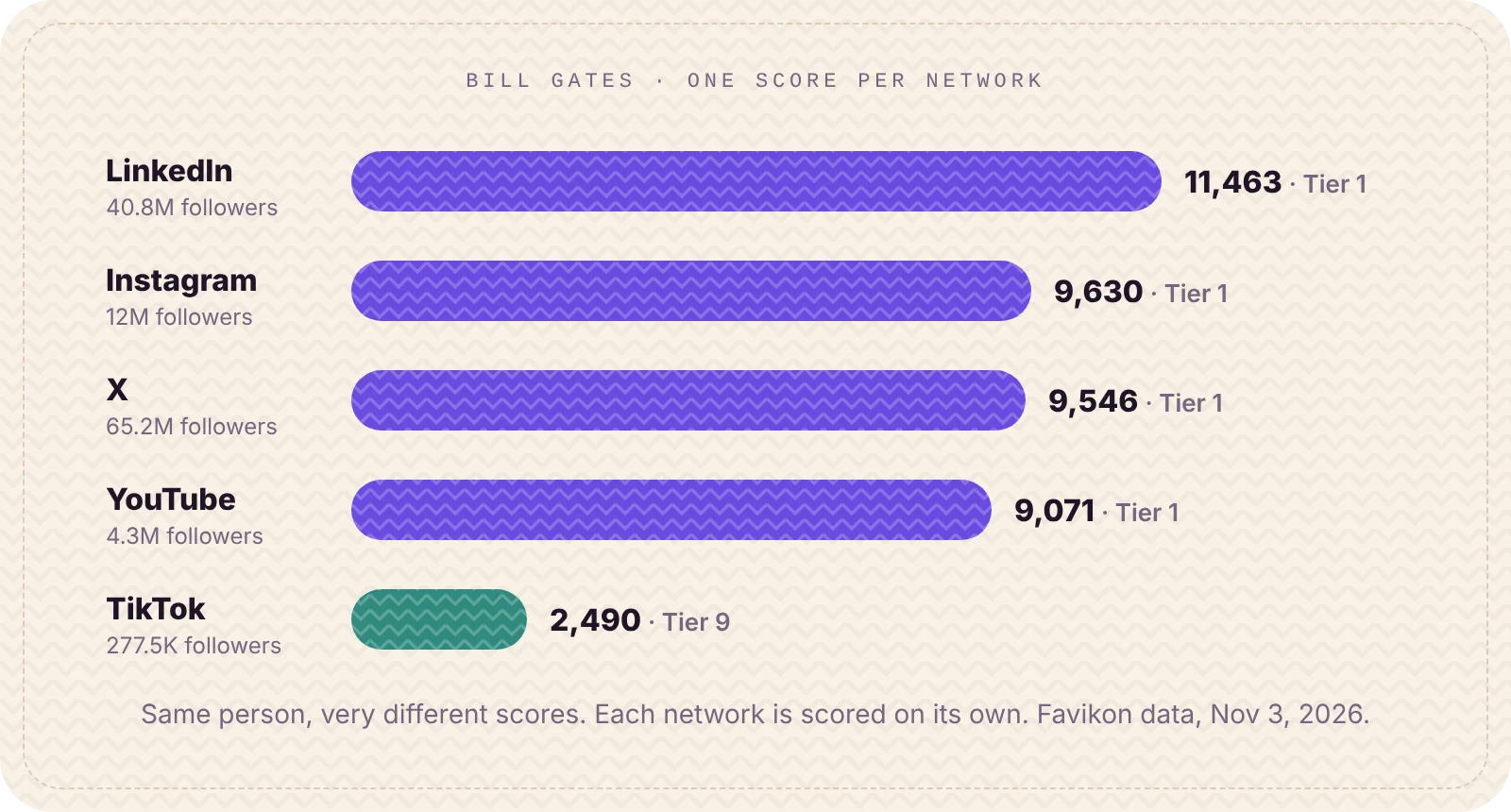
You get a separate score on LinkedIn, X, Instagram, TikTok and YouTube, because the same person can have a very different presence on each.
Bill Gates is a good example. He's Tier 1 on LinkedIn, Instagram, X and YouTube. On TikTok, where he has 277.5K followers, he scores 2,490: Tier 9.
On top of the network scores, every creator gets a Global score that looks at all their networks together. We add up their median views, median engagements, followers and posts across every scored network, then run those totals through the same formula and weights. The Global score has no authenticity factor (each network already carries its own), so it tops out at 10,000. It's a calculation of its own, so it won't match your best network or the average of your networks.
Reach, Engagement and Audience: how you compare
Three of the four parts are percentiles. We line you up against every other creator on the same network and see where you land. A Reach of 90 means your posts get more views than 90% of creators on that network.
- Reach uses your median views per post over the last 90 days.
- Engagement uses your median likes, comments and shares per post over the same 90 days.
- Audience uses your follower count today.
Why medians? Because one viral post shouldn't define you. If you post 20 times and one blows up, your median barely moves. Same if one flops. (On LinkedIn, a post that doesn't show a view count is counted at 9 × its likes and comments.)
Percentiles also explain something that surprises people at the very top. Bill Gates has about 110 times more LinkedIn followers than Lara Acosta (40.8M vs 371.7K). His Audience score is 100. Hers is 99.7. Once you're ahead of almost everyone, being further ahead adds very little, and the score turns to what you do with that audience.
Who you're compared with:
- Everyone on the same network. We don't split by country, niche or size, so a LinkedIn creator in Lyon is ranked against every LinkedIn creator we track.
- Only active creators. The comparison group is every creator who posted at least once in the last 90 days. Brand accounts are left out.
- Updated monthly. We rebuild the comparison groups on the 1st of each month. In between, your percentile only moves when your own numbers move.
For the curious, here's the exact percentile. Creators tied with you count for half.
Percentile = (Creators below you + 0.5 × Creators tied with you) ÷ Total creators in the comparison group × 100
Consistency: how often you post
Consistency is the only part that isn't a percentile. It's a fixed scale: 25 posts in 90 days gets you the full 100. Below that the curve is steepest at the start, so your first few posts count the most. Going from 0 to 4 posts takes you to 40. Going from 16 to 25 adds the last 20.
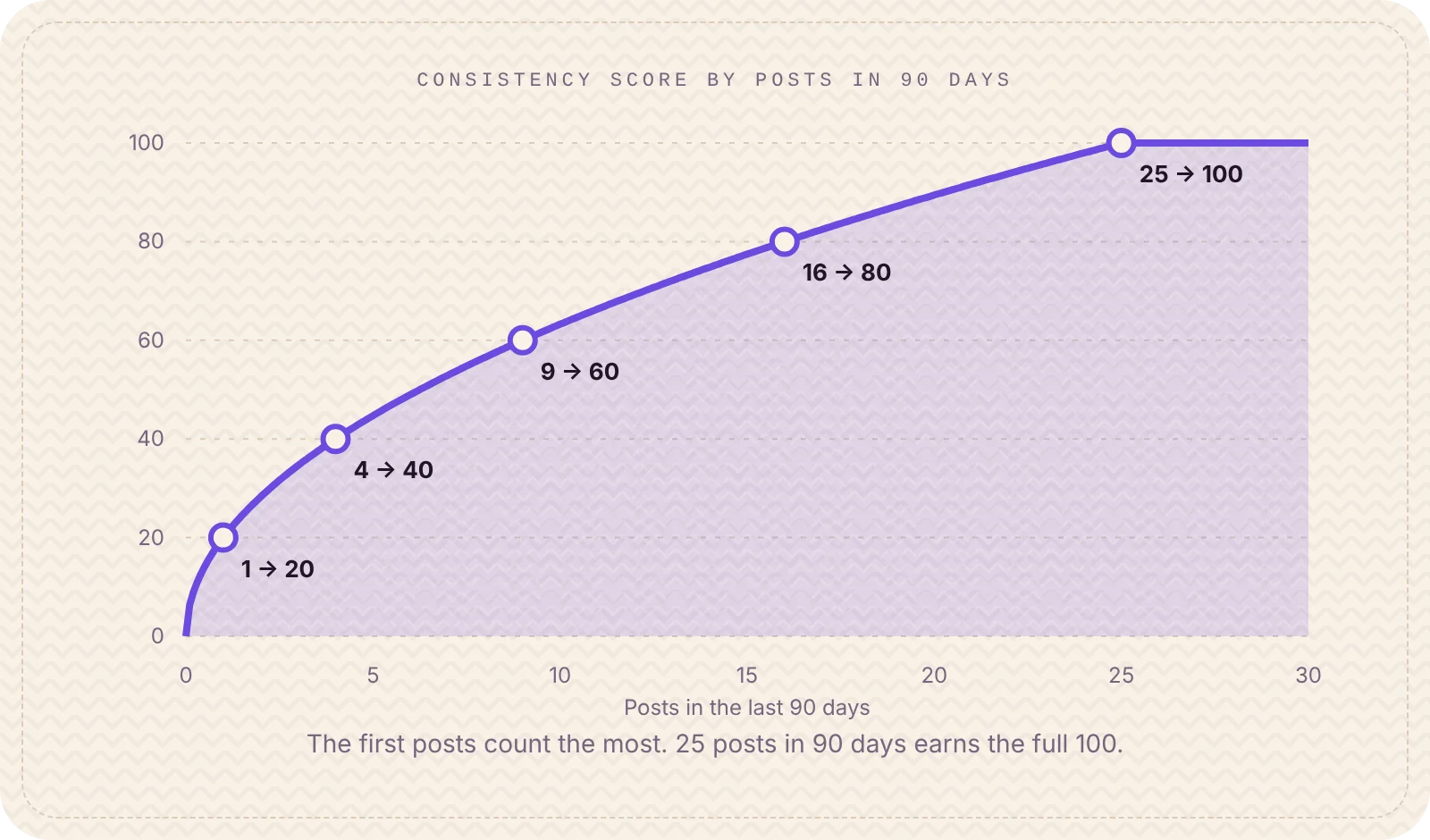
Consistency = 100 × the smaller of 1 or the square root of (Posts in 90 days ÷ 25).
Only the count matters. Twenty-five posts in one busy week scores the same as twenty-five spread over three months.
Putting it together: Lara Acosta on LinkedIn
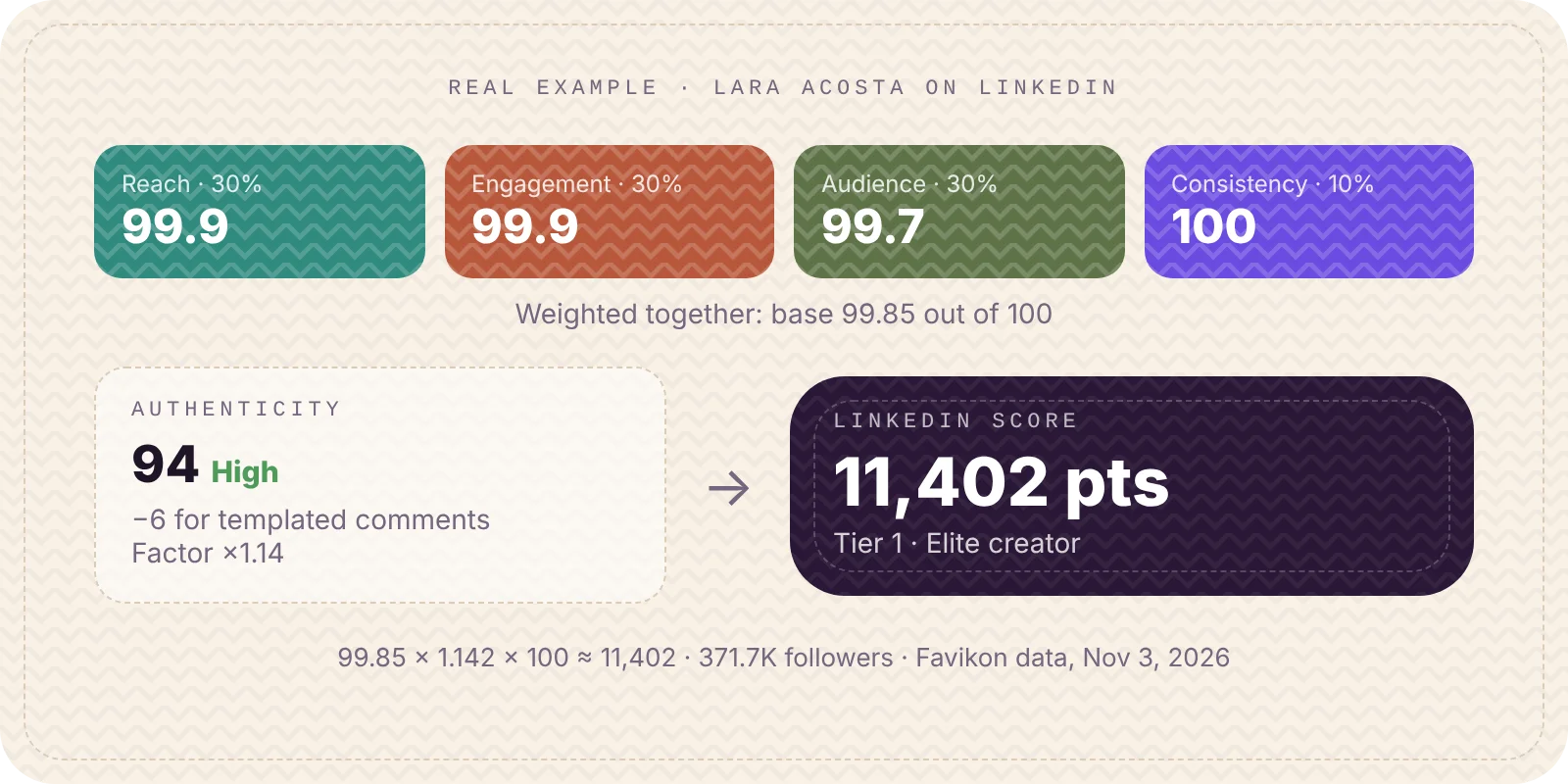
Lara Acosta is one of the best-known personal branding creators on LinkedIn, with 371.7K followers. Here are her real numbers for the last 90 days:
- 60 posts, about 4.5 a week, so Consistency is maxed out at 100.
- A median of 195K views per post, ahead of 99.9% of LinkedIn creators. Reach: 99.9.
- A median of 2,505 engagements per post, also 99.9.
- 371.7K followers, which puts her Audience at 99.7.
Weighted together, that's a base of 99.85 out of 100. Her authenticity score is 94, which is in the High band and gives a factor of ×1.14.
99.85 × 1.142 × 100 ≈ 11,402 points, which is the score on her profile, give or take a point because each part is rounded to one decimal. That's Tier 1, Elite creator.
The same formula puts her Instagram at 7,051 (Tier 3) and her TikTok at 1,335 (Tier 10), where she has 40.3K followers. LinkedIn is clearly home.
The authenticity factor
Big numbers mean less when the engagement behind them isn't real. That's why the last step multiplies the score by an authenticity factor between ×0.50 and ×1.15.
The factor has no effect at an authenticity score of about 78. Above that, your score gets a boost of up to 15%. Below it, your score can lose up to half. The steepest part of the curve is between 70 and 85, where each authenticity point moves your score by almost 2%.
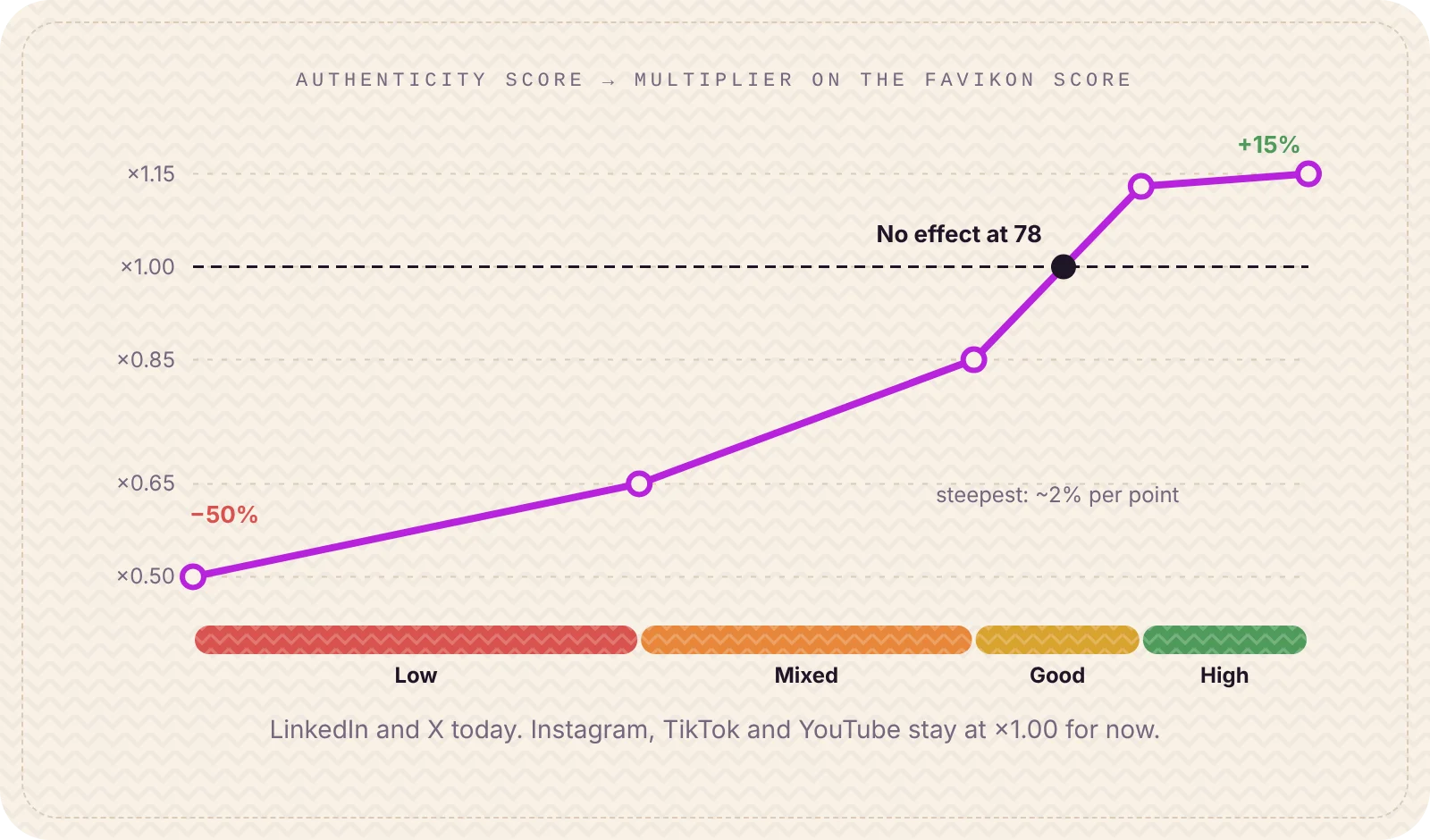
Right now the factor applies on LinkedIn and X. On LinkedIn it uses the new checks described below. X keeps our previous method: an AI review of recent posts and comments. Instagram, TikTok and YouTube don't have an authenticity score yet, so they stay at ×1.00, and so does any creator we haven't scored.
How we spot fake engagement on LinkedIn
We read a creator's recent posts and their comments (5 to 30 per post, most-liked first). Every post starts at 100 and loses points for each sign of engagement that isn't genuine. The creator's checks score is the median of their latest 30 scored posts.
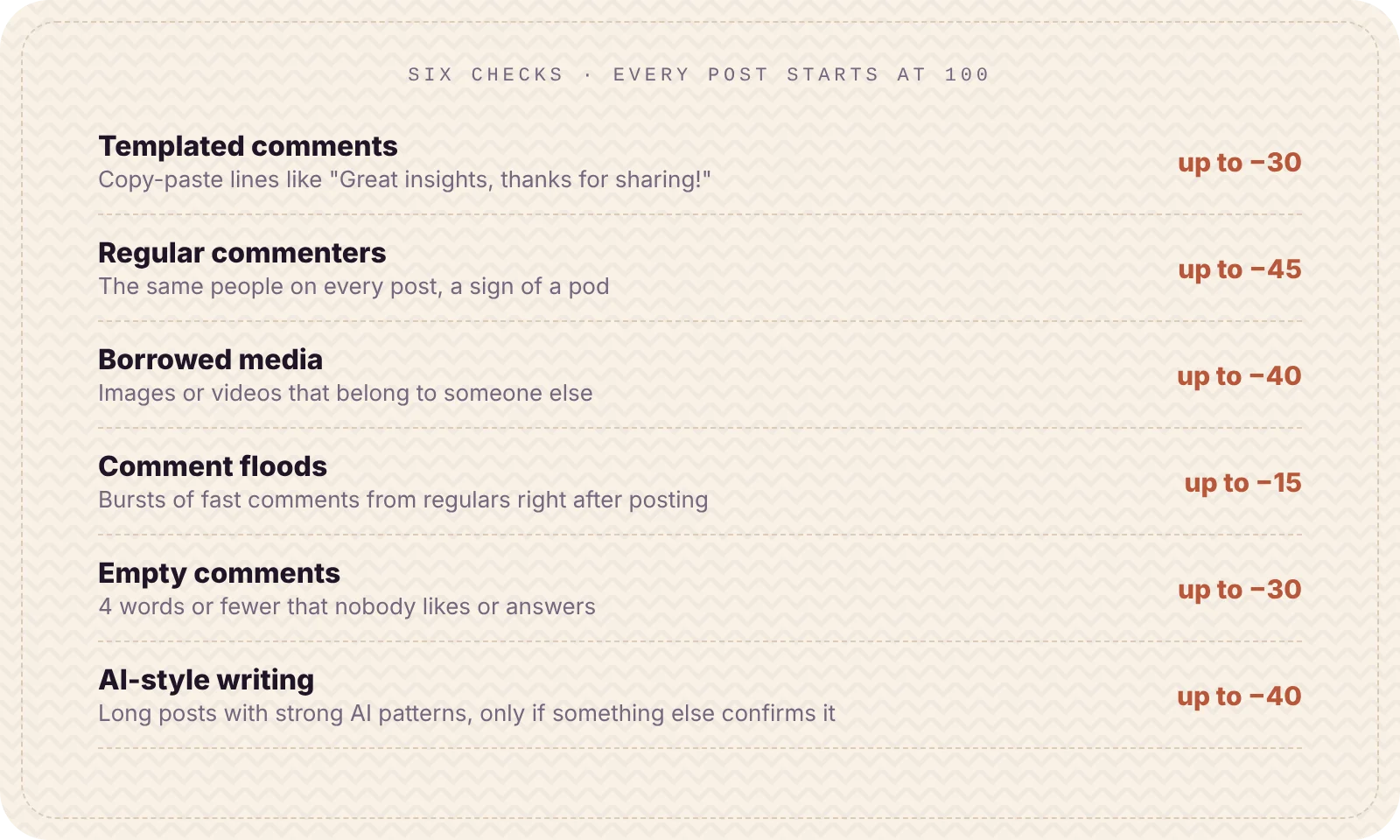
- Templated comments. Copy-paste lines that share an opener, say nothing personal, or match the length of other comments. −1 point per % of comments. A template from a regular commenter counts in full; one from a one-time commenter counts for a quarter. Up to −30.
- Regular commenters. People who commented on at least half of the creator's 9 previous posts, the classic sign of an engagement pod. The first 5% are free, then −1 per % up to 20%, then −2 per %. Up to −45.
- Borrowed media. Images or videos that belong to someone else. −0.6 per % of posts, where an uncredited post counts as 1, a credited one as half, and a credited one inside an opinion post of 150+ words as 0. So 10 uncredited brand images in 50 posts (20%) costs 12 points. Up to −40.
- Comment floods. Far more comments than reactions, arriving fast and from regulars, while the creator barely replies. Comment-to-receive giveaways don't count. −3 per flagged post, up to −15.
- Empty comments. Four words or fewer, with no likes and no replies except the creator's. The first 20% are free, then −1 per %. Skipped on announcement posts. Up to −30.
- AI-style writing. Long posts (100+ words) with at least two strong AI-writing patterns, or an AI-generated image. We only measure it once a creator has 5 long posts. The share is the flagged posts divided by the long posts plus 2, so one or two flagged posts don't swing a small sample. The first 30% is free, then −1.5 per %, up to −40.
One rule matters a lot here: AI-style writing only costs points when something else backs it up, such as regular commenters, comment floods, empty comments, or a low audience quality. Writing with AI tools isn't fake engagement, and we don't treat it that way.
Audience quality: the ceiling
The checks catch fake signals. Audience quality catches something subtler: an audience that's real but empty. For each scored post, our AI rates four things from 0 to 100, and the tab shows them as:
- Conversation: do commenters talk with the creator and with each other?
- Audience match: do they bring knowledge relevant to the topic?
- Content quality: is the post itself worth something? (Capped at 50 when the media is borrowed or the post only relays news or product specs.)
- Comment depth: do comments add something real?
Audience quality is the average of the four. When it drops below about 47, it puts a ceiling on the authenticity score: at 40 the ceiling is 80, at 35 it's 65, at 30 it's 50. For reference, Lara Acosta's audience quality is 66, Bill Gates's 64 and Richard Branson's 55, so none of them gets near the ceiling.
Here's what it looks like when it does kick in. Take a LinkedIn creator whose checks come out at 84 but whose audience quality is 39. Their ceiling is 3 × 39 − 40 = 77, so their authenticity score is 77 and the tab shows "Held down by audience quality".
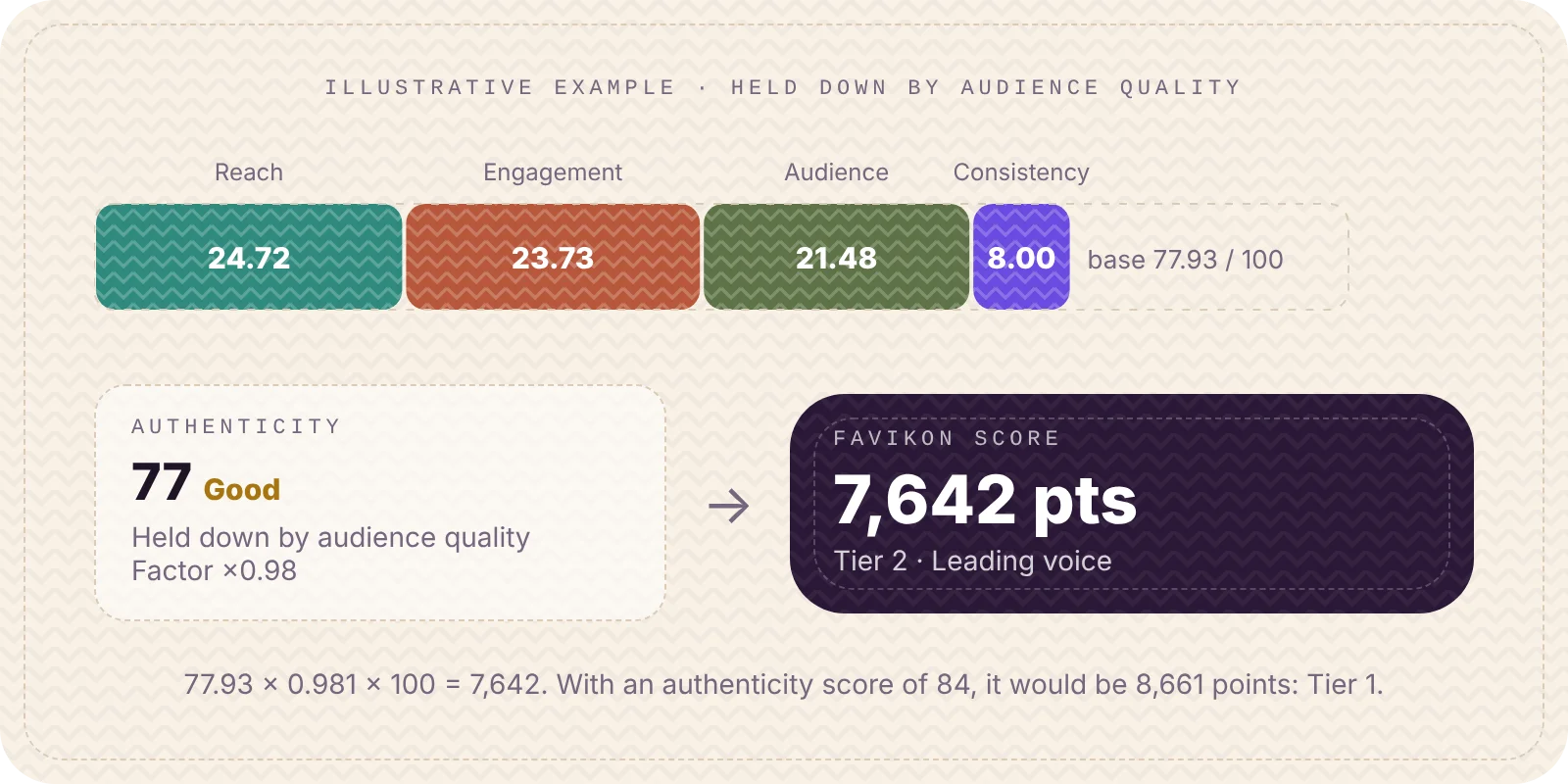
With a base of 77.93, that's 7,642 points and Tier 2. Without the ceiling, the same creator would be at 8,661 points and Tier 1. On LinkedIn, the quality of your comment section can be worth a whole tier.
If you want to dig into a creator's authenticity yourself, the full breakdown lives on the Authenticity tab of any profile in Favikon creator analytics. And if you're vetting Instagram accounts, our guide on how to check for fake followers covers what to look for while Instagram scoring is on its way.
See any creator's authenticity breakdown
From score to tier
Most influencer tiers you'll find online (nano, micro, macro, mega) are based on follower count alone. Ours are based on the whole score. By follower count, Bill Gates's 277.5K on TikTok would make him a macro influencer. By Favikon Score, he's Tier 9 there, because reach, engagement and consistency matter as much as audience size.
Every score lands in one of 10 tiers. The same point ranges apply to every network, to the Global score and to brand accounts.
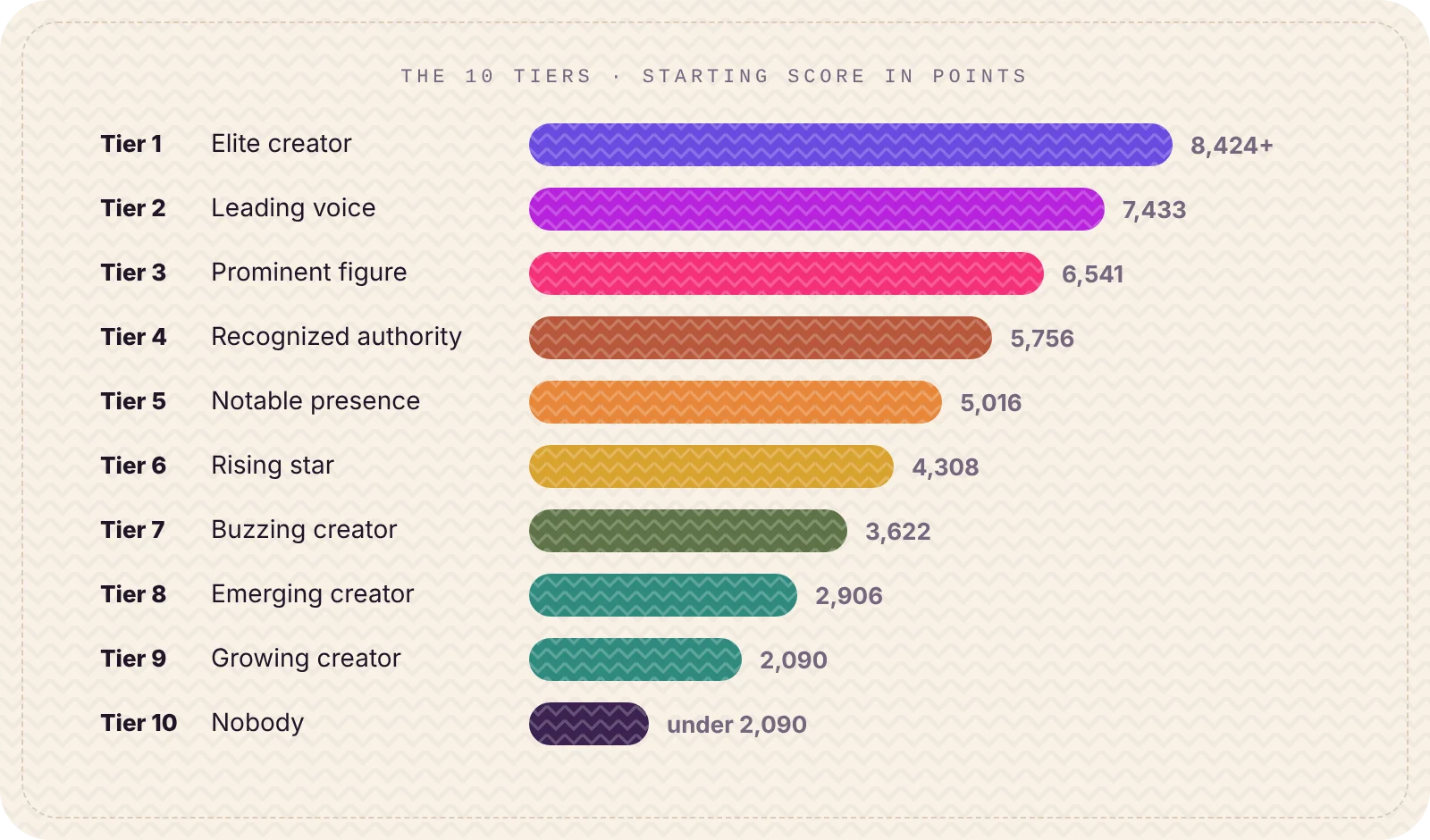
The ranges are set in points, so other creators growing won't push you into a lower tier. You move when your own score crosses a line. Your score can still shift a little when the comparison groups are rebuilt each month.
Who gets a Favikon Score
Anyone with an account on LinkedIn, X, Instagram, TikTok or YouTube. There's no minimum follower count and no minimum number of posts. Twitch, Snapchat, Pinterest and Substack aren't scored yet.
When your score updates
Your score is recalculated every time your data is refreshed. How often that happens depends on where you're looking:
Frequently asked questions
What is a good Favikon Score?
Anything from 8,424 points up is Tier 1, Elite creator. To see how a score really stacks up, compare it with creators in the same niche and country on the Favikon leaderboards.
Why did my score change with the update?
The formula is new. Reach, engagement and audience now compare you with everyone on your network, and on LinkedIn and X, authenticity now multiplies your score.
My score moved, but I didn't post. Why?
Usually one of two things. Your data was refreshed and your 90-day window moved with it, so older posts dropped out and your follower count changed. Or it's a new month and the comparison groups were rebuilt.
Can a score go above 10,000?
A network score can, up to 11,500, with a high authenticity score on LinkedIn or X. The Global score can't.
How do I improve my Favikon Score?
Post regularly (25 posts in 90 days maxes out Consistency), write posts people actually stop for, and end them with a question that gets specific answers. On LinkedIn and X, engagement pods and templated comments lower your authenticity factor, and that pulls the whole score down.
How does Favikon detect fake engagement?
On LinkedIn, six checks look for templated comments, the same commenters on every post, borrowed media, bursts of fast comments, empty comments and AI-style writing. An audience-quality ceiling catches audiences that are real but empty. X uses an AI review of recent posts and comments.
Does using AI to write my posts lower my score?
Not on its own. AI-style writing only costs points when another signal backs it up, like an engagement pod or a wall of empty comments.
Is the Favikon Score the same as engagement rate?
No. Engagement rate divides interactions by followers. The Favikon Score compares your median engagements per post with every other creator on the network, then weighs that alongside reach, audience size and consistency.
Others articles